Summary
Editor's rating
Is it worth the money compared to other options?
Tall, narrow, and mostly sensible… with a few silly choices
How it actually feels to sit in front of it
Build quality and how sturdy it feels
Noise, airflow, and everyday usability
What you actually get out of the box
Cooling performance in real-world use
Pros
- Noticeably cooler airflow than a basic fan when used with cold water and ice packs
- Low power consumption (55W) so you can run it for hours without big energy costs
- Removable 5L tank and filter make refilling and cleaning fairly easy
Cons
- Does not truly cool an entire room like an air conditioner, mainly personal cooling
- Remote is weak, line-of-sight only, and status lights are hard to see from a distance
- Ice pack system feels half-baked and water needs regular changing to avoid cloudiness

Specifications
View full product page →| Brand | Pelonis |
A heatwave helper, not a magic AC box
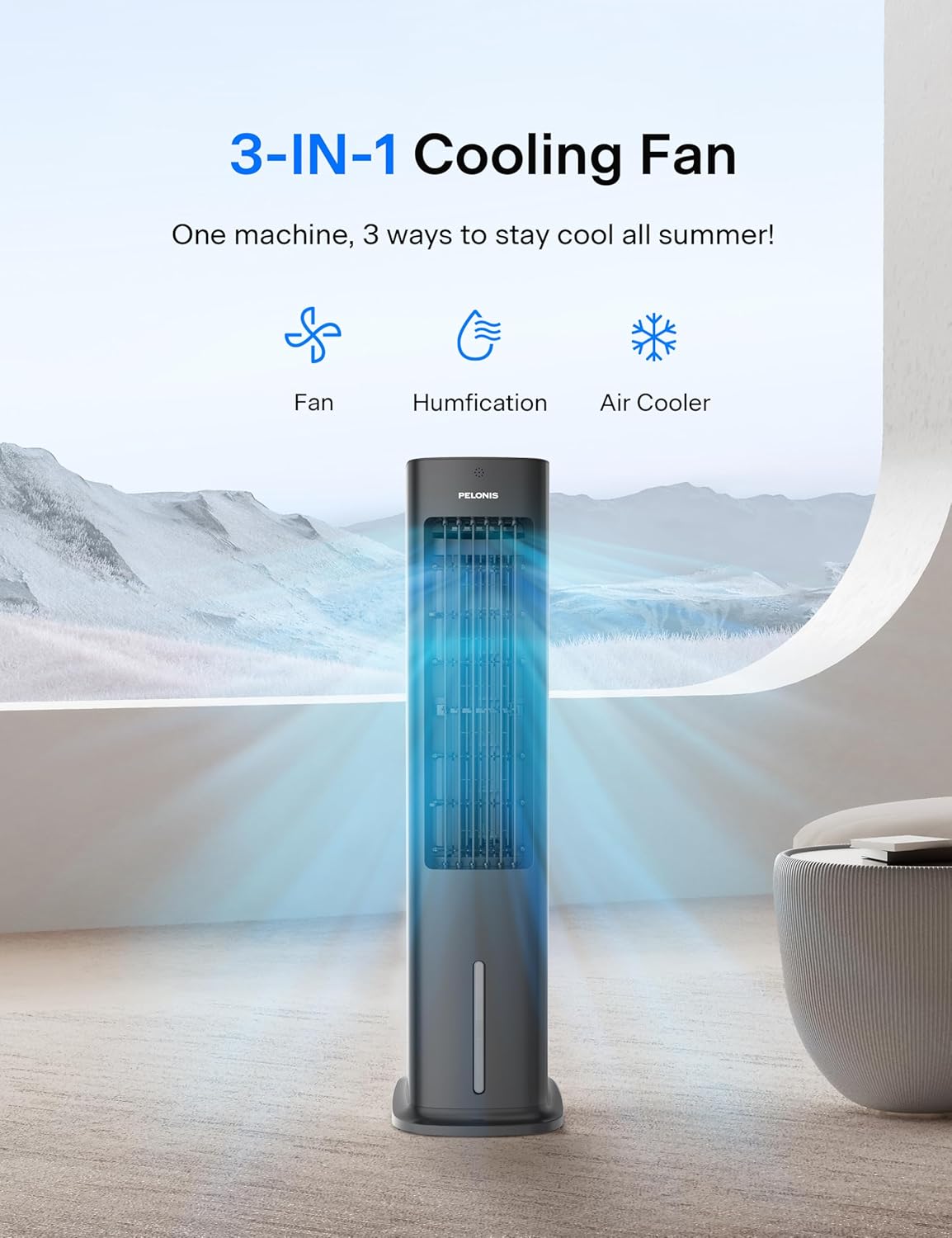
I’ve been using this Pelonis 5L evaporative air cooler through a couple of warm spells in a small UK flat. I bought it because normal pedestal fans just push warm air around, and I didn’t want to mess with a full portable air conditioner with hoses and window kits. This one sits in the middle: more cooling than a basic fan, less hassle and cost than AC. That’s the theory anyway.
In practice, it does roughly what you’d expect from an evaporative cooler. With cold water and the ice packs in, the air coming out feels noticeably cooler than room temperature, especially if you’re within a few metres. It’s not like sitting in front of a car AC on full blast, but it’s definitely more comfortable than a standard fan when the room is stuffy. If you go in expecting AC-level cooling for an entire room, you’ll be disappointed. If you treat it as a strong fan with a cooling boost, it makes more sense.
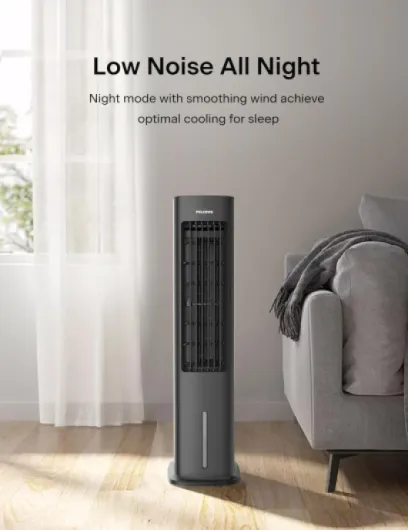
The 5L tank and tower format actually work well for a typical UK bedroom or living room. I mostly used it in a bedroom at night and occasionally dragged it into the living room during the day. The built-in handle and wheels make that easy enough, even when the tank is full. Noise-wise, I’d call it acceptable: low and medium are fine for TV or sleeping with the door closed, high is more for when you’re roasting and don’t care about sound.
Overall, my first impression after a few days was: pretty solid bit of kit, but not magic. It helps me get through hot nights without feeling sweaty and stuck to the sheets, and for me that already justifies the purchase. Just don’t expect it to cool the whole flat by ten degrees, because that’s not what this type of product does.
Is it worth the money compared to other options?
On value, this sits in a slightly awkward but still reasonable spot. It’s clearly more expensive than a basic pedestal or tower fan, but much cheaper than a proper portable AC unit. One reviewer mentioned that around £80 would feel more reasonable and I tend to agree; depending on what you actually pay (prices bounce around), it can feel a bit pricey for what is essentially a fan with a water tank and some basic electronics. That said, if you compare it to branded evaporative coolers from other companies, it’s in the same ballpark.
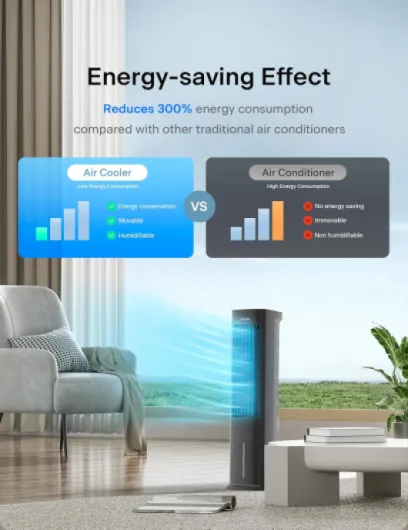
The way I look at it: if you only need cooling for a few weeks a year and you can’t be bothered with hoses, noisy compressors, and high electricity bills, this is a decent compromise. It uses only 55 watts, which is peanuts compared to portable AC units that regularly pull 700–1000 watts. If you run this for hours every evening during a heatwave, you’re still not going to see a scary jump in your electricity bill. So from an energy-use perspective, it’s good value.
Where the value takes a small hit is the missing modern features. No Wi‑Fi, no app, no proper smart home integration, and it doesn’t even resume operation after a power cut or via a smart plug. At this price, even some basic smart fans have app control or at least better remote responsiveness. Also, only two ice packs means you can’t easily rotate sets (two in use, two in the freezer) unless you buy extras yourself, which you probably will if you get serious about using the cooling function.
Overall, I’d say the value is pretty solid if you buy it at a sensible discount and you understand what an evaporative cooler can and can’t do. If you’re expecting full-room cooling or smart-home features, you’ll feel short-changed. If you just want something stronger than a fan that helps you sleep during hot spells without wrecking your energy bill, it’s a reasonable spend, but not some crazy bargain.

Tall, narrow, and mostly sensible… with a few silly choices
The design is basically a tall, slim tower in black plastic with some metal bits inside. It doesn’t look premium, but it also doesn’t scream cheap toy. In a corner of a living room or bedroom it blends in well enough. I’ve had chunkier pedestal fans that take more space and look worse, so on the design front, this is okay. The narrow base means it doesn’t eat much floor space, which matters in small UK flats where every bit of room counts.
Functionally, the design is mostly practical. You’ve got 60° auto-oscillation left to right, and you can manually tilt the vents up and down. That helps a lot because you can push the airflow higher or lower depending on whether you’re in bed, on the sofa, or at a desk. I usually angle it slightly up and let it swing so the air sweeps across the room instead of blasting my face non-stop. The oscillation is smooth and hasn’t made any weird noises so far.
There are some odd design decisions though. The biggest one for me is the indicator lights on the top panel instead of the front. If you’re not standing over it, it’s hard to see which mode or timer is active. The remote is also strictly line-of-sight and quite weak; you really have to point it directly at the top front area, and the range isn’t great. From bed or sofa it works, but you can’t be lazy and just wave it vaguely in the direction of the unit.
Another slightly clumsy bit is how the ice packs are handled. As mentioned, they just float in the tank. There’s no proper slot or holder, so you end up dropping them in after filling the tank and then trying not to splash water everywhere. It’s not a deal-breaker, but for this price I expected a slightly better thought-out internal layout. Overall, the design is decent and gets the job done, but it’s clearly built to a budget and you feel that in the details.
How it actually feels to sit in front of it
This is the bit that really matters: does it make you feel cooler and more comfortable when it’s hot? For me, yes, but within limits. When the tank is filled with cold water and the ice packs are frozen and inside, the airflow feels noticeably cooler than the room air. Sitting about 1.5–2 metres away, you get a steady, cool breeze that takes the edge off that sticky, humid UK heat. Compared to a basic fan, it’s clearly nicer on the skin. It doesn’t dry you out like AC, and it doesn’t just blast warm air back at you.
I’ve used it mostly in a small bedroom at night. On low speed, I can sleep with it on without getting annoyed by the noise. It’s not silent, but it’s more of a consistent hum than a harsh whine. On medium, I can still sleep if I’m really hot, but you do notice it more. High speed is too loud for me to sleep next to, but it’s good for quickly cooling yourself down before bed or when working in a home office during the day. One reviewer said the night mode feels like medium; I kind of agree. It’s not some magical super-quiet mode, it just changes the airflow pattern a bit.
In terms of room cooling, you need to manage expectations. It doesn’t really drop the entire room temperature by a big number like a proper air conditioner. What it does is make you, the person in front of it, feel cooler. If you sit where the airflow reaches you, it’s comfortable. If you’re in a corner far away, you won’t feel much difference. With the oscillation on, it does a decent job of sharing the cool air between two people on a sofa or a couple in bed, but it’s still very much a personal cooling device, not a full-room solution.
The extra humidity is a mixed bag. On very dry hot days, it actually feels nice and makes the air less scratchy. In typical UK humidity, if you run it for hours with a closed window, the room can feel a bit damp. I didn’t see condensation or mould or anything, but the air can get slightly heavy if you don’t crack a window. Overall, comfort is good if you position it properly and don’t expect miracles. It’s a solid upgrade from a cheap fan, especially for sleeping through warm nights.
Build quality and how sturdy it feels
In terms of build, the Pelonis cooler feels fairly solid for a mostly plastic appliance. The housing doesn’t flex too much when you move it, the base feels stable, and the oscillation mechanism hasn’t shown any wobble so far. I’ve wheeled it around between rooms quite a few times, and it hasn’t creaked or felt like it was going to tip over, even with the tank full. It’s not premium, but it’s not flimsy pound-shop plastic either.
The water tank slides in and out smoothly, which is important because you’ll be doing that a lot. The plastic there feels a bit thinner, so I wouldn’t go banging it on the sink, but if you treat it reasonably, it should be fine. The filter is easy to remove and rinse, and so far it hasn’t degraded or warped. That’s key for evaporative coolers, because a clogged or mouldy filter is what usually kills them or makes them gross to use after a season.
The buttons on the top panel have a decent click and haven’t started to stick or misfire. The remote is very lightweight and feels cheap, but it works as long as you point it directly at the unit. I wouldn’t be shocked if the remote died first just from being dropped or sat on, but that’s fairly standard at this price. The main unit itself feels like it will outlast a couple of summers easily if you keep it clean and don’t abuse it.
There’s a 2-year warranty from Pelonis, which is reassuring, but the EU spare parts availability is only listed as 1 year, which is a bit short. Realistically, if something major breaks after a few years, you’re probably replacing the whole unit rather than fixing it. For the price range, that’s not surprising. Overall, durability feels acceptable: not tank-like, but solid enough for seasonal use if you maintain it and don’t treat it like furniture you can stand on.
Noise, airflow, and everyday usability
Let’s talk raw performance: airflow, noise, and how it behaves day to day. In terms of airflow, it’s pretty strong for the size. On high, you can feel the breeze clearly across a medium bedroom or a small living room. On low and medium, it’s more gentle but still enough if you’re within a couple of metres. The combination of vertical tilt and horizontal oscillation makes it easy to aim, which is actually more important than people think. Get the angle wrong and it feels weak; get it right and it’s much more effective.
Noise-wise, I’d call it “quiet enough” but not whisper quiet. On low, it’s fine for sleeping, at least for me. It’s more of a soft fan noise than a mechanical grinding sound. On medium, you’ll probably need to turn the TV up a notch, but it’s still less intrusive than most portable AC units. On high, it’s noticeable and will dominate a quiet room, but again, that setting is more for when you’re overheating and don’t care about sound. The claimed 28 dB seems optimistic for anything beyond low; in real life it feels more like a normal fan range.
The modes (normal, natural, sleep) are a bit gimmicky in my opinion. Normal is just constant airflow. Natural mode tries to simulate a breeze by varying the speed a bit, which I found slightly annoying rather than relaxing, so I rarely used it. Sleep mode is supposed to be quieter, but as one of the Amazon reviewers said, it feels very similar to medium in terms of noise. I ended up just using low or medium speed in normal mode 90% of the time and ignoring the fancy labels.
The timer is useful but basic. You get 1h, 2h, and 4h buttons, and you can combine them to get up to 7 hours. It works, but you can’t set something like 3 hours exactly; you’d do 1+2 or 2+4 etc. Also, the unit doesn’t auto-start when it gets power, which means you can’t really use a smart plug to schedule it to turn on before you get home. It will power on in standby, but won’t start blowing until you press the button or use the remote. Slightly annoying in 2026, but not a deal-breaker if you’re mostly home when you use it.
What you actually get out of the box
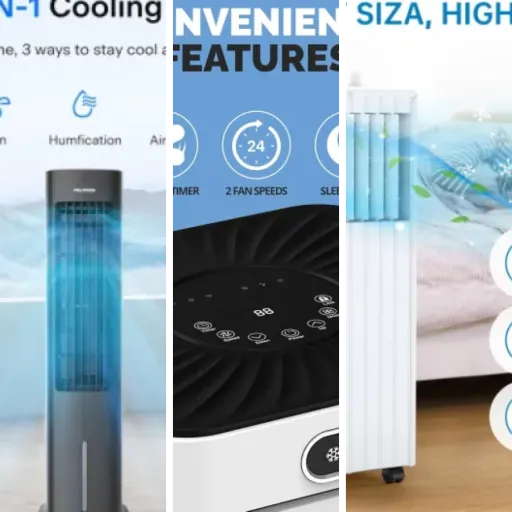
Out of the box, the Pelonis cooler is pretty straightforward. You get the tower unit itself, two reusable ice packs, a small remote, and the usual manual. No tools needed, no weird assembly. You basically pull off a few bits of packaging, slide out the water tank, give it a quick rinse, fill it, and you’re ready to go. Compared to a portable AC with hoses and window seals, this is plug-and-play. It’s about 85 cm tall, so roughly hip height, and has a narrow footprint, which is nice in tight rooms.
The front has the vertical vents, and on top you’ve got the control panel with physical buttons and indicator lights. The interface is simple: power, swing (oscillation), speed, mode (normal, natural, sleep), timer, and a humidifier/cooling button. The lights are on the top panel, though, so if you’re sitting on the sofa a few metres away, you can’t see what speed or mode it’s actually on unless you stand up and look down on it. It’s a small thing, but after a while it gets annoying when you’re trying to check if you’re on low or medium without moving.
The water tank is a pull-out drawer at the bottom, fully removable. That part is handy because you can carry it to the sink to fill it instead of dragging the whole unit. The ice packs just get chucked into the tank; there’s no proper slot or cage for them, so they float around. It works, but it feels like a bit of an afterthought. I ended up adding a few regular ice cubes as well on the really hot days, which did give a bit more of a cooling kick for an hour or so.
In terms of first use, it took me maybe 10 minutes from opening the box to having cool air blowing in the bedroom. No app, no Wi‑Fi, no pairing, nothing fancy. If you like simple appliances that just switch on and run, this is fine. If you want smart-home stuff and deep integration with Alexa or Google, this one is pretty bare-bones and will probably feel dated to you.
Cooling performance in real-world use
Effectiveness-wise, I’d say this cooler sits exactly where an evaporative unit should: better than a fan, far weaker than real AC. With the tank full and both ice packs frozen and inside, the air coming out feels several degrees cooler than room temperature for the first hour or two. I didn’t measure it with a thermometer, but you can clearly feel the difference on your skin. After a few hours, as the water warms up and the ice melts, the cooling effect drops off and it behaves more like a strong fan with some humidity added.
The 5L tank claim of up to 10 hours is roughly accurate on low or medium, at least in my experience. I could run it overnight on low and still have some water in the morning. On high, the water goes faster and you’re looking at more like 5–6 hours depending on your room temperature and humidity. It’s not a huge hassle to refill, but if you want maximum cooling, you need to plan ahead: keep the ice packs rotating in the freezer and maybe pre-chill some water in the fridge.
Where it’s most effective is in close-range use: next to a bed, near a work desk, or pointed at the sofa. In those setups, it genuinely helps you feel cooler and stops that gross, sweaty feeling on hot nights. If you’re hoping it will make an entire open-plan living area cool, that’s not going to happen. Also, people tend to forget that evaporative coolers work best in drier climates; in the UK, they still help, but not as dramatically as in somewhere like Spain or the US Southwest.
One thing to keep in mind is the water hygiene. After a few days of use, the water in the tank can start to look cloudy or a bit milky if you just leave it there. I ended up emptying and refilling every couple of days, and giving the tank a quick rinse. The removable tank and filter make this easy enough, but it’s something you need to do if you care about not blowing slightly funky air around. Overall, in terms of effectiveness, I’d give it a solid pass: it does what an evaporative cooler is meant to do, as long as you understand its limits.
Pros
- Noticeably cooler airflow than a basic fan when used with cold water and ice packs
- Low power consumption (55W) so you can run it for hours without big energy costs
- Removable 5L tank and filter make refilling and cleaning fairly easy
Cons
- Does not truly cool an entire room like an air conditioner, mainly personal cooling
- Remote is weak, line-of-sight only, and status lights are hard to see from a distance
- Ice pack system feels half-baked and water needs regular changing to avoid cloudiness
Conclusion
Editor's rating
After living with the Pelonis 5L evaporative air cooler through some warm days and nights, my opinion is pretty clear: it’s a decent, no-nonsense way to feel cooler than with a normal fan, but it’s not a replacement for real air conditioning. If you set it up properly with cold water and the ice packs, sit within a couple of metres, and use the oscillation smartly, it gives a genuinely more comfortable breeze than a plain fan. For sleeping and working in a small room, it gets the job done and makes hot, stuffy nights a lot more bearable.
On the flip side, there are some annoyances. The remote is weak and line-of-sight, the status lights are on the top where you can’t see them from the sofa, the ice packs just float around in the tank, and there’s no smart-home or auto-resume function. You also have to keep an eye on water hygiene and be ready to rinse the tank regularly. And again, it doesn’t truly cool the entire room like AC; it mainly makes you feel cooler where the airflow hits you.
I’d recommend this to people in small flats or bedrooms who don’t want the cost, noise, or hassle of a portable air conditioner, and who are happy with a stronger, cooler-feeling fan as a middle ground. It’s also good if you care about running costs and want something low-power you can leave on for hours. If your place turns into an oven and you want several degrees off the room temperature, or you’re big on smart-home control, you should probably look at proper AC or a more advanced unit instead.