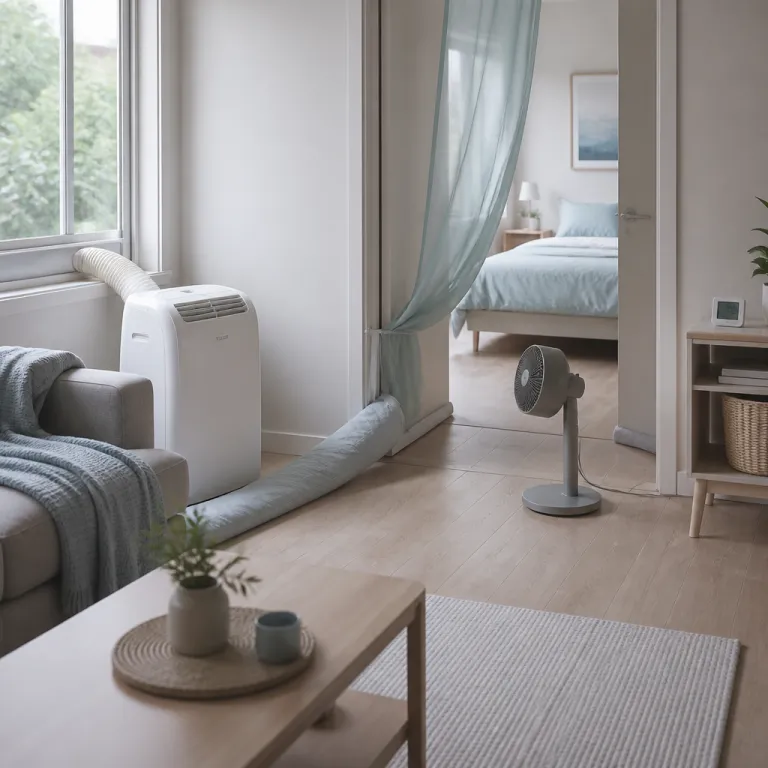
Why one portable air conditioner cools rooms, not whole apartments
A single portable air conditioner is engineered to cool one enclosed room, not an entire apartment. In a 1,000 sq ft (about 93 m²) unit, one portable AC can keep you comfortable only where walls and doors help contain the conditioned air. Once you open everything up, the cooling power bleeds into hallways, kitchens, and unused rooms until the temperature levels out and the machine can no longer keep up.
Think of a 14,000 BTU portable unit as a precision tool, not a whole-home solution. On paper, that portable BTU rating suggests coverage for roughly 500 to 600 sq ft (46 to 56 m²) in a closed room, but real-world performance drops when doors stay open and warm air leaks through every gap. The result is simple: any attempt to use one portable air conditioner to cool several rooms like a central air system will disappoint, because the unit behaves more like a powerful spot cooler with a built-in compressor than a full-building HVAC system.
Manufacturers love big BTU numbers because they look like the best buying options on a product page. Yet the effective cooling capacity depends on the standard SACC rating, the quality of the window kit seal, and how much hot exhaust air gets sucked back into the room. According to typical listings in the AHAM directory and ENERGY STAR product database for 14,000 BTU portables, SACC values often land closer to 8,000 to 10,000 BTU, which better reflects what you feel in a real apartment. When you try to cool 1,000 sq ft at once, the portable unit runs constantly, the temperature barely drops, and your purchase can feel like a mistake rather than a smart, targeted cooling upgrade.
In a typical one-bedroom apartment, the main room might be 215 sq ft (20 m²), the bedroom 130 sq ft (12 m²), and the rest split between kitchen, hallway, and bathroom. A 14,000 BTU portable air conditioner can easily hold the bedroom at 22 °C while the adjacent living room drifts toward 26 or 27 °C if the door stays open. That is why any realistic plan to use a portable AC for more than one room must start with zoning and door control, not wishful thinking about whole-apartment cooling.
Single-hose portable units also pull in unconditioned air from under the door and through cracks. As they exhaust hot air outside, they create negative pressure that drags warm, humid air from other rooms and even from the building corridor. Dual-hose portable units reduce this penalty by separating intake and exhaust, but they still work best when you treat each room as a separate climate zone rather than one big open-concept space.
For a home office worker, this matters every afternoon when the sun hits the west-facing wall. Your portable air conditioner might keep the office at 23 °C, but the rest of the apartment can sit at 29 °C, constantly feeding heat back into your workspace whenever you open the door. The only way to make a single portable AC serve multiple rooms in this layout is by actively managing doors, airflow, and where you actually spend your time.
Noise is another hidden limit on the dream of whole-apartment portable cooling. A typical 14,000 BTU portable air conditioner runs at about 52 to 56 dB on low fan speed, which is fine for a living room but intrusive during video calls in a small office. If you push the fan to high to chase cool air into other rooms, noise climbs toward 60 dB and your remote-work concentration suffers while the temperature barely improves in distant spaces.
Energy use also spikes when you ask one portable air conditioner to cool several rooms at once. A large portable unit can draw 1,200 to 1,500 watts during peak cooling, and if it never cycles off because the apartment never reaches setpoint, your electricity bill reflects that constant load. In contrast, a zoned strategy lets the compressor rest once the target room hits its set temperature, improving both comfort and cost control.
BTU sizing, room fit, and the myth of the 1,000 sq ft portable
BTU sizing for portable air conditioners is where marketing hype collides with physics. A label that promises coverage for 1,000 sq ft on a portable unit box usually assumes perfect insulation, closed doors, and no internal heat gains from people, electronics, or cooking. In a real apartment with laptops, routers, and an active kitchen, that same portable BTU rating shrinks dramatically.
For a home office of 130 to 160 sq ft (12 to 15 m²), a 7,000 to 8,000 BTU portable air conditioner is often the best pick, especially if the room has one external wall and decent shading. When you step up to a combined living and dining room of 270 to 320 sq ft (25 to 30 m²), a 10,000 to 12,000 BTU portable unit becomes a more realistic choice, assuming you can close doors to bedrooms and hallways. Trying to stretch a single 14,000 BTU portable air conditioner across an entire apartment simply spreads that cooling capacity too thin.
Room shape also matters more than most buying guides admit. A long, narrow room with a single window for the exhaust hose behaves differently from a compact square room with two windows and cross-ventilation. If your portable air conditioner sits in a corner with the cooling fan pointed at a wall, you waste airflow and create hot pockets that never feel the cool air stream.
For renters comparing buying options, the choice often comes down to one high-quality dual-hose portable unit versus two cheaper single-hose products. Two 8,000 BTU single-hose air conditioners at around 250 dollars each can theoretically cover two rooms, but each one suffers from infiltration air and lower effective cooling performance. A single 14,000 BTU dual-hose portable air conditioner at roughly 500 dollars offers better efficiency, but only in the room where it actually sits.
To make these trade-offs easier to see at a glance, the table below summarizes typical room-size guidance and how SACC ratings narrow the realistic coverage for common portable AC sizes in apartments.
| Portable AC size | Typical SACC range* | Approx. room size (closed room) | Realistic use in a 1,000 sq ft apartment |
|---|---|---|---|
| 7,000–8,000 BTU | 4,000–5,000 BTU | 130–160 sq ft (12–15 m²) | Small bedroom or office only |
| 10,000–12,000 BTU | 6,000–8,000 BTU | 270–320 sq ft (25–30 m²) | Main living room or studio zone |
| 14,000 BTU | 8,000–10,000 BTU | 480–590 sq ft (45–55 m²) | One large room, not whole apartment |
*SACC ranges based on typical values reported in AHAM and ENERGY STAR listings for portable air conditioners.
In practice, cooling one room to 22 °C while leaving the door open to an adjacent room often results in that second room stabilizing around 25 to 26 °C. The temperature difference feels noticeable but not dramatic, and you still will not get uniform comfort across 1,000 sq ft. That is why any serious multi-room portable AC strategy must accept that you are buying comfort where you are, not everywhere at once.
For small spaces, a detailed BTU guide such as a dedicated 5,000 BTU air conditioner sizing article can help refine your calculations for compact bedrooms and offices. Resources like this guide to choosing the right 5,000 BTU air conditioner for your space show how window orientation, ceiling height, and occupancy change the required cooling capacity. The same logic scales up when you decide whether a 10,000, 12,000, or 14,000 BTU portable unit fits your main room.
Mini-split air conditioning systems often get mentioned as an alternative, and for good reason. A properly sized mini-split with an inverter compressor can modulate output, delivering both cooling and gentle heating in shoulder seasons with higher efficiency than most portable units. Yet for renters who cannot alter the building envelope, a portable air conditioner remains the only realistic way to manage the indoor climate without landlord approval.
Battery-powered portable units and small evaporative coolers promise freedom from hoses and window kits, but they rarely move enough cool air to matter in a 1,000 sq ft apartment. These products can work as a personal cooling fan at a desk or bedside, especially when paired with a standard fan to enhance evaporation. They do not replace a compressor-based air conditioner when the outside climate pushes above 30 °C and humidity climbs.
The zoned strategy: moving cool air between rooms with fans and doors
The only honest way to make a portable air conditioner serve multiple rooms in an apartment is to embrace zoning. You cool the room you are in, then use fans, doors, and timing to nudge some of that cool air into adjacent spaces. Instead of chasing uniform temperatures, you chase comfort where you sit, sleep, and work.
Start with door management, because walls are your cheapest insulation upgrade. When you run the portable unit in the bedroom at night, close the doors to the hallway, kitchen, and any unused rooms so the cooling capacity stays focused on the sleeping zone. In the morning, wheel the portable unit to the living room, close the bedroom door, and let the air conditioner reset the climate in your daytime workspace.
Fan-assisted transfer is the next layer in this zoned strategy. A simple box fan in a doorway can move around 2,000 cubic feet per minute of air, effectively acting as a low-tech duct between rooms. Point the fan so it pushes cool air out of the conditioned room into the warmer adjacent room, not the other way around.
In a 1,000 sq ft apartment, this might look like a 14,000 BTU portable unit in the living room with a box fan in the hallway doorway. The living room holds at 23 °C, while the hallway and adjacent office settle around 25 to 26 °C, which is still a meaningful improvement over 29 °C without any cooling. You will not get perfect parity, but you will get a gradient that keeps your home office tolerable during long remote-work days.
Smart scheduling turns this from a hack into a system. Pre-cool the next zone about 30 minutes before you move, so if you plan to work in the office at 14:00, start running the portable air conditioner there at 13:30 with the door closed. When you arrive, the temperature difference between that office and the rest of the apartment feels dramatic, and the compressor can cycle down instead of running flat out.
Remote control features make this easier to live with. Many modern portable air conditioners include Wi-Fi or at least an infrared remote, so you can start cooling from the sofa or even from outside the apartment. A well-designed remote control or app lets you adjust fan speed, mode, and setpoint without walking over to the portable unit every time.
For buyers who want to understand why the 14,000 BTU number on the box often disappoints, a detailed explanation of BTU inflation and SACC ratings is essential. Resources such as this analysis of what the 14,000 on the box really tells you show how standard test conditions differ from your actual apartment. Once you grasp that difference, your decision-making about buying options becomes more grounded and less vulnerable to marketing claims.
In some cases, two smaller portable units beat one large one, especially when your apartment has two distinct zones you use heavily. For example, an 8,000 BTU portable air conditioner in the bedroom and another 8,000 BTU unit in the living room can each run at lower fan speeds, reducing noise while delivering targeted cooling. The trade-off is higher upfront cost, more products to maintain, and more hoses in your window frames.
Simple zoning checklist for apartments
1) Pick your primary zone (bedroom or living room) and place the portable AC near the best window. 2) Close doors to unused rooms while that zone is cooling. 3) Add a box fan in the doorway to push cool air toward the next room. 4) Pre-cool the next zone 20–30 minutes before you move there. 5) Use the remote or app to lower fan speed once the room reaches your target temperature.
Supply chain realities also shape what you actually find in stores and online during heat waves. Popular models with inverter compressors and higher efficiency often sell out first, leaving only louder, less efficient portable units on the shelf. Planning your buying window before the first major heat spike gives you better options and avoids panic purchases of whatever air conditioner happens to be left.
One dual hose or two single hose units: making the smarter apartment choice
When you try to make a portable air conditioner handle more than one room, the hardest question is not brand, but configuration. Do you buy one high-quality dual-hose portable unit and move it between zones, or two cheaper single-hose units and leave them parked in place? The answer depends on your floor plan, noise tolerance, and how disciplined you are about zoning.
A dual-hose portable air conditioner pulls in outside air through one hose and exhausts hot air through the other, reducing the negative pressure that drags hot corridor air into your apartment. This design usually improves effective cooling capacity and can make the unit feel like it has more usable BTU power than a similar single-hose model. For a 1,000 sq ft apartment where you mainly use one large living room and one bedroom, a 14,000 BTU dual-hose portable unit is often the best single-device pick.
Two 8,000 BTU single-hose portable units, however, offer better zoning flexibility. You can keep one in the bedroom for nighttime use and one in the living room for daytime work, avoiding the daily ritual of moving a heavy portable unit and resealing the window kit. The downside is that each single-hose air conditioner pulls warm air from other rooms, slightly undermining the cooling performance and raising energy use.
Noise and workflow should guide your decision more than raw BTU numbers. If you spend eight hours a day on video calls, a quieter inverter-based portable air conditioner with a gentle fan mode will feel worth the premium. If you mainly need strong cooling for a few evening hours, two louder but cheaper portable units might be acceptable, especially if you can run them on lower fan speeds most of the time.
Battery-powered devices and USB mini coolers can still play a supporting role in this ecosystem. A compact evaporative cooling fan at your desk can make a slightly warm room feel more comfortable by increasing local air movement over your skin. Products like the small USB mini air conditioning unit described on this portable mini air cooler test page illustrate how personal cooling can complement, but not replace, a compressor-based portable air conditioner.
Remote work also changes how you value features like timers and smart scheduling. A programmable portable air conditioner that offers a 24-hour timer, sleep mode, and precise temperature control lets you pre-cool your office before a big meeting and then ramp down to a quieter fan mode. Over a season, that kind of control can shave meaningful kilowatt-hours off your bill while keeping your climate stable during long calls.
From a buying perspective, the best strategy is to map your apartment, list your most used rooms, and assign a target temperature to each. Then match those zones to specific portable units, cooling capacities, and fan placements, rather than chasing a mythical one-size-fits-all solution. In the end, what matters is not the BTU on the box, but the temperature drop at 15:00 in August when your laptop, router, and brain all run hot.
Key figures for portable AC zoning in apartments
- A 14,000 BTU portable air conditioner typically delivers an effective SACC of around 8,000 to 10,000 BTU in independent lab tests (for example, AHAM and ENERGY STAR listings), meaning real-world coverage closer to 45 to 55 m² (480 to 590 sq ft) in a closed room rather than the larger areas suggested by marketing claims.
- Temperature data collected in small apartments using basic USB data loggers placed in adjacent rooms show that cooling one room to 22 °C with a portable unit usually leaves an open neighboring room at 25 to 26 °C, confirming that zoning creates gradients rather than uniform whole-apartment cooling.
- Box fans rated around 2,000 cubic feet per minute can move enough air through a doorway to reduce the temperature in an adjacent room by roughly 1 to 2 °C over an hour when paired with a properly sized portable air conditioner, assuming interior doors stay mostly closed and exterior windows remain shut.
- Noise tests on common portable air conditioners, measured at 1 m distance with a consumer sound level meter, indicate typical sound levels of 52 to 56 dB on low fan speed and 58 to 62 dB on high, which is comparable to a normal conversation and can affect concentration in small home offices.
- Energy consumption measurements show that a 14,000 BTU portable unit drawing about 1,300 watts for eight hours per day can add roughly 10 kWh to daily usage (1.3 kW × 8 h), making zoning and smart scheduling important for controlling electricity costs.
- Comparisons between single-hose and dual-hose portable units in manufacturer data sheets and third-party reviews suggest that dual-hose designs can improve effective cooling efficiency by roughly 10 to 15 percent by reducing negative pressure and infiltration of warm air from other rooms or corridors.