Summary
Editor's rating
Value for money: worth it if you know what you’re buying
Design and build: light, plastic, and mostly practical
Power and usage: USB-powered, no built-in battery
Day-to-day comfort: good next to you, limited beyond that
Build quality and durability: feels okay, but long-term is a question mark
Cooling performance: decent for one person, not for a whole room
What you actually get in the box and what it really does
Pros
- Quiet personal cooling with 3 fan speeds and mist that feels nicer than a basic fan
- Low power consumption (9 W) and USB power make it cheap and easy to run
- Compact, lightweight design with handle, timer, and remote control for convenient use
Cons
- Not a real air conditioner, only cools a small area close to the unit
- No built-in battery, must be plugged into USB power at all times
- Plastic build and water system may not hold up well if treated roughly or used with very hard water

Specifications
View full product page →| Brand | YFFU |
A “portable air conditioner” that’s really a boosted desk fan
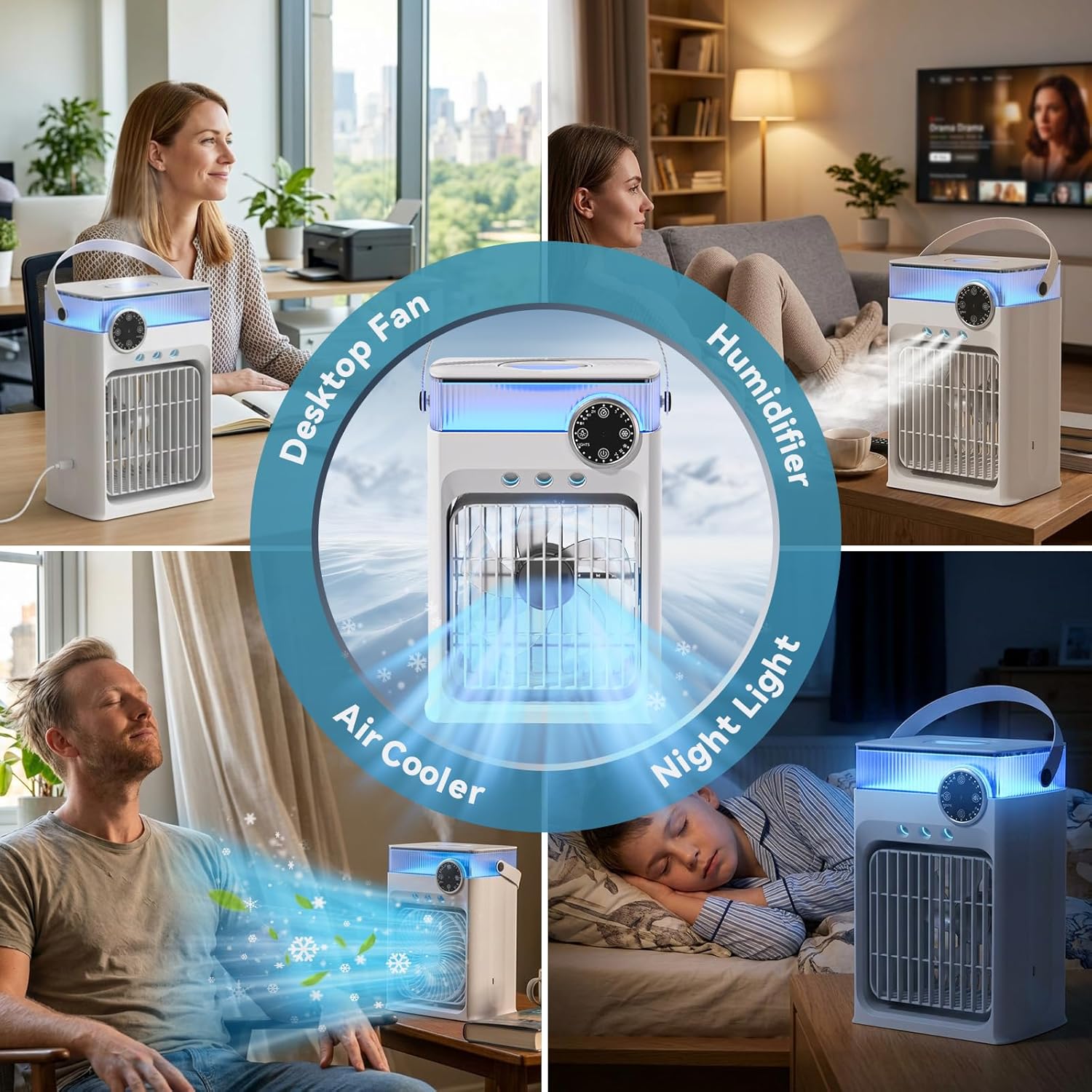
I’ve been using this YFFU “portable air conditioner” for a bit now, and I’ll be blunt: it’s not an air conditioner in the usual sense, it’s an evaporative cooler / water fan. If you buy it thinking it will cool a whole bedroom like a wall AC or a portable 9000 BTU unit, you’re going to be disappointed. If you treat it as a personal cooler that sits about a metre from you, it makes a lot more sense.
In practice, I’ve used it on my desk during the day and on a bedside table at night. It plugs into USB, so I’ve run it off a laptop, a power bank, and a regular USB plug. The airflow is focused and the cooling effect is tied directly to how close you are and whether you’ve put cold water or ice water in the tank. With normal tap water, the effect is mild; with ice water, you feel more of a cool breeze.
The marketing talks a lot about RGB lights, 8 colours, timer, remote control, etc. All that stuff works, but honestly the core question is: does it make you less hot? My answer: yes, a bit, but only in a small area and only if you’re close. It’s more comfortable than a basic USB fan, but it’s nowhere near a real AC unit that actually lowers room temperature.
So my starting point: if you’re in a small room and just want something quiet next to your bed or on your desk, it’s a pretty solid little gadget. If you’re expecting to cool a whole living room, or you run very hot and your room is an oven, this is probably going to feel underwhelming and you’ll think you wasted your money like some of the 1‑star reviews.
Value for money: worth it if you know what you’re buying
On value, it sits in that middle zone where it’s good value for specific uses but not a miracle solution. Compared to a basic USB fan, it costs more, but you get water cooling, mist, timer, night light, and a remote. Compared to a real portable air conditioner with a hose, it’s much cheaper, much smaller, and uses almost no electricity, but also gives you nowhere near the same cooling power.
The Amazon rating around 4.1/5 makes sense to me: people who expected a small personal cooler are mostly happy, the ones who thought it would chill a whole room are clearly disappointed. Based on what it actually does, I’d say the price is fairly reasonable. You’re paying for the convenience of a compact unit that’s quiet and easy to move, not for heavy-duty cooling.
If you live in a small flat, work from home, or just want something next to the bed so you’re not tossing and turning all night, it’s a pretty solid compromise. You avoid the cost and installation hassle of a real AC, and you don’t need a window hose. But if your room turns into an oven in summer, or you’re in a loft or big living room, this will feel like bringing a water pistol to a forest fire. In that case, the money is probably better put towards a real AC or at least a bigger fan.
So in terms of value: for personal spot cooling in a mild to moderately hot environment, it’s decent. For serious heat or large spaces, the value drops, because it simply can’t keep up, no matter how much ice water you pour into it.
Design and build: light, plastic, and mostly practical
Design-wise, it’s fairly straightforward. The colour is a warm white, so it blends in with most bedrooms and offices without drawing too much attention. It’s mostly plastic, which is expected at this price and weight. The plastic doesn’t feel premium, but it doesn’t feel like it’s going to crack in your hands either. You can pick it up easily thanks to the small leather-style handle, and at around 980 g it’s genuinely portable.
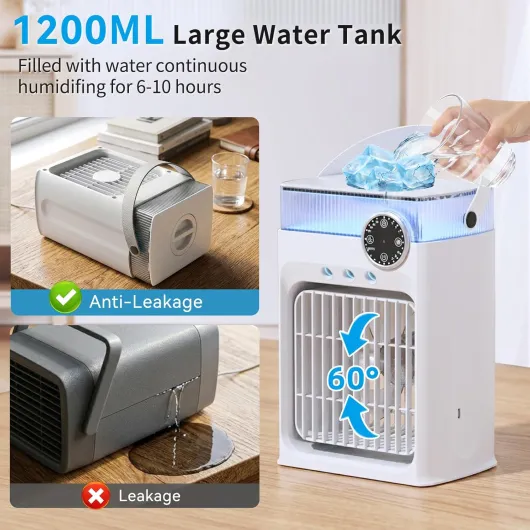
The front grille and tilting air outlet are useful: you can angle the airflow up or down about 60°, which helps a lot if it’s on a low table or next to your bed. On the top, you have the controls: power, fan speed, mist mode, light, and timer. They’re touch buttons, not physical ones, and they respond pretty well. The icons are small but after a day or two you know what’s what. The RGB light is basically a ring inside that glows through the body, and you can either cycle colours, pick one, or turn it off.
The water tank is top-fill, which I prefer. You don’t have to pull out a drawer; you just pour water from a bottle or jug. There’s a transparent window on the side so you can see the water level, though in low light it’s not super obvious unless you shine a bit of light on it. The anti‑leak design is mostly fine: I carried it from one room to another half full, and as long as you keep it fairly upright, it doesn’t spill. If you tilt it heavily, you’ll still risk a bit of moisture around the top, so I wouldn’t move it while it’s running.
In terms of footprint, it’s compact enough for a bedside table or a crowded desk. It doesn’t dominate the space like big portable AC units with hoses. The downside of this small design is obvious though: the cooling radius is limited. It’s built to cool the area right in front of it, not a whole 20 m² room. As long as you accept that, the design feels appropriate and practical for what it is.
Power and usage: USB-powered, no built-in battery
This part is important: there is no built-in battery. The unit is powered via USB‑C and needs to be plugged into something all the time. That can be a wall adapter, a laptop, or a power bank. It runs at 5 V and around 9 W, so the power draw is low compared to real air conditioners, but you still need a steady power source.
In practice, that means a few things. For home use, it’s simple: plug it into a USB wall plug and forget about it. For the office, you can run it from your computer’s USB port, though I prefer a dedicated plug so I’m not loading my laptop ports too much. For camping or outdoors, you absolutely need a decent power bank. With a 20,000 mAh power bank, you can run it several hours, but if you plan to use it all night, you’ll want a good capacity bank or an extra one.
The good side is that at 9 W it’s cheap to run. Even if you run it every night during summer, you won’t see any big change on your electricity bill. It’s closer to running a small USB fan plus a humidifier than any kind of AC. There’s no energy-saving mode or fancy inverter tech; it’s either on or off, with speed choices. But for this type of product, that’s fine.
So if you were hoping for a fully wireless, carry-it-around-the-house-without-cables setup, this isn’t it. You can make it semi-portable with a power bank, but you’ll always have that cable connected. For a bedside or desk scenario, that’s not a big deal. For real outdoor use away from power, it’s more of a compromise.
Day-to-day comfort: good next to you, limited beyond that
In everyday use, the comfort depends heavily on where you put it and how close you are. When I had it on my desk about 70–80 cm from my face, set to medium fan and low or medium mist, it felt pretty good. The airflow is soft, not harsh like some cheap fans that dry your eyes. The added humidity stops your skin and throat from feeling too dry, which is nice if you run fans for hours. I didn’t notice any big water droplets, just a fine cool breeze.
At night, with the unit on the bedside table slightly below head level, low fan + low mist was comfortable. It doesn’t blow super hard, so it doesn’t feel like a wind tunnel. The timer function is useful here: I usually set it for 4 hours so it runs until I’m fully asleep and then shuts off, instead of blasting cold, damp air on my face all night. That helps avoid waking up with a stuffy nose or feeling chilled at 4 a.m.
If you move more than 1.5–2 metres away, the comfort drops off quickly. Across a bedroom, you barely feel it unless the fan is on max, and even then it’s light. So for couples, this is more for the person who sleeps closest to it. Same story in the living room: if you’re on the sofa and it’s on a side table next to you, it helps. If it’s in a corner trying to cool the whole space, not so much.
I didn’t have any issues with condensation on furniture or the floor, which was a concern at first. The mist is fine enough that it doesn’t soak things. Just don’t point it directly at electronics at very close range for hours. Overall, for personal comfort within a short distance, it does its job. For general room comfort, it’s more of a minor boost than a solution.
Build quality and durability: feels okay, but long-term is a question mark
On the durability side, it’s honestly too early to say how it will hold up over multiple summers, but I can share what stands out. The plastic body is light and fairly rigid. It doesn’t creak much when you pick it up, which is a good sign. The handle is stitched/attached well enough that I wasn’t worried about it snapping with the unit full of water. The front grille and tilt mechanism feel a bit light, so I wouldn’t let kids constantly play with it or twist it aggressively.
The main concern with these evaporative units is always the water system: the tank, seals, and atomiser. The anti‑leak design has been fine in my use, but I’ve been careful not to move it while it’s running. The tank itself is just a plastic reservoir; if you’re gentle when filling (no slamming heavy jugs on it), it should be okay. The atomiser is the part that can clog over time if you use hard tap water. To keep it working, I’d recommend using filtered water or at least descaling occasionally if your water is very hard.
The buttons and remote are basic but functional. The remote is a small plastic thing that feels like any cheap remote you get with LED lights. It works, but I wouldn’t expect it to survive being stepped on. The fact that the unit is low-power and simple electronically is actually a plus for durability: fewer high-stress components means fewer things that can burn out quickly.
YFFU gives a 1-year warranty, which is pretty standard for this type of product. I wouldn’t treat this like a 10‑year investment; it’s more like a seasonal gadget you hope will last a few summers if you take care of it. Overall, it feels solid enough for the price, but if you’re rough with your gear or have pets or kids that knock things over, I’d be cautious where you place it.
Cooling performance: decent for one person, not for a whole room
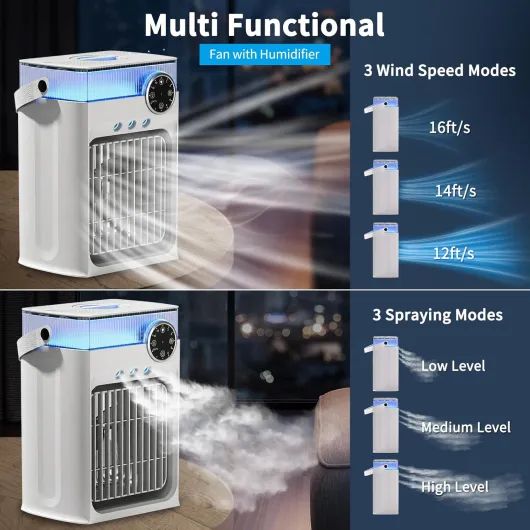
Let’s talk about the main point: does it actually cool you down? I tested it in a small bedroom and in a home office during a couple of warmer days. With just the fan on and no water, it’s basically a small desk fan with three speeds. The airflow is okay but not strong like a big pedestal fan. On high speed, from about 1–1.5 metres away, you feel a clear breeze. Beyond that, it drops off fast.
Once you fill the tank with cold water and turn on the mist, the feeling changes. The air coming out feels cooler and a bit more humid, which is nice if the room is dry. With ice water, the effect is better: the first 30–40 minutes after refilling with ice water feel the coolest. After that, as the water gets closer to room temperature, it’s more of a mild cool airflow. It’s not going to drop the room temperature like a 7000+ BTU portable AC, but if you’re sitting at a desk or lying in bed with this about a metre away, it does make you feel less hot.
They claim up to 10 hours of misting on low. In reality, with medium fan and medium mist, I was getting around 5–6 hours before the water level got low. On high mist and high fan, expect closer to 3–4 hours. The auto‑shutoff / water shortage protection works: when the water runs out, it stops the mist and continues as a regular fan, so you’re not going to burn anything out by forgetting to refill it overnight.
Noise-wise, it’s pretty quiet. On low, I’d say it’s easily sleep-friendly; a soft hum that fades into the background. On medium, still fine for sleep if you’re not super sensitive. On high, you hear it clearly but it’s not a roaring noise, more of a stronger whoosh. They say around 30 dB, and it feels in that ballpark on low. For watching TV or working, I didn’t find it annoying. Overall, performance is acceptable for personal cooling, but if you’re expecting it to chill an entire room or multiple people at once, you’ll be underwhelmed.
What you actually get in the box and what it really does
Out of the box, the YFFU unit is simple: you get the main cooler, a USB‑C cable, a small remote control, and a paper manual. No power brick, so you need a USB plug, power bank, or laptop. The device itself is roughly 27 × 19 × 13 cm and under 1 kg, so it’s easy to move with one hand using the little leather handle on top.
The core idea is straightforward: it’s a 4‑in‑1 gadget according to the brand: fan + evaporative cooler + humidifier + night light. There’s a 1200 ml water tank at the top that you fill with water (ideally cold or even with ice cubes). Inside, it uses an ultrasonic atomiser to turn water into a fine mist that the fan blows forward. That gives you air that feels cooler and more humid than a normal fan. It has 3 fan speeds, 3 mist levels, a 2/4/6/8‑hour timer, and RGB lighting with 8 colours or cycling mode.
Control-wise, you can use the touch buttons on the top or the remote if you’re lazy in bed. The remote worked fine for me up to about 4–5 metres in a straight line; they claim 8 metres, but in real life I wouldn’t count on that distance consistently, especially if there’s furniture in the way. The display and icons are clear enough once you’ve used it a couple of times.
Overall, the presentation is simple and functional. It doesn’t feel premium, but it doesn’t feel like a toy either. Just be aware that the term “air conditioner” on the listing is a bit misleading. This is an evaporative air cooler for personal use, and that’s how you should think about it. If you go in with that mindset, the product makes sense; if you’re expecting real AC performance, you’ll be annoyed from day one.
Pros
- Quiet personal cooling with 3 fan speeds and mist that feels nicer than a basic fan
- Low power consumption (9 W) and USB power make it cheap and easy to run
- Compact, lightweight design with handle, timer, and remote control for convenient use
Cons
- Not a real air conditioner, only cools a small area close to the unit
- No built-in battery, must be plugged into USB power at all times
- Plastic build and water system may not hold up well if treated roughly or used with very hard water
Conclusion
Editor's rating
Overall, the YFFU “portable air conditioner” is really a USB evaporative cooler with some nice extras. It’s quiet, light, cheap to run, and does a decent job of making you feel cooler if you’re sitting or lying close to it, especially with ice water in the tank. The mist and fan combo is more comfortable than a plain fan, and the timer, night light, and remote are genuinely useful day-to-day touches.
Where it falls short is in the expectations set by the word “air conditioner”. It does not cool a whole room, it does not replace a proper AC unit, and if your place gets very hot, this will only take the edge off for the person sitting right in front of it. Build quality is fine for the price, but it’s still mostly plastic and not something I’d expect to last forever without a bit of care.
I’d recommend it for people who want personal cooling at a desk or bedside, don’t have the budget or setup for a real AC, and are okay plugging it into USB all the time. If you’re expecting to cool a big bedroom, a living room, or multiple people at once, you should skip this and look at a higher-power fan or a real mobile AC. As long as you treat it as a boosted desk fan with water, not a full air conditioner, it gets the job done.