Summary
Editor's rating
Value for money: who should actually buy this
Design and build: plastic but practical
Noise, night use and everyday comfort
Build quality and long‑term feel
Modes, speeds and real‑world usage
What this thing actually is (and what it isn’t)
Cooling effectiveness: what you really get
Pros
- Noticeably cooler airflow than a normal fan when using water and ice packs, especially in small rooms
- Quiet enough on low/sleep mode for night use, with a 6L tank that can last most of the night
- Easy to move around thanks to 360° wheels and handle, with simple controls and a useful remote
Cons
- Cooling effect drops a lot in larger or already humid rooms; it’s not a real air conditioner
- Plastic build feels a bit cheap and may not handle rough treatment well
- Requires regular refilling, occasional cleaning and managing humidity, which some people might find annoying

Specifications
View full product page →| Brand | PIAZCEW |
A cheap way to survive hot nights (if you manage your expectations)
I’ve been using this PIAZCEW 3‑in‑1 air cooler for a stretch of warmer days and a few sticky nights, and I’ll be blunt: it’s not a real air conditioner, but it does make the room feel more bearable. If you expect proper AC like a split unit that drops the room from 28°C to 22°C, you’ll be disappointed. If you just want something that blows noticeably cooler air than a normal fan, without wrecking your electricity bill, it gets the job done.
I mainly used it in a small bedroom and a medium living room. In the bedroom (around 10–12 m²), it works pretty well when I fill the 6L tank and use the ice packs. In the living room (around 20–22 m²), it helps, but it doesn’t magically cool the whole space. It’s more like a local comfort zone: sit in front of it or in the oscillation area and you feel a clear difference, move far away and it’s just a slightly cooler breeze in the background.
What surprised me is how simple it is to live with. No hose out the window, no drilling, no weird installation. I unpacked it, filled the tank, plugged it in, pressed power, and that was it. For someone who doesn’t want to faff around with window kits and heavy portable AC units, this is pretty convenient. The trade‑off is, obviously, weaker cooling.
Overall, my feeling after some days of use is: it’s a pretty solid evaporative cooler for the price, as long as you understand the limits of this type of product. It’s quiet enough for sleep on the lower speeds, easy to move around, and the 6L tank actually lasts the night. There are a few annoyances (screen light, plastic feel, and humidity in already damp rooms), but nothing that broke the deal for me at this price point.
Value for money: who should actually buy this
In terms of value, I’d put this PIAZCEW cooler in the “good for the price if you know what you’re buying” category. It sits cheaper than most real portable AC units and roughly in the middle of the evaporative cooler market. For that, you get a 6L tank, 4 ice packs, remote, timer, oscillation, and a reasonably quiet operation. If you compare that to a basic pedestal fan with no cooling function, you’re paying more, but you do get a noticeable comfort boost on hot days.
Compared to a proper portable AC with a compressor, this is obviously weaker in cooling but miles cheaper to run. A 50W device basically sips electricity, so you can run it for hours without worrying too much about the bill. If your budget is tight or your electrical setup can’t handle a big AC unit, this makes sense. Just don’t expect it to cool a whole flat in the middle of a heatwave; it’s more of a spot cooler and fan upgrade than a full solution.
Who is it good for? I’d say: people in small bedrooms, home offices, or rented places where you can’t install anything permanent or drill holes. Also for those who hate the noise and bulk of hose‑type portable ACs. If you’re okay with topping up water and occasionally freezing the ice packs, you’ll get decent use out of it. If you’re lazy about maintenance or live in a very humid region, you might be better off with a strong fan instead.
Considering the features and the current typical price bracket, I’d rate the value as pretty solid. It’s not a miracle machine, but it offers a fair balance between cost, features, and real‑world comfort. If you go in understanding that it’s an evaporative cooler and not a full air con, you’re unlikely to feel ripped off. If you expect it to turn your living room into an Arctic cabin, you’ll be disappointed and should probably save up for a real AC.
Design and build: plastic but practical
Design‑wise, this cooler is pretty basic but functional. It’s a tall, narrow unit: about 65 cm high, 29.5 cm wide, 27 cm deep. So roughly knee‑height on me and slim enough to sit in a corner without hogging space. It’s all white plastic with a black front grille and a small control panel on top. It doesn’t look premium, but it also doesn’t look ugly or cheap‑toy level. It just blends into the room like any other budget fan or air cooler.
The big plus on design is the mobility. It has 4 360° caster wheels and a handle on top, so moving it from bedroom to living room or around the same room is simple. It’s not super heavy, and I could push it with one hand even with a full water tank. If you live in a flat and want something you can roll between rooms every day, this is very convenient compared to those bulky portable AC units with hoses.
The control panel on top is straightforward: physical buttons for power, mode, speed, timer, oscillation, and cooling. The icons are clear enough that after one evening you don’t really need the manual. The front display shows speed, mode, and timer. One thing I liked is that you can dim or close the screen display, which is important if the unit is near your bed. The default brightness is a bit strong in a dark room, so being able to shut it off or dim it avoids that annoying blue glow at night.
On the downside, the plastics feel a bit thin, especially around the tank area. Nothing broke on me, but you can tell it’s a budget product. The wheels are okay but not top quality; I wouldn’t drag it over thick carpet all day. Also, cable length is just average, so you often end up using an extension lead if your outlets are badly placed. Overall, design is practical more than pretty, and for this kind of product, I’m fine with that. It does what it needs to do.
Noise, night use and everyday comfort
Comfort is where this cooler is actually decent. The brand claims around 30 dB in quiet mode. I didn’t measure it with a meter, but on the lowest speed it’s genuinely quiet enough to sleep with if you’re not hyper‑sensitive. It’s a soft airflow noise, more like a gentle fan than a harsh whooshing. On medium, you hear it clearly but it’s still fine for watching TV or working. On high, it’s obviously louder, but still less annoying than many pedestal fans I’ve used.
I used sleep mode most nights. In that mode, the airflow is softer and the pattern is a bit more irregular, supposed to mimic natural wind. In practice, it just feels like a slightly pulsing breeze, which is less boring than a constant blast. Combined with low speed and the display turned off, it didn’t bother me at all. If you’re very sensitive to any noise, you might still notice it, but for me it was okay. I could sleep through the night with it about 1.5–2 meters from the bed.
The 12‑hour timer is also handy. I usually set it for 4 or 6 hours, so it turns off in the second half of the night when it’s cooler outside. Programming the timer is simple: press the timer button to increase the hours, the display shows the remaining time. No weird menus. The remote control adds a lot to comfort: changing mode or speed from the bed or sofa is just easier. The remote is basic but does everything the panel does.
One thing to keep in mind: because it’s an evaporative cooler, it adds humidity. On hot, dry days, that actually feels good. On hot, already humid days, it can feel a bit heavy if the room is closed. I noticed that after a few hours with doors and windows shut, the air felt slightly more sticky. My workaround: crack a window or door a bit so there’s some airflow, and don’t run it at max cooling nonstop in a tiny, already damp room. Overall, in terms of everyday comfort, I’d say it’s quite user‑friendly and works well as a night companion if you tweak the settings.

Build quality and long‑term feel
I haven’t had this unit for months, so I can’t pretend to give a full long‑term durability verdict, but I can at least talk about the build and what feels solid or not. Out of the box, nothing was loose, the body panels fit correctly, and the wheels were already mounted. No rattles when moving it or when the fan is running. It survived being rolled between rooms daily and a couple of minor bumps against furniture without any cracks or weird noises.
The water tank system is the part I checked the most, because that’s usually where cheap coolers fail. The top fill opening is convenient; you can pour water from a jug without pulling the whole tank out. The bottom part is removable for cleaning, which is important because stagnant water and dust can build up. The plastic of the tank feels a bit thin but not flimsy. As long as you don’t yank it out aggressively, it should be fine. No leaks or condensation puddles under the unit so far.
The honeycomb cooling pad inside will need cleaning from time to time, especially if your water is hard. The manual suggests regular maintenance, which is standard for this type of cooler. I haven’t had it long enough to see any mineral build‑up, but based on other similar devices I’ve owned, this is something you’ll have to manage every few weeks or months depending on your water quality. It’s not difficult, just a bit of routine work if you want it to last.
Electronics and buttons feel okay. The top buttons have a decent click, and the remote hasn’t glitched yet. It’s clearly not built like a premium appliance, but for the price range, I’d say durability looks reasonable. If you treat it like a light appliance (no lifting it by the tank, no dragging it over obstacles with a full reservoir, basic cleaning), I don’t see any obvious reason it wouldn’t last several summers. But if you’re rough with your gear, the plastic build might show its limits faster.
Modes, speeds and real‑world usage
This cooler comes with 4 modes (normal, natural, sleep, cold wind) and 3 speeds (low, medium, high). That gives you 12 combinations in theory, but in practice you’ll probably use 3–4 main ones. I mostly rotated between: normal + medium speed in the daytime, cold wind + medium or high when it was really hot, and sleep + low speed at night. Switching modes is one button on the panel or remote, so you quickly find what works for you.
Normal mode is just continuous airflow, nothing fancy. Natural mode varies the airflow a bit, it ramps up and down, which can feel slightly more comfortable over time. Sleep mode is quieter and more gentle. Cold wind is the one that matters for cooling: it activates the water/evaporation system. You do need water in the tank for that, otherwise it’s just a fan again. With the 6L tank full, I could easily get 7–8 hours of use in cold wind on low/medium before needing a refill. On high speed, it obviously empties faster, but still lasted through most of the night.
The airflow strength is decent for a 50W unit. On high, it pushes air across a medium room, though the real cooling effect is felt within a few meters. On low, it’s more of a gentle breeze. I never felt like it was too weak for a bedroom, but if you’re used to big metal‑blade pedestal fans, this won’t feel as powerful purely in terms of airflow volume. It trades some raw power for quieter operation and the cooling function.
In terms of reliability, it started up every time without weird noises or glitches. The pump for the cooling mode is audible if you listen for it, but it’s not loud or annoying. No leaks from the tank so far. I did notice that if you move it around with a full tank and jerk it too fast, you can get a little sloshing sound, so it’s smarter to move it gently or fill it once it’s in place. Overall, performance is consistent with what you’d expect from a mid‑range evaporative cooler: not spectacular, but effective enough for everyday home use.

What this thing actually is (and what it isn’t)
Let’s be clear about the category first. This PIAZCEW unit is an evaporative air cooler, not a compressor air conditioner. That means it cools by evaporating water from the tank through a honeycomb filter, which makes the air feel cooler and more humid, especially if the room is dry. There’s no hot air exhaust hose, no gas, nothing like that. Power is around 50W, which is tiny compared to a 9000–12000 BTU portable AC that usually eats 800–1200W.
The product is sold as a 3‑in‑1: fan, air cooler, and humidifier. In practice, that’s mostly true. In normal mode with no water/ice, it behaves like a standard tower fan. Add water and switch to cooling mode and you feel the temperature difference at the outlet. In very dry air, it doubles as a humidifier, which can be nice if you’re in a dry flat or running heating in winter. I haven’t tested it long‑term as a humidifier, but you can feel the humidity go up a bit in a closed room.
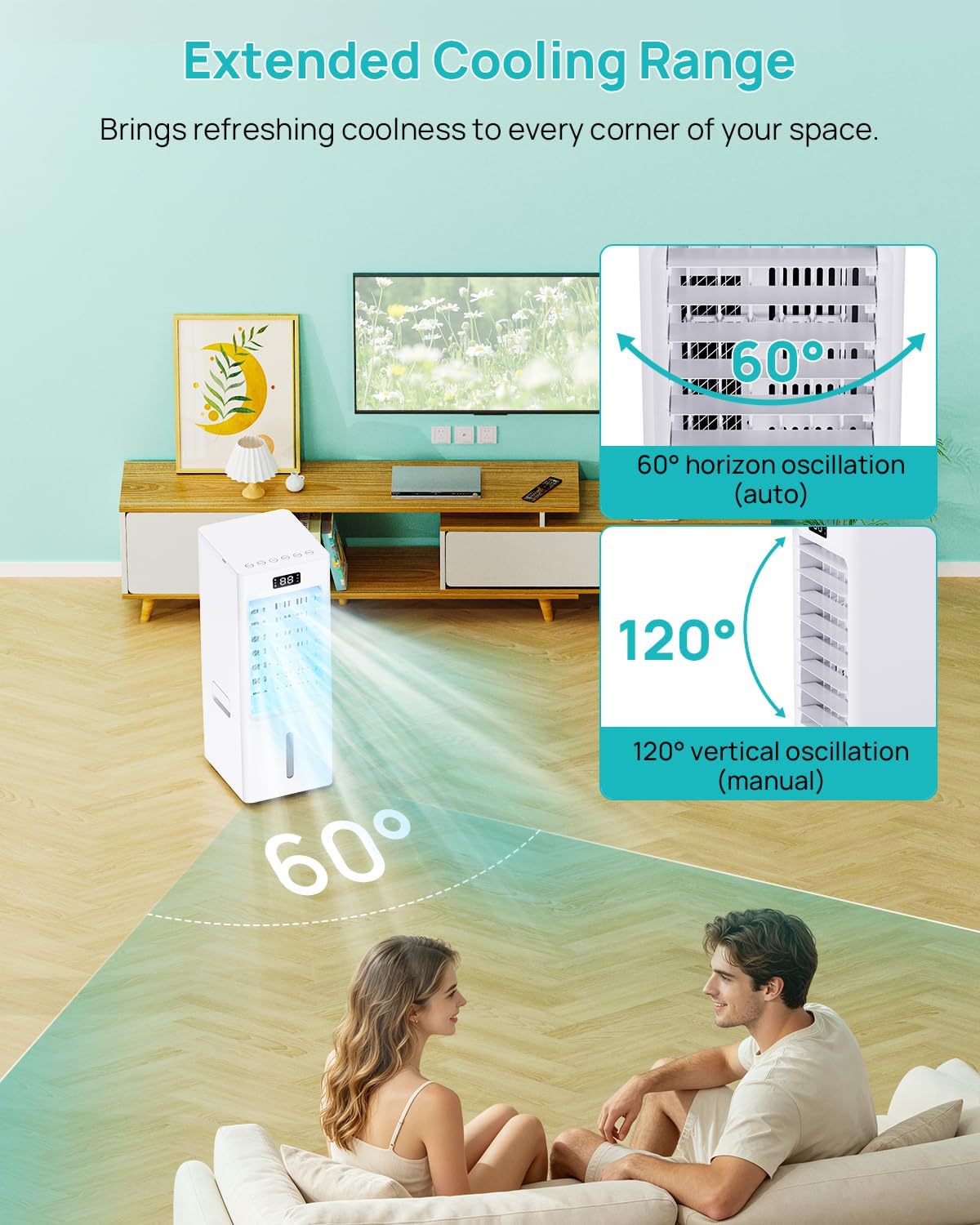
On the feature side, it ticks most of the basic boxes: 4 modes (normal, natural, sleep, cold wind), 3 speeds, 12‑hour timer, oscillation, remote control, and a 6L removable tank with 4 ice packs. The oscillation is horizontal motorized (about 60° side to side), and vertical adjustment is manual (you tilt the fins by hand). The remote works from across the room (they say 5 m; in my case it worked roughly that distance, as long as you point it vaguely toward the unit).
In use, I’d describe it like this: more than a fan, clearly less than real AC. It’s good for personal cooling and small rooms, especially if you’re sitting or sleeping within a couple of meters. For large, hot, humid rooms, it’s going to feel like a decent fan with a slightly cooler breeze, nothing more. If you buy it with that idea in mind, you’ll probably be satisfied. If you expect miracles, you’ll be underwhelmed.
Cooling effectiveness: what you really get
This is the part that matters: does it actually cool you down? In my experience, yes, but within limits. With just fan mode and no water, it’s basically a tower fan. Decent airflow, nothing special. Once you fill the 6L tank and use the cold wind mode with the supplied ice packs, the air coming out is clearly cooler than room temperature. If you put your hand in front of it, you feel a real temperature drop at the outlet.
In a small bedroom (10–12 m²), after running it for around 30–40 minutes with the door mostly closed, the room felt noticeably more comfortable. I don’t have precise temperature logs, but it felt like a 2–3°C perceived drop in that area, especially near the bed. It’s not like walking into an air‑conditioned hotel room, but I stopped sweating and could sleep with just a sheet. For me, that’s enough for summer nights without paying a fortune in electricity.
In a bigger living room (20–22 m²), the effect is more local. If you sit within 2–3 meters and let it oscillate, you feel a strong, cooler breeze on you. Move to the other side of the room and it’s just background airflow. So I’d say it’s best for personal or spot cooling, not for cooling an entire flat. The oscillation (about 60°) helps spread the cool air a bit, but it doesn’t magically condition the whole space.
One thing I noticed: the performance depends a lot on room humidity. On a dry, hot day, the cooler works better. On a day that was already hot and humid, the effect was less impressive, and the air felt heavier after some time. That’s just how evaporative coolers work, not a specific flaw of this model. So if you live in a very humid area, don’t expect miracles. Still, for the UK‑style warm spells or dry indoor air, it’s a decent step up from a plain fan.
Pros
- Noticeably cooler airflow than a normal fan when using water and ice packs, especially in small rooms
- Quiet enough on low/sleep mode for night use, with a 6L tank that can last most of the night
- Easy to move around thanks to 360° wheels and handle, with simple controls and a useful remote
Cons
- Cooling effect drops a lot in larger or already humid rooms; it’s not a real air conditioner
- Plastic build feels a bit cheap and may not handle rough treatment well
- Requires regular refilling, occasional cleaning and managing humidity, which some people might find annoying
Conclusion
Editor's rating
After using this PIAZCEW 3‑in‑1 air cooler in different rooms and conditions, my overall take is pretty simple: it’s a decent evaporative cooler that does what it says, as long as you don’t confuse it with a real air conditioner. In a small bedroom or home office, with the tank full and the ice packs inside, it clearly makes the air feel cooler and more comfortable. Noise is low enough on the first two speeds for sleep or work, and the 6L tank plus 12‑hour timer mean you can run it through most of the night without babysitting it.
The strong points are the easy mobility, straightforward controls, and low power consumption. It’s also nice that you can dim or turn off the display for night use, and the remote makes life easier. On the downside, the build is quite plastic, the effect in larger or already humid rooms is limited, and you do need to handle water, ice packs, and some basic cleaning. If you’re expecting proper AC performance or live in a very humid climate, this probably isn’t for you.
If you just want something better than a standard fan, for a bedroom, small living room, or office, and you’re okay with the concept of evaporative cooling, it’s a pretty solid choice for the money. If you want guaranteed big temperature drops across an entire flat, skip this and look at a real air conditioner instead.