Summary
Editor's rating
Value for money: strong features, steep price
Design: powerful but bulky and awkward to place
Comfort and noise: genuinely quiet, especially for bedrooms
Cooling & heating performance: strong, but not magic
What you actually get with the Portasplit
Real-world effectiveness and daily use
Pros
- Very quiet in silent mode, genuinely suitable for bedroom use
- Strong cooling and decent heating performance with inverter efficiency (A++/A+)
- All‑in‑one unit (cool, heat, dehumidify, fan) with Wi‑Fi and smart home control
Cons
- Expensive compared to standard portable AC units
- Permanently attached, stiff refrigerant hose makes it barely portable in practice
- Bulky footprint and installation constraints limit it to basically one main room

Specifications
View full product page →| Brand | Midea |
A "portable" split AC that’s not really portable
I’ve been using the Midea 4‑in‑1 Portasplit 12000 BTU for a hot spell and a few chilly evenings, mainly in a medium‑large bedroom and occasionally rolled into a home office. On paper, it looks like the answer to a lot of problems: proper split‑style performance, no full wall install, heating and cooling in one box, and very low noise. In reality, it sits in a weird middle ground between a true portable unit and a fixed split system.
The first thing that hit me is the size and weight. This is not like those cheap 9000 BTU monoblocs you wheel around and shove a hose out the window. It’s a chunky unit with an attached outdoor fan module and a thick refrigerant hose in between. Yes, there are casters, but you don’t just casually drag this between rooms every day, especially in a normal UK house with narrow doors or stairs.
I went in expecting at least some compromise on performance because of the “portable” angle, but in terms of raw cooling and heating, it behaves much closer to a proper split. It pulls a 20–25 m² room down from 28–30°C to something comfortable in a reasonable time. It’s also genuinely quieter than any standard portable AC I’ve owned or borrowed, especially in silent mode, which is the main reason I wanted to try it in a bedroom.
Where it annoyed me is the installation flexibility. The permanently attached refrigerant hose and the way the outdoor bit mounts means you have to accept that this is basically semi‑fixed. The marketing around portability feels stretched. If you want quiet, efficient cooling and heating in one main room and you’re okay treating this like a near‑permanent install, it makes sense. If you’re dreaming of rolling it all over the house, you’re going to be disappointed.
Value for money: strong features, steep price
Let’s talk about the price, because that’s where a lot of people will hesitate. This thing often sits around the £1000 mark, which is roughly three times the price of a decent 9000–12000 BTU monobloc portable AC (around £300–£350). One Amazon reviewer summed it up pretty well: it’s bigger, not necessarily faster at cooling than their old unit, but a lot quieter. So the question is basically: how much is noise reduction and energy efficiency worth to you?
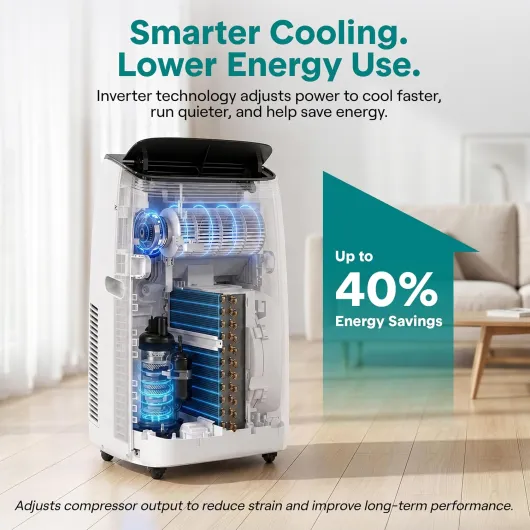
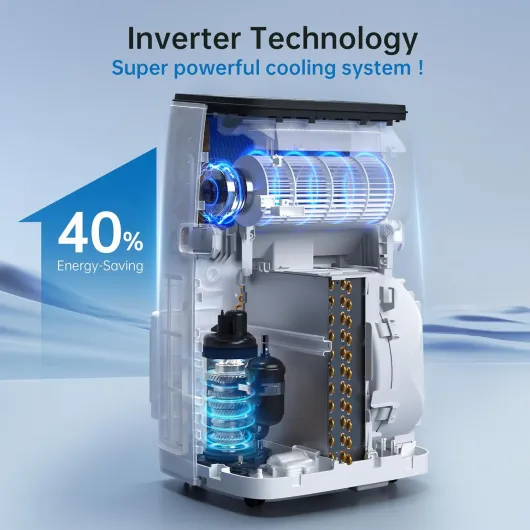
On the plus side, you’re getting A++ cooling efficiency, A+ heating, and an inverter compressor. Over several summers (and winters if you use the heat pump), the running costs should be lower than a cheap, inefficient portable. Midea also claims some AI energy saving tricks that adjust to temperature fluctuations and cut consumption by up to 15%. I can’t verify the exact number, but I did notice that it doesn’t seem to guzzle power the way my old unit did, especially once the room is at the target temperature.
You also get proper all‑year use: cooling, heating, dehumidifying, and a quiet fan. If you live in a place with both hot summers and chilly shoulder seasons, you’ll probably use it more than just a couple of weeks a year. The 2‑year manufacturer warranty is standard, nothing special but decent, and Midea customer service seems responsive enough—one buyer got their faulty remote sorted quickly, which is reassuring.
Still, value is not perfect here. For many people, a cheaper portable AC plus a separate heater will cost less upfront and might be “good enough”, especially if noise isn’t a big concern. Also, because the Portasplit is effectively tied to one main spot, you don’t get the feeling of buying one device for the whole house. In my view, it’s good value if you specifically need a quiet, efficient unit for a main bedroom or office and you’re okay paying a premium. If you just want to cool a room a few days a year and don’t care about noise, it’s overkill.
Design: powerful but bulky and awkward to place
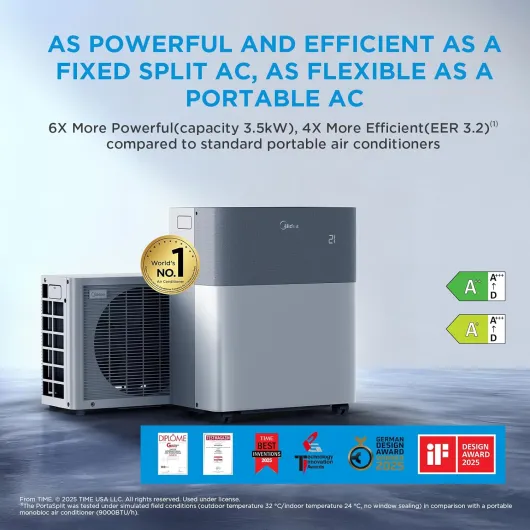
Design‑wise, the unit looks clean enough: white plastic, fairly modern lines, nothing that screams industrial, but it is big. Dimensions are roughly 34D x 51.8W x 64.6H cm, and that’s just the main body. Once you account for the attached outdoor fan side and hose, it occupies more visual and physical space than most people expect from something called “portable”. In a big bedroom or office, it’s fine; in a small room, it pretty much dominates one wall.
The casters roll well on hard floors, but the stiff refrigerant hose is what kills the flexibility. Because it’s not very pliable, you can’t tuck the outdoor section neatly wherever you want. You end up designing the room layout around where this thing can reasonably sit and vent. One Amazon reviewer said it feels more like something you’d see in a small commercial space or a large bathroom, and I agree. It has that slightly industrial vibe simply because of its footprint and the visible hose/outdoor module combo.
Controls and display are okay. The display is clear enough to read across a room, the buttons feel fine, and the remote is straightforward: mode, temp up/down, fan speed, swing, etc. There’s nothing fancy, but it doesn’t feel cheap either. The Wi‑Fi indicator and pairing process are basic but workable. The unit doesn’t have that “premium” feel you’d get from top‑end built‑in splits, but it also doesn’t feel like some random no‑name portable AC. It sits somewhere in the middle.
My main design complaint is the fixed hose. If they had made it detachable with proper quick‑connects, the product would make far more sense. Right now, if you want to move it more than a short distance, it’s a bit of a wrestling match, and you’re always scared of straining that hose. So the design is solid in build quality terms, but conceptually a bit confused: it wants to be both portable and semi‑fixed and ends up compromising on the portability side.
Comfort and noise: genuinely quiet, especially for bedrooms
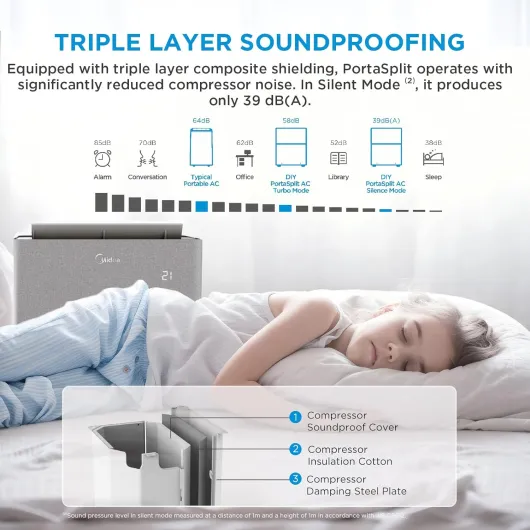
Comfort is where this unit actually earns its price more than the marketing fluff. Noise first: in silent mode, it’s genuinely low. The spec says 39 dB, and while I don’t have a meter, subjectively it’s more like a steady hum than the usual roaring you get from monobloc portables. I’ve slept with it running during a warm night, and it didn’t keep me awake. Compared to my older 9000 BTU portable that sounded like a vacuum cleaner, this is on a different level for bedroom use.
The airflow is strong without feeling like you’re being blasted. Fan speed is adjustable, and the lowest setting combined with silent mode is good for night use. During the day, I usually run it at medium fan speed in normal mode, and there’s still no need to raise my voice for a conversation or video call. For a home office, that’s pretty solid: you can work or take meetings without feeling like you’re in a server room.
Temperature control feels stable. Once it gets the room down to the set point, the inverter compressor seems to do its job: it ramps down instead of constantly cycling on and off. That means fewer sudden noise spikes and fewer temperature swings. I noticed that after about 30–40 minutes, it settles into a steady, low background sound instead of constantly revving up. The air doesn’t feel too dry either, especially if you’re not overdoing the temperature difference compared to outside.
In heating mode, comfort is also decent. It doesn’t feel like a hot hair dryer; it’s more like a mild, steady warm breeze. For shoulder seasons or a chilly evening, it’s enough to make a 20–25 m² room feel comfortable without turning on the central heating. I wouldn’t rely on it alone in the dead of winter for a big space, but as a support heater it’s fine. Overall, for comfort—noise, airflow, and general feel—it’s one of the better options I’ve tried, as long as you accept that it’s aimed at one main room, not the whole house.

Cooling & heating performance: strong, but not magic
In terms of raw performance, this thing does the job well, but it’s not a miracle machine. In a roughly 22 m² bedroom with the sun hitting it in the afternoon, I’ve seen it pull the temperature down from about 29–30°C to 22°C in around 30–40 minutes, which lines up with one of the Amazon reviews claiming 30°C down to 19°C in under half an hour. If you set it to something more reasonable like 23–24°C instead of 19°C, it feels comfortable quite quickly and doesn’t have to run flat‑out for as long.
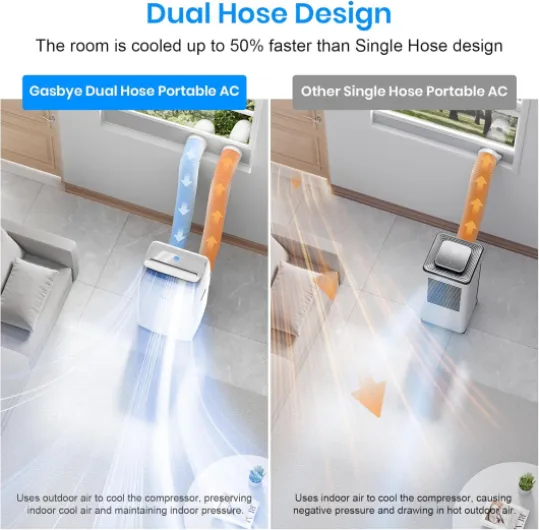
Compared to standard portable monobloc units I’ve used (typically 9000–12000 BTU), it cools a bit faster and, more importantly, feels less wasteful. You don’t have that hot exhaust hose dumping heat back into the room and fighting the unit. Because the outdoor part is separated, you get closer to what you’d expect from a basic fixed split. One Amazon reviewer said it didn’t cool as fast as their old AC, so there will be some variation based on room size, insulation, and expectations, but in my case it’s been more than adequate.
Heating performance is also decent. On a cool evening with the room around 16–17°C, it took maybe 20–30 minutes to get to a comfortable 20–21°C. It’s not going to replace a proper central system, but as a spot heater for one room, it beats electric fan heaters on efficiency and comfort. The A+ rating for heating is nice if you plan to use it all year rather than just in summer.
One thing to note: the claimed room size up to 42 m² is optimistic if you want quick cooldown in a heatwave. For spaces that large, it’ll still work, but expect slower results and possibly running it continuously. For normal UK‑sized bedrooms, home offices, or a big bathroom like one reviewer mentioned, it’s well matched. In short, the performance is strong, just don’t expect it to instantly fix a badly insulated loft or an entire open‑plan floor.
What you actually get with the Portasplit
Out of the box, you’re looking at a 45.5 kg unit with a built‑in indoor section, an outdoor fan section and a stiff refrigerant hose linking the two. There’s no separate outdoor box like a classic split; it’s more like someone fused a portable AC with a mini outdoor module and then insisted it’s still portable. The hose is permanently attached, so you can’t disconnect it and route it differently later or store pieces separately. That’s important to know before you buy because it limits where you can reasonably put it.
In terms of specs, it’s 12000 BTU / 3.5 kW cooling, with an A++ rating and SEER around 6.1. It also works as a heat pump with A+ for heating, so it’s not just a summer gadget. The manufacturer claims it can handle rooms up to about 42 m², but realistically, for UK insulation and typical houses, I’d say it’s best in the 20–30 m² range if you want quick, comfortable cooling without running it flat out all the time.
The control options are decent: you get a remote, onboard buttons, and Wi‑Fi via the Midea SmartHome app, plus Alexa/Google Assistant support. The remote in my case worked fine, but I’ve seen at least one buyer mention a faulty one that had to be replaced. The app setup isn’t complicated if you’ve used smart home stuff before. It’s not the most polished app on earth, but basic functions—mode, temperature, fan speed, timers—are easy enough to reach, and the unit responds quickly.
So in terms of what’s promised versus what you physically get, it mostly lines up. You do get a solid 4‑in‑1 device: cooling, heating, dehumidifying and fan. But the whole “Portasplit” name and portability angle is oversold. Think of it as a compact, efficient alternative to a proper split, not as a throw‑in‑any‑room portable. That mindset will save you a lot of frustration later.
Real-world effectiveness and daily use
Effectiveness for me isn’t just raw power, it’s how the thing fits into daily life. On that front, the Portasplit is a bit of a mixed bag. On the positive side, it’s one of the few units I’ve been comfortable leaving on in a bedroom overnight. Silent mode plus the inverter compressor means it keeps the room at a stable temperature without constant on/off cycling. I woke up without that “stale, over‑cooled” feeling I sometimes get with cheaper portables set too low.
The dehumidify mode is handy during muggy days. It pulls moisture out quietly, and you notice the room air feeling less sticky after an hour or so. If you live in a humid area or have a damp room, that mode alone can make the place feel more liveable without dropping the temperature too far. Fan‑only mode is less exciting but usable if you just want air circulation without running the compressor.
Where effectiveness takes a hit is the whole portability promise. In practice, I ended up treating it as a fixed unit for one floor. Moving it between my top‑floor bedroom and the lower‑floor office was a pain due to the weight and hose. One reviewer also mentioned the lack of a window bracket and how the wall bracket setup limits you to one room. I ran into the same logic: once you’ve set it up in a decent spot, you just leave it there. At that point, the “portable” label feels a bit pointless.
So, day to day, it’s effective as a quiet, solid climate control system for a main room. It’s less effective if your plan is to share it between multiple rooms or use it casually in different parts of the house. If you buy it with a fixed‑room mindset, it makes sense. If you buy it expecting a flexible, easy‑to‑move solution, it will feel like a compromise.
Pros
- Very quiet in silent mode, genuinely suitable for bedroom use
- Strong cooling and decent heating performance with inverter efficiency (A++/A+)
- All‑in‑one unit (cool, heat, dehumidify, fan) with Wi‑Fi and smart home control
Cons
- Expensive compared to standard portable AC units
- Permanently attached, stiff refrigerant hose makes it barely portable in practice
- Bulky footprint and installation constraints limit it to basically one main room
Conclusion
Editor's rating
Overall, the Midea Portasplit 12000 BTU is a solid piece of kit with a very clear profile: it’s for people who want quiet, efficient cooling and heating in one main room and are willing to pay extra and accept a semi‑fixed setup. As an everyday user, I liked the low noise, stable temperature control, and the fact that it doesn’t blast hot exhaust air back into the room like the usual portable units. For sleeping and working in the same room, it’s genuinely more comfortable than the cheaper machines I’ve used.
Where it falls short is the portability promise and the price. The attached, stiff refrigerant hose and the way the outdoor part mounts mean you’ll probably set it up once and rarely move it. If you were hoping to roll it between rooms or up and down stairs, it’s not a good match. And at around £1000, you really need to care about noise, energy use, and year‑round heating to justify it over a £300–£400 portable AC.
If you have a main bedroom, office, or large bathroom that you want to keep comfortable all year, and you don’t want the hassle or visual impact of a full split install, this is worth considering. If you just want something cheap and simple to cool the odd heatwave, or you plan to move the unit between multiple rooms, I’d look at a standard portable instead or save up for a proper fixed split system.





![4-in-1 Portasplit Air Conditioner with Heat Pump, 12000 BTU 3.5kW, Only 39dB(A) in Silent Mode, Cooling A++/Heating A+, Smart WiFi Control, for Rooms up to 42m²/105m³ [Energy Class A++] White Midea Portasplit 12000 BTU](https://www.portable-air-conditioner-guru.com/storage/895575/71LclLP-L1L._AC_SL1500_.jpg)