Summary
Editor's rating
Is it worth the money compared to other portables?
Design and noise: quiet for what it is, but not invisible
Day-to-day comfort: living with it in a bedroom and office
Build quality, quirks, and long-term worries
Cooling performance: finally a portable that doesn’t feel fake
What you actually get out of the box
Pros
- Dual-hose and inverter design actually cools a room properly and more efficiently than typical single-hose units
- Noticeably quieter than most portable ACs, realistic to use in a bedroom or TV room
- Smart features (Wi-Fi, app, voice control) and good remote make day-to-day use easier if you want automation
Cons
- Window kit and plastic clips feel flimsy and are expensive to replace
- Heavy and not very flexible to move or re-orient due to the large, stiff hose
- Quality control seems inconsistent, with some reports of rattles or compressor issues and only a 1-year warranty

Specifications
View full product page →| Brand | Midea |
A portable AC that actually cools like a real unit?
I picked up the Midea Duo 14,000 BTU because I was tired of two things: loud portable ACs that barely cool, and landlords who drag their feet on fixing central air. This model kept coming up in forums as "the one" to get if you want a portable that behaves more like a window unit. Dual hose, inverter, quieter than average – sounded good on paper, so I decided to actually live with it for a while.
In my case, it’s been used in a 350–400 sq ft bedroom/office and occasionally rolled into a roughly 500 sq ft living room. Climate is dry and hot, so when it’s 95–100°F outside, you know right away if an AC is legit or just making noise. I mainly wanted something that could keep one main room comfortable without nuking my power bill or sounding like a jet engine.
After a few weeks of use, including some nasty hot days, I can say it’s not perfect, but it’s definitely not in the same league as the usual cheap single-hose boxes. It actually cools the room properly, it’s reasonably quiet, and it doesn’t roast the hose like a space heater. But there are some annoyances: the window kit feels fragile, the unit is heavy, and quality control seems hit-or-miss based on my experience and other reviews.
If you’re expecting magic central AC performance from a portable, you’ll be disappointed. If you go in with realistic expectations – one room, doors mostly closed, and you’re willing to fiddle a bit with installation – it’s a pretty solid option, especially if noise and energy use matter to you.
Is it worth the money compared to other portables?
Price-wise, the Midea Duo 14,000 BTU sits on the higher side of the portable AC market, especially if you compare it to basic single-hose units. But you’re paying for three main things: dual-hose design, inverter efficiency, and lower noise. If you don’t care about those and just want the cheapest cold air box, this probably won’t feel worth it. If you specifically want something that can actually cool a room properly without wrecking your power bill or your ears, the premium starts to make more sense.
Compared to older units like the Whynter ARC-14S, this one is smaller, quieter, and generally cools more evenly. One user literally sent the Whynter back after running this side by side. Energy use is where it pays off long term. If you’re using it daily through summer or using the heat pump in mild winters, the power savings vs a resistance heater or an old central AC can add up over a couple of seasons. It’s not free money, but it softens the hit of the higher upfront cost.
Where the value takes a hit is the accessories and potential durability questions. Paying a good chunk of money for a unit and then being told replacement window parts are $60–$100 feels off. Also, if your unit happens to be one of the unlucky ones with compressor or fan issues down the line, the one-year warranty might leave you annoyed. On the flip side, several people had decent experiences with Midea support, including full refunds, which is not nothing.
Overall, I’d call the value “pretty solid” if you actually use its strengths: single main room, doors closed, hot climate, and you care about noise and energy use. If you only need an AC for a couple of weeks a year, or you’re trying to cool a massive open area, then this is overkill and you’d be paying for features you won’t really benefit from. In those cases, a cheaper basic portable or a proper window unit might make more sense.
Design and noise: quiet for what it is, but not invisible
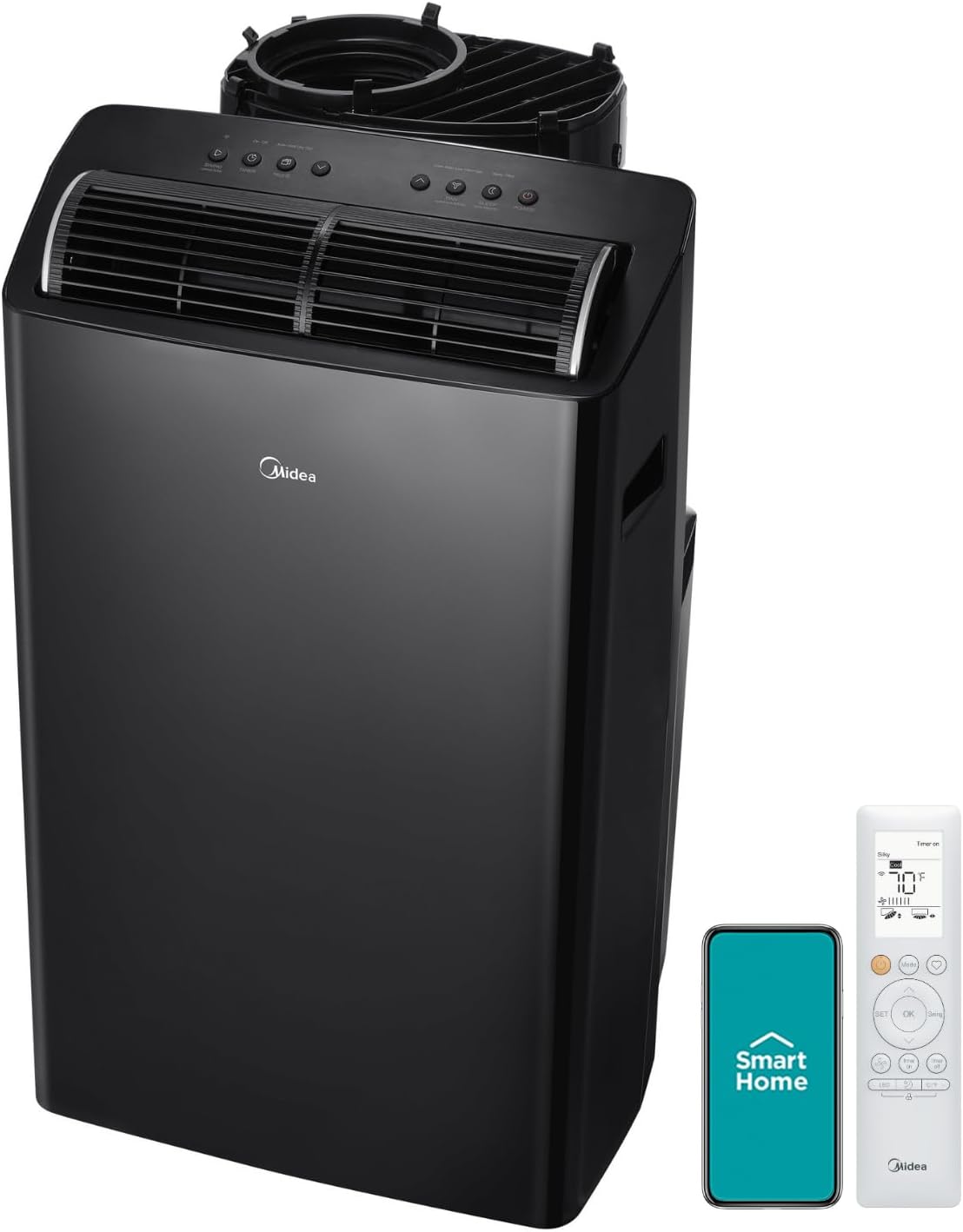
Design-wise, the Midea Duo looks more like a tall glossy speaker than a typical portable AC. The black finish looks decent in a living room or bedroom, but it’s a fingerprint magnet. If you have pets or kids, expect smudges and paw prints all over the front pretty fast. The footprint is fairly compact front-to-back, so it doesn’t jut out into the room as much as some big square units, which I liked in a smaller bedroom.
The air outlet is at the top, and that matters. The cold air mostly shoots upward and forward. When the vent is fully open, the air is cold and you feel it across the room, but if you’re sitting right in front of the unit on the floor, you don’t get that direct blast people sometimes want. It’s more about cooling the whole room rather than freezing your ankles. The swing function helps spread the air, but it’s limited – don’t expect precise directional control like a high-end fan.
On noise, it’s genuinely on the quiet side for a portable AC. On low fan, it’s basically a soft whoosh with an occasional brief high-pitched whine when the compressor ramps up. I could watch TV two meters away without cranking the volume. Sleeping with it on low is realistic if you’re not hypersensitive. It’s not silent – you will hear airflow and the occasional compressor tone – but compared to older Whynter or generic single-hose units, it’s a big step down in noise.
The control panel, though, is oddly designed. Fan speeds are shown with icons (Y, +, star) instead of clear text like “Low/Med/High”. Combined with a generic manual that covers multiple models, the first setup is more confusing than it should be. The remote is better thanks to a backlit screen, but the UI on the unit feels like the designers got clever instead of just being clear. Once you’ve used it a few days, you learn what’s what, but the first afternoon is a bit of button-guessing.
Day-to-day comfort: living with it in a bedroom and office
For actual comfort, I care about three things: can I sleep with it on, can I work with it nearby without going nuts from noise, and does it keep humidity and temp at a steady level. On those fronts, it does pretty well. On low fan, the sound is more like a box fan than an industrial AC. I’ve slept with it running right in the bedroom and had no real issue. If you’re extremely sensitive to any kind of fan noise, you might still notice it, but it’s far better than most of the portable units I’ve heard.
The airflow pattern is more about room comfort than direct blast. The vent throws air upward and across the room, so the whole space slowly becomes evenly cool. If you like that ice-cold stream directly on your body, you’ll probably want to pair it with a small oscillating fan pointed at you. If you just want the room temp down 10–15°F from outside, it does that steadily without hot and cold swings. The built-in thermostat is not super accurate, but once you figure out the offset (usually 2–3°F), you just set it accordingly.
Dehumidifying is decent too. In dry climates, you don’t notice it much, but in more humid days, the air feels less sticky after an hour or so. Condensate handling in cool mode is mostly automatic; you don’t have to constantly empty a bucket unless you’re in very humid conditions. For heat mode (if you get the heat version), condensate is heavier but there’s an internal pump, so you can run a small hose to a drain or shower and forget about it. One user was heating an 850 sq ft condo in a mild winter climate with just this unit, which tells you the heat pump side is not a gimmick.
The only comfort downside is that when the compressor ramps up or down, it sometimes makes a brief high-pitched sound. Most people will tune it out after a few days, but if you’re very picky about high-frequency noises, it could bother you. Also, if your room holds heat (thick walls, bad insulation), the AC will still cool the air, but the surfaces radiate heat for a while, so you might need to start it earlier in the day to feel fully comfortable by evening.
Build quality, quirks, and long-term worries
Physically, the main body feels sturdy enough. The plastic doesn’t flex much, the wheels roll fine on hard floors, and the hose itself feels more robust than the usual paper-thin ones. Where it feels cheap is the window kit and some of the mounting clips. Several people, including me, have either almost broken or actually broken those little plastic tabs while adjusting the kit. Replacements from Midea are not cheap, which is annoying for what is basically molded plastic.
Internally, it’s a bit of a mixed bag. When it works, it works well. But there are enough reports of rattles, vibrations, and occasional compressor noises on first use that it’s clear quality control isn’t perfect. One user had refrigerant lines rattling against each other out of the box and had to adjust the vibration sleeve. Another had a high-pitched metal-on-metal squeak from the compressor that magically cleared up after running in heat mode for a while. I had a mild hum the first couple of days that faded after some use. So, there’s a pattern: some units need a “break-in” period where they sound sketchy, then settle down.
More concerning is that at least one user had the unit start buzzing and failing after about eight months, likely a compressor issue. Midea ended up refunding them, which is good customer service, but it also means the unit was not worth repairing. In places where you pay disposal fees for refrigerant devices, that’s an extra hidden cost. The warranty is only one year, which is pretty standard but not generous for something in this price range and complexity.
My take: the design is smart, the materials on the main unit are OK, but the accessories and some internals feel a bit on the edge. If you treat it gently, don’t move it constantly, and install it once and leave it, you’ll probably be fine. If you plan to yank it in and out of windows every season, move it between rooms a lot, or you’re rough with gear, expect more wear and tear and maybe some broken plastic. I’d seriously consider buying an extended warranty on this one, just because repair vs replacement doesn’t seem to favor the consumer.
Cooling performance: finally a portable that doesn’t feel fake
In actual use, this thing cools properly if you stay within its limits. In a 350–400 sq ft bedroom/office with the door mostly closed, in 95–100°F dry heat, it brought the room down to the high 70s and held it there. If I set it to 78°F, the real room temperature usually sat around 75–76°F according to a separate thermometer, which matches what another user mentioned (it reads a couple degrees off). For me, that was comfortable enough to work without sweating and sleep without feeling sticky.
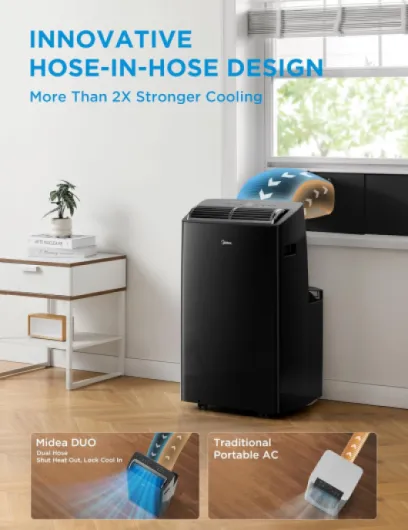
The key difference from cheaper units is the dual-hose + inverter combo. Because it pulls intake air from outside and exhausts outside, it doesn’t suck your cooled indoor air out and create a vacuum. That means the room actually gets cold instead of just “less hot”. You notice it when you walk into the room from a hot hallway – the temp drop is clear. The inverter also helps avoid that on/off cycling. Instead of the compressor slamming on and off, it ramps up and down, so the temperature stays more stable and the noise level is more even.
When I rolled it to a more open 500 sq ft living room with doors open to other areas, it still cooled, but you start to see the limit. The main area felt comfortable, but corners and adjoining rooms stayed warmer. With a fan helping move air around, it did the job, but it’s obvious this is really meant for one main zone, not a whole apartment. If you try to cool a big open-concept space or a garage, you’ll probably be disappointed and blame the unit for doing something it was never designed to do.
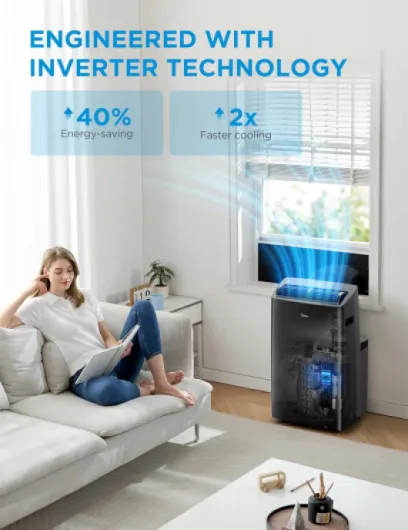
Energy-wise, it’s noticeably easier on the bill than running old central AC all day. I don’t have a lab setup, but comparing power usage on my panel and monthly bills, it’s clearly under what my central unit would pull for the same comfort level in one room. Others have reported similar – around 40% savings compared to standard portables or old central systems when used smartly (start early in the day, keep doors closed, use fans to help). If you expect it to slam a hot 90°F room down to 65°F in an hour, you’ll be disappointed. If you run it early and let it maintain, it works much better.
What you actually get out of the box
Out of the box, you get the main unit (about 75 lbs), the big dual hose, a telescoping window kit, a remote, and some foam and small bits. Nothing fancy, but it’s all there. Unboxing is easy because the box lifts off the top, so you don’t have to deadlift the AC out of a deep carton. You do have to tilt or lift it a bit to get the bottom cardboard out, which isn’t fun if you’re alone, but it’s manageable if you’re reasonably fit.
The hose is one of the first things you notice. It’s thick, wide, and not very flexible. Compared to the skinny, flimsy hoses on cheaper units, this feels more serious, but it also means you can’t snake it around tight corners. Once it’s attached and in the window, you quickly realize the unit doesn’t like being twisted or moved too far from that angle. This is not the kind of portable AC you casually drag from room to room every day.
The window kit is where the product feels a bit cheap. The plastic rails and clips can break if you’re rough or reinstall it a lot. Several users mentioned broken clips and high replacement costs from Midea, and I can see why. It works, but you need to treat it gently. If you have odd windows (tilt-out, casement, etc.), expect to DIY something with acrylic or cardboard to make it seal properly. The included kit is mainly designed for standard sliding or sash windows.
Overall, the first impression is: solid main unit, decent hose, mediocre accessories. It’s clear most of the cost went into the internals and the inverter/dual-hose design rather than the window plastic. If you’re handy, that’s fine. If you want a true plug-and-play experience with zero fuss, you might find the install side a bit annoying.
Pros
- Dual-hose and inverter design actually cools a room properly and more efficiently than typical single-hose units
- Noticeably quieter than most portable ACs, realistic to use in a bedroom or TV room
- Smart features (Wi-Fi, app, voice control) and good remote make day-to-day use easier if you want automation
Cons
- Window kit and plastic clips feel flimsy and are expensive to replace
- Heavy and not very flexible to move or re-orient due to the large, stiff hose
- Quality control seems inconsistent, with some reports of rattles or compressor issues and only a 1-year warranty
Conclusion
Editor's rating
The Midea Duo 14,000 BTU is one of the few portable ACs I’ve used that actually feels close to a proper window unit in terms of real cooling. The dual-hose design and inverter compressor aren’t just marketing buzzwords; in practice they mean the room actually gets cool, the temperature stays more stable, and the noise level is much more tolerable than the usual on/off roar you get from cheaper models. In a 350–500 sq ft space, used correctly (doors closed, early start in the day), it gets the job done with less drama and lower bills than running a tired central AC for just one room.
It’s not perfect. The window kit and plastic clips feel fragile, the hose is bulky and limits how you can position the unit, and there are enough reports of rattles and occasional failures that I’d seriously consider an extended warranty. The UI on the unit itself is also weirdly cryptic for no good reason. But if your priority is a quieter, more efficient portable that can genuinely cool a bedroom, office, or small living room, this is one of the better options out there right now.
I’d recommend it to renters dealing with weak or unreliable central AC, people in condos where window units aren’t allowed, and anyone who wants a serious portable for one main room and cares about noise and power use. I’d skip it if you want to cool a huge open floor plan, you move your AC between rooms constantly, or you’re on a tight budget and just need the cheapest thing that blows cold air. In short: solid performer with some quirks, worth it if you play to its strengths.