Summary
Editor's rating
Is the Whynter ARC-14S worth the money?
Big, boxy, and not exactly pretty – but practical enough
Daily comfort: noise, airflow, and living with it all day
Build quality, long-term use, and what might break
Cooling performance: where it actually earns its keep
What you actually get with the Whynter ARC-14S
Pros
- Dual-hose design cools a 400–500 sq ft room more effectively than most single-hose portables
- Straightforward controls and useful modes (cool, dehumidify, fan) with decent airflow
- Build feels sturdy enough and casters roll okay on hard floors for semi-permanent placement
Cons
- Heavy and bulky, not practical to move between rooms every day
- Noticeably loud at medium/high fan speeds, especially for light sleepers
- Window kit and hose connections can be fiddly, especially with non-standard or casement windows

Specifications
View full product page →| Brand | Whynter |
A portable AC that’s actually meant to cool, not just blow lukewarm air
I’ve used a bunch of portable ACs over the years, and most of them are basically loud fans that spit out slightly cooler air and send your power bill through the roof. I picked up the Whynter ARC-14S because of the dual-hose setup and the good reviews, and also because my living room turns into an oven whenever it passes 85°F outside. I’ve been running it on and off through hot, humid days, mostly in a 400–450 sq ft open space plus a hallway.
Right away, this thing doesn’t feel like a toy. It’s big, it’s heavy, and it looks more like a mini fridge on wheels than a sleek gadget. Setup took a bit of tinkering with the window kit and hoses, and I had to improvise a bit for my not-so-standard window, but nothing a basic trip to the hardware store couldn’t fix. If you’re expecting to just plop it down and plug it in with zero effort, that’s not what this is.
Once it was in place and I let it sit upright (to let the compressor oil settle after shipping), I fired it up and it started dropping the room temperature in a way that a lot of single-hose units just don’t manage. It’s not silent, and you definitely know it’s running, but you also feel the air getting cooler instead of just less humid and stuffy. That, for me, is the key difference.
So this isn’t some magical fix for a whole house, and it’s not perfect. It’s loud, it’s bulky, and moving it around is a chore. But if you actually want to cool a decent-sized room without putting a unit in the window or installing central air, it gets the job done a lot better than the cheap portables I’ve tried before.
Is the Whynter ARC-14S worth the money?
Price-wise, the ARC-14S usually sits higher than basic 10,000–12,000 BTU single-hose portables, but it’s not absurd given the size and dual-hose design. The way I look at it: if a cheaper unit can’t actually cool your space, then it’s wasted money. Compared to the random budget portable I had before, this one actually holds a set temperature in a larger room, so even if it costs more upfront, it’s at least delivering what I bought it for.
The energy efficiency isn’t stellar on paper (SEER around 7.7), and it’s not Energy Star rated, so don’t expect miracles on your power bill. Still, because it cools more effectively, I find I don’t need to run it at max all the time. I usually start it early in the day and then let it maintain, which seems to be less punishing than blasting a weaker unit nonstop at full power. If you’re in a moderate climate and only use it for heat waves or a few weeks per year, the power cost is reasonable. In constant 100°F+ climates, any portable is going to cost you.
Compared to window units, this is worse value in pure cooling per dollar, no question. A decent 10,000–12,000 BTU window AC can be cheaper and more efficient. But window units don’t work for everyone: some windows can’t take them, some landlords don’t allow them, and some people just don’t want something hanging out of their window. In those cases, this Whynter is a decent compromise: more expensive and less efficient than a window unit, but way more practical than installing central air or suffering in the heat.
For me, the value is in the combination of real cooling performance + dual-hose design + decent build. It’s not cheap, and it’s not perfect, but compared to fighting with multiple weak units or installing something more permanent, it hits a reasonable middle ground. If you only need to cool a tiny bedroom, this is overkill and not great value. If you’ve got a medium to large room or an open-plan living area and can’t do a window or mini-split, then the price starts to make more sense.
Big, boxy, and not exactly pretty – but practical enough
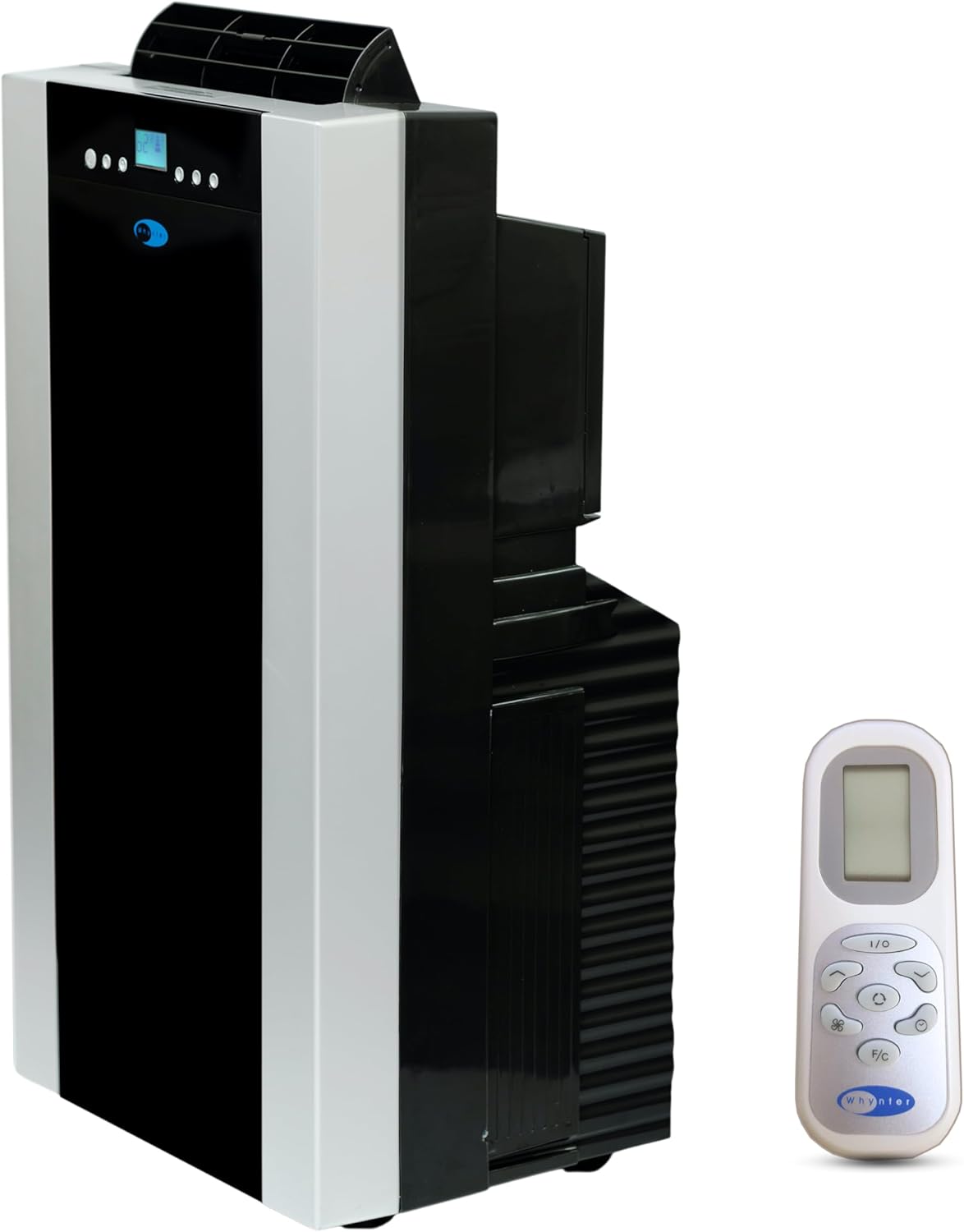
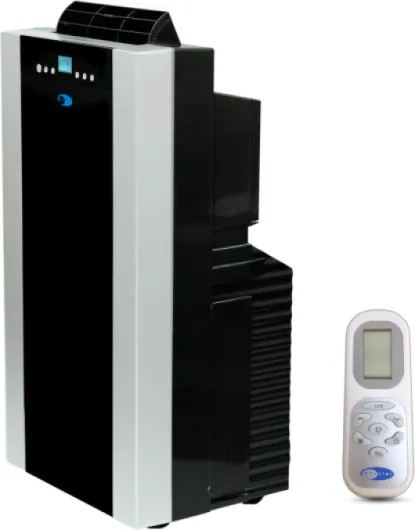
Design-wise, this is not some sleek, discreet tower you hide in a corner. It’s a big plastic box: 19" deep, 16" wide, 35.5" high, and about 73 pounds. The platinum/black color is neutral enough, so it doesn’t scream “cheap white appliance,” but it still stands out in the room. If you’re tight on space, measure before buying because it does eat up floor area, especially once you hook up the two hoses to the window.
The control panel on top is straightforward: power, mode, temperature up/down, fan speed, and a timer. The display is bright enough to read across the room but not super harsh at night. The remote works, but it’s a bit dumb in the sense that it doesn’t sync two-way with the unit. If you change something on the unit, the remote doesn’t update, so if you’re picky about perfect control, that might annoy you. Personally, I ended up just walking over and using the buttons on top most of the time.
The vent design is simple: it blows air out the front-top area, and you can angle the louvers up or down, but not left/right. Some people complain that it blows too much straight up; for me, tilting it slightly down solved that. It’s not a precision airflow system, but once the room is cooled, it doesn’t matter much where the stream goes as long as it’s circulating air.
The casters on the bottom roll fine on hard floors. On carpet, especially thicker carpet, it’s a bit of a struggle because of the weight. You can move it, but I wouldn’t call it convenient. This is technically “portable” in the sense that you can move it around, but in practice, it’s more like “pick a room and leave it there.” Between the hoses, the window kit, and the weight, you’re not going to drag this from bedroom to living room twice a day without getting annoyed pretty fast.
Daily comfort: noise, airflow, and living with it all day
In terms of comfort, I look at two things: how it feels to be in the room and how annoying it is to live with the machine running. On the first point, it does a solid job. The air feels cooler, less sticky, and the room doesn’t have that heavy, stale feeling you get when you’re just running a fan in a hot space. If you pair it with blackout curtains and keep doors mostly closed, you end up with a pretty comfortable bubble, even when the rest of the house is warmer.
The noise is the main comfort trade-off. At low fan, it’s a steady hum you get used to, kind of like a dishwasher in another room. At medium and high, you’ll definitely hear it over normal conversation or TV unless you turn the volume up. Personally, I can still watch TV or work with it on medium, but it’s not something you “forget” is running. If you’re super sensitive to sound, you may not want this in a bedroom right next to your head. In a living room or office, it’s fine, just not discreet.
Another comfort angle is air direction and draft. The airflow is strong enough that if you sit right in front of it, you’ll feel a cold stream. That’s great when you’re overheated, but some people don’t like a direct blast. Since you can only angle the louvers up or down, you may need to place the unit slightly off to the side so it’s not blowing straight at your face. Once the room is cooled, I usually bump the fan speed down and it feels more like a gentle circulation than a cold wind.
In day-to-day use, I ended up running it on a schedule: on in the late morning or early afternoon, off at night unless it’s brutally hot. It also doubles as a dehumidifier, which helps comfort a lot in humid weather. You do need to be aware that in very humid areas, you might have to drain it more often or run a hose to a drain. Where I am, the auto-evaporation handled most days fine, but if you’re in a swampy climate, plan for some water management. Overall, it made the room way more livable even in heat waves, at the cost of some background noise and floor space.

Build quality, long-term use, and what might break
Build-wise, the ARC-14S is mostly hard plastic, but it doesn’t feel flimsy. The casing is solid, the hoses click in reasonably well (though the window-side screws are a bit questionable, as one reviewer noted), and the wheels haven’t given me trouble so far. It’s not premium, but it doesn’t feel like it’s going to fall apart if you bump it into a table. The unit is heavy, which actually helps it feel more stable when you’re moving it around a bit.
On the durability side, experiences are mixed if you look at long-term reviews. Some people have had theirs for several summers without any major issues, others saw problems around year 4–5 with the control panel or compressor behavior. One reviewer mentioned that after nearly five years, their unit started acting up after draining: the compressor would run constantly, freeze up, and modes wouldn’t switch properly. That’s not shocking for a portable AC; these things are basically compact fridges with fans, and they do wear out, especially if they run hard every summer.
The warranty is one year on the unit and three years on the compressor. That’s okay but not generous. If something big fails after year three, you’re on your own. Also, getting parts or service for portable ACs in general can be a pain; that’s not just Whynter, that’s the category. If you’re expecting 15+ years of life like some old-school window units, you’re probably going to be disappointed with any portable, including this one.
To keep it in good shape, you really do need to clean the filters, keep the hoses free of kinks, and make sure the drainage is handled correctly. I also let it sit upright for several hours before first use, like the manual says, just to be safe with the compressor oil. In my case, no leaks, no weird rattles beyond a brief “pinging” sound on first start that went away. Overall, I’d say the durability is decent for a portable AC, but I wouldn’t call it a tank. Expect several good seasons if you treat it reasonably well, but don’t count on it as a 10-year investment.
Cooling performance: where it actually earns its keep
This is the part that matters: does it cool well? In my experience, yes, especially compared to the usual portable units. In a roughly 400–450 sq ft open area with normal insulation and blackout curtains, I can keep the room around 72–75°F when it’s in the high 80s outside. On a nasty humid day, it might creep up a bit, but it’s still comfortable enough to cook and move around without sweating nonstop. When it hit the low 90s outside, the unit ran basically nonstop, but still kept the main area in the mid-70s, which is fine for me.
The cool-down speed is decent. If I start it in the morning before the heat builds up, it maintains the temp easily. If I wait until the room is already a sauna, it takes longer, obviously. That’s not unique to this AC; that’s just how cooling works. In my case, starting it early in the day was the key to not overworking it. A few users claim they cooled 1,000+ sq ft somewhat, but that’s more like “it takes the edge off” rather than properly cooling that much space; I wouldn’t rely on it for more than ~500 sq ft as primary cooling.
The dual-hose setup really does help. My older single-hose portable always made the rest of the house feel hotter because it was sucking air from other rooms and blowing it out the window. With this one, that effect is way less noticeable. The room with the unit feels like an actual cooled zone instead of a weird pressure vacuum. The downside is you have more plastic and hoses hanging out of your window, and you need a better seal, but performance-wise, it’s worth it.
Noise-wise, at low fan speed it’s bearable for a bedroom if you’re okay with some constant background hum. At high fan, it’s loud, no point sugarcoating it. You probably won’t want this right next to your TV or your bed if you’re a light sleeper. But for a living room or office, I’d call it normal AC loud, not jet-engine loud. For me, the trade-off is fine: I’d rather have noise and real cooling than a quiet unit that barely drops the temp. Power draw sits around 1300W, which is typical for this size. You’ll see it on your electric bill if you run it all day, but that’s the reality of any 14,000 BTU-class AC.

What you actually get with the Whynter ARC-14S
On paper, the Whynter ARC-14S is a 14,000 BTU portable AC (9,500 BTU SACC) rated for up to about 500 sq ft. In real life, I’d say that’s roughly accurate if your room isn’t a sunroom made of glass and you’re not trying to cool an entire floor with one unit. My setup is a living room + kitchen + small hallway, around 400–450 sq ft, and it holds the temp in the low 70s even when it’s in the upper 80s outside, and stays decent into the low 90s.
Out of the box, you get the main unit, two hoses, the window kit, a remote, filters (pre-filter and carbon filter), and a storage bag. The hoses extend to about 60 inches, and the window kit is made for standard vertical or horizontal windows. If you have casement or weird windows, expect to do some DIY with plexiglass or board like other users mentioned. I had to add some foam and tape to seal gaps around the panel so hot air wasn’t leaking back in.
The unit has three modes: cool, dehumidify, and fan, with three fan speeds. The thermostat goes from 61°F to 89°F. I mostly leave it on cool at around 72–74°F. Dehumidify mode pulls a lot of moisture, but in my climate (moderate humidity) the auto-drain has been enough most of the time. Only on really sticky days did I have to think about drainage at all. Airflow is decent at 253 CFM, so it pushes a good amount of air out the top vent.
In practice, the big selling point is the dual-hose design. One hose pulls in outside air, the other exhausts hot air, so it doesn’t suck your cooled air out of the room like single-hose units do. You can actually feel the difference: the rest of the house doesn’t get as warm from negative pressure, and the room with the unit cools faster and stays more stable. It’s not magic, but compared to the single-hose portable I had before, this is clearly better at real cooling, not just making noise.
Pros
- Dual-hose design cools a 400–500 sq ft room more effectively than most single-hose portables
- Straightforward controls and useful modes (cool, dehumidify, fan) with decent airflow
- Build feels sturdy enough and casters roll okay on hard floors for semi-permanent placement
Cons
- Heavy and bulky, not practical to move between rooms every day
- Noticeably loud at medium/high fan speeds, especially for light sleepers
- Window kit and hose connections can be fiddly, especially with non-standard or casement windows
Conclusion
Editor's rating
Overall, the Whynter ARC-14S is a solid choice if you actually need a portable AC that cools a decent-sized room, not just a tiny bedroom. The dual-hose system and 14,000 BTU rating translate into real-world performance: it can keep a 400–500 sq ft space comfortable in hot weather, especially if you help it out with curtains and reasonable insulation. It’s not silent, it’s not small, and it’s not the cheapest, but it does the basic job of making a hot room livable, which is more than I can say for a lot of portable units I’ve tried.
On the downside, it’s heavy, noisy at higher fan speeds, and not something you’ll want to move from room to room every day. The window kit is fine for standard windows but can be annoying for casement or odd setups, and you may end up at the hardware store for extra materials. Long-term durability seems decent but not legendary; it should last several seasons if you maintain it, but don’t expect it to behave like a 20-year-old window unit. Power use is typical for this size but not especially efficient, so keep that in mind if you plan to run it nonstop.
If you have one main area you want to cool (living room, studio, big bedroom/office), can commit to a semi-permanent installation in a window, and you’re okay with some fan noise, this unit is worth considering. If you’re super sensitive to sound, want to cool multiple rooms with one device, or can install a window unit or mini-split instead, you might be happier going another route. It’s pretty solid overall, not perfect, but it gets the job done in the situations it’s designed for.