Summary
Editor's rating
Value for money: worth paying more than a budget portable?
Design & setup: bulky, but thought-through for a portable
Comfort & noise: cools well, but you’ll still hear it
Build quality, hoses & long-term feel
Cooling performance & dehumidifying: actually does the heavy lifting
What this Whynter ARC-1230WN actually is (and isn’t)
Pros
- Dual-hose inverter design cools rooms up to ~600 sq ft more evenly and efficiently than typical single-hose units
- Quieter once target temperature is reached, with smooth inverter ramp-down instead of harsh on/off cycles
- Sturdy, more durable hose and a cleaner hose-in-hose setup compared to older dual-hose designs
Cons
- Short hose length and somewhat finicky window connection make placement and sealing a bit tricky
- Heavy (around 77 lbs) and not convenient to carry between floors

Specifications
View full product page →| Brand | Whynter |
Portable AC that actually keeps up with the heat?
I’ve been using the Whynter ARC-1230WN 14,000 BTU portable AC for a bit now in a small open-plan apartment (about 550–600 sq ft) and also tried it in a regular bedroom. I bought it because window units aren’t allowed in my building, and my old single-hose portable unit was basically just a loud fan that made the rest of the apartment hotter. So I wanted to see if all the talk about dual-hose and inverter tech actually changes anything in real life.
To be clear, I’m not here to write poetry about an air conditioner. I just wanted something that cools properly, doesn’t sound like a jet engine at night, and doesn’t kill my power bill more than necessary. The ARC-1230WN is not perfect, but it’s a clear step up from the cheap portable units I’ve had before. It actually feels like a real AC, not a compromise you tolerate because you can’t install a window unit.
What stood out first was how fast it drops the temperature in a closed room, and how the noise level changes when the inverter ramps down. On full blast it’s noticeable, but once the room is close to the set temperature, it calms down a lot. The dual-hose "hose-in-hose" design is also a nice change from the mess of two separate hoses; it’s still bulky, but at least it’s more manageable.
If you’re thinking about this unit, the main things to know are: it cools well, it’s fairly efficient for a portable, setup isn’t hard but the window kit and hose length have some quirks, and it’s heavy. I’ll go through the design, performance, comfort, noise, durability, and whether I think it’s worth the price compared to cheaper portable ACs.
Value for money: worth paying more than a budget portable?
Price-wise, the ARC-1230WN usually sits clearly above the bargain portable ACs you see everywhere. So the real question is whether the extra cost is justified. For me, comparing it to my old cheaper single-hose unit and what I’ve seen in friends’ places, the answer is mostly yes, if you actually care about whole-room cooling and noise more than just having cold air blowing in your face.
What you’re paying for here is a mix of things: dual-hose design, inverter compressor, better hoses, slightly more thought-out design, and Wi‑Fi/app control. The inverter and dual-hose combo are the big ones. They don’t magically make it ultra-cheap to run, but they do make the cooling feel more efficient and stable. If you’re running it daily through the summer, that matters. If you only need occasional spot cooling in a small room, a cheaper unit might be enough and this could feel overkill.
The Wi‑Fi and smart features are a nice bonus but not essential. I like being able to turn it on from my phone before I get home so the place isn’t a sauna when I walk in. The app is basic and sometimes logs you out, but it works. If you don’t care about smart features at all, there are slightly cheaper Whynter models or other brands that drop the Wi‑Fi and save some money.
Overall, in terms of value, I’d call it good but not mind-blowing. You’re paying a premium, but you’re actually getting something for it: better cooling of larger spaces, more comfortable operation, and a design that feels more robust than the $300–$400 options. If your budget is tight, you can survive with a cheaper portable. If you’re tired of those and want something that behaves closer to a real AC, this one makes sense.
Design & setup: bulky, but thought-through for a portable
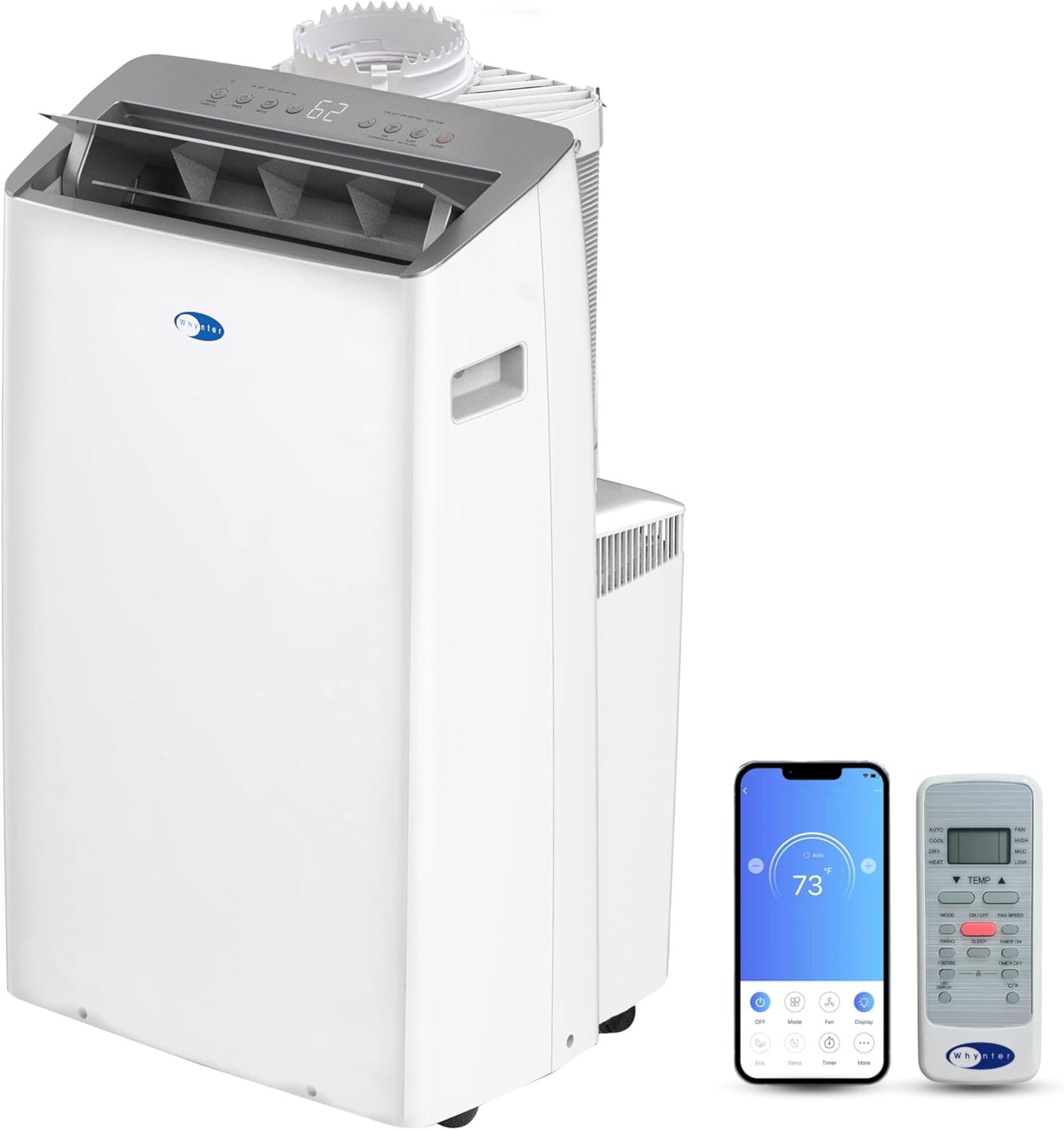
Design-wise, the ARC-1230WN is pretty standard for a larger portable AC: tall, white, and not exactly pretty, but neutral enough that it blends in. It’s about 32.5" tall, 19.5" wide, and 16.75" deep. So it does take up a good chunk of floor space. In my living room, it sits in a corner near the window and you definitely notice it, but it doesn’t scream industrial machine either. If you’re expecting something tiny, this is not it.
The part I actually liked is the hose-in-hose dual setup. Older Whynter models and other brands use two totally separate hoses, which turn into a plastic octopus behind the unit. Here, both intake and exhaust are nested, so you only manage one big hose going to the window plate. It’s still fat and stiff, but less chaotic. The downside: the hose is on the short side. If your window is high or far from where you want the unit, you’ll have to compromise on placement or get creative with the furniture.
Installation is manageable if you’re handy at a basic level. The window kit is adjustable up to 82" and works fine for standard vertical windows. For narrower windows, you might have to cut the plastic panel; I had to trim mine with a small handsaw. It’s plastic, so it’s not difficult, just a bit annoying. Once installed, the hose connection feels decent but not rock solid. If you bump it or pull the unit too far from the window, you can create a gap or unclip it, so you need to be a bit careful.
The controls on top are straightforward: big buttons, clear icons, nothing fancy. The remote is light but much better than the typical cheap remotes I’ve had on older units. The only real pain point in the design for me is the weight. At around 77 lbs, carrying it up stairs alone is not fun. The wheels help on a flat floor, but this is not something you’ll want to drag between floors regularly. Overall, the design is practical, but you have to accept the size and weight.
Comfort & noise: cools well, but you’ll still hear it
From a comfort angle, this unit is pretty solid. In my 14x14 bedroom, it cooled the room from about 80°F down to 72°F in roughly an hour with the door closed, blinds down, and fan on high. After that, once the set temperature was reached, the inverter compressor dialed back and the noise level dropped a lot. That’s where the inverter tech really shows up: instead of constantly cycling on/off at full blast, it ramps down and maintains the temperature more smoothly.
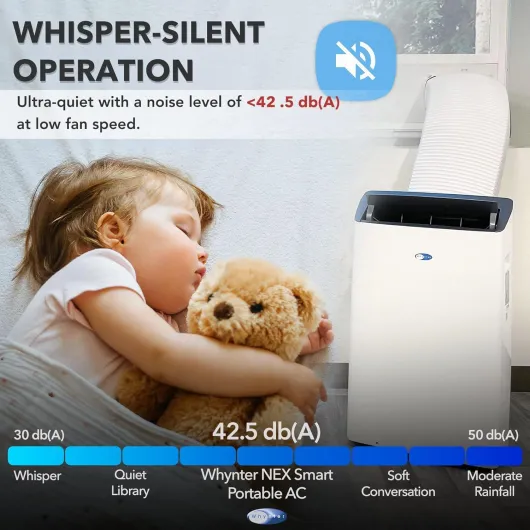
Noise-wise, on full power it’s not quiet, but it’s about what I expect from a serious portable AC. The spec says around 42.5 dB at the low end, and subjectively I’d say: on low it’s a soft background hum similar to a box fan on low; on high it’s more like a strong fan plus compressor hum. I’m a light sleeper, and I can sleep with it on low once the room is cooled. I wouldn’t want it blasting on high right next to my bed all night, but that hasn’t really been necessary so far.
The airflow is strong. On high fan, you can feel the cold air across the room. The vents are front-facing and adjustable up and down, but not side to side. I usually angle it slightly up so it mixes the air instead of blasting my legs. If you sit right in front of it, the air feels slightly less icy than some older non‑inverter units I’ve used, but the room as a whole ends up more comfortable because it runs more steadily and doesn’t overcool and then stop.
In day-to-day comfort, the thing I liked most is the auto mode and the timer. I set it to 74°F, auto fan, and a shutoff timer for the night. It ramps up at the beginning, cools the room, then settles into a quieter mode. Compared to my old single‑hose, the room doesn’t feel stuffy or under-ventilated, and I don’t get that hot draft from under the door as much. It’s not whisper silent, but for the cooling power you get, the noise level is acceptable and predictable.

Build quality, hoses & long-term feel
In terms of build, the ARC-1230WN feels solid but still like a home appliance, not commercial gear. The outer plastic shell doesn’t flex too much when you move it, and the casters roll smoothly on hardwood and tile. It’s heavy at 77.2 lbs, and that weight at least gives the impression of a serious compressor and hardware inside, not just empty plastic. I’ve rolled it around a few times to reposition it and haven’t noticed any wobbling or weird rattles so far.
The hose quality is better than the flimsy stuff I’ve seen on cheaper units. It feels thicker and less likely to tear when you twist it into place. One Amazon reviewer mentioned they liked these hoses compared to cheaper ones that tear, and I agree. That said, the connection to the window panel can be a weak point if you’re rough with it. If you push or pull the unit too far from the window, you can stress the connection and slightly open a gap. Once I realized that, I just stopped moving it more than a few inches after setup, and it’s been fine.
The washable air filter is standard, nothing fancy. It’s easy to pull out, rinse, and put back. Doing that every couple of weeks in heavy use is probably enough for most people. I haven’t had it long enough to talk about multi-year durability, but Whynter gives a 1‑year limited parts warranty and 3 years on the compressor, which is at least some reassurance they expect it to last more than one summer.
Based on my experience and the number of reviews from people who own multiple Whynter units over the years, I’d say durability is above average for portable ACs. It’s not bulletproof, and you still need to treat the hose/window kit with a bit of care, but nothing on it feels cheap or like it’s about to snap. If anything fails, my guess would be more on the app/connection side than the actual cooling hardware.
Cooling performance & dehumidifying: actually does the heavy lifting
Performance is where this unit justifies its price. In my roughly 550–600 sq ft open-plan area (kitchen + living), with outside temps around 85–90°F and decent insulation, it brought the temperature from 79°F down to about 74–75°F in around 90 minutes. That lines up pretty well with what some other users reported. It won’t magically turn a sun-baked 750 sq ft oven into a fridge, but it gets the space to a comfortable level and then holds it there without constantly running at 100%.
The dual-hose setup really helps in these conditions. With my old single-hose 12,000 BTU, I could feel hot air being pulled in from the hallway and under the door, and the room never felt truly cool unless I sat directly in front of the vent. With the Whynter, the room temperature itself drops more evenly. You don’t get that feeling of the AC fighting against the rest of the house as much. The air coming out of the front vent is not the coldest I’ve ever felt from a portable, but the overall cooling of the room is better.
The built‑in dehumidifier is also useful in humid weather. It’s rated for up to 87 pints/day, and while I didn’t measure exact numbers, I can say the room feels much less sticky after an hour or two of running. The auto-drain feature means I haven’t had to manually empty a tank when using it in AC mode; the condensate goes out through the exhaust. If you use straight dehumidify mode without venting hot air, you may need to drain it via the hose/tap depending on your setup, but in normal cooling use it’s been hands-off.
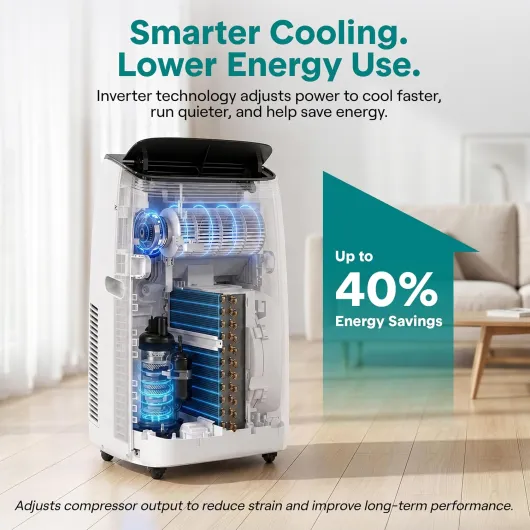
Power draw maxes out around 1293W / 11.9A according to the specs. On my usage, it doesn’t sit at max all the time, thanks to the inverter. The compressor ramps down once the set temperature is close, which you can hear and also see on a power meter if you track it. Compared to a non‑inverter portable I used before, the runtime at full blast is shorter, and the unit spends more time cruising at lower power. So in terms of performance vs. energy use, it’s pretty efficient for a portable, though still not as efficient as a well‑sized split system, obviously.
What this Whynter ARC-1230WN actually is (and isn’t)
On paper, the Whynter ARC-1230WN is a 14,000 BTU (12,000 BTU SACC) dual-hose portable AC with inverter technology, Wi‑Fi, and a built‑in dehumidifier, rated for up to 600 sq ft. In practice, I’d say that’s mostly accurate, as long as your expectations are realistic. It’s strong enough for a big bedroom or a medium living room, and it can handle a small open-plan space if you’re not dealing with direct sun all day and you keep doors closed as much as possible.
You get three main modes: cool, dehumidify, and fan (with 3 fan speeds). There’s a thermostat setting from 60°F to 86°F, plus a 24‑hour timer, sleep mode, and auto‑restart after power cuts. The unit also has smart control through the NetHome Plus app and works with Alexa and Google Home. The app is basic but does what it needs to: turn it on/off, change mode, change temperature, and fan speed from your phone.
A key detail is the dual-hose inverter part. Most cheap portable ACs are single-hose and basically suck air from your room, blow hot air out the window, and pull hot air back in from under doors and cracks. This one uses separate intake and exhaust (inside a single combined hose) so it doesn’t create that negative pressure effect as much. You actually feel the room getting cooler instead of fighting against the rest of the house.
What it’s not: it’s not a silent little cube you tuck in a corner and forget. It’s a 77 lb appliance that takes space, needs a proper window setup, and will make noise when it’s working hard. If you go in expecting a portable unit that behaves closer to a window AC in terms of cooling, but with some compromises on bulk and sound, that’s closer to reality.
Pros
- Dual-hose inverter design cools rooms up to ~600 sq ft more evenly and efficiently than typical single-hose units
- Quieter once target temperature is reached, with smooth inverter ramp-down instead of harsh on/off cycles
- Sturdy, more durable hose and a cleaner hose-in-hose setup compared to older dual-hose designs
Cons
- Short hose length and somewhat finicky window connection make placement and sealing a bit tricky
- Heavy (around 77 lbs) and not convenient to carry between floors
Conclusion
Editor's rating
The Whynter ARC-1230WN is a solid choice if you’re serious about cooling a medium to large room and you’re stuck with portable units. The dual-hose inverter setup actually makes a difference in real life: rooms cool faster, stay cooler, and the unit doesn’t blast at full power all the time. Noise is reasonable for the power level, especially once the inverter ramps down, and in a bedroom or office it’s manageable as long as you don’t expect silence on max.
It’s not perfect. The hose is a bit short, the window kit needs some tinkering if your windows are awkward, and the unit is heavy to move up stairs. The air coming out might feel a bit less icy than some older non‑inverter models, but the overall room comfort ends up better. The app and Wi‑Fi are useful but not life-changing, more of a convenience layer on top of a basically solid machine.
If you have a 400–600 sq ft space, decent insulation, and want something that actually cools the whole room instead of just blasting one corner, this is a good fit. It’s also a good option if you run AC a lot and want something more efficient than the usual portable bricks. If you only need occasional spot cooling in a small room or you’re on a tight budget, a cheaper single-hose unit will still do the job, just less comfortably and less efficiently. Overall, I’d rate it as a strong, practical purchase for people who are done gambling on the cheapest portable ACs.