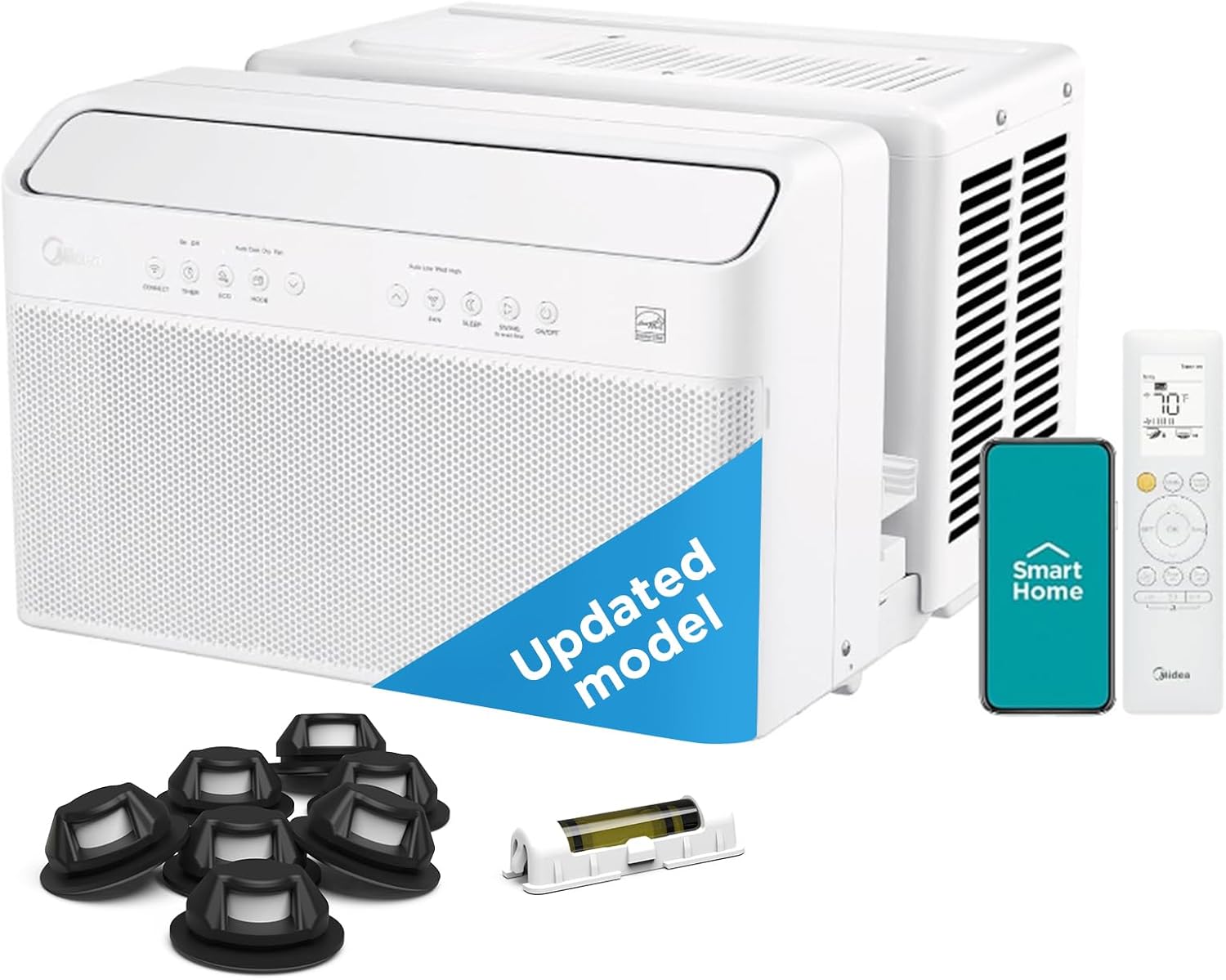
Summary
Editor's rating
Is it worth the money compared to a basic window AC?
U-shaped design: cool idea that mostly works
Day-to-day comfort: sleeping, working, and living with it
Build quality and what feels solid (and what doesn’t)
Cooling, noise, and smart features in real life
What you actually get out of the box
Pros
- Much quieter than typical 8,000 BTU window units thanks to U-shape and inverter
- Energy-efficient (Energy Star, inverter) with noticeable reduction in power use
- Keeps part of the window usable and allows limited fresh-air opening
- Smart controls (app + Alexa/Google) with scheduling and remote access
Cons
- Heavier and more complex to install than a basic window AC; easier with two people
- Smart app can be a bit laggy and occasionally forgets preferences after updates
- Only works with standard single-hung or double-hung windows; not ideal for unusual frames

Specifications
View full product page →| Brand | Midea |
| Manufacturer | Midea |
| Part Number | MAW08V1QWT |
| Item Weight | 55.6 pounds |
| Product Dimensions | 19.17 x 21.97 x 13.46 inches |
| Item model number | MAW08V1QWT |
| Color | White |
| Style | 8,000 BTU (Updated) |
A window AC that doesn’t sound like a lawnmower
I’ve been using this Midea 8,000 BTU U-shaped smart inverter window AC for a few weeks in a small apartment bedroom plus office area, roughly 300–320 sq ft. I bought it mainly because I was sick of the usual window units that drown out the TV and turn the room into a dark cave. On paper, this one promised quiet operation, lower power use, and the ability to still open the window a bit. I was curious how much of that was just marketing talk.
In practice, the first thing that stood out is the noise level. Compared to my old 6,000 BTU standard window AC, this thing is noticeably quieter, especially on low and medium fan. I can take video calls and sleep with it running without having to crank up the volume on anything. It’s not dead silent, but for a window unit, it’s pretty solid. You mostly hear air movement, not the compressor constantly kicking on and off.
The second big point is the cooling performance. In my space (top floor, average insulation, east-facing windows), it handles normal summer days fine. It cools from around 80°F down to 72–73°F in maybe 15–20 minutes, then just kind of maintains that. It’s not instant, but it feels smoother than the cheap on/off units. The inverter compressor helps avoid those big temperature swings where you’re freezing one minute and warm the next.
It’s not perfect though. Installation is more involved than the old-school box units, especially because it’s heavier and has that bracket system. Also, the smart app is useful but a bit clunky at times. Overall, after a few weeks, I’d say it does what it says: quiet, efficient cooling with the bonus of not blocking your entire window, but you do need to be ready to deal with a slightly more complex setup and some app quirks.
Is it worth the money compared to a basic window AC?
On value for money, this Midea U-shaped 8,000 BTU isn’t the cheapest option out there. You can easily find a regular 8k BTU window AC for less. So the question is basically: are the quieter operation, better efficiency, and smart features worth paying extra? In my case, I’d say yes, but it depends what you care about. If you just want raw cooling on a tight budget and don’t care about noise or looks, a cheaper traditional unit will still get the job done.
Where this unit earns its price is in a few areas:
- Noise reduction – noticeably quieter than basic models
- Energy savings – inverter + Energy Star, so lower running costs if used a lot
- Smart control – remote app control, scheduling, and voice assistant support
- Window usability – you don’t lose your whole window and can still get fresh air
On the downside, installation is more of a project. If you’re in a rental with weird windows or you move often, this isn’t as plug-and-play as a basic unit you can just drop in and out. Also, if you never use smart features and always just hit the power button, you’re paying for stuff you won’t really use. The app is decent but not perfect, so don’t buy it only for the smart home side.
Overall, I’d call the value good but not mind-blowing. You’re paying a bit of a premium for quieter, smarter, and more efficient cooling that feels nicer to live with. For someone who works from home, is sensitive to noise, or runs AC a lot and cares about the bill, it’s worth the extra cost. For someone who just wants cheap cold air a few days a year, there are more basic options that will be easier on the wallet.
U-shaped design: cool idea that mostly works
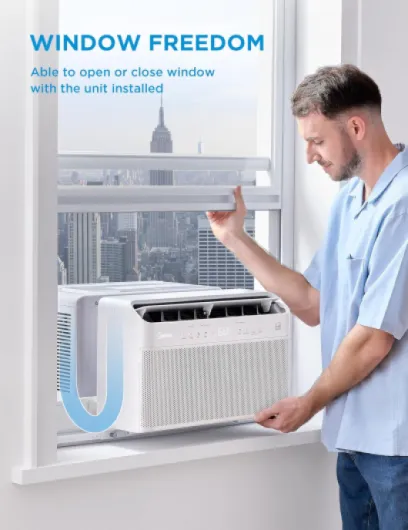
The U-shaped design is the whole point of this thing, and it does change how it feels to live with it. Instead of blocking the entire window with a big white box, the unit sits low and the window sash slides down into the middle cutout. That means you keep a decent chunk of glass above it, so the room doesn’t feel like a bunker. In my case, I still get a good amount of daylight and I can slide the window up a bit if I want some fresh air when the AC is off.
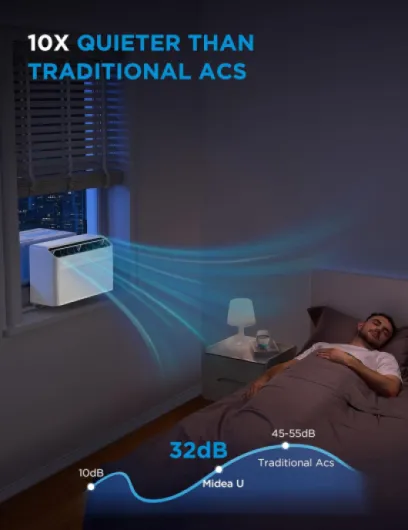
From a practical standpoint, the design also helps with noise isolation. By lowering the compressor outside and letting the window glass act as a barrier, most of the mechanical noise stays outside. Inside, you mainly hear the fan. On low speed, it’s more like a gentle airflow sound rather than the usual rattly hum. On high, you hear it for sure, but it’s still less annoying than the older box-style units I’ve had. If you’re picky about noise for sleeping or working, this design actually makes a difference.
There are some trade-offs. Because of the shape, it’s not as flexible for weird windows. It’s meant for single-hung or double-hung windows only, and you need at least about 13.75" of height. If your sill isn’t level or you’ve got old, warped frames, you’ll spend extra time shimming and adjusting the bracket so the unit sits properly and drains. Also, once it’s in, it’s not something you’re going to yank out and move around easily. This is more of a “leave it in for the season” type unit.
Visually, it’s just a white plastic box with a modern front grille. Nothing fancy, but it looks more modern than the usual louvered front panels. The top controls are clean and basic, and the display is readable without being blinding at night. Overall, the design idea is actually useful in daily life, not just a gimmick, but you need a compatible window and a bit of patience to set it up right.
Day-to-day comfort: sleeping, working, and living with it
From a comfort perspective, this unit is a clear step up from the basic window ACs I’ve used before. First, the airflow is more even. Instead of blasting a freezing jet of air in one direction, the fan output feels more spread out. I’ve got it installed in a bedroom/office, and it doesn’t create that “icebox corner” near the unit while the rest of the room is still warm. I can sit at my desk about 8–10 feet away and feel a steady, comfortable breeze rather than sharp cold bursts.
For sleep, this is where the quiet operation pays off. On low fan with Eco or a moderate temperature setting, it fades into the background. There’s no aggressive compressor kick that wakes you up at 2 a.m. like many older units. The sound is more of a soft whoosh. The display brightness is manageable too; it’s not like a flashlight in your face. If you’re sensitive to noise when sleeping, this design makes it easier to leave the AC running all night without feeling like you’re in a server room.
The ability to keep part of the window usable also helps with comfort in a different way. On milder days or evenings, I sometimes just shut the AC off and crack the window open a bit for fresh air. With traditional units, that’s either impossible or really awkward. Here, it’s as simple as sliding the sash up a bit, and the U-shape leaves room for air to come through. It sounds minor, but over a full season it makes the room feel less closed-in and stuffy.
There are a couple of comfort downsides. The unit is still a chunk of plastic and metal sitting in your window, so if you hate the look of window ACs, this doesn’t magically solve that. Also, depending on how well you install the foam around the sides, you might still get a small draft or some outside noise leaking in. You need to take your time sealing it properly. But overall, for daily living—working, sleeping, hanging out—it’s much more comfortable than the older, louder models I’ve had.
Build quality and what feels solid (and what doesn’t)
In terms of materials and build, most of the exterior is plastic, which is normal for window ACs. The plastic doesn’t feel fancy, but it also doesn’t feel super flimsy. The front grille has a bit of flex if you push on it, but nothing alarming. The metal bracket is the piece that really matters for safety, and that part feels strong and well-finished. Once it’s screwed in and the sidearms are locked, the unit doesn’t wobble or feel sketchy in the window, which was one of my main concerns with a heavier U-shaped design.
The sliding mechanism into the bracket is pretty well thought out. After first install, I tried sliding it out a bit (with support) just to see how it behaves, and it sits firmly in the rails. The anti-theft aspect is more about the window being locked down over the unit than any fancy hardware, but that’s fine. For long-term durability, the thing to watch will be the plastic clips and side panels. Like with most window ACs, if you’re rough with them or remove/reinstall every season, they can wear or crack over time.
On the internal side, you’ve got a standard washable dust filter that slides out. The filter frame is basic but holds up to rinsing. The fan and louvers haven’t rattled or made weird noises yet, which is a good sign. Drainage seems fine too; after a few humid days, I didn’t see water pooling inside, and there were no leaks inside the room. As long as the unit is slightly tilted out as instructed, it should handle condensation normally.
Long-term durability is always hard to judge after just a few weeks, but compared to cheaper box units I’ve used, this feels more solidly engineered, especially the bracket and the main chassis. It’s still mostly plastic, so don’t expect some tank-like build, but for the price range, the construction is pretty solid. The two-year limited warranty is standard; not super generous, but at least it’s not just one year. If you install it carefully and don’t abuse the moving parts, I don’t see any obvious weak point that screams “this will break in a month”.
Cooling, noise, and smart features in real life
In terms of cooling performance, for an 8,000 BTU unit, it holds its own. I’m using it in around 300–320 sq ft with average insulation. On a 85–90°F day, starting from about 80°F inside, it brings the room down to around 72–73°F in roughly 15–20 minutes on high. After that, thanks to the inverter, it doesn’t just slam on and off; it ramps down and keeps the temperature steady. That makes the room feel more comfortable because you don’t get that constant cycle of “too cold / too warm”.
The noise is where it really stands out compared to the old-school units I’ve owned. Midea claims as low as 32 dB; I didn’t measure it with a meter, but subjectively, on low fan it’s about like a quiet fan or a fridge running in the background. I can sleep with it on low with no problem, and I don’t need to blast the TV. On medium and high, you hear the air movement, but the mechanical clunking is way less than traditional units. The U-shaped layout plus the inverter compressor really help here.
For smart control, the Wi-Fi and app are handy but not perfect. I set it up on 2.4 GHz Wi-Fi, and the SmartHome app recognized it quickly. From the app, I can:
- Turn it on/off remotely
- Set temperature and modes (Cool, Eco, Fan)
- Adjust fan speed
- Set schedules and timers
On the energy side, the inverter and Energy Star rating do help. Compared to my previous non-inverter 8k BTU unit, my power usage over a hot week dropped a bit (roughly 20–30% based on my smart plug readings). Obviously that depends on your usage, but it’s not just marketing fluff; you can see some savings if you run it a lot. Overall, performance is solid: it cools well for its size, it’s genuinely quieter than the usual suspects, and the smart features are useful even if the app isn’t perfect.
What you actually get out of the box
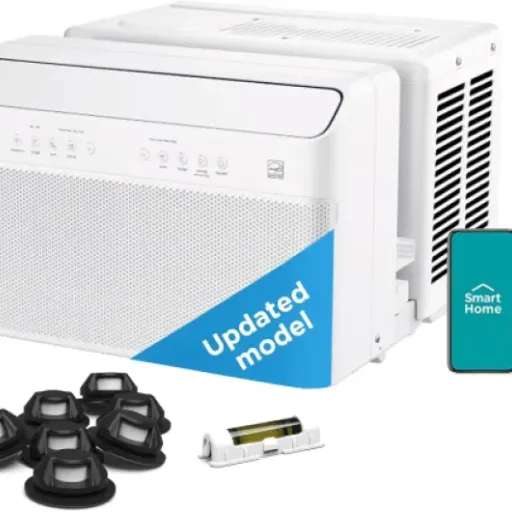
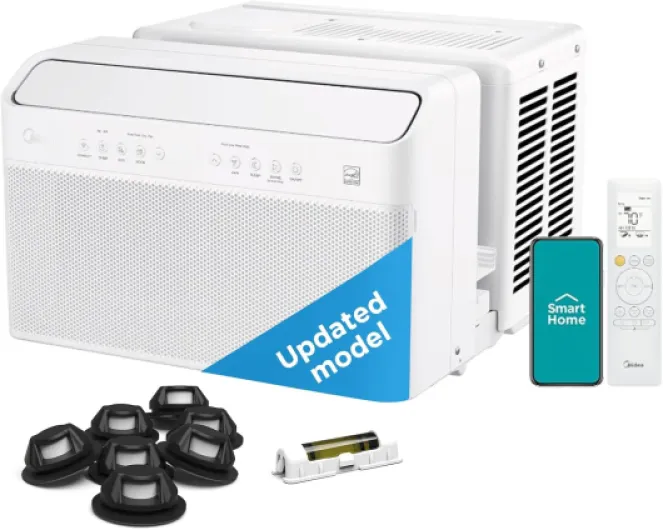
Out of the box, the Midea 8,000 BTU U-shaped AC comes with the main unit, a metal quick-snap window bracket, side panels, some foam insulation, screws, and a small remote with batteries. So you don’t need to buy extra rails or brackets for a normal single-hung or double-hung window between 22" and 36" wide. Everything you need for a standard install is there, which is nice. The manual is decent: not fancy, but the diagrams are clear enough that you can follow the steps without guessing too much.
The unit itself is about 55 lbs, so it’s not light. The U-shape is basically a big cutout in the middle where your window sash slides down. The compressor and noisy parts stay outside, while the fan and controls are on the inside. It’s rated for up to 350 sq ft, 115V, 710W, with a SEER of about 15 and an Energy Star label. So on paper it’s more efficient than a lot of basic 8,000 BTU window units that just hammer on and off at full blast.
Setup is a bit more involved than just “lift and drop” like old units. You first mount the bracket on the sill, adjust it, and lock it in. Then you slide the AC onto that bracket and secure the sidearms and foam. I did it alone but honestly, a second person would make it safer. The bracket does feel sturdy once it’s tightened down. The anti-theft lock feature is basically the fact that the window is locked down over the unit, so it’s harder to just lift it out from outside.
Overall, the presentation is practical: not fancy, but clearly designed by someone who actually thought about noise and energy use. The box doesn’t hide the fact that it’s heavier and a bit more complex than a basic unit, and after installing it, I’d say that’s accurate. You’re trading a simple drop-in install for a more secure, quieter, and more efficient setup.
Pros
- Much quieter than typical 8,000 BTU window units thanks to U-shape and inverter
- Energy-efficient (Energy Star, inverter) with noticeable reduction in power use
- Keeps part of the window usable and allows limited fresh-air opening
- Smart controls (app + Alexa/Google) with scheduling and remote access
Cons
- Heavier and more complex to install than a basic window AC; easier with two people
- Smart app can be a bit laggy and occasionally forgets preferences after updates
- Only works with standard single-hung or double-hung windows; not ideal for unusual frames
Conclusion
Editor's rating
Overall, the Midea 8,000 BTU U-Shaped Smart Inverter window AC is a solid option if you care about noise, energy use, and not blocking your whole window. It cools a 300–350 sq ft room reliably, doesn’t cycle on and off like a maniac, and is clearly quieter than the standard window units I’ve used in the past. The U-shape and bracket system feel thought-through, even if installation takes more effort and ideally a second pair of hands.
The smart features are useful but not perfect: the app works, voice control works, but you’ll run into the occasional lag or minor glitch. Still, being able to turn it on before you get home or adjust settings from bed is genuinely handy. In terms of build, it’s mostly plastic but feels decently sturdy, with a strong bracket and no obvious cheap corners cut. If you run AC a lot, the inverter and Energy Star rating can shave some money off your power bill over time.
I’d recommend this to people who: work from home, are sensitive to noise, live in a small to medium room, and plan to use the AC regularly through summer. It’s also good if you hate feeling like your room turned into a cave because the window is fully blocked. On the other hand, if you’re on a very tight budget, move often, or have non-standard windows, a simpler, cheaper window unit might make more sense. This one is more of a long-term comfort and efficiency play than a quick, cheap fix.
![10000 BTU Window Air Conditioners [2023] Remote Control WiFi App Ultra-Quiet Washable Filter Cools 450Sq.Ft for Medium & Large Room AC Unit air conditioner Easy Install White LW1017ERSM1 10000 BTU Wi-Fi Bright White](https://www.portable-air-conditioner-guru.com/storage/656419/conversions/616cF6zSYmL._AC_SL1500_-medium.webp)