Summary
Analysis score
Average of the criteria rated below
Value: lots of cooling per dollar if you’re in the right climate
Design: compact, wheeled, and all about airflow
Materials and build: light ABS shell with a few weak points
Durability and reliability: overall solid with minor weak spots
Performance: airflow, noise, and water usage in real life
What the Hessaire MC18M actually offers
Cooling effectiveness: strong in dry climates, limited elsewhere
Pros
- Strong 1,300 CFM airflow with effective cooling reported in hot, dry climates
- Lightweight (16 lb) ABS construction with wheels and handle for easy mobility
- Can run on hose feed with float valve for continuous use without refilling
Cons
- Small 4.8-gallon tank needs refilling roughly every 3–4 hours in cooling mode
- Fan noise is noticeable and may be too loud for quiet indoor environments
- Very basic controls (no remote, timer, or digital thermostat) and some small plastic parts feel flimsy

Specifications
View full product page →| Brand | Hessaire |
A swamp cooler that actually seems to cool
The Hessaire MC18M is a compact evaporative cooler that shows up a lot in discussions about surviving heat waves without blowing up the power bill. On paper, it pushes 1,300 CFM, claims coverage up to 500 sq. ft., and runs at a listed noise level of 53.4 dB. It is not an air conditioner: it uses water evaporation to lower the air temperature, so it’s much more dependent on climate and ventilation than a traditional AC. The big question is whether this fairly small, 16‑pound unit really delivers useful cooling or just a damp breeze.
Looking through the public reviews, a pattern stands out: buyers in dry areas like Southern California, Utah, and the desert Southwest are largely satisfied, often saying it cools better than they expected for the size and price. Several people bought it as a stopgap when their central AC failed or when working in outdoor or semi‑outdoor spaces, and they report that it made those situations more bearable. That lines up with what you’d expect from evaporative cooling in low humidity.
There are downsides too. The 4.8‑gallon tank and ~1.2 gallons per hour consumption mean frequent refills if you don’t use the hose hookup. A few owners call this out as the main annoyance: around 3–4 hours per tank in real‑world use. Noise is another recurring topic; many users describe it as a strong, somewhat loud fan, especially on high. For outdoor work or garages that seems acceptable to most, but several comments say it might be too loud for quiet indoor living rooms.
Overall, the MC18M looks like a straightforward, no‑frills swamp cooler that trades fancy features for raw airflow and relatively low power draw. In my opinion, the combination of 1,300 CFM, decent build materials, and a long track record on the market makes it a serious candidate if you live in a hot, dry climate and understand what evaporative cooling can and cannot do.
Value: lots of cooling per dollar if you’re in the right climate
On the value front, the Hessaire MC18M positions itself as a high‑airflow, low‑power alternative to portable air conditioners and smaller “personal” swamp coolers. The exact price isn’t listed here, but given its sales rank (#8 in Mini Evaporative Coolers) and long run on the market, it clearly competes in the midrange rather than the bargain‑basement category. For that, you’re getting 1,300 CFM, 500 sq. ft. claimed coverage, and a unit that draws a fraction of the electricity of a compressor‑based AC.
Several reviewers directly compare it to cheaper or more “feature‑rich” evaporative coolers. One owner who went through multiple Breezewell units that failed quickly concludes that the Hessaire is stronger, blows colder air, and feels more reliable, and they sound happy to have paid for the upgrade. Another user who uses it as a central‑AC assist during a severe heat wave notes that it was able to bring a large room’s temperature down into a livable range when the existing AC couldn’t keep up, which is a strong argument that you’re getting real functional value, not just specs on paper.
The trade‑offs that hurt perceived value are mainly missing conveniences: no remote, no digital controls, no built‑in timer, and a relatively small tank that needs refilling every few hours unless you use a hose. Some buyers would gladly pay a bit more for a bigger reservoir or smarter controls to reduce the daily hassle. On the other hand, the simplicity likely helps keep the price and failure points down, and many owners seem fine with the basic knob‑only interface.
In my opinion, value is strong if you meet two conditions: you live in a hot, dry climate and you accept that this is not a traditional AC. Under those conditions, the MC18M offers a lot of cooling power, reasonable build quality, and low running costs for what you pay. In humid regions or for users who demand quiet operation and zero maintenance, the value drops quickly. So it’s a good deal for the right user profile, and just average or even poor if you try to force it into a role it’s not designed for.
Design: compact, wheeled, and all about airflow
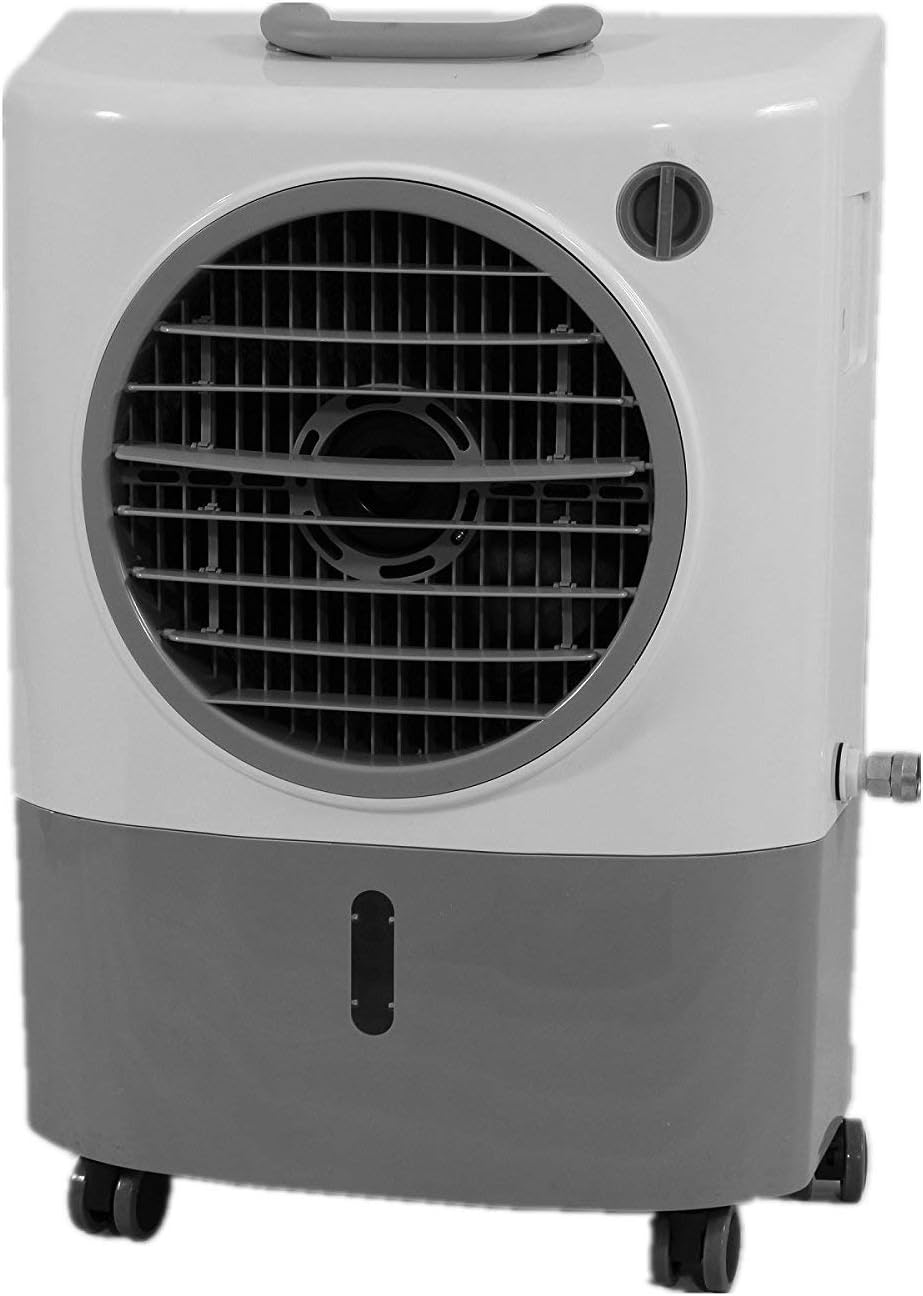
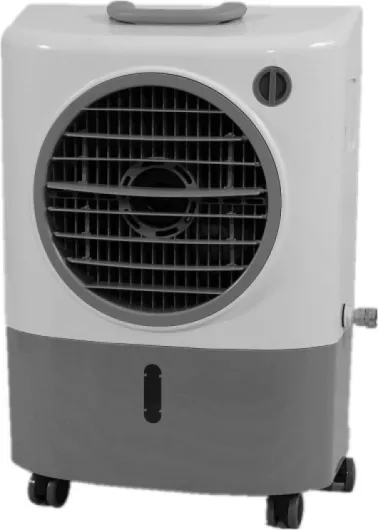
The design of the Hessaire MC18M is clearly function‑first. It’s a freestanding tower‑style unit with integrated caster wheels and a single top handle. At 16 pounds, it is relatively light for something pushing 1,300 CFM, which makes it easier to move between a patio, garage, and different rooms. Several buyers highlight that the wheels roll smoothly on concrete, which matters if you’re dragging it across a shop floor or outdoor booth all day.
Airflow is driven by a patented axial propeller, which Hessaire claims throws air farther than typical blower designs. You can see the effect described in reviews: users say the fan is strong enough that they often only use the low setting, and some mention that on high the airflow can feel intense if you’re very close. That matches what you’d expect from 1,300 CFM in a small frame. There’s a simple front grille for air output and a single cooling pad on the intake side, which the brand argues improves efficiency and reduces complexity compared with multi‑pad setups.
The controls are as minimal as it gets: a single rotary knob on the top front of the unit. No digital display, no remote control, no timer. For some people this is a plus—less to break, very intuitive to operate. Others who are used to modern AC units with remotes and programmable timers might find it a bit barebones. The water level window on the front or side (depending on production batch) gets praise in comments because it lets you quickly check if you’re about to run dry, which is handy when the tank only lasts a few hours with the pump running.
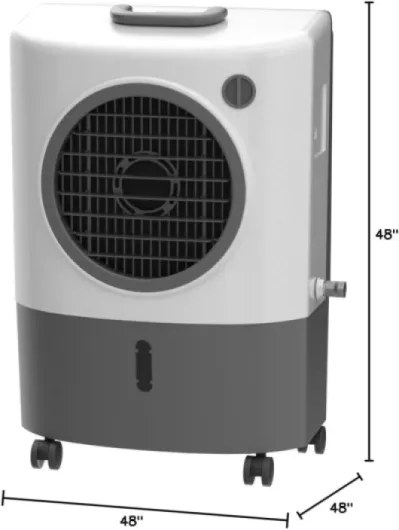
From a footprint perspective, the official product dimensions given (48"D x 48"W x 48"H) look off for this model and almost certainly reflect a placeholder or packaging figure, since buyers describe a much more compact unit. In practice, photos and comments indicate something more like a small to mid‑sized cooler that fits easily in a corner or under a workbench. In my opinion, the overall design is utilitarian but sensible: it prioritizes airflow direction, mobility, and ease of use over sleek aesthetics or advanced controls. If you care more about looks than function, this probably won’t impress you, but for a workshop, patio, or garage, the design choices line up with the intended use.
Materials and build: light ABS shell with a few weak points
The MC18M uses ABS resin / polypropylene plastic for its body, which is a common choice for this type of cooler. ABS is light, relatively tough, and less brittle than some cheaper plastics. Hessaire explicitly mentions that the molded resin construction is meant to be lighter and less fragile than traditional coolers. At 16 pounds for a 1,300 CFM unit, the weight figure supports that: you’re getting a fairly robust shell without a lot of metal, which keeps it corrosion‑resistant and easy to move, especially in outdoor or semi‑outdoor environments.
The internal cooling media is Hessaire’s high‑density XeL50 pad. The marketing claim is that this pad offers expanded air intake area and better efficiency. While we don’t have lab numbers here, many buyers comment that the unit actually blows noticeably cool air when the pump is on, which suggests the pad is doing its job in dry climates. Long‑term pad durability is not heavily discussed in the comments provided, but in general these pads are consumables: they usually last a few seasons depending on water quality and maintenance.
On the downside, some small components appear less robust. One verified buyer mentions that the latch on the manual fill door, described as a tiny piece of plastic, broke after just a couple of days. That’s an isolated report in the sample, but it’s a good reminder that while the main shell may be sturdy, minor parts like doors, clips, and knobs can be more vulnerable. The trade‑off for light weight and cost is that you’re not getting thick metal hardware everywhere.
Overall, the material choices make sense for a residential evaporative cooler meant for patios, garages, and indoor assistance during heat waves. The ABS body should handle bumps and moisture better than thin sheet metal, and the plastic construction avoids rust. In my opinion, the cooler looks well thought out at a structural level but with a few cost‑cut corners on small plastic accessories. If you’re gentle with the fill door and handle, and you don’t expect industrial‑grade hardware at this price level, the materials are decent and aligned with its 4.1/5 average rating from over 10,000 reviews.
Durability and reliability: overall solid with minor weak spots
The Hessaire MC18M has been on the market since 2018 and carries a 1‑year parts warranty from the manufacturer. That longer market presence, combined with over 10,000 reviews and a 4.1/5 average rating, suggests the basic design is fairly proven. Several buyers explicitly say they waited until the end of summer to comment and report that the unit held up well over months of frequent use during heat waves or full seasons in outdoor work settings.
The core components—ABS body, axial fan, water pump, and float valve—do not attract a lot of negative attention in the comments provided. One user working in a large outdoor booth in Southern California highlights that the unit showed no leaks and that the wheels and drain plug functioned reliably. Another buyer who compares it to multiple Breezewell units (two of which failed within days) is relieved that the Hessaire keeps running and calls it “a unit that really works,” implying better reliability than what they experienced with the alternatives.
The weak spots seem to be small plastic parts and the general reality that evaporative coolers need maintenance. There is a specific report of the manual fill door latch breaking quickly, which hints at cost‑cut hardware on non‑critical parts. Pads will eventually need replacement, and mineral buildup from hard water can affect both the pad and pump if you don’t periodically clean the system or use water treatment. Hessaire itself advises running the fan for 30 minutes to dry the media before storing, which is a simple step that should help prevent mold and extend pad life.
In my opinion, durability here is “good for the price but not bulletproof.” The core design seems reliable enough for seasonal use, and the large number of satisfied long‑term owners backs that up. Just don’t treat it like an industrial unit: handle the fill door and handle with some care, expect to replace the pad every so often, and follow basic maintenance instructions. If you do that, the odds of getting multiple seasons out of it look decent.
Performance: airflow, noise, and water usage in real life
On the performance side, three numbers matter most for the Hessaire MC18M: 1,300 CFM airflow, 53.4 dB noise level, and 1.2 gallons per hour water consumption. The 1,300 CFM rating is high for a unit this compact and is reflected in reviews describing a very strong fan. Multiple owners say they primarily use the low setting because the airflow on high is intense. This high throughput helps the unit cover larger open spaces and is a key reason it can cool outdoor booths, garages, or big rooms more effectively than many smaller “personal” evaporative coolers.
Noise is more subjective. The spec sheet lists 53.4 dB, but buyers often call it “a bit loud” or compare it to a strong fan. One user who works in a large outdoor booth says the noise isn’t an issue in that environment but thinks it might be too loud for indoor use if you want a quiet background. Another reviewer compares it favorably to a Breezewell unit that advertised itself as quiet, saying the Hessaire sounds at least as quiet to their ears despite being more powerful. So it’s not silent, but for a 1,300 CFM fan, the noise level seems reasonable.
Water usage is where the MC18M asks for some compromise. With a 4.8‑gallon tank and about 1.2 gallons per hour consumption, you’re looking at roughly 3–4 hours of continuous cooling per fill. Several people mention this directly and call the frequent refills the main annoyance, especially when using it indoors where a hose connection isn’t practical. Some owners handle this by occasionally switching to fan‑only mode to stretch the water, or by using a hose connection outdoors so the float valve can maintain the water level automatically.
In my opinion, the performance picture is clear: this is a high‑throughput cooler that trades convenience (small tank, refills, fan noise) for serious airflow and low power draw. If you’re okay with refilling every few hours or can hook up a hose, and you expect fan‑level noise, the overall performance is strong for the price bracket and explains the large number of positive reviews despite the compromises.
What the Hessaire MC18M actually offers
The Hessaire MC18M is a portable evaporative cooler rated for up to 500 sq. ft. of open space. It uses a 1,300 CFM fan pulling air through a water‑soaked pad (Hessaire’s high‑density XeL50 media). The unit runs on 115V household power and draws about 82 watts in standby, which is very low compared with any compressor‑based AC. Operation is fully manual via a knob, with no remote or app. The control dial provides five positions: off, fan‑only low, fan‑only high, and two modes that run fan plus pump at low or high speed.
Water handling is pretty central here. The cooler has a 4.8‑gallon reservoir and an advertised water consumption of 1.2 gallons per hour, which lines up with multiple reviews saying a tank lasts roughly 3–4 hours with the pump on. You can fill it manually through a top door or connect a standard garden hose to the built‑in float valve for continuous operation. When connected to a hose outdoors, owners say it can run all day without babysitting, which makes sense given the float valve design that should stop overflow.
Physically, the MC18M weighs about 16 pounds, is freestanding, and comes on wheels with a top handle for mobility. The manufacturer lists a coverage area of 500 sq. ft., but this assumes an open or well‑ventilated environment. Several reviewers mention using it in large rooms, garages, and outdoor booths; the general theme is that it works best when you have some air exchange and low humidity, exactly where evaporative cooling shines. In muggy climates, the same design will add more humidity than useful cooling.
In my opinion, the spec sheet paints a picture of a simple, utilitarian cooler focused on airflow and energy efficiency rather than fancy controls. There’s no built‑in thermostat, no smart features, and no multi‑direction louver gimmicks called out. If you want a plug‑and‑play swamp cooler that you roll into place, fill with water, and turn on, this no‑nonsense setup makes sense. If you expect the precision and flexibility of a portable AC with digital controls, this will feel basic.
Cooling effectiveness: strong in dry climates, limited elsewhere
The key selling point of the Hessaire MC18M is its cooling effectiveness in hot, dry air. Several reviewers from Southern California and Utah say it “really does blow out cool air” and describe the output as almost comparable to a refrigerated unit when humidity is low. One buyer in Utah even compares it directly with smaller Breezewell evaporative units and finds the Hessaire delivers stronger airflow and noticeably colder air, to the point where they sometimes have to turn it down because the room becomes too cold for comfort.
There’s also feedback from users who tried it as an assist for central AC during extreme heat—one comment mentions outdoor temperatures of 112–117°F and indoor temps stuck around 86°F before adding this cooler. With the Hessaire running, they report the indoor temperature dropping into the 78–80°F range in a large room. That’s not a scientific measurement, but it gives a rough idea of what a 1,300 CFM evaporative cooler can do when the air is dry and you’re moving a lot of air across a wet pad.
At the same time, evaporative coolers are inherently limited. The product description itself warns that they are less effective in high humidity areas and work best with hot, dry air and some ventilation. Several owners comment that they use the MC18M with doors or windows cracked to allow moisture to escape, which is standard practice for swamp coolers. In a humid climate or a tightly sealed room, the unit will add humidity faster than it can provide meaningful temperature reduction, so expectations need to be realistic. It’s also notable that one reviewer uses it primarily as a powerful humidifier in a dry, hydronically heated home, confirming that it can ramp humidity up quickly.
In my opinion, the MC18M’s effectiveness is solid for the intended use: garages, patios, outdoor booths, and dry inland climates. It’s not a replacement for compressor AC in muggy regions or fully sealed houses, and it’s not marketed as such. If you understand that its strength is evaporative cooling plus strong airflow, and you’re in the right climate, the user reports suggest it delivers meaningful comfort improvements instead of just a damp breeze.
Pros
- Strong 1,300 CFM airflow with effective cooling reported in hot, dry climates
- Lightweight (16 lb) ABS construction with wheels and handle for easy mobility
- Can run on hose feed with float valve for continuous use without refilling
Cons
- Small 4.8-gallon tank needs refilling roughly every 3–4 hours in cooling mode
- Fan noise is noticeable and may be too loud for quiet indoor environments
- Very basic controls (no remote, timer, or digital thermostat) and some small plastic parts feel flimsy
Conclusion
Analysis score
The Hessaire MC18M comes across as a straightforward, hard‑working evaporative cooler that focuses on airflow and simplicity rather than bells and whistles. With its 1,300 CFM rating, 500 sq. ft. claimed coverage, and relatively light 16‑pound ABS body on wheels, it’s built to be rolled into hot, dry spaces and push a lot of cooled air with minimal power draw. Public reviews from dry regions back that up: buyers repeatedly say it actually cools noticeably, sometimes enough to rival a small AC in feel when humidity is low.
It’s not without compromises. The 4.8‑gallon tank and roughly 1.2 gallons per hour consumption mean frequent refills if you don’t use the hose connection, and noise is in the “strong fan” category rather than quiet background hum. Minor plastic parts like the fill‑door latch may not be the toughest, and there are no modern comforts like a remote, timer, or digital thermostat. It’s basically a big swamp cooler on wheels with a manual knob.
In my opinion, this cooler is a good fit for people in hot, dry climates who need to make garages, patios, outdoor booths, or large rooms more livable without cranking up an AC bill. It also makes sense as a temporary backup when central AC fails or as a way to add humidity in very dry heated homes. If you live in a humid area, demand quiet operation, or want a fully featured smart appliance, you’ll likely be disappointed. But for the right environment and expectations, the MC18M offers solid performance and good value, which explains its strong overall customer rating.