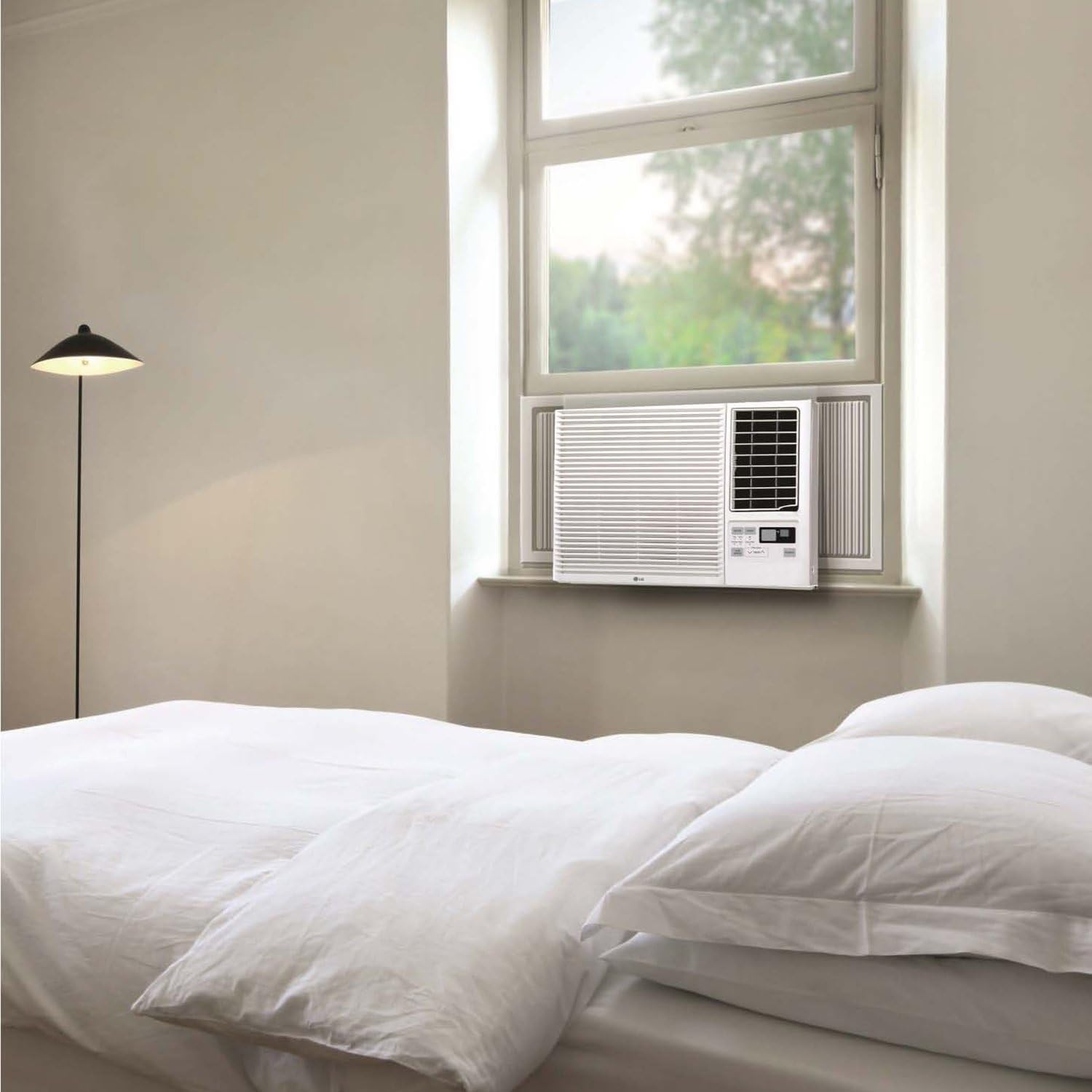
Summary
Editor's rating
Value for money: worth it if you really need this much power
Design: big white brick with practical controls
Comfort in daily use: temperature, airflow, and noise in real life
Durability and reliability: solid build, but some worrying reports
Performance: strong cooling, solid heat, a bit of noise but manageable
What this LG unit actually offers on paper
Pros
- Strong cooling and useful supplemental heat for large rooms (up to ~1,400 sq ft in decent conditions)
- Simple, practical controls with remote, timer, and auto restart that work well in daily use
- Year-round use (AC + heat) in one unit, avoiding separate heaters and extra clutter
Cons
- Very heavy and bulky; requires solid window, likely a support bracket, and two people to install
- Needs a 230V outlet, which may require paying an electrician if you don’t already have one
- Some reports of early failures and only a 1-year warranty, so reliability isn’t guaranteed long-term

Specifications
View full product page →| Brand | LG |
A big, heavy box that actually cools and heats
I picked up the LG LW2423HR because I needed one unit that could handle both cooling and heating a big space without messing around with multiple devices. I’m talking about a roughly 900–1,000 sq ft open area that my old 12,000 BTU window unit just couldn’t keep up with in the summer. I also wanted to stop relying on plug-in space heaters in winter because they’re noisy, kind of sketchy, and don’t really heat evenly. This LG is rated around 23,000–24,000 BTU for cooling and has supplemental heat (9,200/11,200 BTU), so on paper it looked like it should handle a large room or a small open-plan space.
First thing to know: this thing is big and heavy. The box says around 145 pounds, and it feels like it. This is not a unit you casually lift into a window by yourself. I needed another person plus a proper support bracket for the outside. If you’re used to those smaller 5,000–8,000 BTU units, this is a different world. It’s more like installing a small appliance than just dropping a fan in a window.
I’ve been using it for a mix of cooling and heat for a few weeks, trying it in different modes and fan speeds, and I also compared my experience to what other buyers say online. Overall, it does what it says: it cools and heats a big space reliably, with some quirks you should know before buying. There are good points like strong performance and decent noise levels for the size, but it’s not perfect and definitely not for every situation or every window.
If you’re thinking of this as a quick plug-and-play solution for a bedroom, that’s probably overkill. But if you’ve got a larger room, a garage conversion, a shed, or a living room that standard window units struggle with, then this one starts to make sense. Just be ready for the weight, the 230V requirement, and the fact that the heat is “supplemental,” not a full replacement for a central heating system in super cold climates.
Value for money: worth it if you really need this much power
In terms of value, this LG sits in that middle zone: not cheap, not luxury. For the capacity you’re getting—around 23,000 BTU of cooling and solid supplemental heat—the price is reasonable compared to other big window units with heat. You’re basically paying for two things: high output and year-round use. If you only need cooling for a small room, this is overkill and a waste of money. But if you’re trying to handle a big living room, an open-plan area, or a large shed/garage where smaller units just spin their wheels, then it starts to look like a good deal.
What makes the value decent is that it replaces both a strong AC and a separate heater. You don’t need a separate space heater or a second appliance in the window. One user mentioned switching from propane to this unit for heating and being very happy with the efficiency and the fact that they’re no longer dealing with fuel and fumes. Another replaced a small heater in a mancave and liked that this one both cools in summer and heats in winter without a big spike in the electric bill. So if you were already planning to run electric heat plus AC, combining them into one unit can simplify things and sometimes save some money over time.
On the downside, you need 230V power, which can add cost if you don’t already have that outlet near the window. If you have to hire an electrician to run a new 230V line, that’s a real extra expense you should factor in. Also, the energy efficiency (SEER 11.3) is okay but not cutting-edge. A high-end mini-split will usually beat this in power usage, but of course, that’s a different price bracket and a more involved installation.
My take: value is pretty solid if your space is big enough to justify it and you already have or can easily add a 230V line. If you’re trying to cool a bedroom or a small office, I’d say save your money and get a smaller, cheaper unit. If you’ve got a big room that smaller units can’t handle, or you want one device to handle both heating and cooling all year, then the price starts to feel fair for what it does.
Design: big white brick with practical controls
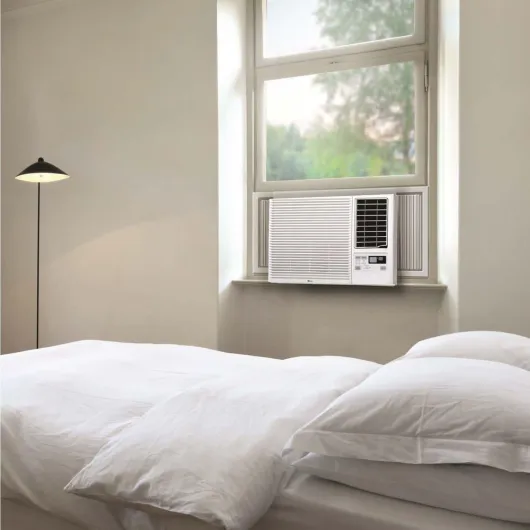
Design-wise, this LG isn’t trying to be pretty. It’s basically a large white rectangle with a standard front grille and a basic digital control panel on the right side. If you’ve used any mid-range LG window unit before, the layout will feel familiar. You get simple buttons for mode, fan speed, temperature up/down, and a small display that shows the set temp or timer. From a user point of view, that’s fine. You don’t have to dig through weird menus or guess what symbol means what. Everything is labeled clearly enough that you can just walk up and set it without reading the manual.
One thing I do like is the 4-way air deflection. You can adjust where the air blows—left, right, up, down—which matters a lot with a big unit like this. In practice, I angled the vents slightly up and to one side to avoid cold air blasting my face on the couch. It’s not super precise, but it’s enough to avoid hot or cold spots right in front of the unit. Compared to cheaper units where the louvers barely move, this one gives a bit more control, and for a big 23,000 BTU machine, that’s pretty important.
The downside of the design is purely physical: it’s massive and heavy. You need a wide enough window and a sturdy frame, and ideally a support bracket outside. The unit sticks out a fair bit, so if you’re putting it above a walkway or deck, be aware it will dominate that wall. Also, because it’s 230V, you’ll have a thicker power cord and a different plug, which isn’t exactly “discreet” if the outlet is in a visible spot. This is functional gear, not décor.
Overall, the design is nothing special but effective: easy-to-read controls, a simple remote, and adjustable vents. No Wi‑Fi, no app, no color screen. Personally, I’m fine with that. I’d rather have a unit that cools and heats well with simple buttons than something overloaded with smart features that break. But if you’re into smart-home integration, this one will feel a bit old-school.
Comfort in daily use: temperature, airflow, and noise in real life
In day-to-day use, the comfort level with this LG is generally good, as long as you’re realistic about what a big window unit can do. The temperature control is straightforward: set your target temp, pick a mode (cool, heat, fan, or energy saver), and let it run. The thermostat isn’t lab-accurate, but it’s close enough. When I set it to 72°F, the room floated between about 71–74°F depending on how often the compressor cycled. That’s normal for this type of unit. I never felt big swings where I was sweating one minute and freezing the next, which is what I care about more than exact numbers.
Airflow is strong. On high fan, you can definitely feel it from across a large room. For comfort, I ended up using low fan most of the time and angling the vents slightly up so it didn’t blow directly on people sitting on the couch. That’s one of the perks of having this much capacity: you don’t have to run it full blast all the time. In heat mode, the air feels pleasantly warm, not scorching like some cheap space heaters. It warms the space more evenly, especially if you leave it on a steady setting instead of constantly turning it on and off.
The noise is where some people will either be fine or annoyed. If you’re used to small window units, this will feel louder simply because the compressor and fan are bigger. On low, it’s more like consistent white noise—noticeable but not disruptive. I could sleep with it on in a nearby room, but for a small bedroom right next to your bed, it might be borderline if you’re picky. One user mentioned using it in the bedroom and called the compressor “a tad loud but acceptable,” which lines up with my impression: okay, but not ultra-quiet. For a living room, shed, or garage, the sound level is perfectly normal.
From a convenience angle, the remote control and 24-hour timer add to comfort. I liked being able to set it to turn off after a few hours or come on before I got home. The auto restart after a power cut is also handy—you don’t have to go reset everything, it just comes back on with the last settings. Overall, comfort is solid: the room feels evenly cooled or heated, the airflow is strong but adjustable, and the noise is acceptable for the size, even if it’s not what I’d call quiet.

Durability and reliability: solid build, but some worrying reports
Physically, the unit feels sturdy. The metal body is thick enough, the front grille doesn’t feel like it will snap off if you touch it, and the filter slides in and out without feeling flimsy. At around 145 pounds, you can tell there’s real hardware inside—compressor, coils, fan, the whole deal. This isn’t a cheap, lightweight unit you swap every summer. It feels like something that’s meant to sit in a window for years. The included installation hardware is basic but serviceable, though I’d still recommend a separate heavy-duty support bracket under it, just for peace of mind.
Where things get a bit more mixed is reliability over time. My unit has been fine so far, but looking at other buyers’ comments, there are a few red flags. One reviewer said their unit worked perfectly for 32 days and then suddenly stopped blowing cold air—compressor running, but cold air coming out the back instead of the front. That sounds like either a refrigerant issue or an internal failure. The annoying part is it happened just after the Amazon return window, which obviously feels bad when you’ve spent this much money. They also mentioned LG’s support first questioned the installation, which is a common script but not very reassuring.
On the other hand, there are plenty of reviews from people running it year-round for both heating and cooling without major issues. One off-grid user even runs it with a generator and solar setup and is clearly putting it through more stressful power conditions than a normal household, and they’re still happy with it. So it’s not a disaster product, but it does seem like a small percentage of units fail early, which can happen with big appliances but is still annoying at this price.
LG gives a 1-year parts and labor warranty, which is standard but not generous. For something this heavy and specialized, I would have liked to see two or three years on major components like the compressor. My honest take: the build feels pretty solid, but there is some risk of early failure based on a few reviews. If you buy it, I’d test it hard in both heat and cool modes as soon as you get it, so if something’s wrong, you catch it within the return window. Also, consider where you buy it—some retailers or credit cards extend warranties, which might be worth it for a unit in this price and weight range.
Performance: strong cooling, solid heat, a bit of noise but manageable
In terms of cooling performance, this thing is a beast compared to standard window units. In my roughly 900–1,000 sq ft open area (average insulation, decent windows), it dropped the temperature from 80°F to about 72°F in under an hour on high cool. After that, I could drop the fan to low or use energy saver mode to maintain it. It’s definitely more power than you need for a single small bedroom, but in a big living room or a workshop, it actually feels correctly sized. One Amazon reviewer mentioned running it off solar and a generator and still being happy with the cooling power—and I believe it, because you can feel the airflow across the room.
On the heating side, remember this is a supplemental heat unit. It’s not a full furnace replacement. That said, for cool to moderately cold days, the heat pump function works well. In my test space, going from about 60°F to 70°F took under an hour, and it held that temp without constantly cycling. It’s more even and comfortable than a little space heater blasting at your legs. Several buyers use it to heat sheds or mancaves and say the same: it keeps the space comfortable without blowing up the electric bill, as long as you’re not in extreme winter conditions.
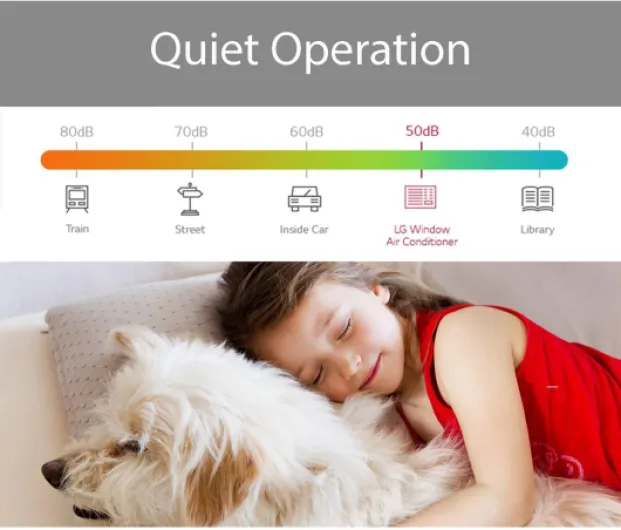
Noise-wise, it’s not silent, but for a big 23,000 BTU unit, it’s acceptable. LG lists around 50–51 dB on low. In real life, on low fan, you can still watch TV or sleep with it on if you’re not super picky. On high, you’ll hear the compressor kick in and out, but it’s more of a steady hum than a rattling mess. One reviewer did say the compressor is “a tad loud” in a bedroom, and I agree: if you’re light-sensitive to noise, putting this in a small bedroom might annoy you. For living rooms, dens, garages, or sheds, the sound level is fine and kind of expected for this size.
Overall, performance is the main reason to buy this unit. It cools fast, heats decently, and moves a lot of air. Just don’t expect whisper-quiet operation or super precise temperature control like a high-end mini-split. It’s a strong, old-school window unit that gets the job done without trying to be fancy.
What this LG unit actually offers on paper
On paper, the LG LW2423HR is a 23,000 BTU cooling / supplemental heat window unit that runs on 230V, not standard 110/120V. LG says it can handle up to around 1,400 square feet, which is roughly a 22' x 25' room or a big open area if your insulation is decent. It’s marketed as both an air conditioner and a heater, with a heat pump-style supplemental heat mode (9,200/11,200 BTU). If your winters are mild to moderate, that’s usually enough to keep a big space comfortable, but I wouldn’t count on it to heat a full house in sub-zero temperatures.
You get 2 cooling speeds, 2 heating speeds, and 2 fan speeds, plus a few useful features: a 24-hour timer, energy saver mode, auto restart after a power cut, and a remote control. There’s also a washable filter and a filter reminder light. Nothing fancy or smart-home connected here, just basic, practical controls. The SEER rating is 11.3, which is okay—not ultra efficient, but not terrible for this power level. It’s more about brute force cooling and heating than chasing the lowest electric bill.
Size-wise, it’s about 30.5" deep x 25.5" wide x 16.8" high, and around 145 lbs. That means it’s going to take up most of a standard window and you absolutely want a proper support bracket or at least a solid sill and frame. The finish is basic bright white with a matte look, so it blends in like most standard window units. No fancy design, no color options, just a big white box that does a job.
Looking at user reviews, the overall Amazon rating is around 4.1/5 with over a thousand reviews, which lines up with my experience: it’s pretty solid, not flawless. People like the year-round use and strong output. Some complain about reliability issues (units failing right after the return window, or cooling problems), and a few mention the compressor being loud. So you’re not buying something perfect, but for the price and capacity, it’s a fairly straightforward, powerful unit meant to work hard more than to impress anyone visually.
Pros
- Strong cooling and useful supplemental heat for large rooms (up to ~1,400 sq ft in decent conditions)
- Simple, practical controls with remote, timer, and auto restart that work well in daily use
- Year-round use (AC + heat) in one unit, avoiding separate heaters and extra clutter
Cons
- Very heavy and bulky; requires solid window, likely a support bracket, and two people to install
- Needs a 230V outlet, which may require paying an electrician if you don’t already have one
- Some reports of early failures and only a 1-year warranty, so reliability isn’t guaranteed long-term
Conclusion
Editor's rating
Overall, the LG LW2423HR is a big, no-nonsense window unit that cools and heats large spaces reliably, as long as you understand its limits. It’s not pretty, it’s not smart, and it’s not whisper-quiet, but it moves a lot of air and actually changes the temperature in a big room instead of just stirring hot air around. The cooling power is strong, the supplemental heat is genuinely useful for mild to moderate winters, and the basic features like the timer, remote, and auto restart make it easy to live with day-to-day.
Where it falls short is mostly around weight, installation, and potential reliability issues. It’s heavy, needs a 230V outlet, and really should be installed with a proper support bracket and at least two people. A few users have had early failures, which is frustrating at this price, and the 1-year warranty isn’t especially generous. Noise is acceptable for the size but not ideal for a small bedroom. So it’s not a perfect all-rounder.
I’d say this unit is for people with a big room, mancave, shed, garage, or open living space who want one machine to handle both cooling and heating without going to a full mini-split system. It’s also a decent fit if you’re off-grid or using generators/solar and want a powerful but manageable load, as one user described. If you just need to cool a small bedroom or you’re obsessed with ultra-quiet operation and smart features, skip this and look for a smaller, quieter or smart model, or consider a mini-split instead.