Summary
Editor's rating
Value for money: decent, but check your sleeve and expectations
Design and installation: heavy, a bit fussy with sleeves
Daily comfort: airflow, humidity, and living with it
Build quality, overheating issues, and long-term concerns
Cooling performance and noise in real life
Specs and what you actually get in the box
Pros
- Strong cooling for medium spaces (up to ~500 sq ft) with honest 11,800 BTU performance
- Runs on standard 115V power and includes useful modes (Energy Saver, Dry, 3 fan speeds)
- Quieter than many older or cheaper wall units, with decent airflow and 4‑way vent control
Cons
- Installation in older or non‑standard sleeves is fiddly and poorly explained in the manual
- Reports of CH34 overheating errors when used in certain wall sleeves, raising reliability concerns
- Plastic front grille can rattle and overall build feels average, not particularly robust

Specifications
View full product page →| Brand | LG |
A wall AC that cools hard but isn’t perfect
I’ve been using this LG 11,800 BTU through-the-wall air conditioner in a mid‑size apartment for a chunk of the summer, so I’ve had time to see it in normal heat and in those ugly humid days. On paper it looks pretty solid: 11,800 BTU, 115V, rated for around 500–530 sq ft, remote control, timer, energy saver mode, and it’s supposed to fit most wall sleeves. In reality, it does cool well, but there are a few things I wish I’d known before buying and wrestling it into the wall.
The first impression: it’s heavy and it’s not a quick plug‑and‑play swap if your sleeve is older or bigger. I had an older through‑the‑wall unit that died, and I thought this would just slide in. It didn’t. I had to mess with foam, gaps, and the trim kit more than I expected. Once it was in and sealed reasonably well, though, the cooling performance was clearly better than my old unit, and the room actually felt less muggy.
Day to day, the unit is basically what you expect from a mid‑range LG: decent construction, plastic that feels a bit cheap but not terrible, and a control panel that’s functional but not exactly friendly if the unit is mounted high. The remote ends up being the main way you use it. Noise-wise, it’s not silent, but for a through‑the‑wall unit it’s acceptable. If you’re used to window units or older wall units, this will probably sound a bit quieter, but it’s still very present in the room, especially on high fan speed.
Where it gets tricky is the design around sleeves and heat management. Some users are seeing that CH34 overheating error when the unit is in certain sleeves, and the tech feedback basically hints at a design limitation. I haven’t hit that error personally, but I can see how a tight or old sleeve could trap heat. So the short version: it cools well and does its job, but installation and long‑term reliability in older sleeves are the big question marks. If you expect a totally hassle‑free setup, you might be disappointed.
Value for money: decent, but check your sleeve and expectations
In terms of value, this LG sits in that mid‑priced wall AC zone. You’re not paying premium Friedrich money, but it’s not the cheapest unit on the market either. For the cost, you get strong cooling (11,800 BTU), a recognized brand, a remote, multiple modes, and a unit that runs on 115V, which is a big plus if you don’t want to mess with a 230V line. Compared to replacing an entire HVAC system or adding mini‑splits, this is obviously much cheaper, and if your space is around 400–500 sq ft, it covers that use case well.
Where the value starts to wobble is when you factor in installation hassle and potential compatibility issues. If you already have a modern sleeve that matches the size, you’re in better shape. If your sleeve is older or larger, you may end up spending extra on materials, handyman time, or just several hours of your own labor to get it sealed and stable. For some people, that’s not a big deal. For others, that’s a hidden cost. The fact that at least one repair tech openly recommended other brands for sleeve situations also makes you question if this is the best long‑term choice for tricky installs.
On the other hand, if you compare it to some cheaper brands (like Keystone or random off‑brands), the LG feels a bit more reliable and slightly quieter. One user even replaced a Keystone with this and was happier with the noise level and performance. So if you’re upgrading from a bargain unit, this feels like a reasonable step up without going full high‑end. The average rating around 3.8/5 on Amazon also says a lot: not a disaster, not a star, just middle of the pack with some people very happy and some really annoyed.
So value-wise, I’d call it “good but not great”. If your sleeve is compatible and you want solid cooling without smart features, it’s a fair deal. If your sleeve is old, cramped, or you’re extremely sensitive to noise and error codes, you might be better off spending a bit more on a brand that’s known to handle difficult sleeve setups better. It does the job, but it’s not the kind of purchase where you feel you scored something special.
Design and installation: heavy, a bit fussy with sleeves
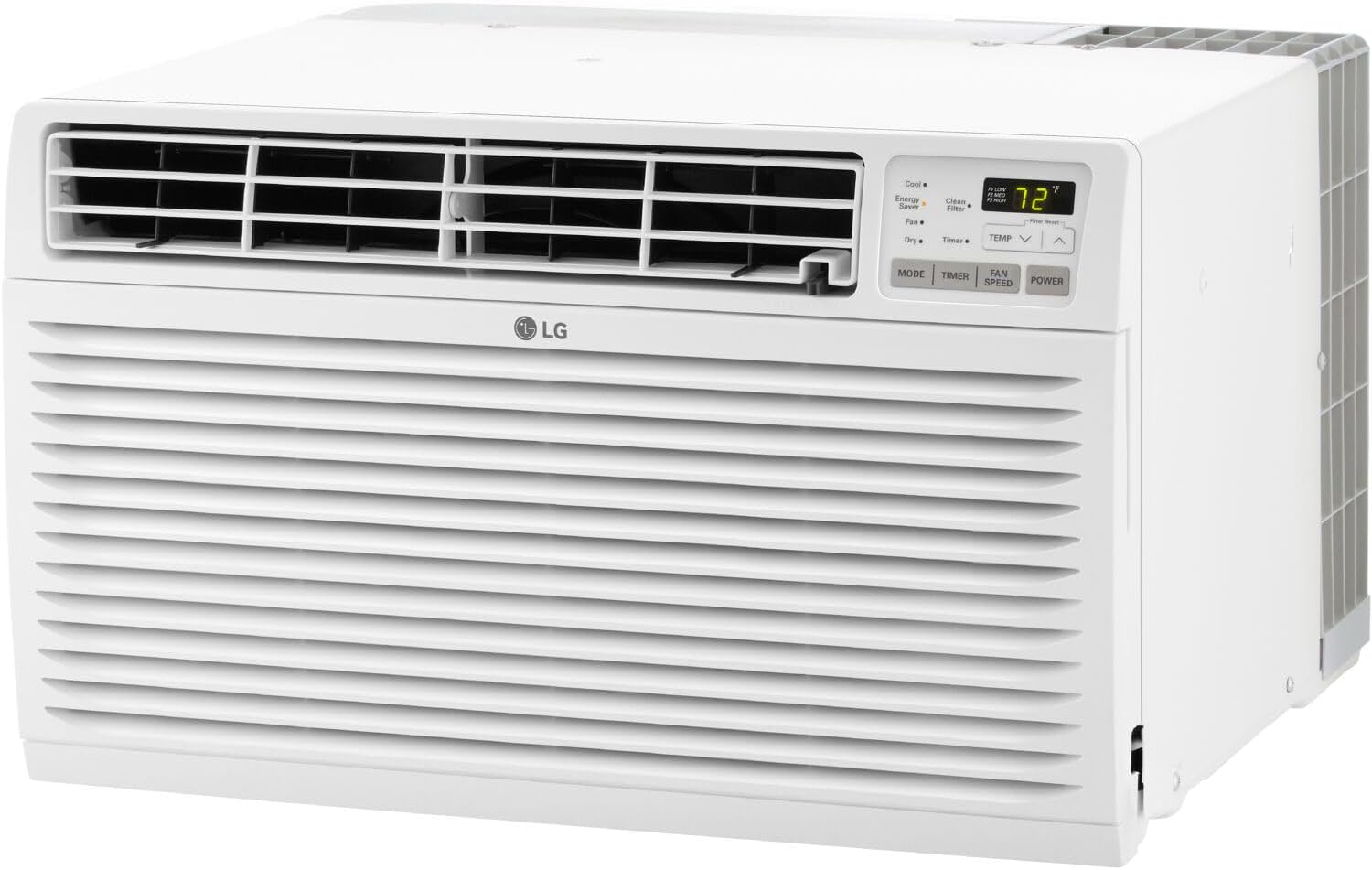
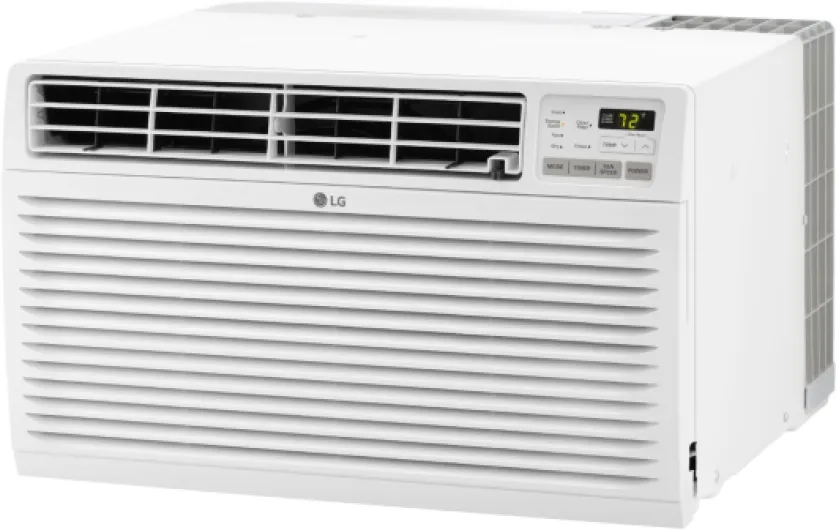
Design-wise, this thing is pretty standard LG: white plastic shell, front grille, top control panel, nothing fancy. It doesn’t look ugly on the wall, but it’s not winning any design awards either. The front vents have 4‑way air deflection, so you can point the air up, down, left, right. That part is actually useful if the unit is off to one side of the room. The control panel is angled in a way that makes more sense if it’s mounted lower on the wall. If yours is high up, like many wall sleeves are, you end up relying on the remote because you can’t really read the display without craning your neck.
Installation is where the design shows its limits. The unit is heavy (around 76 lbs) and awkward to hold. Realistically, you want two people to handle it safely. Sliding it into a newer sleeve that matches the recommended dimensions is manageable. But if, like me, you have an older, taller sleeve, the trim kit and foam instructions don’t really cover what you’re supposed to do. The manual has small diagrams and vague notes, and you kind of have to guess where to add foam to block air gaps and keep the unit centered. One reviewer mentioned their sleeve was 4" taller and I ran into a similar gap issue. It’s fixable, but it’s annoying.
The back of the unit is built for through‑the‑wall venting, not for windows, and LG is very clear: this is not for window installation. The louvers on the outside are decent, but based on at least one detailed review, the way hot air exits in some sleeves might not be efficient enough, which can cause CH34 overheating errors. I haven’t seen that code on mine, but I can believe it’s a thing if the sleeve is old, tight, or poorly vented. That’s more of a design compatibility issue than user error, and it’s worth keeping in mind if your sleeve is ancient.
So in practice: design is functional but not very forgiving. If you’re handy and don’t mind tweaking foam and trim, you’ll get it in and sealed up fine. If you’re expecting a perfect universal fit and plug‑and‑play install, you might be swearing at it for an afternoon. Once installed properly, it looks clean enough and doesn’t draw attention, which is all I really want from an AC box in my wall.
Daily comfort: airflow, humidity, and living with it
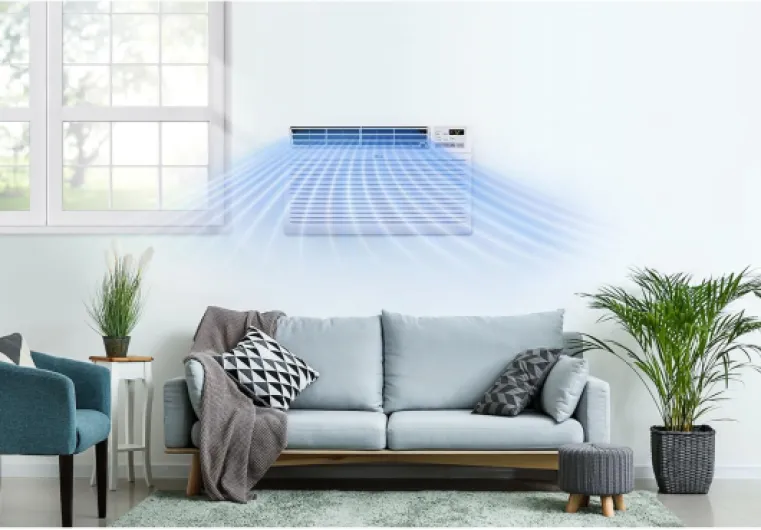
In terms of pure comfort, I’d say this unit does a good job at making the room livable, especially on hot and humid days. The airflow is strong on medium and high, and the 4‑way directional vents help avoid having a freezing blast directly on your face all the time. I usually point the louvers slightly up and to the side so the cool air bounces around the room instead of hitting one spot. If you sit close to the unit, high speed can feel a bit aggressive, but that’s the trade‑off for faster cooling.
The built‑in Dry mode (dehumidifier) is handy on days when it’s not super hot but really sticky. It doesn’t turn the place into a desert, but you can feel the air getting less clammy after an hour or so. The listed dehumidifying capacity is only a few pints per hour, so don’t expect it to replace a dedicated dehumidifier, but as a side benefit, it’s nice. The room generally feels less muggy when the unit has been running for a while, which makes the temperature more comfortable at slightly higher settings.
At night, comfort really depends on how sensitive you are to noise and cycling. The Energy Saver fan cycling every few minutes can bother light sleepers. The compressor thud can also wake you if the room is totally quiet and you’re half asleep. Personally, I got used to it after a week, but the first few nights I definitely noticed every on/off event. If you want a steady background noise, you can leave the fan on a constant speed instead of Energy Saver, but that uses more power.
Another small comfort detail: the remote is essential if the unit is mounted high. The IR receiver seems to like being aimed downwards (as one reviewer mentioned), so sometimes you have to angle the remote a bit to get it to register. Not a huge deal, but slightly clumsy when you’re half‑asleep and just want to bump the temp up a degree. Overall, in daily use, once you’ve dialed in your preferred mode and fan speed, the unit keeps the space cool and reasonably dry. It’s not luxurious, but for a bedroom or living room in summer, it gets the job done.
Build quality, overheating issues, and long-term concerns
On durability, I can’t pretend I’ve used it for years, but between my experience and the Amazon reviews, a few patterns show up. The outer shell and front panel feel like typical mid‑range LG plastic: not super sturdy, not super flimsy. One reviewer mentioned the front grille rattling sometimes due to cheap plastic design, and I’ve heard a bit of that on mine too when the fan is on high. It’s not constant, but if the panel isn’t seated perfectly, you get little buzzes and rattles. Pushing on the grille or tweaking it usually quiets it down, which tells me it’s more about fit than internal damage.
The bigger durability red flag is the CH34 overheating error that some users are getting. One reviewer had a tech out who basically said LG wall units in sleeves often show this error, and even admitted that other brands (Frigidaire, Friedrich) handle that situation better. That’s not a great sign. If the unit overheats regularly because the fan can’t push hot air out of the sleeve properly, that’s extra stress on the compressor and electronics. It might not fail immediately, but it’s obviously not healthy long‑term. LG apparently knows about it but hasn’t recalled anything, which suggests it’s a design compromise they’re just living with.
On the positive side, a lot of people (and myself so far) report no functional issues through at least one full season. The compressor kicks on reliably, the modes work, and the clean filter alert is just a timer (about every 250 hours) rather than a sign of real trouble. The washable filter is easy to remove and rinse, which helps keep airflow decent without buying replacements all the time. The 1‑year limited warranty is standard, nothing special. If you’re unlucky and get a unit that overheats or fails early, you’ll need to lean on that warranty quickly.
So my honest take: build is average, not tank‑level, and the overheating stories make me a bit cautious about long‑term reliability, especially in older or poorly vented sleeves. If your sleeve is good and the unit can breathe, I’d expect a normal lifespan for a mid‑range wall AC. If your setup is marginal, this might be the kind of unit that gives you mysterious error codes right when you need it most, which is not fun at all.
Cooling performance and noise in real life
On performance, this LG unit is pretty solid. In my case it’s cooling a space that’s roughly 450–500 sq ft: a living area plus an open kitchen. From about 78–80°F down to 72–73°F, it takes a couple of hours, which lines up with another reviewer who said it cooled a 700 sq ft apartment from 78°F to 72°F in about 3–5 hours. So the 11,800 BTU rating feels honest. Once the room is at temperature, it cycles on and off normally, and the air coming out is noticeably cold even on medium fan speed.
The Energy Saver mode actually works, but it has its quirks. The fan shuts off when the compressor stops, then kicks on briefly every few minutes to sample the room temperature. That’s good for power bills, but at night, you definitely notice the fan starting up every 3 minutes or so. One reviewer mentioned lying in bed tracking those cycles, and I get it—it’s a small but slightly annoying behavior if you’re a light sleeper. Temperature control is okay: setting it to around 69–70°F in energy saver seems to keep the room hovering in the low 70s, usually between 72–74°F. Not perfect precision, but good enough for daily use.
Noise-wise, it’s not silent, not awful. On low and medium fan speed, the indoor noise is completely livable. On high, it’s loud but that’s expected when you want maximum airflow. There is a noticeable thud when the compressor kicks on or off, which lines up with another user’s experience. It’s not a dealbreaker, but if the unit is right above your bed or couch, you’ll hear it. I’ve had noisier wall units before, and this LG is quieter than those, but if you’re chasing "library quiet," this isn’t it.
One more thing about performance: several users reported the CH34 overheat error when used in older sleeves. That’s not something you want to discover in a heat wave. I haven’t seen it on mine, but the fact a tech admitted he sees it often on LG units in sleeves makes me think the heat exhaust design is a bit borderline in tougher conditions (tight sleeves, very hot days, poor outdoor airflow). So cooling performance is good when it runs, but reliability in bad sleeve setups is a question mark. If your sleeve and outdoor venting are decent, it gets the job done well.
Specs and what you actually get in the box
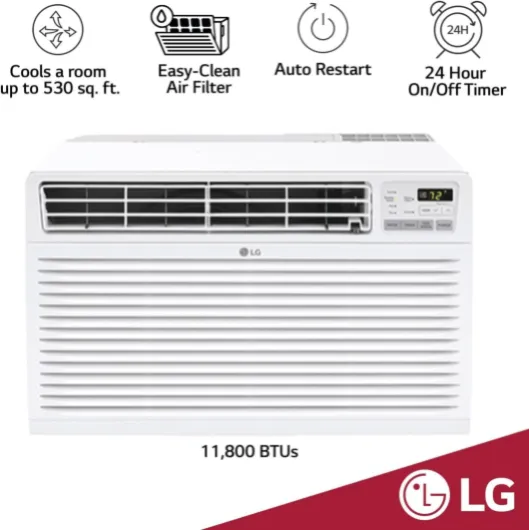
On the spec sheet, this LG LT12124CNR is a 11,800 BTU, 115V, cool‑only through‑the‑wall unit rated for up to about 530 sq ft. It pulls around 1,110 watts, has an EER around 10.6, and uses R‑32 refrigerant, which is more efficient than the old R‑410A stuff. Noise level is listed at 66 dB, which is not whisper‑quiet but pretty standard for this type of unit. The unit size is about 24" W x 20.1" D x 14.4" H and weighs roughly 76 lbs, so you’re not installing this solo unless you enjoy back pain.
In the box you get the AC itself, a trim kit, some insulation foam, a washable filter, the remote, and the usual manual and warranty info. One important detail: the wall sleeve is not included. This is only the unit. LG markets it as having a "universal design" that fits most sleeves, and that’s half true. If your sleeve is from a fairly recent unit and roughly matches the dimensions, you’ll probably be fine with some foam adjusting. If you have an older or extra‑tall sleeve, expect to improvise a bit.
You also get a few built‑in modes: Cool, Dry (dehumidifier), and Energy Saver. There are 3 cooling speeds and 3 fan speeds, plus a 24‑hour timer. The remote is simple: temp up/down, mode, fan speed, power, and a few extra buttons. Nothing fancy like Wi‑Fi or app control. For the price and spec level, that’s okay, but if you’re used to smart home stuff, this one is pretty basic.
Overall, presentation-wise, it’s a practical, mid‑range wall AC: enough features to manage comfort decently, but no fancy extras. The main selling points are the cooling capacity, the through‑the‑wall form factor, and the fact it runs off 115V instead of needing a 230V circuit. Just don’t assume “universal sleeve” means you’ll slide it in and be done in ten minutes. It’s more like "universal with patience and foam".
Pros
- Strong cooling for medium spaces (up to ~500 sq ft) with honest 11,800 BTU performance
- Runs on standard 115V power and includes useful modes (Energy Saver, Dry, 3 fan speeds)
- Quieter than many older or cheaper wall units, with decent airflow and 4‑way vent control
Cons
- Installation in older or non‑standard sleeves is fiddly and poorly explained in the manual
- Reports of CH34 overheating errors when used in certain wall sleeves, raising reliability concerns
- Plastic front grille can rattle and overall build feels average, not particularly robust
Conclusion
Editor's rating
Overall, the LG 11,800 BTU through‑the‑wall AC is a decent workhorse: it cools well, handles a medium apartment or a big bedroom without struggling, and the basic features (remote, timer, energy saver, dry mode) cover what most people actually use. Noise is acceptable for a wall unit, not whisper‑quiet but clearly better than some older or cheaper models. If you have a reasonably modern wall sleeve and you’re okay with a bit of DIY foam tweaking, it will probably serve you fine for typical summer use.
The catch is mainly in installation and long‑term reliability in older sleeves. The “universal” fit is only partly true, the manual is vague, and if your sleeve is tall or oddly shaped, you’ll be improvising. The reports of CH34 overheating errors in sleeve installs are concerning, especially when a tech basically says LG units do this more than some competitors. That doesn’t mean every unit will fail, but it’s something to think about if your setup is less than ideal or you live in an area with very hot summers.
If you want a 115V wall unit with strong cooling and you’re reasonably handy, this is a solid option and good enough value. If you’re looking for the quietest, most robust unit for a tricky sleeve, or you hate dealing with installation quirks, I’d look at Frigidaire or Friedrich as alternatives. This LG gets the job done, but it’s more "practical choice" than "wow, this is perfect".