Summary
Editor's rating
Value for money: strong price, but you’re trading off long-term peace of mind
Design: simple, discreet, and clearly built to hit a price point
Comfort: quiet operation, decent airflow, but temperature reading is a bit off
Durability and reliability: mixed signals, and that’s the real catch
Performance: quiet and efficient, but with some question marks on longevity
What you actually get with this ROVSUN mini split
WiFi, app, and controls: handy but not life-changing
Pros
- Very affordable compared to big-name mini splits, especially if you DIY the install
- Quiet operation indoors and outdoors, much less noise than window units
- Runs on 115V, good for older homes or places without 220V circuits
Cons
- Mixed reports on long-term reliability, including compressor failures just after warranty
- Instructions for vacuuming and leak testing are vague, making DIY install confusing
- Brand support and warranty handling seem weaker than established HVAC brands

Specifications
View full product page →| Brand | ROVSUN |
A budget mini split that looks tempting on paper
I put this ROVSUN 9000 BTU WiFi mini split in a roughly 300–350 sq ft room that used to rely on a loud window unit and a space heater. I wanted something quieter, more efficient, and ideally under the price of the big brands. This one kept popping up because of the low cost, 115V power, and the decent 4.3/5 rating. So I decided to try it, fully aware it’s more of a budget option than a premium setup.
In day-to-day use, the main thing that stood out right away is how quiet it is compared to a window unit. At low fan speed, you can actually forget it’s running, which is a big change if you’re used to the constant roar of a cheap window AC. Cooling performance is pretty solid for a room this size, and the heat pump actually works, not just as a gimmick. I’ve used it in mild winter weather and it held the room at a comfortable temperature without needing backup heat.
The flip side: buying this kind of unit at this price means you’re taking on more responsibility. The install is not “plug and play” like a portable AC. You either pay an HVAC tech or you learn how to pull a vacuum, check for leaks, and follow the steps correctly. The unit is pre-charged, but that doesn’t mean you skip the vacuum pump. A lot of the negative experiences you see online come from skipped install steps or unclear instructions.
Overall, after living with it, I’d say this: it’s good value for the money if you’re handy or willing to learn, but it’s not the brand I’d pick if I wanted bulletproof long-term reliability and full dealer support. For a budget build, rental, garage, or bonus room, it makes sense. For your main living space where you can’t tolerate downtime, I’d think twice or at least factor in the risk of earlier failure like some reviewers reported.
Value for money: strong price, but you’re trading off long-term peace of mind
Where this ROVSUN 9000 BTU unit really stands out is price. People are installing it for well under $600 total if they DIY the install and buy their own vacuum pump and gauge set. Compare that to quotes around $2,000–$3,000 for a more well-known brand installed by an HVAC company, and you see why a lot of folks are tempted. For that money, you get quiet operation, heating and cooling, decent efficiency, and smart features. On a pure features-per-dollar basis, it’s hard to argue.
The other way it saves money is by running on 115V. That means in many cases you don’t have to pay an electrician to pull a new 220V line; you can often use an existing 20A circuit (assuming it’s dedicated and up to code). For older homes or manufactured homes, that’s a big plus. Some users literally just drilled a hole, ran the power, and plugged it into a 115V outlet (though personally I’d still recommend a proper disconnect and following electrical code).
The downside is risk. You’re trading a higher upfront cost for a cheaper unit that might not last as long and might not have the same level of warranty support. If it dies after 2–3 years, you might still come out ahead versus a $3,000 system, but it’s frustrating, and you’re dealing with the hassle of replacement. If it lasts 5+ years, then the value is very good. That’s the gamble.
So in terms of value, I’d say: if you’re budget-conscious, somewhat handy, and okay with a bit of risk, this is good value for money. If you want something you can forget about for a decade and you hate dealing with warranty fights or DIY tools, you’re better off spending more upfront on a better-known brand and a pro install. This is a “good deal” if you go into it with clear expectations, not if you expect premium performance and support at a bargain price.
Design: simple, discreet, and clearly built to hit a price point
Design-wise, this thing is pretty standard mini split territory. The indoor unit is a plain white wall-mounted head with a small display that shows the set temperature. It’s not ugly, it’s just generic. If you’ve seen any basic mini split, you’ve basically seen this one. The dimensions (about 32" wide, 8" deep, 11.5" high) are compact enough that it doesn’t dominate the room, especially if you mount it high on the wall above a window or door.
The plastic on the indoor unit feels average. Not super cheap, but clearly not premium either. The front flap opens smoothly, and the louvers move freely for the 4-way swing. Nothing rattles on mine, even at higher fan speeds, which is a good sign. The remote is also very basic: lightweight, slightly cheap feel, but it works and the buttons are clear enough once you get used to them. It’s backlit only in a basic way, so don’t expect a fancy remote, but it gets the job done.
The outdoor unit is more interesting from a design perspective because it’s compact for a 9000 BTU system and runs on 115V, which is handy if you don’t want to run a new 220V line. It’s not huge, and a wall-mount bracket works well if you’re in a flood or snow-prone area. The casing is metal, paint looks fine, and the fan grille is standard. Noise from the outdoor unit is low; you can hear a gentle hum if you’re standing next to it, but it’s much quieter than a typical central AC condenser.
Overall, the design is functional and discreet. No fancy finishes, no premium touches, but also nothing that screams “cheap junk” from across the room. If you care a lot about aesthetics, you might lean toward a higher-end brand. If you just want a white box on the wall that quietly moves air, this is fine. The main thing is that it doesn’t vibrate, doesn’t rattle, and the layout of ports and line connections is straightforward for installation.
Comfort: quiet operation, decent airflow, but temperature reading is a bit off
From a comfort standpoint, this unit does what you actually want: it cools or heats the room quietly without blasting you in the face with air. The 4-way swing lets you direct airflow up, down, left, and right. I usually aim it slightly up so the air washes over the room instead of hitting the bed or desk directly. On high fan, it moves a good amount of air; on low or sleep mode, it’s gentle enough that you don’t feel like you’re in a wind tunnel.
The temperature control is decent but not perfect. Like a lot of wall-mounted units, the thermostat is in the indoor head near the ceiling. That means the air up there can hit the set temperature while the lower part of the room is cooler (in heating mode) or warmer (in cooling mode) depending on your layout. One user mentioned having 68°F at ceiling level and 57°F at bed height, which lines up with what you’d expect in a room with poor air circulation. The fix is simple but not elegant: you set the unit a bit hotter or colder than you actually want, and you learn your room’s “offset.”
Humidity control in dry mode is pretty decent too. It’s not a dedicated dehumidifier, but it does a good job pulling moisture out of the air in sticky weather. The room feels less clammy, even when the temperature isn’t super low. That’s a big win for comfort in summer, especially if you’re in a humid area. Just keep in mind that dry mode isn’t about dropping the temperature fast; it’s more about taking the edge off the humidity.
Overall comfort is pretty solid: it’s quiet, the airflow is adjustable, and once you figure out the thermostat quirk, it keeps the room where you want it. If you’re replacing a noisy window unit, it feels like a big upgrade in day-to-day living. It’s not perfect climate control like a high-end system with remote sensors, but for the price bracket, it does a good job keeping the space livable and comfortable.
Durability and reliability: mixed signals, and that’s the real catch
Durability is where this ROVSUN mini split is a bit of a question mark. On the positive side, there are several owners saying they’ve had units running for 2+ years with no issues, including one who liked it enough to buy a second, larger one for another area. Those people report consistent heating and cooling, no major drop in performance, and no leaks or compressor problems so far. The build doesn’t feel super flimsy, and the outdoor unit looks like it can handle normal weather just fine if installed correctly and kept off the ground in snow or flood zones.
On the other side, you’ve got people who had serious failures just after the warranty period. The example that stands out is the user who had a bent piston in the compressor after a bit more than a year of actual use. Their HVAC tech said this is common with this brand, and ROVSUN apparently didn’t offer much help beyond telling them to repair it at their own cost. A compressor issue like that usually means a repair bill that’s higher than just replacing the whole unit, which kind of defeats the point of going cheap in the first place.
It’s also worth saying: installation quality plays a huge role in reliability. If the lines aren’t properly vacuumed, if moisture or air stays in the system, or if the flares are bad and you have slow leaks, the compressor is going to suffer. Some of the negative reviews look like possible install-related failures disguised as “bad unit.” But at the same time, a stronger brand typically has better support, clearer install documentation, and a more robust warranty process, which this one doesn’t really offer at the same level.
So realistically, I’d rate durability as average to slightly risky. If you get a good unit and do a proper install, you might get several years of trouble-free use and feel like you scored a bargain. If you get a bad one, you may be stuck with a paperweight just after the warranty ends. I’d be comfortable using this in a workshop, garage, rental, or secondary room. For a main bedroom in a cold climate, I’d either budget for a possible early replacement or go with a more established brand.
Performance: quiet and efficient, but with some question marks on longevity
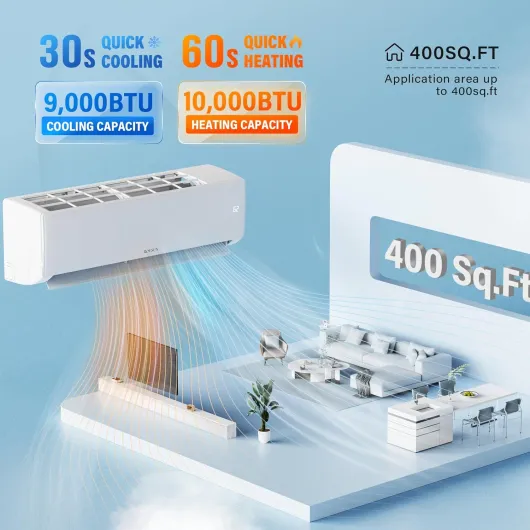
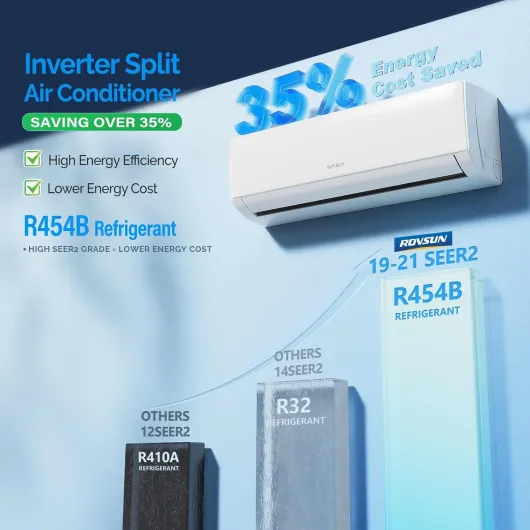
In terms of raw performance, the cooling on this ROVSUN is pretty solid for its size. In a 300–350 sq ft room with average insulation, it can drop the temperature from stuffy to comfortable in 15–20 minutes on turbo mode. Once the room is at the set temperature, the inverter compressor settles down and just sips power to maintain it. The 19 SEER2 rating isn’t top of the line, but it’s respectable, and you can feel that it doesn’t cycle on and off like a cheap window unit. It ramps up and down smoothly, which also helps with noise.
The heating function is what surprised me a bit. A lot of budget mini splits claim to heat well, then struggle once it gets actually cold. This one does fine in mild to moderately cold weather. I’ve used it with outside temps around freezing (32°F / 0°C), and it kept the room comfortable. You do need to understand one thing: the temperature sensor is high on the wall, so the air near the ceiling can be at the set temp while your bed or couch is several degrees cooler. One user solved it by cranking the set temp higher, and that’s exactly how it behaves in practice. Warm air rises, so you might have to set it to 78–80°F to get 70–72°F at sitting level.
Noise levels are a big plus. On low fan or “mute” mode, the indoor unit is very quiet. You can sleep with it on, no problem. The outdoor unit is also much quieter than a typical central AC condenser or a noisy window unit. If you live in a small house or use it in a bedroom, this matters a lot. I barely notice it over normal background noise.
Where things get a bit dicey is long-term reliability. Some owners report 2+ years of solid use with no issues and even bought more units. Others report failures just after the warranty window, like a bent piston in the compressor. That kind of failure is expensive to fix, often more than the unit cost. It’s hard to say if that’s a bad batch, poor install, or just the risk of a budget brand, but it’s something to keep in mind. If you treat this as a lower-cost system that might not last as long as a premium brand, the performance for the price is good. If you expect 10–15 years of trouble-free use, you’re probably being optimistic.

What you actually get with this ROVSUN mini split
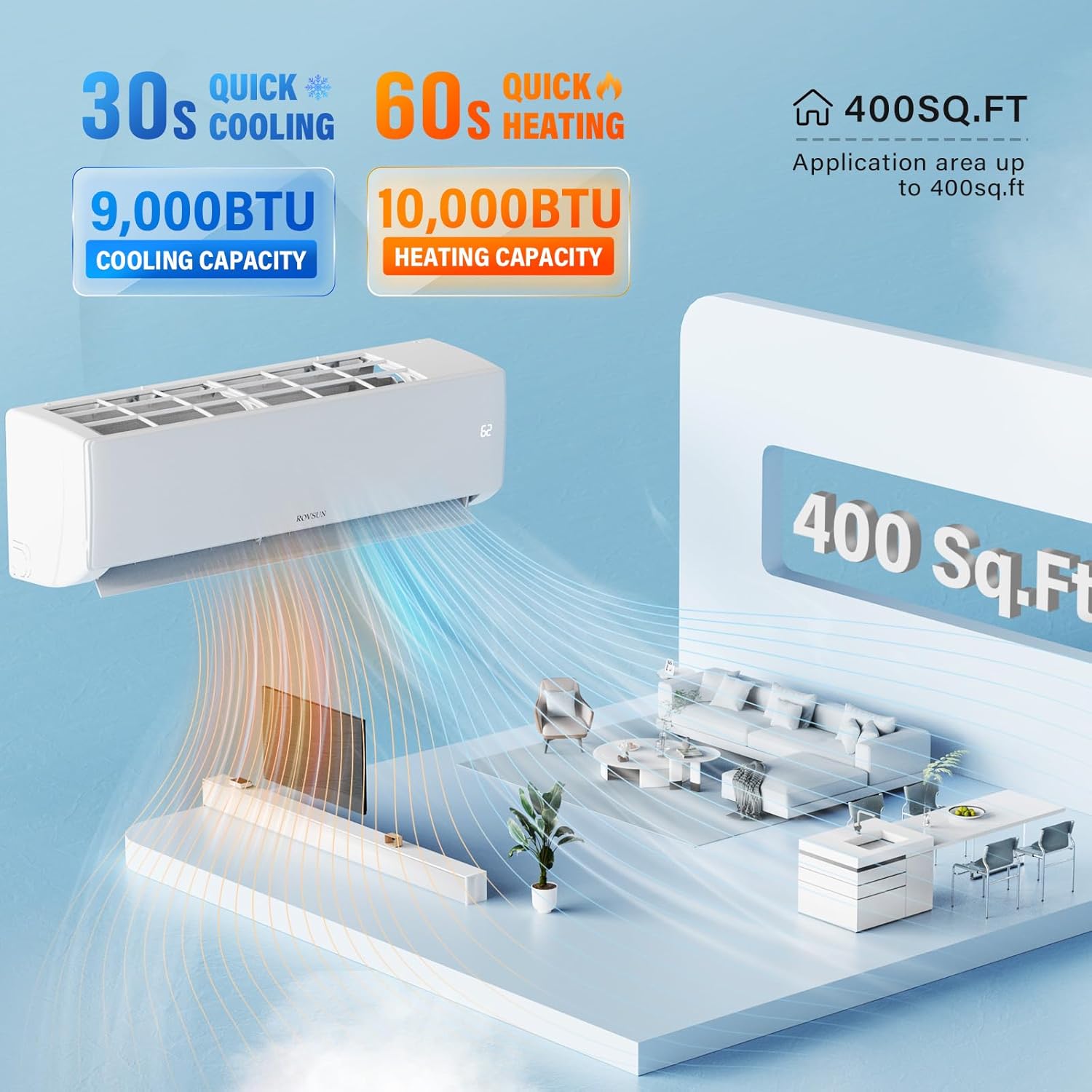
On paper, the specs look decent for the price: 9000 BTU, 19 SEER2, runs on 115V so you don’t need a 230V circuit, and it’s both a cooling and heating unit with a heat pump. It’s rated for up to about 400 sq ft, which in practice feels right for a well-insulated bedroom, office, or small living room. If your room has poor insulation or big windows, I’d treat that 400 sq ft number as optimistic and think more like 250–300 sq ft for solid performance in hot climates.
In the box, you get the indoor head, the outdoor condenser, the pre-charged line set (about 16.4 ft of copper), the signal/power cable between the units, wall brackets/plate for the indoor unit, and some basic wrapping/tape for the lines. You do not get the vacuum pump, manifold gauges, or the main power cable from your panel to the outdoor unit. That’s on you. The instructions mention professional install, but they’re pretty weak when it comes to explaining the vacuum and leak test step clearly. That’s where YouTube comes in.
The feature list is pretty loaded for the price: WiFi control, works with Alexa/Google Assistant, multiple modes (cool, heat, dry, fan, auto), sleep mode, ECO mode, turbo, and 4-way swing. In reality, I mostly use cool, heat, dry, and fan, and occasionally sleep mode at night. The smart features are a nice bonus but not mandatory. If you don’t care about WiFi, you can run everything with the remote just fine.
So in short, you’re getting a full mini split kit that’s functional out of the box, but it’s clearly aimed at budget buyers and DIYers. It’s not as polished as Mitsubishi, Daikin, or Fujitsu, but those cost 3–4x more once installed. If your priority is low entry cost and decent performance, this hits that target. If you want premium support, polished manuals, and a long track record, this brand isn’t there yet.
WiFi, app, and controls: handy but not life-changing
The remote control is what you’ll use most of the time, and it’s straightforward: mode button, temperature up/down, fan speed, swing, turbo, sleep, etc. The layout isn’t fancy, but after a day or two, muscle memory kicks in and you don’t have to think about it. The display is basic but readable. The one annoyance is that the beeps from the indoor unit when you change settings are a bit sharp, though not unbearable.
The WiFi and app control are a nice bonus if you like gadgets. You can connect it to your phone, set schedules, and control the unit from outside the house. It also works with Alexa and Google Assistant, so you can say something like “set bedroom AC to 72 degrees” and it responds. In practice, I mostly use the app for two things: turning it on before I get home and checking if I accidentally left it running.
Setup for the WiFi is a bit clunky the first time. It’s that usual routine of holding a button to enter pairing mode, connecting to a temporary network, then linking it to your WiFi. Not hard, just a bit annoying. Once it’s set up, it’s been stable for me—no constant disconnects or anything like that. Just don’t expect the app to be super polished like a big brand’s ecosystem; it’s functional, not pretty.
Overall, the smart features are nice to have but not the reason to buy this unit. If you’re old-school and just want to use the remote, you’re not missing much. If you like automation and routines, it’s handy to be able to pre-cool or pre-heat the room and integrate it into your smart home. For a budget unit, having WiFi and voice control at all is a plus, even if the software side is a bit basic.
Pros
- Very affordable compared to big-name mini splits, especially if you DIY the install
- Quiet operation indoors and outdoors, much less noise than window units
- Runs on 115V, good for older homes or places without 220V circuits
Cons
- Mixed reports on long-term reliability, including compressor failures just after warranty
- Instructions for vacuuming and leak testing are vague, making DIY install confusing
- Brand support and warranty handling seem weaker than established HVAC brands
Conclusion
Editor's rating
This ROVSUN 9000 BTU WiFi mini split is basically a budget-friendly way to get quiet cooling and heating in a small to medium room without going through an HVAC company and dropping a few thousand dollars. It cools and heats well for its size, it’s quieter than any cheap window unit I’ve used, and the 115V power requirement makes it easier to install in older homes or smaller spaces. The WiFi and smart features are a nice bonus but not the main reason to buy it. For day-to-day comfort, it gets the job done and feels like a clear upgrade from window units or space heaters.
The trade-offs are mostly around installation and long-term reliability. You either need to be comfortable with a DIY install using a vacuum pump and gauges, or you need to pay a pro. The instructions are not great about the leak test and vacuum steps, so you’ll probably end up on YouTube. And while some owners report years of trouble-free use, others have had serious failures just after the warranty period, with limited support from the brand. That’s the risk you accept at this price point.
I’d recommend this unit for people who are handy, on a budget, and okay with some risk: garage, workshop, rental, home office, or a secondary bedroom. It’s also a decent solution if you’re replacing loud window units and want something quieter without a huge investment. I’d be more cautious if this is for your main living room or your only heat source in a very cold climate. In that case, spending more on a well-known brand and pro install might save you headaches down the road.