Summary
Editor's rating
Is it worth the money?
Design: compact footprint, but “portable” is oversold
Everyday comfort: using it in real life
Build quality and long‑term feel
Cooling performance and noise: strong chill, noticeable hum
What you actually get with this 4‑in‑1 unit
How well the 4‑in‑1 modes actually work
Pros
- Strong cooling for bedrooms and medium rooms; noticeably drops temperature within an hour
- WiFi app, remote, and timer make it easy to control and schedule
- Decent build quality with washable filter and included window kits for different window types
Cons
- Quite noisy when the compressor is running; not ideal for light sleepers
- Window solutions for push-out/high windows are clunky and may require DIY or extra parts
- Heavy and only semi-portable in practice, especially between floors

Specifications
View full product page →| Brand | DR.PREPARE |
Portable AC that actually cools – but with a few catches
I’ve been using the DR.PREPARE 9000 BTU portable air conditioner for a few hot spells now, mainly in a medium bedroom and occasionally dragged into the living room. I’m not an HVAC nerd, I just hate sweating through summer nights and wanted something stronger than a fan. I went for this model because of the WiFi control, the 4‑in‑1 modes, and the fact it supposedly works with different window types.
In day‑to‑day use, the main thing is: it cools well for its size. When the compressor kicks in, you get properly cold air, not just slightly fresh air like some cheap units. In a 12–15 m² room it can drop the temperature a few degrees in under an hour if you vent it properly. So on the core job – making a hot room bearable – it gets the job done.
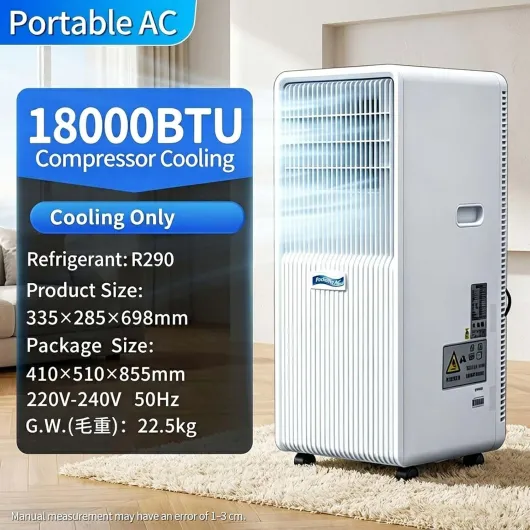
On the downside, it’s not quiet and not that portable. Yes, it has wheels and side handles, but at around 22 kg you’re not casually carrying this up and down stairs. And when the compressor is running, you hear it. If you’re sensitive to noise at night, that’s going to matter more than any fancy app feature.
Overall, my feeling so far is that this is a pretty solid mid‑range unit: strong cooling, decent app, slightly overhyped window flexibility and noise levels. If you know what you’re getting into with portable ACs in general – hose, noise, and setup faff – you’ll probably be happy. If you expect quiet, plug‑and‑play comfort like a split system, you’ll be disappointed.
Is it worth the money?
Price‑wise, this DR.PREPARE sits in that mid‑range portable AC bracket. It’s not the cheapest 9000 BTU unit you can buy, but it’s also not in the premium bracket with fancy brand names. One Amazon reviewer felt around £250 was a bit steep, and I kind of see their point: you’re paying for WiFi, multiple window options, and the 4‑in‑1 label, not just raw cooling.
From my own use, I’d say the value depends on what you care about most. If you just want cold air and don’t care about apps, you can probably find a cheaper 9000 BTU unit that cools just as well but with fewer features. If you like the idea of remote control, timers, and flexible window kits, then this one starts to make more sense. The fact that it has a dehumidifier mode and a decent energy efficiency rating also helps justify the cost a bit over ultra‑budget models.
Where the value drops a bit is the noise and window setup reality. The marketing suggests quiet operation and support for almost all window types, but in practice it’s as loud as most portables and the push‑out window solution (the big fabric sock) is clunky. If your windows are awkwardly placed or high up, you might end up buying extra bits or doing DIY boards, which adds hidden cost and hassle. That’s not unique to this brand, to be fair – it’s a general portable AC problem – but it still affects how good the deal feels.
Overall, I’d call it decent value but not a bargain. You get strong cooling, WiFi control, and a reasonably solid build, but you also accept typical portable AC downsides: noise, hose faff, and some compromises with windows. If you catch it on discount, it’s an easy yes. At full price, it’s good, but you should go in with realistic expectations.
Design: compact footprint, but “portable” is oversold
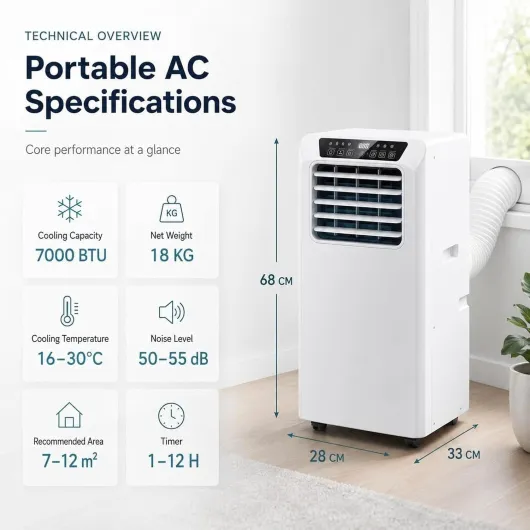
Design‑wise, this thing is pretty straightforward: a tall white tower‑style unit with vents on the front, controls on the top, and the hose connector on the back. The footprint is fairly compact (about 30 cm wide and 29 cm deep), so it doesn’t eat too much floor space. In my bedroom it tucks into a corner without blocking furniture, which I appreciate. It doesn’t scream “industrial box”, but it’s not stylish either – it just looks like a modern appliance.
The brand pushes the “portable” angle with four casters and two side handles. On a flat floor, rolling it around is easy enough, even on thin carpet. But at around 49 lbs / 22 kg, you’re not casually carrying it upstairs unless you’re fairly strong and careful. I did one trip up a staircase with it and decided that was enough; this is more “move it between a couple of spots on the same floor” than “roam freely around the house”. If you plan to move it between rooms a lot, factor that in.
The control panel on top is clear and simple: mode buttons, temperature, fan speed, timer. The display is bright enough to see during the day but not so bright that it lights up the room at night, which I like. The vents are fixed; you can’t motorize them via remote, so you still need to walk over if you want to angle airflow slightly. It’s a bit old‑school there, but not a big deal.
One annoyance is the hose and window setup. The hose itself is quite stiff, which is good for holding shape but annoying when you’re trying to position it. It tends to tug at the fittings, and if you’re not careful it can pop off. Once it’s in place, it’s fine, but getting it there the first time is a bit fiddly. Overall, the design is practical enough, nothing fancy, but the portability claim is a bit optimistic if you think you’ll be moving it up and down stairs all summer.
Everyday comfort: using it in real life
In daily use, the big comfort win is simple: walking into a cooled room instead of a stuffy oven. On hot days, I set it to around 23–24°C, close the door, and after 30–40 minutes the room is much easier to live in. You don’t feel sticky, and the air doesn’t feel heavy. Compared to just running a fan, it’s night and day – the fan just moves hot air, this actually changes the temperature and humidity.
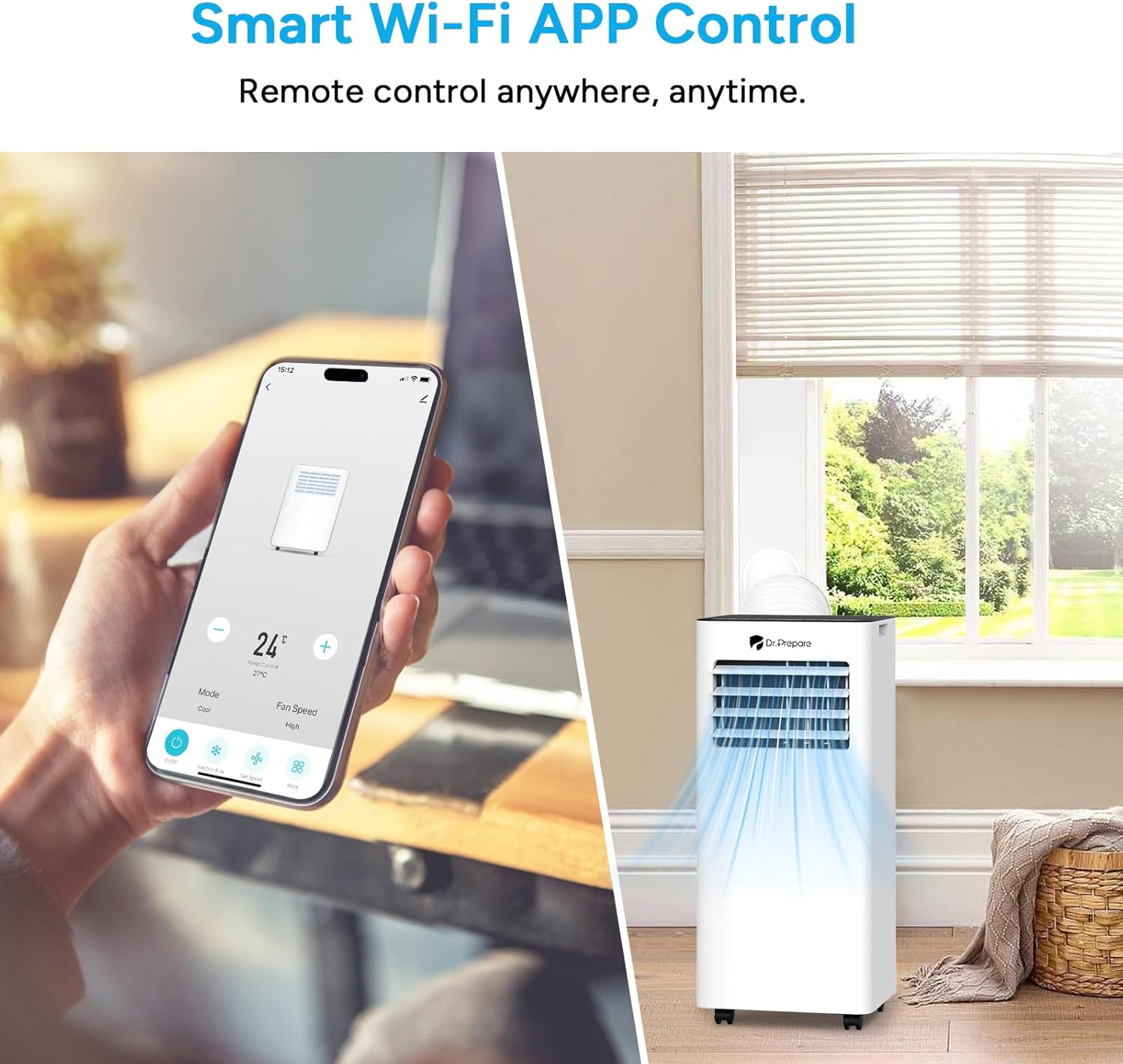
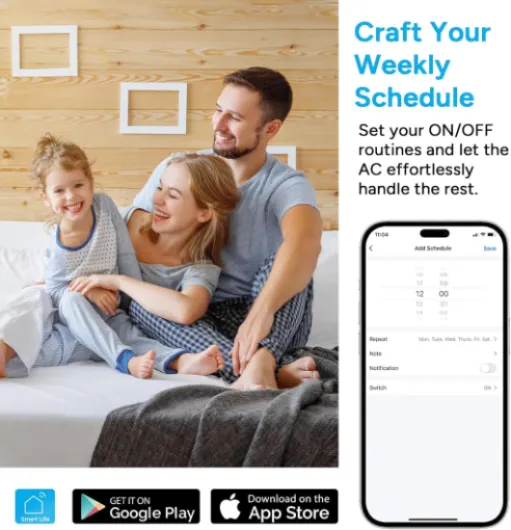
The WiFi app control genuinely adds comfort if you’re a bit lazy like me. Being able to start it from the sofa, or from outside the house before you get home, is nice. I also like that you can set schedules – for example, have it run for two hours in the late afternoon, then switch off. One reviewer called the Alexa integration a bit of a gimmick, and I kind of agree: it’s nice to say “turn on AC” but you could live without it. The app itself is more useful than the voice control.
Noise is the main comfort trade‑off. If you’re trying to sleep, the constant hum and compressor on/off cycle can be tiring. I ended up using it to pre‑cool the bedroom for an hour or two before sleep, then turning it off and switching to a normal fan. That gave me a decent compromise: cooler room but quiet enough to sleep. If you’re someone who can sleep through anything, you might manage with sleep mode on low fan. If you’re a light sleeper, don’t expect miracles.
The dehumidifier function
Build quality and long‑term feel
In terms of build, the unit feels fairly solid for the price. The plastic shell doesn’t flex much when you push on it, the wheels roll without any grinding, and the buttons don’t feel loose or cheap. A couple of reviewers also mentioned that it feels well made, and I’d agree. It’s not premium, but it doesn’t feel like it will fall apart after one summer either.
The parts that worry me more are the hose and connectors. The hose is stiff and a bit awkward, and you can tell if you keep twisting it around every day, something might loosen eventually. The connection to the back of the unit is okay but not bulletproof – if you pull too hard, it can pop off. Best approach is to set it up in one spot and mostly leave it there, rather than constantly relocating it and stressing the fittings.
Maintenance is pretty simple: there’s a washable mesh filter you can remove and rinse. That should help the machine last longer and keep airflow decent. As long as you clean it every few weeks during heavy use and don’t let dust and pet hair build up, the internals should stay in decent shape. The R‑290 refrigerant is standard and efficient, nothing weird there.
Warranty‑wise, you get 1 year on the unit and 3 years on the compressor for material and workmanship. That’s reassuring for a mid‑priced portable AC. The only catch is the manual warning about not extending the hose, which is annoying because some people will need a longer reach. If you do extend it and something goes wrong, they might push back on warranty claims. Overall, though, the durability seems fine if you treat it as a semi‑fixed appliance rather than tossing it around the house.
Cooling performance and noise: strong chill, noticeable hum
Performance is where this unit holds up pretty well. In a 12 m² bedroom with the door mostly closed, it can drop the temperature by about 4–5°C in under an hour during a warm, humid evening. That matches what other buyers said: the air coming out is properly cold, and you feel it across the room even on the lower fan speed. In a bigger lounge, it still helps a lot, but you’re not going to turn a sun‑baked open‑plan space into an ice cave; it just makes it more comfortable.
The fan has two speeds. On low, the airflow is still decent and the noise is a bit easier to live with. On high, it really pushes air, which is good when the room is roasting, but the overall noise goes up. The spec sheet says 65 dB, and that feels about right with the compressor running. It’s not jet‑engine loud, but it’s far from silent. For watching TV, it’s okay. For sleeping, that depends on how tolerant you are; personally I can nap with it, but at night I find the constant compressor cycling a bit annoying.
The sleep mode helps a bit by dialing things down and aiming for around 45 dB, but that’s still not whisper‑quiet. If you’re used to a simple fan at 35–40 dB, this will feel louder, especially when the compressor kicks in. One Amazon reviewer measured around 58 dB at full fan, which matches my rough impression: think “noisy office” rather than “library”. If you’re very noise‑sensitive, plan on using it mainly to pre‑cool the room before bed rather than all night.
On the positive side, the unit doesn’t seem to struggle or short‑cycle. It keeps a steady temperature once it gets there, and the energy efficiency rating (A, SEER 16) is decent for a portable unit. I didn’t see any crazy spikes on my energy monitor when running it a few hours in the evening. Overall: cooling performance is strong for the size and price, but you pay for it in noise, which is pretty standard for this type of machine.

What you actually get with this 4‑in‑1 unit
On paper, this DR.PREPARE is a 4‑in‑1 machine: cooling, fan, dehumidifier, and a sleep mode (which is really just a quieter/softer version of cooling). It’s rated at 9000 BTU, which in practice is fine for a bedroom or a small to medium living room, roughly up to 25–30 m² if you’re not expecting meat‑locker levels of cold. The spec sheet says up to 30 m² and that feels realistic if your insulation isn’t terrible.
There’s WiFi app control, a remote, and touch controls on top. I mostly used the app and the top panel. The remote is basic but does everything you need: temperature up/down, mode changes, fan speed, timer. The app adds scheduling and lets you turn it on before you get home, which is actually handy if you come back to a hot flat. It also has a 24‑hour timer, child lock, and memory function so it comes back on with previous settings after a power cut.
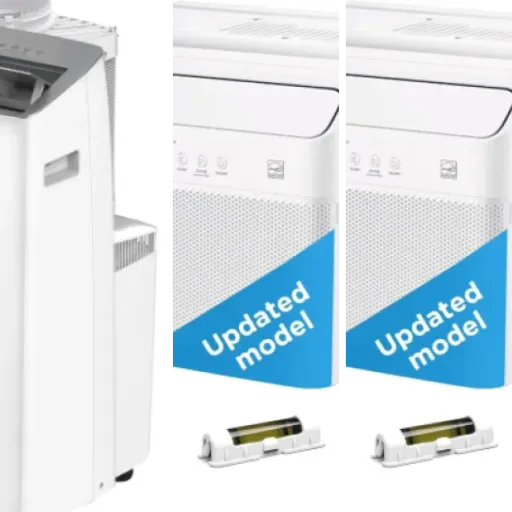
The included kit is fairly complete: window bracket for sliding windows, a fabric window seal for awkward windows (casement, awning, etc.), hose, connectors, drain hose, and adhesive tape. In theory it supports most window types. In practice, like one of the Amazon reviews said, if you have high, outward‑opening windows and the hose is just a bit too short, you’ll be improvising or swearing. The seal kit works, but it’s not plug‑and‑play neat; you need to spend a bit of time getting it tight.
Overall, as a package it feels pretty complete for the price: all the basic modes, remote+app, and a reasonably thought‑out accessory pack. It’s not some premium smart‑home centrepiece, it’s a white box that blows cold air and gives you enough control options so you don’t have to get up from the sofa all the time. That’s about it, and that’s fine.
How well the 4‑in‑1 modes actually work
Let’s break down the 4‑in‑1 claim. Cooling mode is clearly the main event and it works well. The unit hits the set temperature reliably, and the airflow is strong enough that you don’t need to sit right next to it. For a typical UK/European summer heatwave, it’s more than enough to get a bedroom or office under control. It’s not going to handle a huge open‑plan area perfectly, but that’s not really what 9000 BTU is for.
Fan mode is basically just the AC without the compressor – so it’s a regular fan built into a big box. It circulates air fine, but if you only want a fan, a cheap pedestal fan is quieter and takes less space. I only use fan mode when the room isn’t hot enough to justify full cooling but I still want a bit of air moving. It’s a nice extra, not a selling point.
The dehumidifier mode is more interesting. On really damp or rainy days, it does pull out a lot of moisture. You’ll either need to empty the water occasionally or connect the drain hose for continuous drainage. I noticed the room feels less clammy after an hour or two in dehumidify, which helps comfort even if the temperature doesn’t change much. If you already own a dedicated dehumidifier, this won’t replace a strong one, but it’s completely usable as a backup or for occasional use.
Sleep mode is a mixed bag. It lowers the fan speed and tries to keep noise down while gently adjusting the temperature. In reality, it’s still not quiet enough for me to forget it’s there, but it is an improvement over full blast. If you can sleep with moderate background noise, it might be enough; if not, use it to cool the room first, then switch off. Overall, the unit delivers on all four modes, but cooling and basic dehumidifying are the only ones that feel truly strong. The others are nice add‑ons rather than big reasons to buy.
Pros
- Strong cooling for bedrooms and medium rooms; noticeably drops temperature within an hour
- WiFi app, remote, and timer make it easy to control and schedule
- Decent build quality with washable filter and included window kits for different window types
Cons
- Quite noisy when the compressor is running; not ideal for light sleepers
- Window solutions for push-out/high windows are clunky and may require DIY or extra parts
- Heavy and only semi-portable in practice, especially between floors
Conclusion
Editor's rating
After living with the DR.PREPARE 9000 BTU for a while, my overall take is simple: it cools very well, but it’s not quiet and not magic. In a bedroom or medium‑sized living room, it can drop the temperature quickly and make heatwaves much more bearable. The WiFi app and remote are genuinely handy, and the build feels solid enough to last several summers if you look after it. Dehumidifier mode is a nice bonus on muggy days, and the filters are easy to clean.
On the flip side, the noise level is noticeable, especially when the compressor runs. If you’re picky about sound at night, you’ll probably end up using it to pre‑cool rather than leaving it on while you sleep. The window solutions are workable but not as universal as the product page suggests, especially for high or awkward push‑out windows. And while the unit is on wheels, the weight means you won’t be hauling it up and down stairs constantly.
I’d recommend this to people who really struggle with summer heat in one or two key rooms, have at least one convenient window for venting, and don’t mind some background noise in exchange for proper cooling. If you want whisper‑quiet operation, have very tricky windows, or are on a tight budget and don’t care about WiFi or extra modes, you might be better off looking at either a cheaper, no‑frills portable AC or saving up for a split system instead.