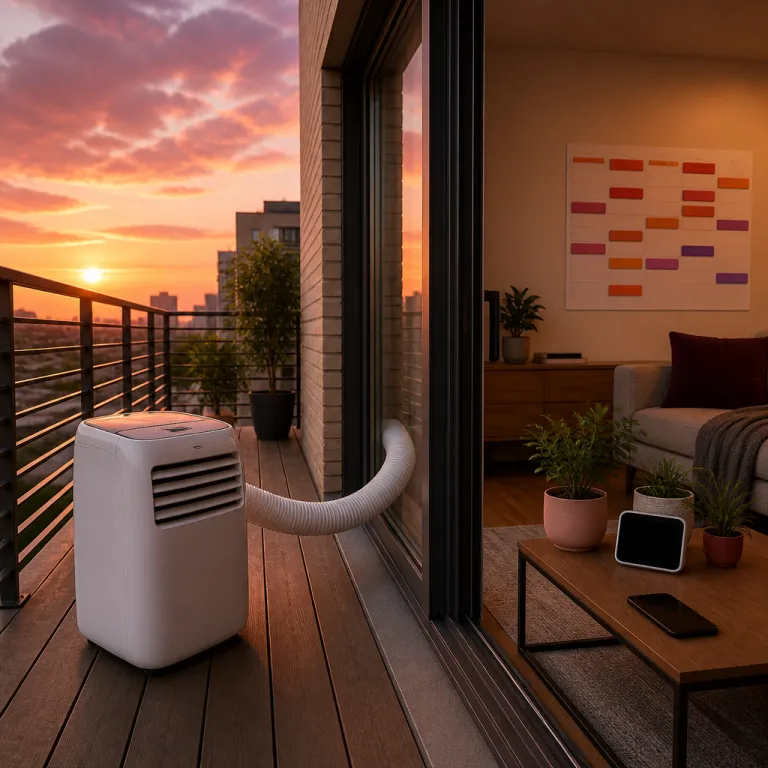
Smart portable ACs are only as good as their schedule brains
Most buyers searching for a smart portable air conditioner wifi app 2026 think WiFi is the headline feature. The reality is that the wireless chip in a smart portable air conditioner is just plumbing, while the schedule algorithm quietly decides whether your electricity bill spikes or your home office stays comfortable. If you work in a single hot room all afternoon, the difference between a basic timer and a genuinely smart air schedule can be the difference between a cool room and a sweaty video call.
Look closely at current smart portable air conditioners and you will see two very different philosophies. On one side are portable units that simply mirror the physical remote control in an app, giving you on, off, target temperature and maybe a crude sleep mode with a fixed noise level curve. On the other side are a handful of smart portable inverter designs that use occupancy patterns, outside air conditions and historical data to pre cool the conditioner room just before you need it, then ramp the inverter compressor down instead of cycling it on and off.
When you read marketing for a smart portable air conditioner wifi app 2026, you will see the same checklist repeated. WiFi, works with Alexa Google, quiet mode, 12 000 BTU, suitable for small rooms or large rooms up to some square feet number. What you rarely see explained is how the unit actually decides when to start pushing cold air into your living room or office, and whether its smart inverter logic can hold a stable temperature without constant fan noise or wasted energy.
The Whynter NEX ARC 1230WN, Midea Duo MAP14HS1TBL and Hisense HAP0824TWD all include WiFi and an app, but they do not behave identically. Midea’s Duo line uses a dual hose design and a variable speed inverter compressor, which lets the unit modulate BTU output more precisely to match the room load instead of blasting full power and then shutting off. In practice that means the portable air conditioner can keep a 20 square metre room at 24 °C with a lower noise level and less infiltration air from leaky window gaps.
Whynter’s app leans harder into automation, with weekly scheduling that actually respects how people use their rooms. You can set different start times and target temperatures for workdays and weekends, so the unit cools your home office room from 13:30 to 18:30 while leaving bedrooms and other rooms untouched. That kind of schedule control sounds simple, yet it is exactly what most smart portable air conditioners still fail to implement cleanly.
Hisense’s HAP0824TWD targets small rooms with a compact portable unit and a lighter BTU rating, but the same principle applies. If the app only lets you toggle power and adjust temperature, you will end up using it like a slightly fancier remote control and losing the chance to automate your day. A genuinely smart portable AC should help you forget about micromanaging air conditioners remote settings and instead focus on the work you do in that overheated corner of your apartment.
For a home office worker, the mission is simple. You want the best balance between a quiet conditioner and enough BTU capacity to cool room spaces that actually overheat, not the whole flat. That is why the smartest product is rarely the one with the flashiest app interface, but the one whose schedule logic matches your real life time at the desk and your real room size in square feet or square metres.
Remote on your phone is not smart — adaptive scheduling is
Most marketing around a smart portable air conditioner wifi app 2026 treats remote on off as a premium feature. In reality, turning a portable air conditioner off from the train is useful exactly once, the day you forget to hit the power button before leaving the living room. After that, the value comes from how the app lets you shape time, temperature and noise into a pattern that fits your work and sleep.
Look at the Whynter NEX ARC 1230WN and you will see a better template for smart portable control. Its app supports Alexa Google voice commands, weekly scheduling and per mode presets, so you can define a quiet sleep profile for bedrooms and a higher airflow profile for your office room without digging through menus every evening. When a smart portable AC works with Alexa or Google Assistant reliably, voice control becomes a natural extension of the remote control rather than a gimmick.
Midea’s Duo MAP14HS1TBL goes a step further with geo fencing that pre cools when your phone approaches home. That means the smart air conditioner can start ramping its smart inverter compressor 20 minutes before you walk into your hot office, using fewer BTU overall because it avoids the frantic full power blast against already overheated air. Used well, this kind of adaptive schedule can cut energy use by 15 to 20 percent compared with a dumb timer that simply turns the unit on at the same time every day regardless of weather or occupancy.
Hisense’s HAP0824TWD keeps things simpler but still benefits from thoughtful scheduling in small rooms. If you work from a compact office of 12 square metres, you can program the unit to start cooling just before your first call and then drop into a quieter sleep or eco mode once the sun moves off that window. The key is that the app must let you define multiple time blocks per day, not just a single on and off, or you will end up babysitting the conditioner like an old mechanical timer.
When you evaluate any smart portable air conditioner wifi app 2026, open the app store listing before you open your wallet. Read how users describe the schedule editor, whether the app crashes, and how long commands take to reach the unit when it works with Alexa or Google Assistant. A five second lag between saying a command and hearing the fan change speed might not sound like much, but it quickly becomes irritating when you are on a call and trying to tame noise from the air conditioners in your home.
For European buyers, Dreame’s P Wind10 portable units hint at where the market is heading. The P Wind10 integrates into a broader smart home ecosystem, so the AC can respond to window sensors, occupancy detectors and even dynamic electricity tariffs instead of just a fixed schedule. That is the kind of automation that turns a portable air conditioner from a standalone product into a responsive part of your home infrastructure.
If you want a concrete example of a well executed WiFi enabled portable air conditioner with a solid app, look at a detailed test of a low energy, low noise model with a flexible window kit and WiFi control such as the MeacoCool Pro series. A thorough review of a WiFi enabled portable AC with a dedicated app and a free flexible window kit shows how much difference a good schedule interface and low noise design can make to real world comfort. Once you have lived with a quiet, properly scheduled unit, going back to a basic timer on a loud conditioner feels like stepping back a decade.
Why dual hose, inverter compressors and geo fencing beat raw BTU numbers
Every summer, spec sheets for a smart portable air conditioner wifi app 2026 shout BTU ratings as if they were horsepower. The uncomfortable truth is that a badly designed 14 000 BTU single hose portable air conditioner can cool room spaces less effectively than a 10 000 BTU dual hose smart inverter model with a better schedule algorithm. What matters is not just how much heat the unit can move in a lab, but how it handles infiltration air, cycling losses and the real thermal behaviour of your rooms.
Dual hose portable units like the Midea Duo MAP14HS1TBL pull intake air from outside and exhaust it back out, instead of sucking conditioned air from your room and throwing it out the window. That design reduces negative pressure, which in turn cuts the stream of hot outside air sneaking in through door gaps and leaky window frames. Pair that with an inverter compressor that can modulate output and you get steadier temperatures, lower noise and less wasted energy than a traditional bang bang compressor that slams on and off.
For a home office of around 25 square metres, a well tuned 10 000 to 12 000 BTU smart portable AC with a dual hose and a good schedule will usually outperform a louder 14 000 BTU single hose unit in perceived comfort. The reason is simple, because the quieter unit can run continuously at a lower fan speed, maintaining a stable air temperature and humidity instead of swinging wildly. When the schedule algorithm knows your occupancy pattern, it can start cooling earlier at a lower power level, which is both more efficient and more comfortable than a late, noisy blast.
Geo fencing, as implemented in the Midea Duo app, is one of the few genuinely smart features that changes how you use a portable air conditioner. Instead of setting a fixed time, you let the unit infer when you are likely to arrive and adjust its start time based on your phone’s location and the current room temperature. That is a far cry from the typical smart portable air conditioner wifi app 2026 that only offers a basic countdown timer and a token sleep mode.
Voice control through platforms that work with Alexa or Google Assistant can be helpful, but only when the underlying schedule is solid. Saying a command to an AC that already knows your preferred sleep temperature and noise level is a pleasure, while shouting at a poorly designed app to fix a too cold conditioner room at 3 a.m. is just a band aid. In practice, the best use of voice is to handle exceptions, like starting the living room unit early on an unusually hot day or nudging the temperature during a long meeting.
Some buyers look at evaporative coolers as an alternative to compressor based portable air conditioners, especially in dry climates. A detailed guide on how a swamp cooler can transform your portable air conditioning experience shows that these devices move a lot of air with very low energy use, but they do not replace a true air conditioner in humid regions. If you live where summer humidity is high, you need a refrigerant based conditioner with enough BTU capacity and a smart schedule, not just more airflow.
When you compare products, resist the urge to chase the highest BTU number or the flashiest smart air branding. Focus instead on whether the unit is a dual hose or single hose design, whether it uses a smart inverter compressor, and how granular its scheduling and automation triggers are. In the end, comfort comes from the temperature in your room at 15:00 on a sunny day, not from the marketing copy on the box.
How to match a smart portable AC to your room, noise tolerance and routine
Choosing a smart portable air conditioner wifi app 2026 for a home office starts with honest measurements. You need the real square feet or square metres of your room, the orientation of its window and a sense of how much equipment heat your computers and monitors add. Once you know that, you can pick a BTU range and a smart portable feature set that match your actual cooling load instead of a generic rule of thumb.
For many apartments, a 10 000 BTU portable air conditioner is the sweet spot for a 25 to 30 square metre office or bedroom, especially when the unit uses an efficient inverter compressor. A detailed guide to the 10 000 BTU portable AC sweet spot explains how this capacity can cool a roughly 28 square metre room without constantly tripping breakers or roaring at full speed. In practice, that means you can run the conditioner in quiet mode during calls and still keep the air comfortable, instead of shouting over fan noise.
If your living room or combined office and lounge is larger, you may need 12 000 to 14 000 BTU, but only if the schedule and airflow are well designed. A smart portable AC with a dual hose, a good window kit and a thoughtful app can often handle large rooms more gracefully than a basic high BTU unit that leaks air around a flimsy window panel. The goal is to cool room spaces evenly, not to blast cold air at one corner while the rest of the room bakes.
Noise is the other half of the equation for remote workers. Look for manufacturers that publish decibel ratings at different fan speeds, and treat any smart portable air conditioner wifi app 2026 that hides its noise level as a red flag. A difference of just 5 dB can be the line between a conditioner you forget about during a call and one that your colleagues hear through your microphone.
Sleep modes matter too, especially if your home office doubles as a bedroom. A well implemented sleep profile will gradually raise the setpoint temperature while lowering fan speed, keeping the room comfortable without the sudden compressor starts that can wake light sleepers. When the app lets you tie sleep mode to specific time blocks, you can have one profile for workdays and another for weekends, instead of constantly reprogramming the unit.
Before buying, spend ten minutes reading app store reviews for the specific smart portable model you are considering. Pay attention to comments about connectivity drops, schedule bugs and how reliably the unit works with Alexa or Google Assistant, because a flaky app will turn even the best hardware into a daily frustration. If multiple users mention that the conditioners remote functions lag or fail when the WiFi signal is weak, plan to place your router or an access point closer to the room where the unit will live.
Finally, think about maintenance and long term noise. Clean the air filters monthly during heavy use, check the window kit for gaps that leak hot air back into the conditioner room, and drain condensate as the manual recommends. A smart portable AC that starts quiet can become a rattling unit by the third summer if you ignore basic care, and no amount of scheduling intelligence will fix a clogged airflow path.
Key figures on smart portable ACs, energy use and comfort
- Adaptive scheduling that matches room occupancy patterns can cut portable air conditioner energy use by roughly 15 to 20 percent compared with fixed timers, according to field tests by several utilities in North America.
- Dual hose portable units with inverter compressors can reduce infiltration air losses by up to 30 percent compared with single hose designs, which translates into faster cooling and lower electricity bills for the same BTU rating.
- A 10 000 BTU portable air conditioner is typically suitable for cooling about 25 to 30 square metres, while a 14 000 BTU unit can handle roughly 35 to 40 square metres, assuming average insulation and ceiling heights.
- Noise levels for modern smart portable air conditioners range from about 50 dB on low fan speed to 60 dB or more on high, and every 3 dB increase represents roughly a doubling of perceived loudness for many listeners.
- Field measurements show that maintaining a stable indoor temperature with an inverter driven portable AC can reduce compressor cycling by more than 40 percent, which improves comfort and extends component life.
- App store analyses of popular smart portable AC brands indicate that connectivity and scheduling bugs account for a significant share of one star reviews, underscoring that the quality of the WiFi app is as important as raw cooling performance.