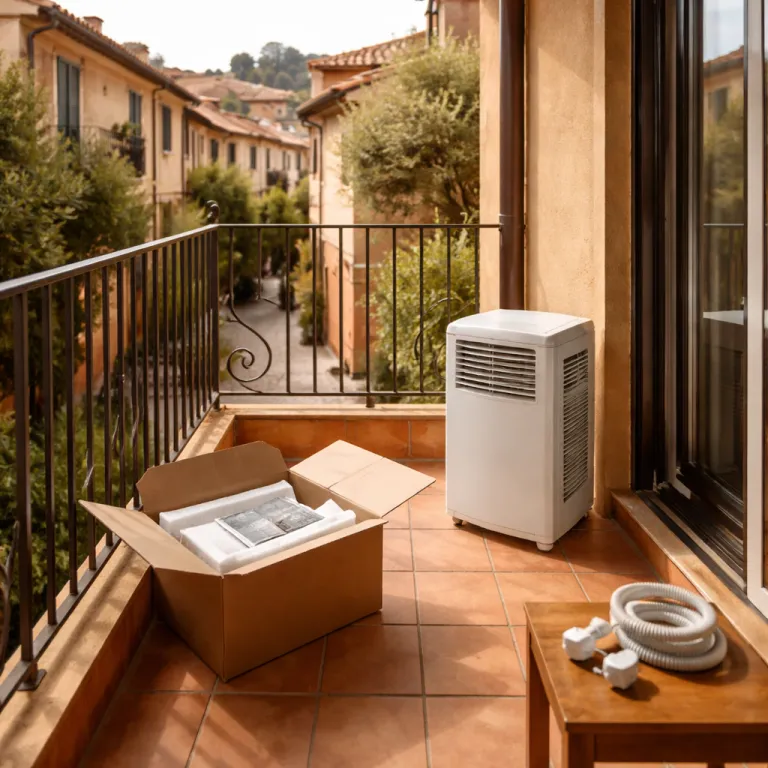
Dreame portable air conditioner P-Wind10 enters the single hose fight
The Dreame portable air conditioner P-Wind10 lands in Europe as a compact single hose unit aimed squarely at renters on tight budgets. Dreame, better known for its robot vacuums and cordless stick vacuums, is using the same high power motor and powered airflow know how to push into the portable air market with two P-Wind10 versions rated at 7,000 BTU for about 25 m² and 9,000 BTU for roughly 33 m² according to the company’s own coverage guidance. In practice that means one Dreame portable air conditioner P-Wind10 can realistically cool a full room bedroom or small living room, while the larger P-Wind10 handles a midsize open plan space where hot air tends to pool near windows.
For buyers comparing single hose portable air conditioner models, the Dreame wind design matters more than the marketing photos. A single hose system always pulls some warm infiltration air from hallways or leaky windows, so the Dreame portable air conditioner P-Wind10 leans on strong powered airflow and a tight window kit to limit that penalty and keep the air in the room feeling fresh rather than muggy. If you want a deeper dive into how single hose portable air conditioner units behave in real apartments, a detailed guide to top single hose portable air conditioners explains why placement, hose length and window sealing can matter as much as raw BTU numbers.
The Dreame air strategy is clear when you look at pricing, specs and features together. At a launch price of around 359 euros for the 7,000 BTU Dreame portable air conditioner P-Wind10 and 399 euros for the 9,000 BTU version in early European listings, Dreame’s own materials suggest it undercuts many established smart portable air competitors by roughly twenty to thirty percent while still offering Wi Fi app control, sleep mode, self evaporation and auto defrost. Typical single hose units in this size range draw roughly 800 to 1,000 watts on full cooling, which would translate to an estimated EER in the 7 to 9 range for the P-Wind10 depending on the final certified rating, and the company quotes a noise envelope of about 50 to 55 dB on low fan speed measured at one meter. That combination of a relatively small 12.0 × 11.2 × 27.6 inch chassis on casters, a three in one cooling and dehumidification mode, and a focus on clean lines that match Dreame robot vacuums and stick vacuums suggests the company sees air and floor cleaning as one connected smart home series rather than separate product silos.
Key Dreame P-Wind10 specifications at a glance
- Cooling capacity: 7,000 BTU or 9,000 BTU (manufacturer rating)
- Recommended room size: about 25 m² or 33 m²
- Dimensions: 12.0 × 11.2 × 27.6 inches (approximate)
- Estimated power draw: roughly 800–1,000 W on max cooling
- Noise level: about 50–55 dB on low fan, according to company data
- Functions: cooling, fan and dehumidification with self evaporation
- Included accessories: single exhaust hose, window sealing kit and remote control
From robot vacuums to portable air: what Dreame’s move means for buyers
Dreame built its reputation on robot vacuum models that mix strong suction power with smart mapping, and that same playbook now shows up in the Dreame portable air conditioner P-Wind10. The brand’s pro ultra and pro wet robot vacuums, along with the Dreame pro flexreach vacuum mop and wet dry cordless stick vacuums, already compete aggressively on price while keeping noise and maintenance under control, which is exactly what budget buyers want from a portable air conditioner in a small flat. When a company that already sells millions of vacuums and dry vacuums decides to add a wind portable series of air products, it usually means margins are thin and price pressure on incumbents will rise quickly.
The Dreame air and Dreame air purifier lines show how the firm treats air as a long term category rather than a side project. Company statements indicate its air and environment division reportedly reached on the order of tens of millions of US dollars in revenue within its first year, with early quarter growth described as several times higher year over year, and that kind of trajectory normally funds rapid iteration across air purifiers, portable air units and related accessories like filters or window kits. Those figures come from Dreame’s own briefings rather than independent financial filings, so buyers should treat them as indicative rather than audited. For a first time buyer comparing a Dreame portable air conditioner P-Wind10 to a no name shop brand conditioner on a marketplace, that scale still matters because it usually translates into better spare part availability, more frequent firmware updates for smart features and a clearer roadmap for future models in the same series.
North American shoppers should pay attention even though the Dreame portable air conditioner P-Wind10 currently sells only in Spain, France and Germany based on the initial European rollout. Dreame held its DREAME NEXT event in San Francisco to signal a broader push into the United States, and its MF10 bladeless fan has already appeared near the top of the sales rankings in at least one major online shop according to retailer charts at the time of launch, which suggests that a Dreame wind portable air conditioner for that market is more a question of timing than intent. If you want to understand how quiet a well designed unit can be during a late night video call, a specialist comparison of portable ACs that stay under about 45 dB gives useful context for judging whether the P-Wind10’s quoted noise levels will really fade into the background in a small bedroom.
Living with the P-Wind10: single hose trade offs, maintenance and air quality
Using a Dreame portable air conditioner P-Wind10 day to day feels closer to running a compact air purifier than a clunky old air conditioner, especially if you already own a Dreame air purifier or other air purifiers from the same brand. The chassis has the same rounded edges and understated white finish as Dreame robot vacuums, and the top panel uses a simple smart control layout that mirrors the company’s robot vacuum app, which helps first time buyers avoid the usual maze of cryptic icons and buried timer settings. Once you set a target temperature and fan speed, the powered airflow pushes a steady wind of cool air across the room within about fifteen to twenty mins, though like any single hose unit it works best when doors stay closed and curtains block direct sun.
Maintenance on the Dreame portable air conditioner P-Wind10 is straightforward but still matters if you care about fresh and clean indoor air. You need to rinse the washable filters regularly, just as you would clean the roller brush on a Dreame robot vacuum or empty the dust bin on a cordless stick vacuum, because clogged filters reduce high power output and make the compressor run longer for the same cooling effect. Anyone sensitive to hair, dust or pollen should think of the P-Wind10 as one part of a broader Dreame air ecosystem that includes a dedicated air purifier for continuous filtration, since the portable air conditioner’s built in filter is designed mainly to protect the internal components rather than replace a full size purifier.
For shoppers weighing a 7,000 BTU Dreame portable air conditioner P-Wind10 against other compact units, independent lab tests of a 7,000 BTU portable air conditioner in a 15 m² room typically show a drop of several degrees Celsius within the first half hour, which offers a useful benchmark for realistic cooling expectations. A single hose conditioner will never match the efficiency of a dual hose design, but for renters who cannot drill walls or install split systems, a well sealed window kit, careful hose routing and regular filter cleaning can narrow the gap enough that comfort, not theoretical efficiency, becomes the deciding factor. In that sense the Dreame portable air conditioner P-Wind10 fits the same philosophy as the brand’s floor care products, where the real measure of performance is not the wattage on the box but how cool and breathable the full room feels at three in the afternoon during a heat wave.