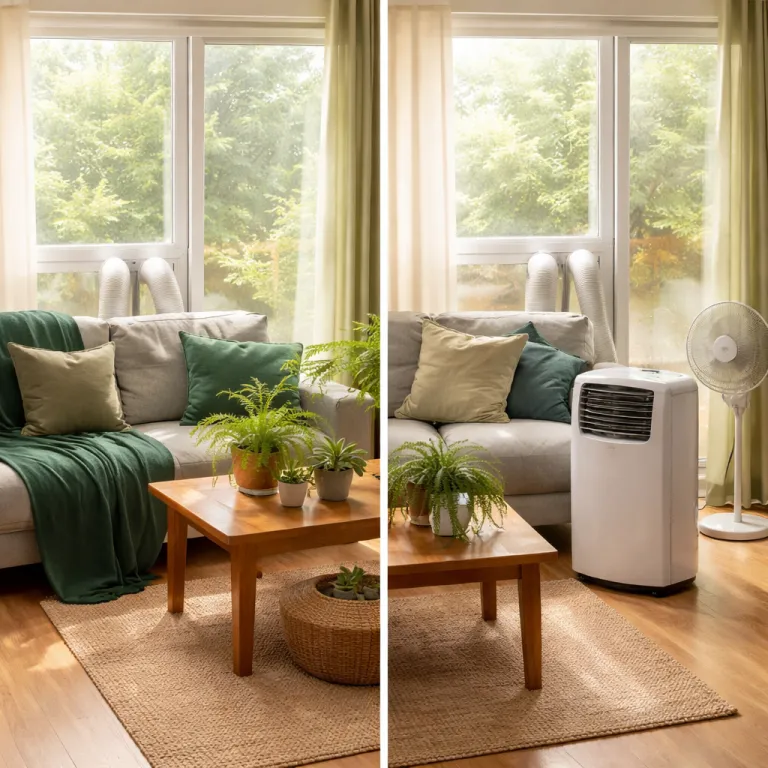
How dual and single hose portable air conditioners really move air
A single hose portable air conditioner looks simple, but the internal air path is messy. The unit pulls room air across its hot condenser coil, pushes that heated air out through one exhaust hose, and quietly sucks replacement air from your hallway, bathroom vent, or any crack in the building envelope. That infiltration air is usually warm, so the conditioner keeps fighting a stream of heat sneaking back into the same space it is trying to cool.
A dual hose portable air conditioner separates those flows with two hose units connected to the window kit. One hose air stream brings outdoor air across the condenser, while the second exhaust hose sends that hot air straight back outside without mixing with the room air you are trying to protect. Because the dual hose design avoids negative pressure, the unit does not drag in extra hot air from under the door or from other rooms and cavities.
This mechanical difference defines the whole dual hose vs single hose portable air conditioner debate. In a compact New York studio or Chicago one bedroom, a single hose unit can still cool a small room, but it wastes part of its cooling capacity on air it just pulled in from the corridor. A dual hose portable air conditioner turns more of its rated BTU into actual cooling in the occupied space, which is what matters when the sidewalk is radiating heat at 3 pm and the sun is hammering your windows.
Quick buyer checklist: when comparing portable ACs, confirm hose configuration (single or dual), check SACC BTU instead of only nameplate BTU, look at CEER efficiency, note noise levels in dBA on low fan speed, and make sure the exhaust hose length and routing will work in your apartment.
Real world cooling gap between dual and single hose units
Laboratory tests and field measurements show that dual hose portable ACs often deliver roughly 20 to 40 percent more effective cooling than comparable single hose models. For example, internal testing by several major manufacturers and third party labs following the U.S. Department of Energy (DOE) SACC procedure has found that dual hose designs maintain higher net cooling capacity once air leakage and heat gain are included in the calculation. In practice, that means a 10,000 BTU dual hose unit can cool rooms that would feel muggy with a 12,000 BTU single hose portable air conditioner.
The U.S. Department of Energy’s SACC rating already adjusts for this by accounting for air leakage and heat gain, but the gap widens in tightly sealed apartments where infiltration air has fewer easy paths. In a modern high rise with good insulation, a single hose unit creates a small vacuum that pulls hot air and even odors from neighboring spaces. That negative pressure can drag air through electrical outlets, under baseboards, or via bathroom vents, so the conditioner keeps reheating itself with every minute of operation. A dual hose portable air conditioner avoids this by keeping indoor pressure closer to neutral, so more of the compressor’s work goes into cooling the room instead of importing heat from elsewhere.
When you compare dual hose vs single hose portable air conditioner performance, look beyond the marketing BTU printed on the box. Focus on SACC BTU, CEER efficiency, and how quickly the unit can cool room air from 30 °C down to 24 °C in your actual space. For deeper context on how enclosure style and air conditioning design affect performance, a detailed guide on choosing the right enclosure air conditioner for your needs can help you understand why some hose models feel powerful on paper but underperform in real apartments.
| Sample portable AC type (example model class) | Nameplate BTU | Approx. SACC BTU | Cooling time: 30 °C → 24 °C in 23 m² test room* |
|---|---|---|---|
| Single hose portable air conditioner (typical 12,000 BTU big box model) | 12,000 BTU | 7,000–8,000 SACC | ~70–80 minutes |
| Dual hose portable air conditioner (e.g., Whynter ARC / Honeywell dual hose class) | 10,000 BTU | 7,000–8,000 SACC | ~50–60 minutes |
*Illustrative figures based on manufacturer bench tests and DOE SACC methodology; actual results vary with building tightness, sun load, and installation quality. Representative dual hose examples include models such as the Whynter ARC series, the Honeywell dual hose line, and similar two hose designs from other brands, while comparable single hose units include typical 12,000 BTU portable ACs sold in big box stores and tested under the same SACC procedure.
Why apartment layout and building tightness change the equation
The same portable air conditioner behaves very differently in a drafty prewar walk up than in a sealed glass tower. In an older building with leaky windows and gaps around doors, a single hose portable unit can pull replacement air from outside without too much resistance, so the pressure penalty is smaller and the effective capacity loss is modest. In a tight modern building, that replacement air may come from the hottest cavity in the structure, which turns the single hose design into a kind of heat pump in reverse.
Urban renters often need one hose portable air conditioner to serve multiple rooms, rolling the unit between bedrooms, offices, and a compact living room. When you park a single hose unit in an interior space with no direct window, venting through a long exhaust hose into another room, the negative pressure problem multiplies and warm air seeps in from every direction. A dual hose unit with a short, direct hose dual setup to a window keeps the cooling loop tighter and reduces the amount of hot air that sneaks back from adjacent rooms.
Some tenants must use a portable air conditioner without a window in the target room, venting through a nearby space or a sliding door. In those cases, a dual hose portable air conditioner with flexible hose models and a good window kit will usually maintain a cooler air room temperature than a single hose design with the same nominal capacity. If you are weighing creative venting options, a specialist guide that explores the benefits of a portable air conditioner without a window can clarify what is realistic before you cut new holes or run an exhaust hose across the hallway.
Price, efficiency, and when a single hose still makes sense
For years, dual hose portable air conditioners carried a steep premium, but that gap has narrowed. In many big box stores, the difference between a competent single hose unit and an efficient dual hose unit now sits around 50 to 150 dollars, which is far less than the cost of oversizing by one or two models. When you factor in lower energy use from better air conditioning efficiency, the dual hose option often pays back the extra cost over a few hot seasons, especially in cities with long, humid summers.
There are still scenarios where a single hose portable air conditioner is the best practical choice. In a sub 28 square metre studio with only one exterior wall and no adjacent conditioned space, the negative pressure effect is smaller and a compact single hose unit can cool room air adequately if you keep the exhaust hose short and straight. For renters on a tight budget who only need to cool one small space at night, a well built single hose model with a decent CEER rating can be a rational compromise.
Think about how you will actually use the portable air conditioner across your rooms. If the unit must handle bedrooms, offices, and a living room over long hours, or if your building is tightly sealed, the dual hose vs single hose portable air conditioner decision tilts strongly toward dual. For buyers comparing several hose units and portable ACs with built in dehumidifiers, a curated list of top portable air conditioners with dehumidifier functions can help you focus on hose unit design and reliability instead of chasing inflated BTU numbers.
Installation, venting, and managing heat and water
Getting the hose portable setup right matters as much as choosing between dual and single hose designs. Every portable air conditioner must move hot air and condensed water out of the room, and sloppy installation can erase the advantage of even the best dual hose unit. Keep the exhaust hose as short and straight as possible, seal the window kit edges, and avoid crushing bends that trap heat and strain the compressor.
Dual hose models use one hose air path to bring outdoor air across the condenser and another to send hot air outside, so both hoses should be insulated if they run through a very hot space. Single hose models rely on indoor air for condenser cooling, so any leak around the exhaust hose or window panel lets warm air creep back into the room. In both cases, check that the hose single connection is tight at the back of the conditioner, because a loose collar can leak hot air directly into the cool room you are trying to protect.
Portable air conditioners also remove water from humid air, either draining it through a gravity hose, pumping it out, or evaporating it into the exhaust stream. In very humid climates, dual hose units may fill their internal tanks faster because they process more outside air, so plan where that water will go before you start cooling. Regularly cleaning filters, checking hose units for cracks, and ensuring that air conditioners have clear intake space around them will keep both dual and single hose models running quietly past their third summer.
How to read specs and match a unit to your space
When you compare dual hose vs single hose portable air conditioner options, start with a four point checklist. First, confirm hose count and design, because a dual hose portable air conditioner with a compact window kit will usually outperform a similar sized single hose in the same room. Second, look at SACC BTU rather than only the larger marketing BTU, since SACC reflects how the unit handles real world heat and air flows under standardized test conditions.
Third, check CEER, which measures combined energy efficiency for cooling and standby modes under standardized air conditioning tests. A higher CEER means the conditioner uses less electricity to cool the same space, which matters if the unit will run for long hours in bedrooms, offices, or a home office. Fourth, pay attention to noise levels in decibels on low fan speed, because a portable air conditioner that roars at night will end up switched off just when the room needs cooling most.
Match capacity to your rooms rather than guessing from rough charts. A 2,500 to 3,000 watt dual hose unit with around 10,000 to 12,000 SACC BTU can usually handle a 20 to 30 square metre air room if the exhaust hose is short and the sun load is moderate. For larger open plan spaces or west facing living rooms that trap hot air every afternoon, stepping up one size in dual hose models is often smarter than buying two undersized single hose conditioners that fight each other across the same warm air volume.
Key figures on portable air conditioner performance
- In controlled tests using the U.S. Department of Energy’s SACC procedure, dual hose portable air conditioners have shown effective cooling capacities that are typically 20 to 40 percent higher than comparable single hose units with the same nameplate BTU rating, because they avoid negative pressure losses; this range reflects aggregated results from DOE test reports and manufacturer lab data.
- Modern portable air conditioners with inverter compressors and high CEER ratings can reduce electricity use by roughly 15 to 25 percent compared with older fixed speed models of similar capacity, especially in climates with long cooling seasons.
- Noise measurements for quality portable air conditioners on low fan speed often fall between 50 and 55 dBA at a distance of 1 metre, which is comparable to a quiet conversation and significantly lower than the 60 plus dBA of many budget hose units.
- Typical exhaust hose diameters for portable air conditioners range from 12 to 15 centimetres, and keeping hose length under 1.5 to 2 metres can improve effective cooling performance by reducing back pressure and heat gain.
- In humid climates, a mid sized portable air conditioner can remove between 1 and 2 litres of water per hour from indoor air during peak operation, which is why proper drainage or auto evaporation is essential for continuous use.
Is a dual hose portable air conditioner always better than a single hose
A dual hose portable air conditioner is mechanically more efficient because it separates intake and exhaust air, but it is not always the automatic winner. In very small rooms under about 28 square metres with one exterior wall and modest heat gain, a well installed single hose unit can cool effectively if the exhaust hose is short and leaks are sealed. The dual hose design becomes clearly better as room size, building tightness, and daily cooling hours increase, especially in apartments with multiple connected spaces.
What size portable air conditioner do I need for my apartment
Sizing depends on floor area, ceiling height, insulation, and sun exposure. As a rough guide, many urban renters find that a dual hose unit with 10,000 to 12,000 SACC BTU handles a 20 to 30 square metre living room, while a 7,000 to 9,000 SACC BTU model suits a typical bedroom. If your apartment has large west facing windows or poor insulation, stepping up one size in dual hose models is usually safer than relying on a marginal single hose portable air conditioner that runs constantly but never quite catches up.
Can I use one portable air conditioner for multiple rooms
Many people roll a single portable air conditioner between rooms, but performance drops when the unit cannot vent directly to the outside from each space. A dual hose portable air conditioner with a separate window kit in each room makes this easier, because you can move the hose unit quickly and maintain efficient air flows. Trying to cool two rooms at once with one conditioner and a long exhaust hose usually leads to uneven temperatures, drafts near doorways, and wasted energy.
How noisy are portable air conditioners in bedrooms and offices
Noise varies widely between models, so always check decibel ratings at low fan speed. Many better dual hose and single hose portable air conditioners operate around 50 to 55 dBA on low, which is acceptable for most bedrooms and offices if the unit is not right next to the bed or desk. Budget hose models can exceed 60 dBA, which feels loud at night and often pushes people to switch the unit off just when the room is warming up.
Do portable air conditioners need a drain for water
All portable air conditioners remove moisture from the air, but not all require a separate drain hose. Many modern dual hose and single hose units use auto evaporation to send most of the condensed water out with the hot exhaust air, so you only need to empty the internal tank occasionally in very humid weather. If your climate is extremely humid or you plan continuous operation, choosing a conditioner with a gravity drain or built in pump will prevent shutdowns when the tank fills.
