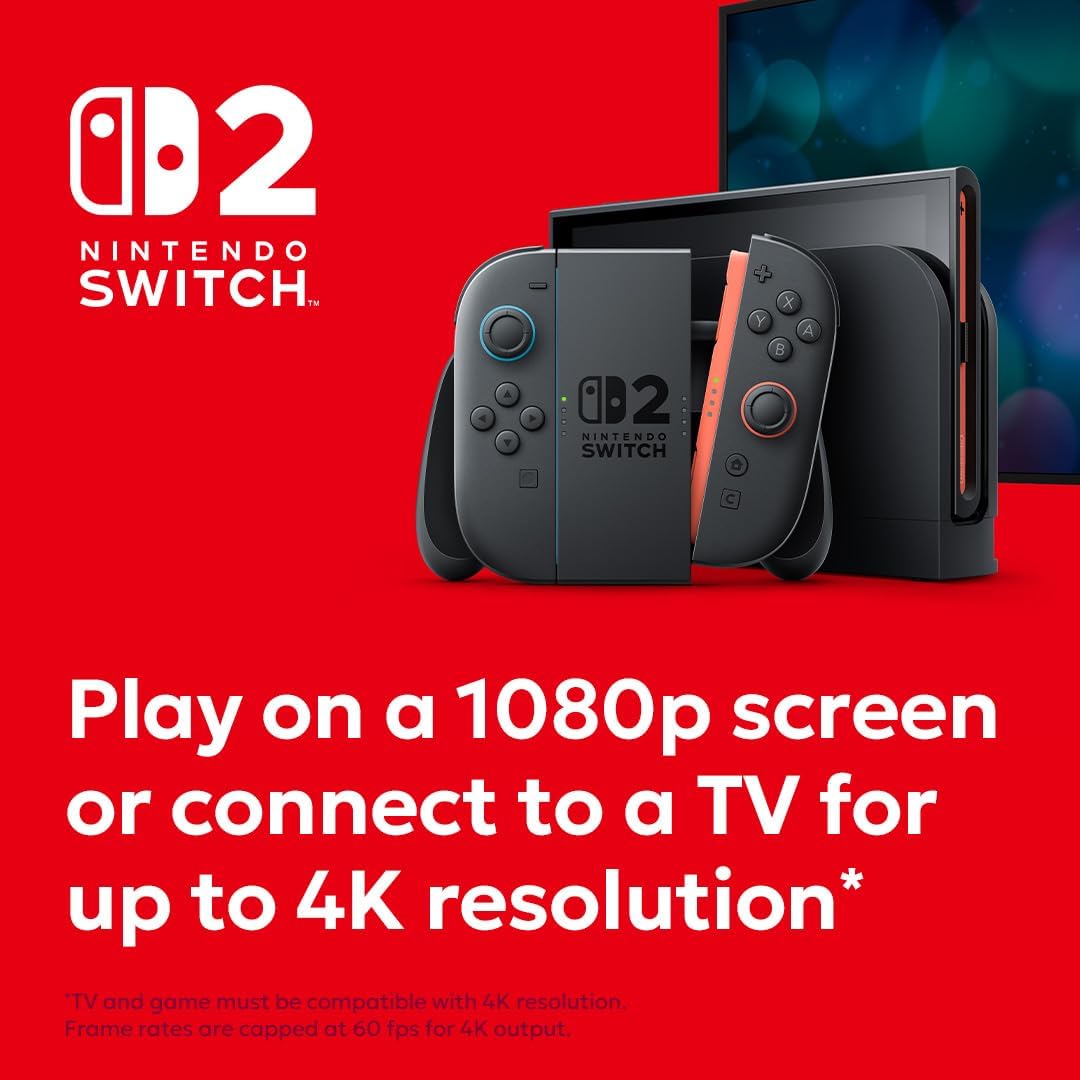
Summary
Editor's rating
Value for money: good upgrade, but the ecosystem adds up
Design: familiar, chunkier, and more serious
Battery life: acceptable, but still not all-day
Comfort: good, but plan on a grip for long sessions
Durability and build: feels sturdier, still needs care
Performance: clearly better, still not a PS5
What the Switch 2 actually offers in real life
Pros
- Noticeable performance and visual upgrade over the original Switch, especially in handheld
- Larger 1080p screen with HDR/VRR support and better overall build quality
- Magnetic Joy-Con 2 feel more solid, with improved rumble and mouse-style use in some games
Cons
- Battery life still limited for long portable sessions with demanding games
- Ecosystem costs add up (microSD Express, camera, online membership, accessories)
- Some Nintendo Switch games may not be fully supported or optimised on Switch 2

Specifications
View full product page →| Brand | Nintendo |
A proper upgrade, not a revolution
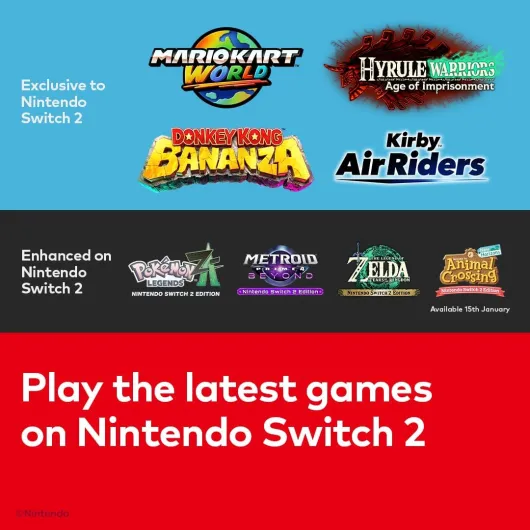
I’ve been using the Nintendo Switch 2 for about three weeks now, mostly in the evenings after work and a couple of long weekend sessions. I came from the original launch Switch, so I’m exactly the target user: someone who already knows the ecosystem and just wants better performance and a nicer screen without switching to PlayStation or Xbox. I’ve played Mario Kart World, Zelda TOTK, a bit of Donkey Kong, plus some older Switch titles to see how they behave.
First blunt take: this is clearly better than the first Switch, but it’s not some magic box that suddenly turns Nintendo into a pure 4K powerhouse. If you’re used to a PS5 or a high-end PC, you’ll still see limits. But if you’ve been stuck on the old Switch for years, the jump in sharpness, colours and loading times is very noticeable. It just feels more modern and less like a tablet from 2017.
What stood out to me right away was the screen quality in handheld mode and the much more solid feel of the new Joy-Con 2 controllers with the magnetic connectors. It feels less toy-like than the first Switch, even if the overall design is still very Nintendo: practical, a bit chunky, and focused on family use. Battery life is okay, not mind-blowing, but acceptable considering the better graphics.
So, overall, my early impression is: nice upgrade if you already like Nintendo games and you can live with some compromises. It’s not perfect, some choices are a bit annoying (new microSD Express, separate camera, some old games not fully compatible), but in daily use it does the job and clearly improves the experience over the original Switch.
Value for money: good upgrade, but the ecosystem adds up
On the money side, the Switch 2 isn’t cheap, and you feel it when you start adding things up: console, games that are now often more expensive, microSD Express card if you need more space, maybe the Nintendo camera for GameChat, plus a grip or a Pro-style controller if you want better comfort. The base console itself feels fairly priced for what it offers compared to the old Switch, but the ecosystem around it can quickly push the total cost up.
Compared to buying a PS5 or Xbox Series X, the Switch 2 is generally cheaper up front and uses less power, but it’s also less powerful. So the value really depends on how much you care about Nintendo exclusives like Mario Kart World, Zelda, Donkey Kong, etc. If you mainly want those games and you already have a decent TV with HDR and 4K, then you’re actually getting a good mix of portability and living-room play for the price. If you don’t care about Nintendo’s catalogue, there are better pure performance options elsewhere.
Another thing to keep in mind is the online and accessories: Nintendo Switch Online membership for online features, possible camera purchase for video chat, and those new microSD Express cards that aren’t the cheapest right now. It’s a bit annoying that some accessories from the old Switch era don’t carry over perfectly, and that some old games may not be fully compatible. That slightly hurts the feeling of value for long-time users who invested a lot previously.
Overall, I’d say the Switch 2 offers solid value if you’re already in the Nintendo camp or you really want a hybrid console. It’s not the budget option, and it’s not the raw power king, but it finds a good middle ground. If you’re price-sensitive and don’t care about playing Nintendo exclusives at launch, you might be better off waiting for price drops, bundles, or the second-hand market.
Design: familiar, chunkier, and more serious
Design-wise, the Switch 2 doesn’t try to reinvent the wheel. If you put it next to the original Switch, you immediately see it’s from the same family: central screen, detachable Joy-Cons, dock for the TV. The differences are in the details. The console is heavier, but in a good way: it feels more solid and less like a plastic toy. After a few days, I stopped noticing the extra weight, but I did notice the better balance when holding it in handheld mode.
The most obvious upgrade is the larger 1080p screen. Bezels are thinner, colours are more vivid, and text is much easier to read in games with lots of menus. Playing Zelda or Harry Potter in handheld mode is way more comfortable than on the original Switch. I didn’t need to lean in or squint as much to read small text. At the bar or on the couch, you just drop it on the table and it looks sharper and more modern, even if it’s not the fanciest screen on the market compared to high-end phones.
The dock is pretty basic visually, black plastic, but it does the job. You plug HDMI to your TV, power cable, slide the console in, and that’s it. It supports up to 4K with HDR and VRR on compatible TVs, but don’t expect the interface to be flashy. It’s still Nintendo: simple icons, basic menus, nothing that screams high-end design, but it’s clear and functional. I’d say the overall look is practical and neutral rather than stylish.
If you’re into super sleek, ultra-thin electronics, this won’t impress you. But if you liked the original Switch and just wanted something that feels less flimsy and more like a proper piece of kit, the Switch 2 goes in that direction. It’s not pretty in a fancy way, but it feels sturdier and more mature, which is what matters more to me when I’m actually using it.
Battery life: acceptable, but still not all-day
Battery life is always a sore point with portable consoles, and the Switch 2 is no exception. It’s better than my launch Switch, but it’s not some miracle device that gives you a full day of heavy gaming. On average, playing something demanding like Zelda or Donkey Kong at decent brightness, I got around 3 to 4 hours before needing to plug it in. With lighter indie games or just menu browsing and a bit of eShop, I could push it closer to 5 hours.
In practice, that means it’s fine for commuting, evenings on the couch, or a couple of hours in bed, but not ideal if you plan to play a lot on a long trip without access to a charger. I ended up keeping a USB-C power bank nearby on a weekend away, just like I did with the first Switch. The better screen and performance obviously eat more power; you can feel it when you raise brightness and play something more graphically heavy: the battery gauge drops faster.
Docked, obviously, battery is not an issue since it’s charging all the time. Also, the console doesn’t seem to get too hot in handheld mode, which is good. It gets warm, but I never felt it was uncomfortable to hold. Fan noise is also pretty reasonable. I could hear it in quiet rooms during heavy scenes, but it never turned into a mini jet engine like some laptops.
Overall, I’d call the battery decent but nothing special. It’s good enough that it doesn’t ruin the experience, but it’s not a selling point either. If your main use is at home, mostly docked, you won’t care. If you mainly want a travel console for long offline trips, you’ll probably want a power bank and to manage brightness and Wi‑Fi to stretch it a bit.
Comfort: good, but plan on a grip for long sessions
Comfort was one of my main concerns because the original Switch gave me cramped hands after long sessions. The Switch 2 is heavier but better balanced, which helps, but the basic shape is still a flat slab with small controllers on the sides. For short play sessions (30–45 minutes), it’s fine. For anything longer, especially with action-heavy games, I started to feel the same hand fatigue as with the original model.
After a few days, I bought a third-party grip, just like I did with the first Switch. With that, handheld sessions of 2–3 hours became much more bearable. So if you know you like to play in handheld a lot, I’d honestly budget for a grip from the start. It’s not that the console is unusable without it, but the ergonomics are still clearly designed around portability and not around perfect hand comfort.
The Joy-Con 2 controllers themselves feel nicer. The magnetic connectors are more reassuring than the old rails, and the buttons and sticks feel a bit more precise. I haven’t had any drift yet (fingers crossed), and the rumble is well tuned: noticeable without being too noisy or buzzy. Each Joy-Con can also act like a mouse in supported games, which is a weird but occasionally handy feature when navigating certain menus or mini-games, though I wouldn’t say it changes much in daily use.
Overall, in terms of comfort, I’d say: handheld is decent but not perfect, docked with a proper controller is very comfortable, and tabletop mode is okay if you’re close enough to the screen. Nintendo hasn’t solved the ergonomics issue entirely, but they’ve made small improvements. If you struggled with the original Switch, expect it to be a bit better, but you’ll probably still want some accessories to make it truly comfortable for long gaming nights.
Durability and build: feels sturdier, still needs care
In terms of durability, after three weeks of daily handling, the Switch 2 feels more solid than the original Switch, especially around the Joy-Con connections. The magnetic connectors give a more secure, clean connection, and I haven’t noticed any wobble or creaking like I had on my old console after a few months. The plastic still feels like Nintendo plastic – not premium metal, but dense enough that it doesn’t feel flimsy.
I’ve thrown it into a backpack a few times (in a basic sleeve, not a hard case), and it survived just fine. No visible scratches on the screen so far, but to be honest, I slapped a screen protector on it on day one, because I learned my lesson with the first Switch and its dock scratches. Speaking of the dock, sliding the console in and out feels smoother and less risky this time, but I still wouldn’t do it without a protector if you’re picky about marks.
As for the Joy-Con 2 durability, it’s obviously too early to judge long-term stick drift, but the sticks feel a bit more robust and precise. If Nintendo really fixed drift, that will be a big win, but we’ll only know after a year of use. The buttons and triggers feel solid, with a clear click that doesn’t feel mushy. I haven’t dropped the console hard yet (and I’d rather not test that), but from its weight and build, it feels like it could survive a small fall on a sofa or carpet without instantly breaking.
So far, I’d say the Switch 2 gives a more reassuring feeling than the first model, but it’s still a device you should treat with care: get a case, get a screen protector, and don’t expect it to survive being sat on or dropped on concrete. It’s sturdier, not indestructible. For normal home use and travel in a bag, it seems perfectly fine.
Performance: clearly better, still not a PS5
Performance is where I felt the biggest jump compared to my old Switch. Games like Mario Kart World and Zelda: Tears of the Kingdom run much more smoothly, especially in busy scenes. On the original Switch, I was used to frame drops in intense moments; on the Switch 2, it’s still not perfect, but it’s a lot more stable. The 60 fps cap in 4K is fine for most games, and the combination of HDR and VRR on a compatible TV makes motion look cleaner and less jerky.
In handheld mode, the 1080p resolution makes a big difference in clarity. Text is sharper, distant objects look less blurry, and overall the image looks more detailed. I tried going back to my old Switch after a few days and honestly, it felt dated. Load times are shorter too. Nothing blazing fast like an SSD-based PS5, but enough that you notice you’re not staring at loading screens as long, especially when fast travelling or restarting levels.
That said, if you come from a high-end PC or newer Xbox/PlayStation, you’ll still see the gap. Some games clearly run at lower resolutions internally and upscale, and you can tell in certain scenes. Also, not all titles will hit 60 fps all the time, even though the system supports up to 120 fps on paper. I haven’t seen anything close to 120 fps personally; I see it more as headroom for simpler games and maybe future titles.
Where performance really pays off is in overall responsiveness: navigating the home menu, opening the eShop, switching between games, and using GameChat all feel more fluid. It’s not perfect, but it’s finally at a level where it doesn’t feel stuck in the past. If you stick to Nintendo’s own big games, you’ll probably be happy. If you expect PC-level performance in a portable console, you’ll be disappointed. For me, as a regular Switch user, the performance jump is solid and actually noticeable in day-to-day gaming.
What the Switch 2 actually offers in real life
On paper, the Switch 2 looks pretty ambitious for a hybrid console: 1080p handheld screen, up to 4K output on a compatible TV, HDR, VRR, and frame rates that can go up to 120 fps in theory. In practice, most big games will sit around 60 fps max in 4K and often lower in handheld, but that’s normal for a portable device. The important part is that it feels smoother and sharper than the old Switch, especially in busy scenes in Mario Kart World or Zelda.
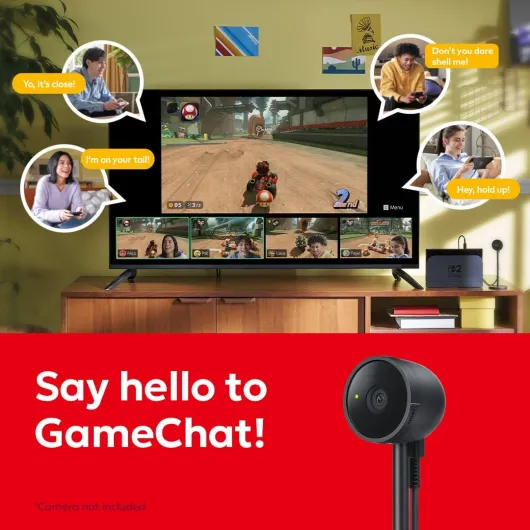
The console still works in three main modes: handheld, docked to the TV, and tabletop with the controllers detached. Nothing new there conceptually, but the execution is more polished. The GameChat feature is clearly Nintendo’s way to catch up on modern online play: you can start a chat with the C button, share your game screen, and even use a camera (Switch 2 camera or a compatible USB-C camera) for face-to-face stuff. It’s not revolutionary, but it finally avoids juggling with a phone app like before.
One important detail: not all old Switch games are fully supported or optimised. Most of the big ones work fine, but I had one smaller indie title that behaved weirdly (stutters and UI scaling issues). So don’t assume your entire old library will be perfect from day one. On the plus side, the system itself feels faster: menus load quicker, eShop navigation is smoother, and suspending/resuming games is snappier.
In short, in day-to-day use, the Switch 2 is basically the Switch concept cleaned up and boosted: same idea, better screen, better controllers, more power, and finally half-decent online features. If you already know what a Switch is, this is that, just more pleasant to use. If you were waiting for a totally new concept with dual screens or something wild, this isn’t it.
Pros
- Noticeable performance and visual upgrade over the original Switch, especially in handheld
- Larger 1080p screen with HDR/VRR support and better overall build quality
- Magnetic Joy-Con 2 feel more solid, with improved rumble and mouse-style use in some games
Cons
- Battery life still limited for long portable sessions with demanding games
- Ecosystem costs add up (microSD Express, camera, online membership, accessories)
- Some Nintendo Switch games may not be fully supported or optimised on Switch 2
Conclusion
Editor's rating
After a few weeks of use, the Nintendo Switch 2 feels like what the original Switch should have been: better screen, better performance, sturdier Joy-Cons, and finally semi-decent online features with GameChat and camera support. It’s a clear upgrade if you’ve been on the first Switch for years. Games look sharper in handheld, run more smoothly on TV, and the whole system feels more responsive. You still hit technical limits compared to a PS5 or a gaming PC, but that’s the trade-off for portability.
It’s not perfect though. Battery life is okay but still not great, some old games may not be fully supported, and the cost of accessories (microSD Express, camera, extra controllers, grips) can creep up quickly. Comfort in handheld is better but still not ideal for very long sessions unless you add a grip. So who is it for? It’s a good choice if you already like Nintendo games and want a cleaner, more modern version of the Switch concept, especially if you play both on TV and handheld. If you mainly care about raw graphics and high frame rates, or you don’t care about Nintendo exclusives, you’ll probably get more for your money with another console.