Summary
Editor's rating
Is it worth the money compared to other portables?
Design and noise: big white box, but reasonably quiet
Daily comfort, sleep mode, and living with it
Build quality, filters, and what might break first
Cooling, dehumidifying, and real‑world performance
What you actually get with this HUMHOLD unit
Pros
- Dual‑hose + inverter combo gives faster, more efficient cooling than typical single‑hose units
- Quiet enough in sleep/low mode for most people to use in a bedroom (~42 dB claim feels realistic at low speed)
- Good at dehumidifying and offers mostly no‑drain operation in normal cooling, with easy filter access and included drain hose for humid rooms
Cons
- Fan completely shuts off in cooling mode when target temperature is reached, which some users find annoying at night
- Needs a strong 15A or ideally 20A circuit; on weak or crowded circuits it can shut off or trip breakers
- Window kit is basic plastic and works best only with standard sliding windows, so odd windows need DIY solutions

Specifications
View full product page →| Brand | HUMHOLD |
A dual‑hose portable AC that actually cools a big room
I’ve been running this HUMHOLD 14000 BTU portable AC for a bit now in a medium‑large living room that opens into a hallway, roughly 550–600 sq.ft. So not the full 700 sq.ft they claim, but close enough to see if it can really handle a big space. I bought it mainly because it’s dual‑hose and inverter, which is still pretty rare in cheaper portable units. I was tired of single‑hose units sucking hot air into the rest of the house and running constantly.
In day‑to‑day use, the first thing that stood out is that it actually cools fast for a portable. I’ve had a couple of older 10,000 BTU single‑hose units and they always felt a bit underpowered. This one, when set to 72°F, pulls the room down to a comfortable level in maybe 20–30 minutes from 78–80°F, which for a portable is pretty solid. It also stays fairly quiet most of the time, especially once it’s near the set temperature and the inverter ramps down.
It’s not perfect though. There are some annoyances you only notice after a few nights. The biggest one for me is the way the fan completely shuts off in cooling mode once it hits the set temperature. So instead of a constant low hum, you get a cycle of quiet/then compressor/fan kicking back on. Some people won’t care, but if you like steady background noise, it’s kind of irritating. Also, the power requirement is stricter than most people realize; it really wants a dedicated 20A circuit or it can trip or shut off.
Overall, my first impression is: it cools well, it’s reasonably quiet for the power, and the dual‑hose design makes a difference. But you do have to live with some quirks in the controls and be ready to deal with window panel fiddling and possibly drainage if you’re in a very humid area. It’s a good unit if you know what you’re buying into, not some miracle machine that fixes every portable AC problem.
Is it worth the money compared to other portables?
Value-wise, I’d put this HUMHOLD unit in the good but not unbeatable category. You’re paying for three main things: dual‑hose design, inverter compressor, and higher capacity (14000 BTU / 10000 SACC). Those three together are still pretty rare below the big brand pricing. If you compare it to a cheaper 10,000–12,000 BTU single‑hose unit, this one costs more, but you actually feel the difference in cooling speed and how the room stays more stable once it hits temperature.
Where the value gets a bit mixed is in the little compromises: the fan behavior in cool mode, the need for a 20A circuit in many setups, and the fact that the window kit is pretty basic. If your electrical panel or windows require extra work, you might end up spending more on an electrician or DIY materials. One reviewer had to install a dedicated 20A receptacle because their 15A circuit kept shutting the unit down after a few minutes. That’s not really the AC’s fault (it’s in the manual), but it’s still an extra hidden cost for some people.
On the plus side, the inverter technology should help your power bill over time if you run it a lot. Instead of slamming full power all day, it ramps down once the room is cool. Over a full summer, that can matter, especially if you’re using it daily. And the fact that condensate mostly self‑evaporates in normal cooling mode means less hassle with emptying tanks, unless you’re in a very humid environment or running Dry mode. Less babysitting is a kind of value too, at least in my book.
So, if you just need a cheap, occasional‑use unit for a small bedroom, this might be overkill and not the best value. But if you want a stronger, more efficient portable AC for a larger room, and you specifically care about dual hose and lower noise, then the price starts to make sense. It’s not the cheapest, and it’s not flawless, but for what it offers, I’d say it’s pretty solid value if you understand the trade‑offs before you click buy.
Design and noise: big white box, but reasonably quiet
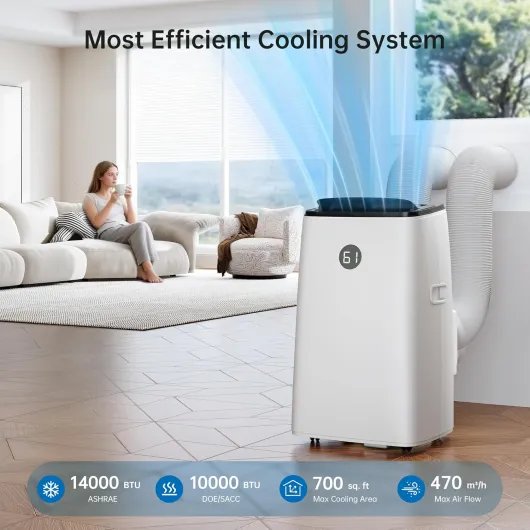
Design-wise, it’s your classic white portable AC tower: about 13" wide, 16" deep, and 27" high, and around 64–65 lbs. It’s not small, but for a 14000 BTU class unit, that’s pretty normal. It has hidden side handles and four wheels, which genuinely help because 65 lbs is not something you want to drag without wheels. I can roll it between a living room and a bedroom without straining my back, but lifting it up stairs is a two‑person job unless you’re really set on suffering.
The front display is simple: temperature and some icons. It’s readable from across the room but not super bright, which I actually like at night since it doesn’t light up the whole space. The top panel buttons feel okay, plastic but not flimsy. The louvers on the front handle the 30–85° auto swing, and that part works well. It pushes air across the room instead of just blasting one spot. You can also fix the angle if you don’t want it moving.
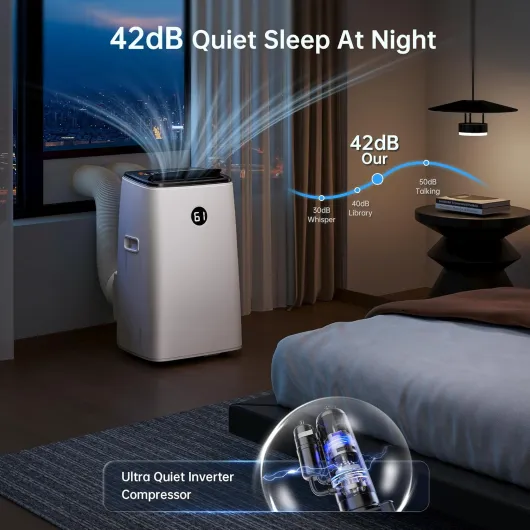
Noise is where the inverter and dual hose make a difference. In normal cooling mode at a medium fan speed, you get a steady whoosh and a soft compressor hum. It’s not silent, but compared to my old 12,000 BTU non‑inverter single‑hose, this one is noticeably easier to live with. In sleep mode, the fan drops to low and the compressor ramps down more gently, and that’s where you can believe the ~42 dB claim. For sleeping, if you’re used to a fan running, it’s fine. If you’re super sensitive to any noise, no portable AC will really make you happy.
The one design decision that bugs me: in cool mode, once the room hits the set temperature, the fan completely stops instead of just the compressor cycling while the fan stays on low. That means you get periods of total quiet followed by the unit kicking back on. One Amazon reviewer called this a deal breaker, and I kind of get it. Personally I’d prefer the fan to run constantly at a low speed to keep air moving and avoid that on/off feeling. It’s not a defect, just how they programmed it, but it’s a design choice that some people will hate.
Daily comfort, sleep mode, and living with it
In terms of comfort, the sleep mode is actually pretty decent. It lowers the fan speed, dims the display, and lets the inverter run at a softer level, so the overall noise is more of a low background hum. I’ve slept with it about 6–7 nights in a row during a warm spell. With the temp set around 72–74°F, the bedroom stayed comfortable and I didn’t wake up sweaty, which is ultimately what matters. The 24‑hour timer is handy too; I usually set it to shut off an hour or two after I expect to wake up, so it’s not running all morning for no reason.
The auto-swing helps avoid that feeling of cold air blasting directly on you. I put it at the far end of the room and let the louvers sweep back and forth, and it spreads the cold air around without freezing one spot. If you sit right in front of it, sure, you’ll feel the direct airflow, but that’s kind of the point. For people who hate having air blow on their face while sleeping, placing it a bit further and using swing mostly fixes that.
The main comfort annoyance, again, is the fan shutoff behavior at the set temperature. At night, you notice the silence when it cuts out, then the slight jolt when it kicks back on. Some will appreciate the quiet periods; I personally prefer a constant low fan noise because it masks other sounds. One Amazon reviewer basically said this alone made it a deal breaker for them. I wouldn’t go that far, but it is something you won’t see clearly described in the product page and you only discover once you use it.
Temperature accuracy seems okay. If I set it to 72°F, my separate thermometer across the room usually reads 73–75°F, which is close enough for a portable. There are no weird cold/hot spots if the unit is placed reasonably and the door isn’t constantly opening. Overall comfort is good: room gets cool, humidity drops, and noise is manageable, but if you’re picky about fan behavior and want perfectly steady airflow, this unit has its quirks you’ll have to accept.
Build quality, filters, and what might break first
Durability is always a bit of a guess with these off‑brand Chinese portables, but I’ll describe what I’ve seen and what other buyers mentioned. Out of the box, build quality feels average to slightly above average for this price range. The plastic casing doesn’t flex too much when you push on it, the wheels roll smoothly, and there are no weird rattles when it runs. The hose and window kit are clearly plastic and not heavy-duty metal, but that’s standard for most portables unless you spend a lot more.
The air filters are easy to pop out and rinse under water, which is a plus for long‑term use. No tools needed. If you’re in a dusty place or have pets, you’ll want to clean them every few weeks. A clogged filter is usually what kills the efficiency and makes compressors work harder than they should. The manual is basic but at least mentions cleaning the filters and how to handle drainage for high humidity or Dry mode. There’s also an auto‑stop when the internal tank is full, which protects you from leaks and potential water damage around the unit.
One Amazon reviewer mentioned pairing this with an extended warranty, and honestly, that’s not a bad idea for any portable AC in this price range, regardless of brand. These things are under heavy load in summer, and repairs usually cost more than just replacing the unit. HUMHOLD isn’t a big name like LG or Frigidaire, but it’s showing up at Lowe’s and on Amazon, so it’s not a total no‑name ghost brand either.
After some weeks of use, I haven’t noticed any odd noises, error codes, or drops in performance. The inverter start‑up is gentler than old‑school compressors, which should help longevity a bit. Still, I wouldn’t expect it to last 15 years like a well‑maintained split system. Realistically, if it gives you several summers of solid use, that’s already decent for a portable. So I’d rate durability as acceptable for the price: nothing screams high‑end, but nothing feels like it’s going to fall apart next month either, as long as you don’t abuse it and you keep the filters and drains in decent shape.
Cooling, dehumidifying, and real‑world performance
Performance-wise, this is where the unit holds up pretty well. The 14000 BTU (10000 BTU SACC) rating with dual hose and inverter actually translates into decent real‑world cooling. In my ~550–600 sq.ft room with average insulation, starting from 78–80°F on a humid day, it took around 25–30 minutes to bring it down to 72–73°F. After that, it mostly idles at lower power to maintain the temperature. Compared to a single‑hose unit I had before, the room feels more evenly cooled and there’s less hot air sneaking in from other parts of the house because the intake is from outside, not from inside the room.
In dehumidifier mode, it pulls a lot of moisture. They claim 80–96 pints/day, and while I didn’t measure with buckets, I can say in my semi‑finished basement (very humid, probably 70–80% RH), the tank filled up fast enough that I had to use the drain hose for continuous drainage. If you live in a humid area and run Dry mode or cool a space like a laundry room or basement, you should plan on using the drain. The auto‑shutoff when the internal tank is full works; it just stops and throws a full tank indicator so you don’t end up with leaks.
As a fan, it’s fine but nothing special. Three speeds, moves a decent amount of air, but it’s not going to replace a strong standalone fan. The weird part is the separation between modes: in cool mode, once it hits the target temp, everything stops, including the fan; in fan mode, it never cools, obviously. You can’t have it maintain temp and still keep the fan running constantly in the same mode, which is how most window units work. For overnight use, that means you either accept the cycling in cool mode or you run it cooler for a while and then switch to fan only, which is a bit of a hassle.
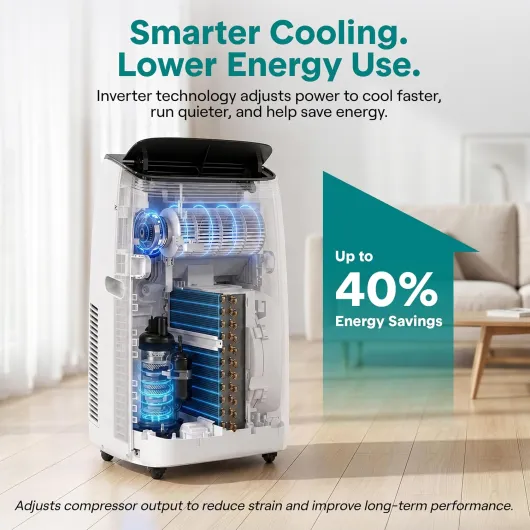
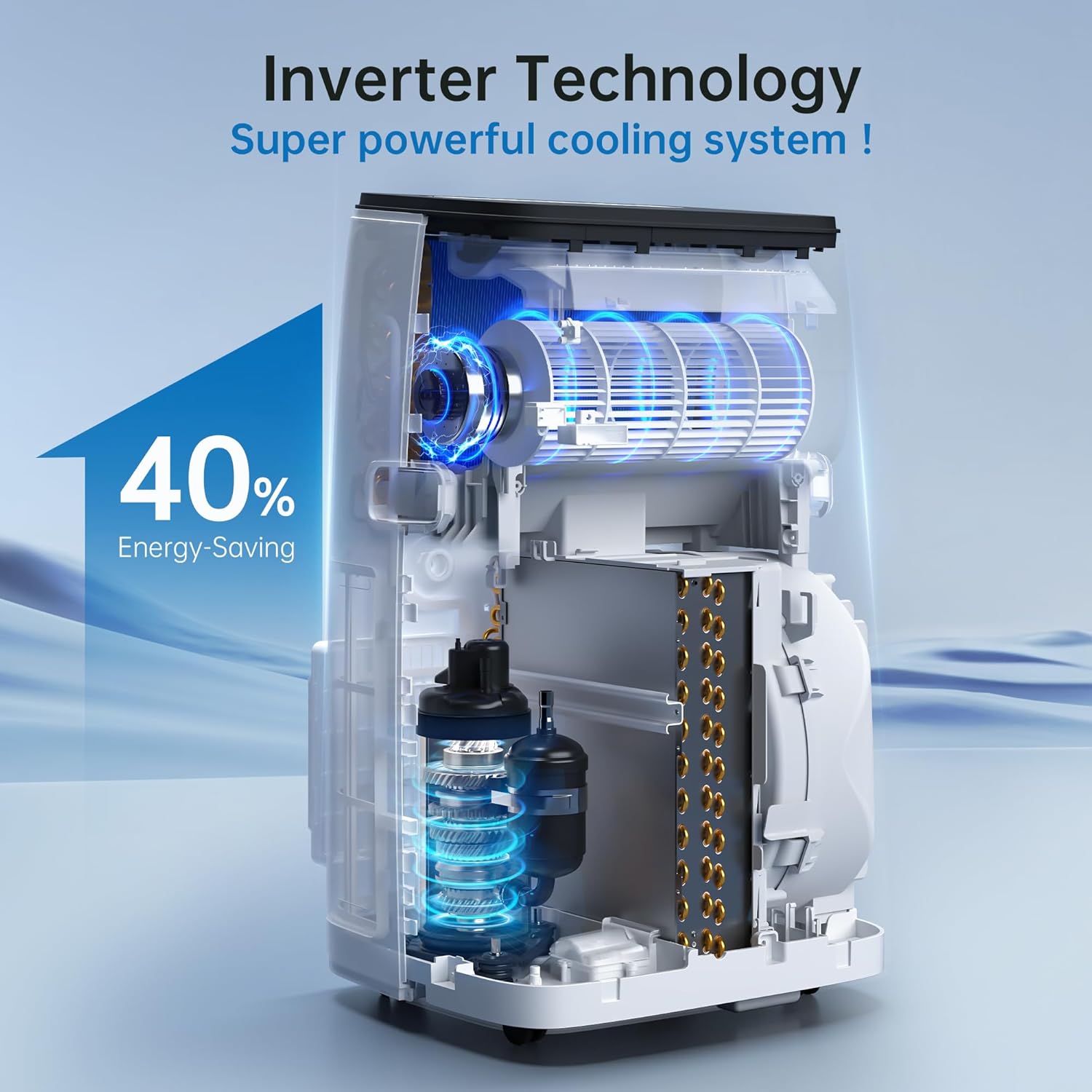
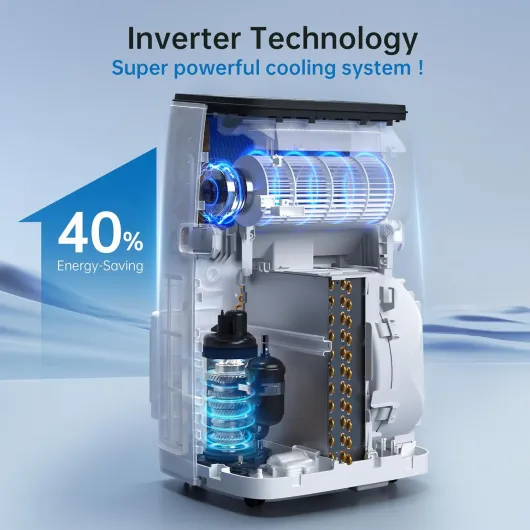
Energy-wise, the inverter is supposed to cut usage by about 40% vs traditional portables. I don’t have lab-grade numbers, but based on how often it ramps down and how it doesn’t just slam on/off at full power, it should be easier on the power bill than a non‑inverter 14000 BTU. Just keep in mind the power draw is still high, and it really wants that 20A circuit. If you try to run it on a heavily loaded 15A line with other stuff (microwave, toaster, etc.), expect random shutoffs or breaker trips. So performance is strong on cooling and dehumidifying, but you have to respect its electrical needs and accept some quirks in fan behavior.
What you actually get with this HUMHOLD unit
On paper, this thing checks a lot of boxes: 14000 BTU ASHRAE / 10000 BTU SACC, dual hose, inverter compressor, dehumidifier, fan mode, sleep mode, remote control, and they claim it can handle up to 700 sq.ft. The model I’ve got is the KY-V10K/11D, same as listed, and the specs line up: about 1250W draw, 115V, R32 refrigerant, and noise listed at 42 dB in quiet mode. In reality, 42 dB is the low end when it’s idling or in sleep mode; when the compressor is going full tilt, it’s obviously louder, but still less annoying than the older fixed-speed units I’ve used.
In the box, you get the unit, remote, window kit, flexible hose, the drain hose, and a basic manual. Nothing fancy, but it’s everything you need. The window kit is clearly built with sliding windows in mind (vertical or horizontal). If you have small or awkward windows, expect to improvise with foam, cardboard, or plexiglass. One Amazon reviewer mentioned exactly that, and I had a similar issue with a short window in a basement room. It’s doable, just not plug‑and‑play in every situation.
The controls are straightforward: front panel with buttons for mode (Cool/Dry/Fan), temperature setting (61–90°F), fan speed, swing, sleep, and timer (up to 24 hours). The remote mirrors all that and has a backlit screen, which is handy at night. No Wi‑Fi, no app, no smart home stuff, which I honestly don’t miss. For a portable AC, I just want it to turn on, set a temp, and not have to think too much.
So in short, the feature list is pretty complete for the price bracket: 3‑in‑1 operation, dual hose, inverter, timer, auto swing, remote. Nothing revolutionary, but the combo of dual hose + inverter is what makes it interesting compared to a lot of cheaper, louder, single‑hose boxes. Just don’t expect luxury build quality or super polished software; it’s a functional appliance, not a tech toy.
Pros
- Dual‑hose + inverter combo gives faster, more efficient cooling than typical single‑hose units
- Quiet enough in sleep/low mode for most people to use in a bedroom (~42 dB claim feels realistic at low speed)
- Good at dehumidifying and offers mostly no‑drain operation in normal cooling, with easy filter access and included drain hose for humid rooms
Cons
- Fan completely shuts off in cooling mode when target temperature is reached, which some users find annoying at night
- Needs a strong 15A or ideally 20A circuit; on weak or crowded circuits it can shut off or trip breakers
- Window kit is basic plastic and works best only with standard sliding windows, so odd windows need DIY solutions
Conclusion
Editor's rating
Overall, the HUMHOLD 14000 BTU dual‑hose inverter portable AC is a solid option if you want real cooling power in a larger room and are tired of weak single‑hose units. It cools quickly, handles humidity well, and stays reasonably quiet for its size, especially in sleep mode. The dual‑hose setup and inverter compressor make it feel more efficient and less suffocating than older portables that constantly suck in hot air from the rest of the house. For day‑to‑day use in a living room, big bedroom, or three‑season room, it gets the job done with enough control options (cool, dry, fan, timer, swing) to adapt to most situations.
That said, it’s not without flaws. The biggest annoyance is the way the fan shuts off completely in cooling mode once the set temperature is reached, instead of just cycling the compressor while keeping airflow. If you’re sensitive to on/off noise changes at night, this can be bothersome. You also need to pay attention to your electrical setup: this thing really wants a 20A circuit, and on a weak or crowded 15A line you may run into shutdowns or tripped breakers. The window kit is basic and works best with sliding windows; small or odd‑shaped windows will require some DIY.
I’d recommend this unit to people who: have a medium‑to‑large room (up to around 600–700 sq.ft with decent insulation), care about faster cooling and lower noise than cheap portables, and don’t mind doing a bit of setup work and possibly using continuous drainage in very humid spaces. If you just need something for a tiny bedroom, hate any kind of cycling noise, or can’t easily provide a solid circuit, you might be happier with a smaller, simpler unit or even a window AC. For the right use case, though, this HUMHOLD is good value and practical, as long as you go in with realistic expectations.