Summary
Editor's rating
Value for money: niche product with a niche price
Design: compact and modern, but bulkier once you add hoses
Battery & off‑grid use: cool idea, but do the math
Noise, daily use & condensation: good overall, but watch the water
Cooling & heating performance: good in small spaces, weak if you push it
What the EcoFlow WAVE 3 actually is (and isn’t)
Pros
- Compact dual‑hose design with better efficiency than typical single‑hose units
- Good app control with useful modes (eco, sleep) and remote start
- Decent cooling in small rooms, vans and campers with relatively low power draw
Cons
- High price, and the 1,024 Wh battery is sold separately and also expensive
- Cooling capacity limited for larger or poorly insulated rooms
- Condensation and hose management can be fiddly, with some risk of leaks if not set up carefully

Specifications
View full product page →| Brand | EF ECOFLOW |
A pricey gadget to finally sleep cool in a van… or not?
I’ve been using the EcoFlow WAVE 3 for a few weeks mainly in a small attic room at home and in a camper-style setup. I went for it because it’s one of the only compact dual-hose AC units that’s actually sold in Europe and can also run off a battery. On paper it looks perfect: cooling and heating, app control, fairly quiet, and you can slap a battery on it for off‑grid use. In reality, it’s a lot more nuanced than the product page makes it sound.
First thing: this is not a magic box that turns a roasting van or a badly insulated room into an ice cave. It’s a small 6100 BTU unit. That’s fine for a bedroom or van-size space, but if you’re picturing it cooling an open-plan flat or a big living room, forget it. In my 13 m² attic room it did the job, but you have to help it a bit: pre‑cool the room, close doors, use both hoses correctly, and don’t expect instant results.
Second thing: the whole battery/off‑grid marketing is a bit misleading if you don’t read the fine print. The 1,024 Wh battery is sold separately and it’s not cheap. Without that, it’s just a regular plug‑in portable AC. And even with the battery, 8 hours of runtime is in ideal conditions on low power, not in full blast mode under a blazing sun. In my use I was closer to 4–5 hours when really pushing it, which is still decent but not what some people might imagine.
Overall, my feeling is this: the WAVE 3 is a smart, compact solution for specific use cases (vanlife, RV, small office/bedroom where you can’t install a split unit). It’s also pretty expensive and has a couple of practical annoyances like condensation management and hose handling. If you go into it with realistic expectations about cooling power and room size, it’s a solid tool. If you expect full‑on house AC in a shoebox, you’ll be disappointed.
Value for money: niche product with a niche price
Let’s be honest: the EcoFlow WAVE 3 is not cheap, especially once you factor in the optional battery. You’re paying for a compact dual‑hose design, the ability to run on DC/battery, and the smart ecosystem. If you just want to cool a single room at home and you don’t care about off‑grid use, a regular 9000–12000 BTU portable AC will give you more raw cooling for less money, even if it’s heavier and uglier. So for a pure home-use buyer, the value is only “okay” unless you really need the small footprint and dual‑hose efficiency.
Where the value makes more sense is if you’re into vanlife, RVs or overlanding and you already invest in gear. In that world, a compact 15.6 kg unit that can sit in an SUV, strap to a truck platform, and run off a battery or solar setup starts to look more reasonable. Compared to installing a full rooftop AC plus a big inverter and permanent wiring, the WAVE 3 is easier to move between vehicles or between home and van. And the power draw is low enough that running it off a decent power station or alternator is realistic.
The 3.6/5 average rating on Amazon reflects what I felt: this is a premium product with clear tradeoffs. People who understand BTUs, room size, and the limits of portable ACs tend to be happier. People who expect it to cool a large, hot room effortlessly feel ripped off. It also loses points for things like hose awkwardness, water leakage risk, and the fact that you basically have to buy accessories (battery, extension cord, some DIY window kit) to get the most out of it.
My personal verdict on value: if you’re a camper/van user with very specific space and off‑grid needs, and you’re okay spending good money to sleep better in heat, the WAVE 3 is pretty solid. If you just want cold air in your bedroom during summer, there are cheaper ways to do that, even if they’re bulkier or less smart. It’s a niche tool; if you’re in that niche, it’s interesting. If not, it’s probably overkill.
Design: compact and modern, but bulkier once you add hoses
Physically, the WAVE 3 is pretty compact for what it does. It’s about 52 cm deep, 30 cm wide and 34 cm high, and weighs around 15.6 kg. That’s a lot lighter than my old 28 kg portable unit, so moving it around the house or in and out of a van is doable if you’re reasonably fit. The top vents double as handles, which sounds like a small detail but actually makes a difference when you’re hauling it up stairs or into a camper.
The look is modern: black and silver, rounded corners, and it doesn’t scream “ugly white office AC”. In a small room it blends in much better than the usual tower-on-wheels type units. The build quality feels solid: plastics don’t creak, the buttons have a decent click, and nothing felt flimsy to me. It’s clearly designed to be thrown in the back of an SUV or on a camper roof using their strap kit without falling apart at the first bump.
Where the design gets less fun is once you attach the dual hoses. The hoses themselves are decent quality and not too flimsy, but they’re thick and a bit awkward to route, especially in European-style windows (outward‑opening PVC casement windows, skylights, etc.). In my attic room I had to put the unit up on a table about 1 m high just to get the hoses to the small corner of the window. In a camper or van with a dedicated vent, that’s easier, but in a normal house the footprint becomes much bigger than the bare unit suggests.
Another small but annoying design choice: the power cable is pretty short, around 1.5 m. In a van where the power outlet is close, no problem. In a room, I almost always needed an extension cord to put it where it actually made sense for the hoses. EcoFlow sells it as portable, and yes, the main body is portable, but once you add hoses, drainage, battery, and an extension cord, the whole setup is less sleek than the marketing photos show. Overall, design is solid and practical enough, but don’t underestimate the space you’ll need around it.
Battery & off‑grid use: cool idea, but do the math
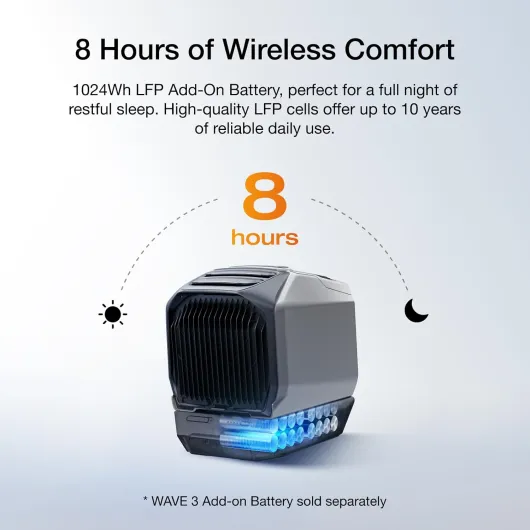
The whole off‑grid angle is a big part of EcoFlow’s marketing, so I’ll be blunt: the WAVE 3 itself does not include a battery. Out of the box it’s a 220 V AC unit you plug into the wall, a generator, or a power station. If you want wireless use, you need the separate 1,024 Wh LFP battery. That’s not cheap, and it adds more weight and bulk to the setup. So if you’re on a tight budget, this is not the most cost-effective solution just to cool a van for a few hours.
EcoFlow claims up to 8 hours of runtime. That’s technically possible, but only in lower power modes. In real use, if the unit is drawing around 600 W in MAX mode, that 1,024 Wh battery is drained in roughly 1.5 hours. In eco or sleep mode at 230–300 W, you’re looking at around 3–4 hours of solid cooling, maybe more if the ambient temperature isn’t extreme and the space is well insulated. So you can get a decent afternoon nap or a night where it cycles on and off, but not a full night of constant max cooling in a roasting van.
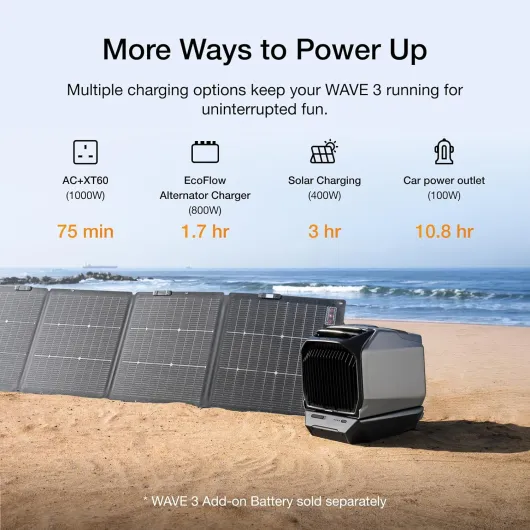
Charging is fast though: up to 1000 W charging in about 75 minutes via mains, alternator, car, or solar (with the right setup). That’s good if you’re driving during the day and want to top it up, or if you’re on a campsite with hookups. The app also shows real‑time consumption and remaining runtime, which helps you manage expectations when you’re off‑grid and trying not to kill your battery before sunrise.
My take: if you already live in the EcoFlow ecosystem (power stations, solar, etc.), the WAVE 3 fits in nicely and the battery option makes sense. If you’re starting from scratch just to get AC in a van, it gets very expensive very fast. In that case I’d seriously compare the cost of a small fixed rooftop unit or a cheaper portable AC plus a separate generic battery solution. The WAVE 3 battery setup is convenient and well integrated, but you pay for that convenience.
Noise, daily use & condensation: good overall, but watch the water
On the comfort side, there are three main things: noise, day‑to‑day usability, and water management. Noise first: EcoFlow mentions 44 dB in standby, which is basically just the low fan hum. In real cooling mode it’s obviously louder, but compared with typical portable AC units, it’s on the quieter side. I could work from home with it on eco mode without losing my mind, and with noise suppression in Teams/Zoom, people on the other end didn’t really notice it. For sleeping, it’s a mixed bag. On sleep mode it’s tolerable for me (I’m a light to moderate sleeper), but you do hear it ramp up when the compressor kicks in. It’s more of a low hum plus fan white noise than a harsh buzz, but if you’re ultra sensitive, it may still bother you.
Daily use is decent. The controls on the unit are simple enough, but the app is where it shines. Being able to pre‑cool the room from your phone before going up to bed is very handy. Same in a van: you can sit outside and start the AC a bit before going in. The app is also useful for switching between eco, max, and sleep modes without getting up. Setup is straightforward if you’ve used smart devices before, but you do need an account, which I find slightly annoying. At least the unit isn’t tied to the cloud to function; once configured it works fine locally.
Now the annoying part: condensation and drainage. When the air is humid, this thing pulls a lot of water out of the air. The internal tank fills quickly. With the drain hose routed into a container under the unit, I had to empty a 1‑gallon container every few hours in heavy use. Some users report leaks even when using the automatic drain hose as recommended. I didn’t get a full carpet disaster, but I can see how it happens if the hose is not perfectly set or if the container is too high or touching the tube end. You need to be a bit careful with the setup and check it the first nights, especially if it sits on wood or carpet.
So in terms of comfort: it’s quite usable day to day, quiet enough in eco and sleep modes, and the climate in the room or van feels much drier and more pleasant. But you can’t just drop it in a corner and forget about it. You have to think about hose routing, where the water is going, and your power situation. If you accept that little bit of babysitting, it’s a nice upgrade from sweating through the night with a fan.
Cooling & heating performance: good in small spaces, weak if you push it
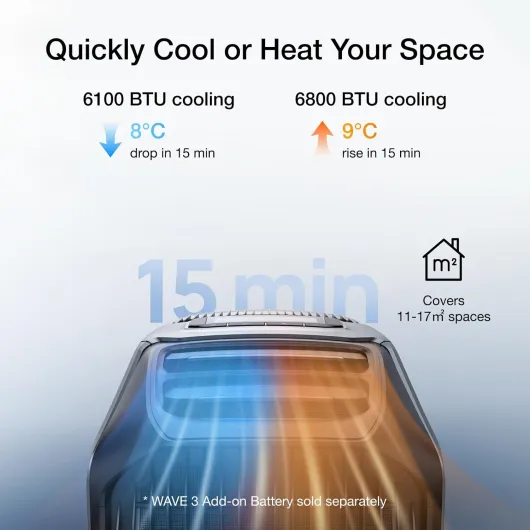
Let’s talk about what matters: does it actually cool? In my 13 m² attic bedroom (poor insulation, dark roof tiles), using both hoses properly, the WAVE 3 could drop the room temperature by around 6–8 °C over about 1–2 hours on max mode. That lines up with EcoFlow’s claim of 8 °C in 15 minutes only if the starting point and room conditions are gentle. In a real hot attic, it’s slower, but still decent. Once cooled, I could keep the room comfortable on eco mode at around 300 W, which is a big improvement over traditional 1 kW single‑hose units.
In a camper around 7 m long, parked in the sun, it managed to hold the inside around 5 °C cooler than outside during the day, and 7–8 °C cooler at night, according to one user review. That matches what I’d expect for a 6100 BTU unit in a metal box sitting in the sun. But the catch is you often have to leave it in MAX mode to get that performance. So yes, it cools, but it’s not effortless: you need to start it early, keep doors/windows closed, and accept that it’s working hard when it’s really hot.
Where it struggles is bigger or badly insulated spaces. One user with a roughly 40 m³ room (around 16 m² with 2.5 m ceiling) saw only about 1 °C drop in their initial test and was disappointed. Honestly, that doesn’t surprise me. 6100 BTU is borderline for that volume if you have significant heat gain from windows or poor insulation. If you’re planning to cool a big lounge or open-plan area, this is the wrong tool. It’s really for small focused zones: bedrooms, offices, vans, small RVs.
Heating is there too (6800 BTU), and it works, but I see it more as a bonus than the main reason to buy it. It can bump a small space by around 8–9 °C, which is handy in shoulder seasons or chilly mornings in a van. But if you already have a decent diesel heater or electric heater in your camper, this won’t replace it; it’s more of an extra option. Overall, I’d say the performance is solid for its size if you respect its limits, but if you go in expecting full split‑AC performance in a big room, you’ll be underwhelmed.
What the EcoFlow WAVE 3 actually is (and isn’t)
On paper, the WAVE 3 is a portable air conditioner and heater rated at 6100 BTU for cooling and 6800 BTU for heating. Power draw when running is in the 600–700 W range in real use, not the 1800–2000 W numbers you see in the title (that’s more the peak cooling/heating output). It’s meant for small mobile spaces like vans, RVs, SUVs and small rooms up to roughly 11–17 m². Anything bigger and you’re really pushing it, especially if the insulation is poor.
The big selling point is the dual-hose design. Most cheap portable ACs in Europe are single-hose, which means they suck the cooled air out of your room and dump it outside, creating negative pressure that drags hot air back in from gaps and doors. With dual hose, one hose brings in outside air to the condenser and the other exhausts hot air out. In practice, this makes a noticeable difference. In my attic room, power use stayed around 300–500 W in eco/max modes while keeping the room comfortable, which is much lower than the 1 kW+ bricks I used before.
There’s also a full smart app (Wi‑Fi/Bluetooth) that lets you control temperature, modes (cool, heat, eco, sleep), timers and see power consumption. You can also get alerts if the water tank is full or if there’s a problem. The app is actually one of the better parts of the product: it’s clean, responsive, and you can control it remotely if you have it on your home network or set up remote access like one reviewer did with a VPN.
What it is not: it’s not a cheap solution, and it’s not a whole‑house AC. It’s also not totally hassle‑free. The hoses take space and are a bit awkward to route, and condensation can be a pain if you don’t manage drainage properly. Also, the battery-friendly marketing is a bit optimistic: the unit itself is 690 W rated, and the separate battery is 1,024 Wh, so do the math – you’re not getting a full night of max cooling off‑grid without compromises.
Pros
- Compact dual‑hose design with better efficiency than typical single‑hose units
- Good app control with useful modes (eco, sleep) and remote start
- Decent cooling in small rooms, vans and campers with relatively low power draw
Cons
- High price, and the 1,024 Wh battery is sold separately and also expensive
- Cooling capacity limited for larger or poorly insulated rooms
- Condensation and hose management can be fiddly, with some risk of leaks if not set up carefully
Conclusion
Editor's rating
After living with the EcoFlow WAVE 3, I see it as a specialist tool, not a universal solution. In a small, enclosed space like a 10–15 m² bedroom, a van, or a medium camper, it cools effectively as long as you use the dual hoses properly and don’t expect miracles in 15 minutes. Power consumption is reasonable, the app is genuinely useful, and the noise level is manageable in eco and sleep modes. The form factor is also nice if you’re tired of huge, clunky portable units.
On the flip side, it’s expensive, the separate battery pushes the price even higher, and condensation management can be annoying if you don’t set up drainage carefully. The cooling capacity is limited by the 6100 BTU rating, so if your space is too big or too badly insulated, you’ll just end up disappointed and a lot poorer. It’s not for someone who just wants to cool a large lounge or an open-plan flat; a bigger traditional AC will do better there.
I’d say the WAVE 3 is for you if you: camp or travel in a van/RV, care about power use, and want a compact, smart AC that you can also use at home in a small room. It’s also for people who like tinkering with smart home stuff and battery setups. You should skip it if you: need to cool big rooms, are on a tight budget, or don’t want to deal with hoses and drainage. In those cases, a cheaper, higher‑BTU portable unit or a proper split system (if you can install one) will make more sense.