Summary
Editor's rating
Is it worth the money?
Chunky, modern box with some practical quirks
Real-world comfort: sleeping, working, and humidity
Build quality, handling and long-term feel
Cooling and noise: strong chill, honest noise
What you actually get and who it suits
Pros
- Strong cooling performance for medium to large rooms, even in hot weather
- Decent energy efficiency (A++) and proper dehumidifier mode
- Solid build quality and simple, effective controls with remote
Cons
- Not truly silent; compressor and fan noise can bother light sleepers
- Short, fussy exhaust hose that needs a near-straight run to the window
- High price at full RRP compared to some other portable AC units

Specifications
View full product page →| Brand | De'Longhi |
A pricey way to survive heatwaves
I’ve been using the De'Longhi Pinguino PACEX100 Silent through a couple of hot spells, including a proper UK-style heatwave where the inside temperature hit the high 20s and low 30s. I bought it mainly for a top-floor bedroom and a small home office, both of which turn into ovens in summer. So this isn’t a quick unboxing impression – it’s based on actually living with the thing when it’s 30°C+ outside and you’re grumpy and sweaty.
First thing: this unit cools very well for a portable. When it’s stupidly hot, it won’t turn your room into a walk-in freezer, but it drags the temperature down to something you can actually function in. In my case, a 18–20 m² room goes from 28–30°C down to around 22–24°C in a reasonable time, and if it’s not blazing outside it will happily sit at 18–20°C. So on pure cooling power, it does the job.
But it comes with trade-offs. It’s heavy, it’s not truly “silent” despite the name, and the hose and window kit are a bit limiting. You really have to plan where it’s going to live, how you’ll vent it, and how much noise you can tolerate at night. If you’re expecting hotel-style built-in aircon, you’re going to be disappointed. If you’re realistic about portable units, it’s actually pretty solid.
Overall, my feeling is: good machine, expensive, with some annoying quirks. If you’re desperate in a heatwave and have the budget, you’ll be glad you bought it. If you’re sensitive to noise or have awkward windows, you might want to think twice or at least plan your setup very carefully.
Is it worth the money?
Price-wise, this thing is not cheap. Depending on when and where you buy it, it often sits in the £600–£800 range new, which is a lot for something you might only use a few weeks a year in the UK. You can sometimes find it cheaper from warehouse deals or second-hand, and at around £350–£400 it feels like much better value. At full price, you really need to hate the heat or be in a room that gets roasted regularly for it to feel justified.
What you’re paying for is mainly: better efficiency (A++), decent build quality, strong cooling for its class, and some extra modes like Real Feel and a proper dehumidifier function. Compared to the very cheap portable units, you get a bit less power draw for similar or slightly better cooling, and generally nicer fit and finish. Compared to premium brands that don’t even cool (like fancy bladeless fans), I’d personally rather have this, because it actually conditions the air rather than just moving hot air around.
On the downside, for this price, the marketing around “Silent” is a bit cheeky. It’s quieter than some older portables, but it’s still a 2.5 kW compressor in a plastic box. Also, the short hose and slightly fussy venting mean you might end up buying extra bits (longer hose, better window kit, foam seals) to get the most out of it. That adds more cost and hassle. If your windows are awkward, factor that in – the included kit is okay for sash, mediocre for others.
So is it good value? I’d say: decent value if you get it at a discount or you really need reliable cooling, borderline at full RRP. If you live in a top-floor flat, south-facing bedroom, or home office that becomes unbearable every summer, the comfort you get out of this can absolutely justify the spend. If you only occasionally feel a bit warm and you’re not that bothered, it’s overkill and your money is probably better spent on blinds, insulation, and a good fan.
Chunky, modern box with some practical quirks
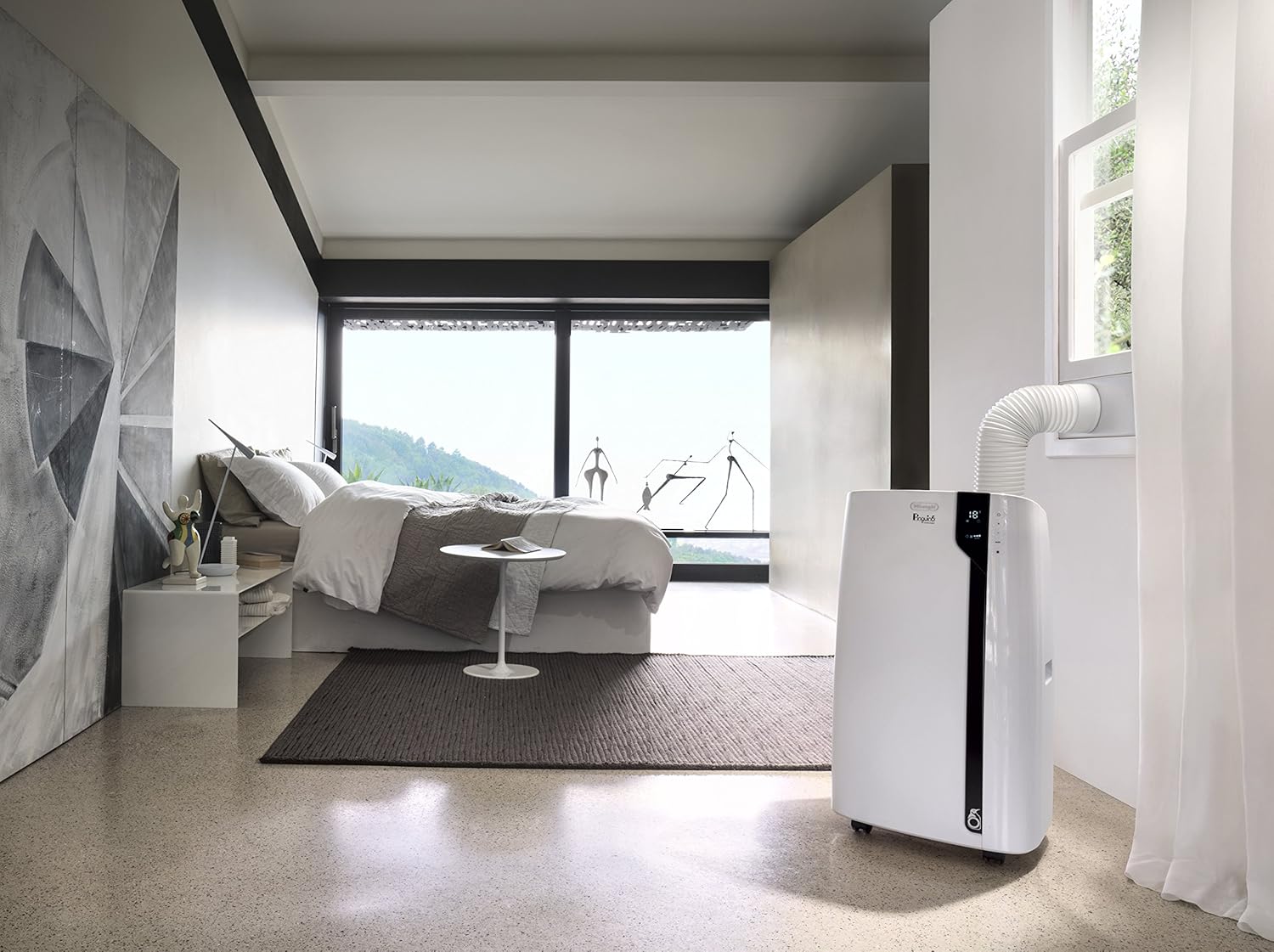
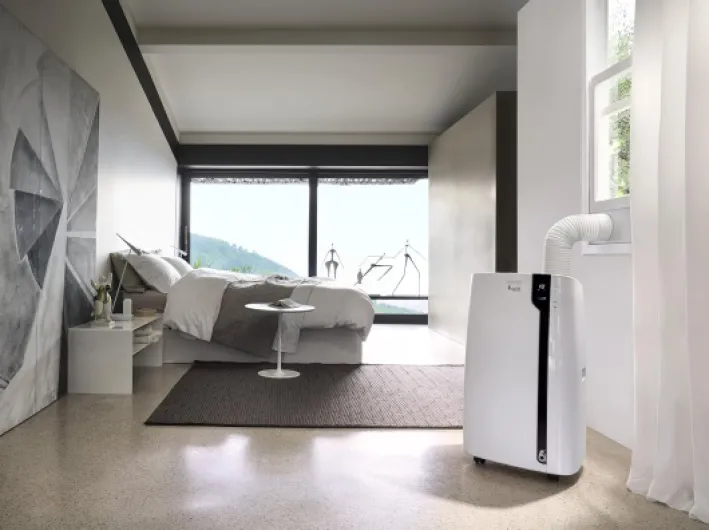
Design-wise, the PACEX100 looks fairly modern and clean. It’s a tall white rectangle with rounded edges and a top vent that opens like a flap when you turn it on. It doesn’t scream “industrial appliance” in the middle of your living room, which I appreciated. That said, it’s big. The listed dimensions (around 15.2D x 17.3W x 31.7H cm) are clearly off or a typo – in reality, think more like a large suitcase on wheels. It weighs about 30–32 kg, so while it’s technically portable, you won’t be joyfully carrying it up and down stairs every day.
The castors are decent. On hard floors it rolls easily; on carpet it still moves, but you need to give it a bit of a shove. I can manage it alone, but if you’re not strong or you’ve got tight staircases, get help when you first move it into place. The top control panel is simple: a few buttons, a clear LED screen, and indicators for mode and Real Feel. The LED is bright enough that in a dark bedroom it’s noticeable, so if light bothers you at night, you’ll want to park it where you don’t stare straight at the display.
The air outlet is on the top under that motorised flap. The flap tilts from almost straight up to slightly forward, and you can set it to oscillate. One thing to note: it never blows straight horizontally; it always has at least a bit of upward angle. That actually makes sense for cooling the warm air at the top of the room, but if you expect a cold blast directly at your face from the front, that’s not how it behaves. The exhaust hose connection is on the back and sticks out quite a bit, which adds to the real-world depth you need to allow from the wall.
Overall, the design is practical but bulky. It looks fine in a modern room, doesn’t feel cheap, and everything is logically laid out. The downsides are the size, weight, and the slightly awkward hose geometry, which forces you to think carefully about where to place it relative to the window. It’s not ugly, it’s just a big white appliance you have to live around.
Real-world comfort: sleeping, working, and humidity
From a comfort point of view, this unit genuinely changes how usable a hot room is, but it doesn’t magically turn it into a silent, perfectly chilled bubble. When I’m working in my home office on the top floor, this thing is the difference between sweating over my keyboard and actually being able to think. With outside temps around 25°C, I can set it to 20°C, close the door, and within 20–30 minutes the room feels fresh and comfortable. It’s strong enough that after a while I’m reaching for a light jumper if I sit still for too long. So for daytime comfort, no complaints.
At night, it’s more nuanced. In my bedroom, I keep it at the far end of the room, about 4–5 metres from the bed, hose out of the bay window. On Silent mode at 20–21°C, the background hum is noticeable but not aggressive. I’m a fairly solid sleeper and can drift off with it running. What helps is starting it an hour or two before bed to pre-cool the room, then either lowering the fan speed or using the timer so it switches off after a while. When I tried Real Feel at night, the constant on/off cycles of fan and compressor were more disruptive than a steady noise, so I stopped using that for sleeping.
The dehumidify mode is actually one of the nice bonuses. On damp days or in a stuffy room, running it in dehumidify-only pulls a surprising amount of water out of the air (spec claims up to 24 litres/day, and while I didn’t measure, the tank fills fast in humid weather). The room feels less sticky, especially during storms or humid nights. You do need to deal with the condensate (either via tank or continuous drain if you set that up), but comfort-wise, it makes a warm room feel less suffocating.
One thing I’d flag: if you’re a light sleeper, don’t expect to sleep right next to this unit. It’s still a compressor-based AC, not a fan. The noise level is comparable to a hotel wall unit but slightly more present because it’s in the room with you rather than in a wall. For people who are desperate in a heatwave, you’ll probably accept the trade-off and sleep anyway because being too hot is worse. But if you’re super sensitive to noise, you might prefer to cool the room before bed and then switch it off, or keep it outside the bedroom door and let some cool air leak in.
Build quality, handling and long-term feel
In terms of build quality, the PACEX100 feels like a proper appliance, not a cheap plastic toy. The outer shell is solid, the plastic doesn’t creak much when you move it, and the top vent mechanism feels smooth and controlled rather than flimsy. The buttons have a decent click, and the LED display has held up fine with regular use. I haven’t had any issues with random error codes or parts falling off so far, which is always my main fear with expensive seasonal gadgets.
The weak spots are more about handling and accessories than the main unit. The exhaust hose is thick and reasonably sturdy, but the connectors are a bit fiddly and feel like the part most likely to annoy you over time. Clipping and unclipping the fittings from the hose is okay once you’ve figured out the trick, but it’s not something you want to do every day. The castors are okay, but on thicker carpet they struggle a bit; you can still move it, but you’re basically dragging 30 kg of metal and plastic. If you plan to shuttle it between floors regularly, expect to grunt a bit or get someone to help.
Noise-wise, over time, I haven’t noticed any worsening – no extra rattles or vibrations popping up. It still sounds like it did out of the box. That’s a good sign, because some cheaper AC units start buzzing or vibrating after a season. The compressor kicks in and out normally, fan speeds are stable, and the Real Feel mode still works the same (even if I don’t love it for sleep). The remote has survived a few drops and still works from across the room, which is all I ask of it.
Given that the model has been around since about 2016 and still sells, I’m reasonably confident it’s not a fragile design. The internals use a rotary/scroll compressor, which is standard and typically reliable. Just be aware: it’s heavy, it’s not something you want to lug around constantly, and if you abuse the hose (sharp bends, constant re-fitting), that’s probably where you’ll see wear first. Overall, I’d call durability good but not bulletproof – take basic care of it, don’t treat it like luggage, and it should last several summers without drama.
Cooling and noise: strong chill, honest noise
On performance, this unit is very solid on cooling, average on noise, and a bit picky about installation. In my use, in a roughly 19 ft x 12 ft room (about 20 m², 7 ft ceiling) on the top floor, when it was around 30°C outside, the room would climb to 29–30°C quickly without cooling. With the PACEX100 running properly vented, I could get the room down to 23–24°C and keep it there. On milder days (20–25°C outside), it has no problem hitting 18–20°C. That matches what a few other owners report: it won’t turn a sun-baked loft into a fridge at 18°C in a 35°C heatwave, but it takes the edge off very effectively.
Noise is where expectations need to be realistic. The “Silent” branding is optimistic. In fan-only mode, it’s reasonably quiet – like a standard desk fan at medium speed. In cooling mode, you hear two things: the fan and the compressor. The fan is a constant whoosh; the compressor is more of a fridge-like hum when it kicks in. On its lowest setting in Silent mode, it’s okay for daytime use, even for calls if the unit isn’t right next to you. At night, it depends heavily on how sensitive you are and how far away it is. Personally, I can sleep with it on the other side of the room in Silent mode set around 20–21°C, but I would not want it parked right next to my head.
The Real Feel mode tries to be clever by cycling the unit to maintain a comfort zone for both temperature and humidity. In practice, I found it more annoying at night because it tends to go completely quiet for a while, then suddenly everything kicks back in with a brief burst of noise. That change wakes some people more than a constant hum. For sleeping, I preferred a fixed temperature in Silent mode so the sound stays more or less stable. During the day, Real Feel is fine and does keep the room feeling less clammy.
One important detail: the unit is fussy about the exhaust hose. If the hose has too much of an S-bend or goes upwards too much, the cooling can cut in and out every 30 seconds due to back pressure or poor airflow. I’ve seen this myself and also in other reviews. To get the best performance, you want the hose as straight and as short as possible, ideally going slightly downhill or flat out to the window. If your window is much higher than the exhaust, you may have problems unless you raise the unit on something sturdy. So the cooling power is good, but you have to respect the limitations of the hose and venting, otherwise it behaves badly and drives you mad.
What you actually get and who it suits
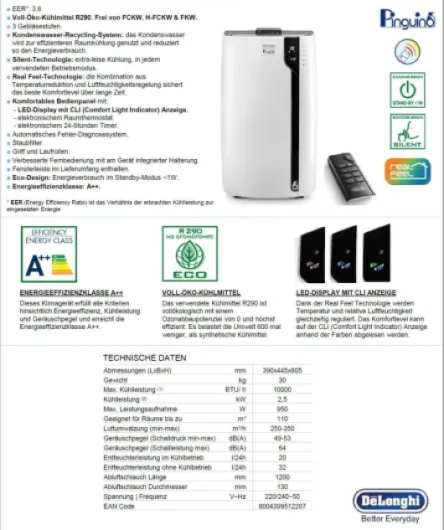
The PACEX100 Silent is a 10,000 BTU (about 2.5 kW) portable air conditioner rated for rooms up to roughly 110 m³. In normal terms, that’s fine for a medium to large bedroom, a typical UK living room, or a decent-sized home office. It’s an A++ / 5-star efficiency model on paper, which is better than a lot of cheaper portable units, and it uses R290 propane refrigerant, which is fairly standard now and a bit less nasty for the environment than older gases.
In the box you get the unit itself, a single exhaust hose, a window kit (the sliding plastic board), and a remote. The hose is about 1.2 m, which is honestly on the short side. The window board is clearly designed with sash windows in mind; with casement windows or tilt-and-turn windows, you’ll be bodging it a bit or buying extra sealing kits. Setup is simple enough: plug in, attach hose, stick hose out the window, and you’re off. But the devil is in the details – the hose fittings are quite chunky, and the rear connection is a bit of a faff the first time.
Feature-wise, you get cooling, dehumidifying, and fan modes, plus this “Real Feel” mode that’s supposed to balance temperature and humidity automatically. There’s also a “Silent” mode that basically lowers fan speed and tones things down slightly. The remote is basic but fine – you can set temperature, modes, fan speed, timer, and Real Feel from the sofa or bed. The LED display on the unit shows temperature and mode, and there’s a little climate light indicator that changes colour to tell you how close you are to the “comfort zone”.
Who is this for? In my view, it suits people who: live in a flat or house where fixed split aircon isn’t possible, have a room that becomes unbearable in summer, don’t mind some background noise, and are okay spending serious money to be comfortable a few weeks per year. If you just want a gentle cool breeze and hate noise, a decent fan and blackout blinds might be a better idea. If you want proper cold air and can tolerate the trade-offs, this is in the right ballpark.
Pros
- Strong cooling performance for medium to large rooms, even in hot weather
- Decent energy efficiency (A++) and proper dehumidifier mode
- Solid build quality and simple, effective controls with remote
Cons
- Not truly silent; compressor and fan noise can bother light sleepers
- Short, fussy exhaust hose that needs a near-straight run to the window
- High price at full RRP compared to some other portable AC units
Conclusion
Editor's rating
The De'Longhi Pinguino PACEX100 Silent is a solid portable AC that actually cools a room properly, as long as you set it up right and accept that “Silent” is mostly marketing talk. In real use, it pulls a medium to large room from sweaty to comfortable, even during UK heatwaves, and the dehumidify mode helps take the stickiness out of the air. Build quality feels decent, the controls are straightforward, and the A++ efficiency is a nice bonus when you’re running it for hours.
On the flip side, it’s heavy, bulky, and not truly quiet. Light sleepers will struggle with it right next to the bed, and the Real Feel mode can be annoying at night because of the sound cycling. The hose is short and doesn’t like tight bends or big height differences, so if your window is awkwardly placed you’ll either have to improvise or pick a different model. Price is also on the high side, especially at full RRP, which makes it a considered purchase rather than an impulse buy.
I’d recommend this to people with a genuinely hot room – top-floor bedrooms, loft offices, south-facing living rooms – who are sick of sweating through heatwaves and are okay with some noise and a chunky box in the corner. If you’re very sensitive to sound, have tricky windows, or only get mildly warm a few days a year, this will feel like too much money and hassle for what you get.