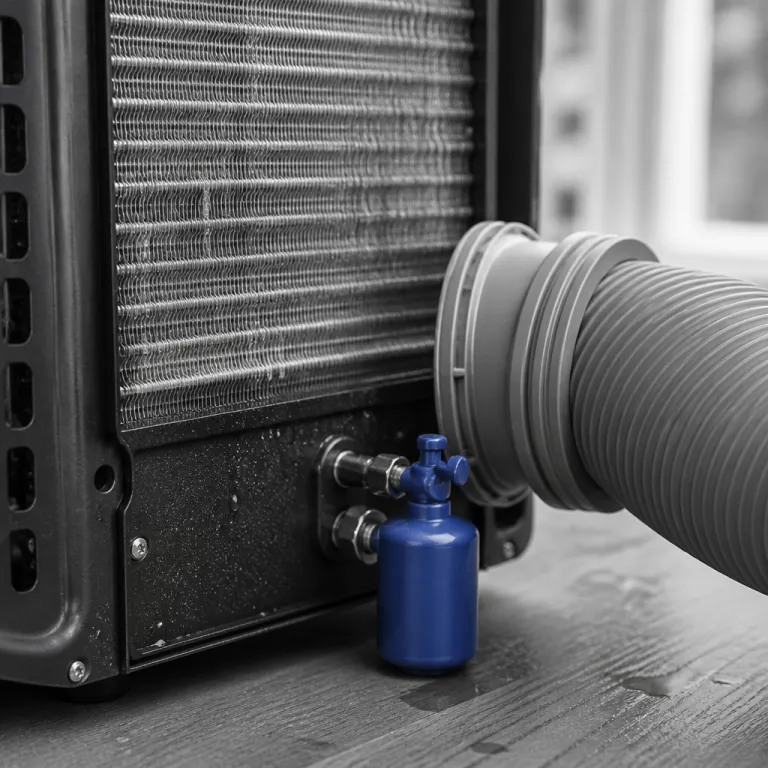
Why R-32 is quietly taking over portable air conditioners
The phrase R-32 portable air conditioner refrigerant 2026 sounds like marketing jargon, yet it describes a real regulatory pivot that reshapes what you can buy. In the United States, the Environmental Protection Agency (EPA) is forcing a refrigerant transition away from high global warming hydrofluorocarbons (HFCs) under the American Innovation and Manufacturing (AIM) Act, so new residential air conditioning systems must use a refrigerant with a global warming potential (GWP) below 700 from 2025–2026 onward in most categories. That single rule means your next portable air conditioner, mini split, or window unit will almost certainly ship with R-32 rather than the older R-410A, even if the box barely mentions the change.
R-410A is an HFC refrigerant with a GWP of about 2,088, while R-32 comes in at roughly 675, which is a 68 percent reduction in climate impact per kilogram of leaked gas according to data summarized in the IPCC Fourth Assessment Report and subsequent industry tables. The EPA transitions program for HFCs is not about making your bedroom cooler faster; it is about cutting the climate footprint of millions of small HVAC systems, from portable air conditioners to ducted heat pumps, without forcing you to replace working equipment. Existing air conditioning systems using R-410A remain legal to operate and service, and the time-based production limits apply mainly to new equipment, not the conditioner already humming in your living room.
For a budget first-time buyer, the key point is simple and slightly boring: R-32 changes almost nothing about how a portable air conditioner feels to use. Cooling capacity in BTU, noise levels, hose diameter, and power consumption in kilowatt-hours stay driven by the overall system design, not by the specific refrigerant molecule moving heat from indoor air to outdoor air. When you see a product page shouting about low-GWP R-32 refrigerant or climate-friendly technology transitions, treat it as a mild environmental bonus, not as a reason to pay a big premium.
What the EPA rule actually does to the market
The EPA rule sits on top of the Kigali Amendment–style HFC phasedown, which gradually cuts allowed HFC production and import volumes for the United States through an allocation system. Manufacturers of HVAC equipment, from portable air conditioners to central heat pumps, have responded by redesigning systems around lower-GWP refrigerants such as R-32 and R-454B to stay under the 700 GWP cap in the new sector-based limits. Carrier, Trane, and Rheem are leaning on R-454B for larger systems, while many portable air conditioner brands quietly standardize on R-32 because it is easier to engineer into compact equipment with modest refrigerant charges.
For portable air conditioners, the refrigerant transition is mostly invisible on the shelf, because the same 9,000 BTU or 12,000 BTU ratings appear on both R-410A and R-32 models. The Department of Energy’s Combined Energy Efficiency Ratio (CEER) rules and any future federal tax credits for high-efficiency HVAC systems will move the needle on energy efficiency and running cost far more than the switch from one HFC to another. When you read about the EPA transitions program or see a label about low-GWP mildly flammable refrigerant, remember that these are regulatory guardrails, not features that change how quickly your room drops from 30 °C to 24 °C.
One thing the rule does change is the pace of technology transitions in small air conditioning systems, because manufacturers will not keep multiple refrigerant platforms alive forever. Over time, R-32-based portable air conditioners will dominate the budget segment, while older R-410A units fade from production as inventories clear. If you are shopping during this overlap, you may find both refrigerants on the same aisle, and in that case it makes sense to lean toward the R-32 unit simply because parts availability, service training, and regulatory support will age better.
Safety, flammability and what “A2L” really means in a small room
R-32 carries an A2L safety classification under ASHRAE Standard 34, which translates to mildly flammable, and that phrase understandably makes some buyers nervous. The mental image of a portable air conditioner leaking refrigerant into a small bedroom and turning into a fire hazard is vivid, but it does not match how these systems are engineered or tested. In practice, the amount of refrigerant in a typical 9,000 BTU portable air conditioner is small, the system is sealed, and the concentration needed to ignite is far above what a slow leak could create in a ventilated room.
Think about the layout of a modern portable air conditioning system: the compressor, condenser coil, and refrigerant lines are buried deep inside the equipment chassis, not exposed like a gas burner. R-32 is indeed more flammable than R-410A, yet it is still far less volatile than the propane cylinders many people store casually for grills or camping stoves. Regulators in the United States, Europe, and Asia have allowed R-32 in millions of air conditioners and heat pumps because real-world testing and risk assessments show that ignition scenarios are extremely unlikely in normal use when equipment is installed according to code.
When you see a label warning that the refrigerant is mildly flammable, treat it the same way you treat the warning on a can of aerosol spray: respect it, but do not let it dominate your buying decision. The bigger safety risks with portable air conditioners remain mundane issues like tripping over a poorly routed hose, blocking airflow with curtains, or running the unit on an overloaded power strip. If you install the conditioner according to the manual, keep the air filter clean, and avoid DIY refrigerant tampering, the R-32 inside is just another working fluid quietly moving heat out of your portable air-cooled refuge.
Why DIY refrigerant work is off the table
Older car owners sometimes remember topping up automotive air conditioning with small cans of HFC refrigerant, and a few people wonder whether the same approach applies to a portable air conditioner. It does not, and with R-32 and other low-GWP blends, it absolutely should not, because these systems are factory sealed and designed to run their entire life without refrigerant service. If a portable air conditioner loses enough refrigerant to stop cooling, the correct response is a warranty claim or replacement, not a DIY recharge kit from an online marketplace.
Technicians working on larger HVAC systems go through specific training to handle mildly flammable refrigerants, and they use recovery machines to capture the old gas rather than venting it into the air. That is partly about safety, but it is also about limiting global warming emissions from HFCs and their replacements, because every kilogram released into the atmosphere counts against the EPA production cap and the national phasedown schedule. For a budget buyer, the practical takeaway is that you should treat the refrigerant circuit as a black box; you care about the BTU output, the energy consumption, and the noise, not the exact pressure inside the coil.
New R-32 portable air conditioner models will arrive with clear labels warning against unqualified service, and you should take those seriously even if you are handy with tools. The combination of high pressure, electrical components, and a mildly flammable refrigerant is not something to experiment with in a studio apartment or small bedroom. Leave the sealed system alone, and focus your maintenance energy on cleaning filters, draining condensate, and ensuring the portable air exhaust hose is short, straight, and well sealed at the window.
Portable versus other cooling options in the R-32 era
Once you understand that R-32 does not magically boost performance, you can compare portable air conditioners against other cooling options on honest terms. A fixed mini split heat pump using R-32 or R-454B will almost always beat a portable air conditioner on energy efficiency, comfort, and noise, but it demands landlord approval and a higher upfront cost. For renters or people facing a sudden heat wave, a portable air conditioner remains the fastest way to get real air conditioning into a room that only had a fan or an evaporative cooler before.
If you are weighing a portable air conditioner against an evaporative cooler for an RV or dry climate, it is worth reading a focused guide on how to choose the best RV evaporative cooler for your travels, because those devices behave very differently from compressor-based systems. Evaporative coolers do not use HFC refrigerant at all, so the EPA transitions program and the refrigerant shift to low-GWP gases do not apply, but they also struggle badly in humid air. In contrast, a portable air conditioner with R-32 will dehumidify as it cools, which matters a lot when a 28 m² bedroom feels like a sauna after a thunderstorm.
For most budget-constrained buyers, the choice is not between a portable air conditioner and a high-end mini split heat pump; it is between sweating through the next heat wave or spending a few hundred dollars on a box that plugs into a standard outlet. In that scenario, a modern R-32 portable unit is a pragmatic compromise, delivering real cooling while trimming the global warming impact of the refrigerant charge compared with older HFC-based air conditioners. You are not solving climate change with a single purchase, but you are at least not making it worse than it has to be.
Energy efficiency, BTU reality and what actually saves you money
Marketing for portable air conditioners leans heavily on big BTU numbers, but the refrigerant label matters far less than the overall system efficiency. A 9,000 BTU R-32 portable air conditioner with a decent Combined Energy Efficiency Ratio can cost less to run than a 12,000 BTU R-410A unit that leaks infiltration air and wastes heat through a long, uninsulated hose. When you are paying the electricity bill, the key metrics are CEER, room size, and how well you can seal the window kit, not whether the refrigerant is branded as Puron Advance or some other trade name.
Portable air conditioners are inherently less efficient than window units or mini split heat pumps, because they sit entirely inside the room and must push hot air out through a hose, which pulls some warm outdoor air back in. That design penalty does not vanish with the refrigerant transition, so an R-32 portable air conditioner still needs careful installation to avoid recirculating heat and wasting energy. Dual-hose systems reduce this problem by separating intake and exhaust air, and if you can find a dual-hose R-32 portable air conditioner within your budget, it will usually beat a single-hose system on both comfort and energy consumption.
For a concrete benchmark, a 9,000 BTU portable air conditioner is realistically suited to a room of about 20 to 28 m², assuming average insulation and a ceiling height around 2.4 m. If your space is larger, has big west-facing windows, or sits under a poorly insulated roof, you either need more BTU capacity or you need to accept that the conditioner will hold 26 °C rather than 23 °C during the worst afternoon heat. The R-32 label on the nameplate does not change those physics; it just means the refrigerant inside the sealed system has a lower global warming potential if it ever leaks.
How the new efficiency rules intersect with R-32
Regulatory changes rarely arrive alone, and the refrigerant transition is happening alongside tighter efficiency standards for portable air conditioners. New Department of Energy rules, based on updated test procedures and minimum CEER thresholds that took effect in 2023, raise the floor for these units and remove the weakest performers from the market. That nudges manufacturers toward better compressors, smarter controls, and more efficient fans rather than relying on raw BTU numbers. If you want a deeper dive into how those rules reshape what appears on store shelves, it is worth reading about the new DOE efficiency rules and what the higher CEER floor changes on the shelf this summer.
From a buyer’s perspective, the combination of R-32 and stricter efficiency rules is mostly good news, because it pushes the market toward lower energy consumption per unit of cooling. You may see slightly higher upfront prices as manufacturers redesign systems and retool production lines, but over the life of the equipment the electricity savings usually outweigh that additional cost. Any future federal tax credits or state-level incentives for high-efficiency HVAC equipment will likely focus on CEER and seasonal efficiency ratings, not on whether the refrigerant is R-32, R-454B, or another low-GWP blend.
One subtle benefit of the refrigerant transition is that engineers can sometimes squeeze a bit more efficiency out of R-32 compared with R-410A, because R-32 has favorable thermodynamic properties for certain compressor designs and heat exchangers. In practice, the difference is small compared with the impact of better airflow, smarter thermostats, and reduced standby power consumption, so you should not pay a big premium just for an R-32 badge. Treat R-32 as a baseline expectation in new models, and focus your comparison on CEER, noise levels, and how well the window kit seals against hot outdoor air.
Running costs in real apartments, not lab conditions
Lab-rated efficiency numbers assume controlled conditions, but your apartment does not care about test chambers. A portable air conditioner that looks efficient on paper can burn through kilowatt-hours if you run it with a kinked hose, clogged filter, or a window kit that leaks hot air around the edges. The refrigerant type does not rescue you from bad installation; it just determines how much global warming impact the system has if the sealed circuit ever fails.
In a typical small apartment in the United States, running a 9,000 BTU portable air conditioner for eight hours on a hot day might use around 4 to 6 kWh, depending on CEER and room conditions. At an electricity price of $0.15 per kWh, that is roughly $0.60 to $0.90 per day, which adds up over a long heat wave but remains manageable compared with the cost of a hotel room or lost sleep. If you size the conditioner correctly, keep doors closed, and use blinds to block direct sun, you can often step down a BTU class and save both upfront cost and ongoing energy consumption.
New R-32 portable air conditioners will not magically cut your bill in half, but they align with a broader push toward more efficient HVAC systems and lower climate impact. The real savings come from choosing the right BTU rating, installing the window kit carefully, and using features like timers and sleep modes to avoid overcooling. Think of the refrigerant as the invisible plumbing of the system: important for regulators and engineers, but secondary to how you actually use the conditioner day to day.
What to buy now: a concrete pick and how to live with it
If you are staring at a heat wave forecast with a budget ceiling around $300 to $400, you do not need a ranked list of twenty similar boxes. You need one solid portable air conditioner recommendation, a clear sense of the BTU rating that fits your room, and a maintenance routine that keeps the system efficient for more than two summers. For a typical bedroom or small living room up to about 28 m², a 9,000 BTU class R-32 portable air conditioner hits the sweet spot between cooling power, energy consumption, and noise.
Among the many generic white boxes on the market, a 3-in-1 9,000 BTU portable air conditioner with dehumidifier and fan modes is usually the best value, especially if it includes a decent window kit and a 24-hour timer. A representative example of this category would be a 9,000 BTU single-hose R-32 portable unit rated for rooms up to 28 m², with a CEER around 7.5 to 8.5 and a maximum draw of roughly 900 to 1,000 watts, as described in detailed breakdowns on specialized review sites that test portable air conditioning performance. Units in this class typically balance cost, efficiency, and noise well enough for everyday bedroom use without demanding a dedicated circuit or professional installation.
When you unbox an R-32 portable air conditioner, the setup steps look almost identical to older models: attach the exhaust hose, fit the window panel, plug it in, and set a target temperature. The only real difference is the label on the side warning that the refrigerant is mildly flammable and should only be serviced by qualified HVAC technicians, which is not something you were going to tinker with anyway. Your job is to keep the air filter clean, ensure the condensate drains properly, and avoid crushing the hose behind furniture, because those simple habits preserve both energy efficiency and cooling performance.
How R-32 fits into the broader HVAC landscape
Portable air conditioners do not exist in a vacuum; they share the HVAC ecosystem with central air, window units, mini split heat pumps, and even niche technologies like geothermal systems. R-32 is already common in ductless mini split heat pumps from brands like Daikin and LG, and it is spreading into window air conditioners and packaged terminal units as manufacturers align with the EPA transitions program and international standards. Carrier and some other big names are betting on R-454B for larger systems, sometimes marketed under names like Puron Advance, but for small portable air conditioners R-32 remains the path of least resistance.
From a climate perspective, the refrigerant transition from R-410A to lower-GWP gases like R-32 and R-454B is only one piece of the puzzle, because the electricity that powers your air conditioning may still come from fossil fuels. Every kilowatt-hour you save through better insulation, smarter thermostat use, or simply raising the setpoint from 22 °C to 24 °C reduces both your bill and your indirect global warming impact. In that sense, an efficient R-32 portable air conditioner in a well-managed apartment can have a smaller overall footprint than a wastefully operated central system, even if the central system uses an even lower-GWP refrigerant.
Looking ahead, technology transitions in HVAC will continue, with experimental refrigerants, variable-speed compressors, and smarter controls gradually filtering down from premium systems to budget portable air conditioners. You do not need to chase every innovation; a solid R-32 portable model with decent CEER, a reliable compressor, and a well-designed window kit will serve you for years if you treat it well. The real test is not the BTU number on the box, but the temperature drop in your room at three in the afternoon when the sun is hammering the glass and the asphalt outside is still radiating heat.
Living with a portable AC beyond the first heat wave
Many people buy a portable air conditioner in a panic during the first brutal heat wave, then shove it into a closet once the weather cools. That stop–start pattern is hard on any system, whether it uses R-410A or R-32, because dust builds up, hoses crack, and seals warp in storage. If you want your investment to last, treat the conditioner as a seasonal appliance that deserves a short ritual at the start and end of each summer.
At the beginning of the season, inspect the exhaust hose for damage, clean or replace the air filter, and check that the window kit still fits snugly without large gaps that leak hot air. During the season, use the timer and sleep modes to avoid running the compressor harder than necessary, and remember that every degree you raise the setpoint saves energy and reduces wear on the system. When autumn arrives, drain any remaining condensate, clean the filter again, and store the unit upright in a dry place so the refrigerant oil settles correctly inside the sealed system.
Handled this way, a compact R-32 portable air conditioner can deliver reliable cooling for many summers, even under the strain of more frequent heat waves linked to global warming. You are not just buying a box of cold air; you are buying a small, sealed HVAC system that quietly moves heat from your living space to the outside world, and it rewards a little care with a lot of comfort. In a market full of hype, the most trustworthy metric is still how well you sleep on the hottest night of the year, not the buzzwords on the refrigerant label.
Key numbers behind R-32 and portable AC efficiency
- R-410A, the outgoing standard refrigerant for many residential air conditioners, has a global warming potential of about 2,088, while R-32 used in newer portable air conditioners has a GWP of roughly 675, which represents a 68 percent reduction in climate impact per kilogram of leaked gas according to widely cited IPCC and AHRI data tables.
- Typical 9,000 BTU portable air conditioners draw around 900 to 1,000 watts at full cooling output, so running one for eight hours uses about 4 to 6 kWh of electricity, which costs roughly $0.60 to $0.90 per day at a residential rate of $0.15 per kWh in many parts of the United States.
- A 9,000 BTU portable air conditioner is realistically suited to cooling about 20 to 28 m² of living space with standard ceiling heights, while larger 12,000 BTU units can handle roughly 30 to 40 m², assuming average insulation and limited direct sun exposure.
- Dual-hose portable air conditioners can improve effective efficiency by roughly 10 to 20 percent compared with similar single-hose models in independent tests, because they reduce the amount of hot outdoor air pulled into the room through infiltration when exhausting heat.
- Energy use from residential air conditioning accounts for an estimated 10 percent of total U.S. household electricity consumption in recent government surveys, which means small improvements in CEER and user behavior across millions of units can translate into significant national energy savings.
- Modern portable air conditioners typically contain between 300 and 500 grams of refrigerant, so even a complete leak of R-32 would represent less than 0.35 metric tons of CO₂ equivalent, whereas the same mass of R-410A would exceed 1 metric ton of CO₂ equivalent impact.