Summary
Analysis score
Average of the criteria rated below
Value for money and who it suits
Design and practicality in everyday use
User comfort, controls and everyday handling
Energy use, noise and day‑to‑day operation
What the LEENON PAC001 actually offers
Cooling, dehumidifying and real‑world comfort
Pros
- Strong reported cooling for small to medium rooms with 9000 BTU output
- Practical 4‑in‑1 functions with dehumidifier, fan and sleep mode plus 24‑hour timer
- Effective window seal kit and easy mobility with 360° casters and handles
Cons
- Average SEER (2.6) and 65 dB noise, typical but not especially efficient or quiet
- Only 1‑year warranty and no inverter or smart‑home features

Specifications
View full product page →| Brand | LEENON |
A compact 9000 BTU unit for UK-style heatwaves
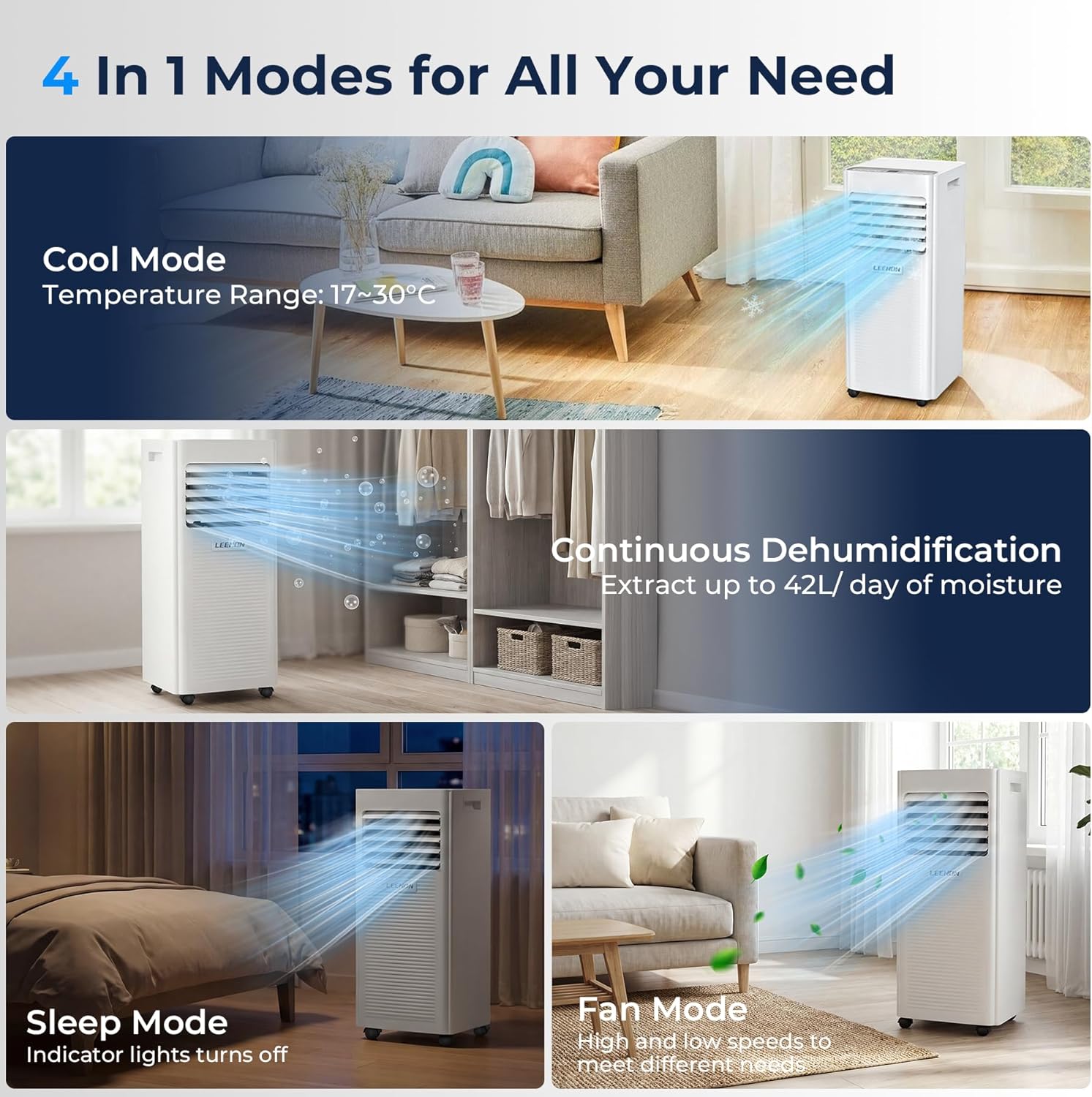
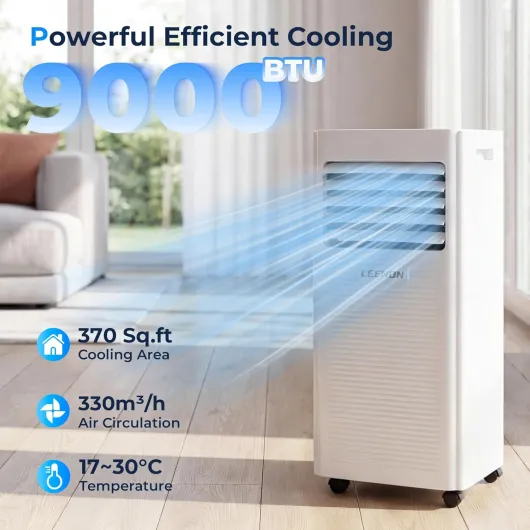
The LEENON PAC001 is a 9000 BTU portable air conditioner aimed at people who want to cool a bedroom, lounge or home office without installing a fixed split system. It runs at up to 990 W, uses R290 refrigerant and is advertised for rooms up to about 370 sq ft (roughly 34 m²), which lines up with a typical UK bedroom or small living room. On paper it is a fairly classic 4‑in‑1 mobile AC: cooling, fan, dehumidifier and sleep mode, with a 24‑hour timer and remote control.
The published customer feedback is strikingly positive: a 4.9/5 average from 19 reviews, with several buyers insisting their rooms became bearable again during warm spells. Comments often mention faster‑than‑expected cooling and a noticeable drop on their separate room thermostats. That doesn’t turn this unit into a miracle device, but it suggests that the 9000 BTU figure isn’t just marketing and that the machine is sized reasonably for the spaces people are actually using it in.
There are also recurring remarks about ease of setup and mobility. Users talk about installing the window kit in around 10–15 minutes and moving the unit between rooms on its casters without drama. For a 22 kg appliance that is not exactly feather‑light, that ease of handling stands out. The included window sealing solution and exhaust hose seem to be doing their job for typical sliding or sash windows, and one review even mentions an inward‑opening casement working acceptably.
In my opinion, this air conditioner positions itself as a practical, mid‑range portable option: not overloaded with smart‑home features, but with the essentials covered. The key questions are whether the cooling performance, noise level and running costs line up with what’s on the spec sheet. From what buyers report and from the technical data, it looks like a solid fit for people who mostly care about getting a hot room under control during a few intense weeks per year rather than running AC all summer long.
Value for money and who it suits
The exact sale price is not quoted here, but we can still judge value by looking at what you get versus typical portable ACs in the 9000 BTU segment. The LEENON PAC001 offers: 9000 BTU cooling power, A‑rated efficiency, R‑290 refrigerant, a 4‑in‑1 feature set (cooling, fan, dehumidifier, sleep mode), a 24‑hour timer, child lock, self‑evaporation, remote control, and a reasonably complete window kit. It also comes with a 1‑year manufacturer warranty, which is standard but not particularly generous. For an unknown brand, the spec sheet is coherent and doesn’t show obvious corner‑cutting.
The 4.9/5 average rating from 19 reviews is a strong signal, even if the sample size is still modest. Buyers consistently mention that it cools effectively, is straightforward to install, and is simple to use day to day. Several comments emphasise that rooms become comfortable quickly and that the window seal helps reduce wasted energy. For people living in the UK or similar climates, where the main need is to keep one or two rooms tolerable during a few heatwaves per year, this kind of portable unit can be more cost‑effective and practical than a full fixed system, especially if you’re renting or can’t modify the building.
On the downside, there are trade‑offs. The SEER of 2.6 is average for a portable AC and far below what an efficient split inverter system can offer, so if you plan to run air conditioning heavily for months, a wall‑mounted unit will pay off in electricity savings over time. The noise level of 65 dB is standard but not low, and there is no Wi‑Fi or app control, which some competitors now offer. The 1‑year warranty is also basic; some better‑known brands sometimes offer longer coverage on the compressor.
In my opinion, the value proposition looks good if the price sits in the typical mid‑range for 9000 BTU portable units. You’re getting solid real‑world feedback on cooling effectiveness, a functional window kit, decent energy class and practical usability features. It’s best suited to renters, small‑home owners, or anyone who needs flexible, non‑permanent cooling for small to medium rooms. People who want ultra‑quiet operation, smart‑home integration or top‑tier efficiency might be better off paying more for a higher‑end model or a fixed system, but for straightforward seasonal comfort this LEENON unit appears to offer good value.

Design and practicality in everyday use
On the design side, the LEENON PAC001 goes for a simple "cool white" rectangular look with soft edges. There’s no attempt at a design statement here, which in a living room or bedroom can actually be an advantage: it is unlikely to clash with furniture or decor. The control panel is on top with an LED display for temperature and mode indicators, and the air outlet is front‑facing. According to buyers, the display is easy to read and the controls are intuitive enough that you don’t need to constantly refer back to the manual once you’ve learned the basics.
The unit is relatively compact for a 9000 BTU model: roughly 30 cm wide and just under 70 cm tall. That footprint makes it easier to tuck beside a desk, bed or sofa compared with bulkier 12,000+ BTU units. At 22 kg, it’s not something you want to carry up and down stairs every day, but the four 360° swivel casters and side handles are clearly doing their job: several reviews mention moving the unit between rooms as "easy" or "simple". For a portable AC, that mobility is important – if you plan to cool a bedroom at night and a lounge during the day, you need wheels that roll and a chassis that doesn’t feel flimsy when pushed.
The included window kit is a key part of the design story. Buyers repeatedly mention the window seal and hose arrangement as a strong point, describing it as a white polyester sleeve that zips around the exhaust hose and attaches via hook‑and‑loop strips to the frame, effectively closing the gap. One reviewer even jokes that it looked like they were sewing a sleeping bag to the window, but they also note that it sits tidy against the sash and can be wiped clean with a damp cloth. Another comment highlights that it worked acceptably on an inward‑opening casement window, which is usually a headache for portable ACs.
In my opinion, the design is functional rather than stylish, but it hits the key points for a mobile AC: compact footprint, real mobility via casters and handles, and a window kit that doesn’t feel like an afterthought. There is no mention of directional louvers with complex oscillation, so expect basic airflow direction rather than elaborate swing modes. For most buyers who just want a discrete white box that cools the room and can be wheeled away when not needed, the design choices look sensible and no major red flags stand out in the comments.
User comfort, controls and everyday handling
Comfort here is both thermal comfort and ease of living with the machine. On the thermal side, buyers repeatedly say that rooms which were previously "uncomfortable" or "stuffy" became noticeably more pleasant in a relatively short time. One user mentions that their previously hot bedroom is now much easier to handle in the afternoon, and another says their workspace cooled so quickly during a heatwave that their drink went cold before they noticed the AC. This kind of feedback indicates that, for the targeted room sizes, the unit does more than just blow slightly cooler air – it actually changes the feel of the room.
The sleep mode is specifically aimed at nighttime comfort. The manufacturer describes it as operating at a low noise level to allow for a peaceful night’s rest. Reviews back this up in general terms, with people saying they can sleep with it running and that it’s a big improvement over trying to sleep in a hot room. There are no detailed complaints about sleep mode being useless, which is a good sign, although individual tolerance to noise and cool air will always vary. The ability to set a timer so the unit can stop after you’ve fallen asleep adds another layer of comfort, especially for those who wake up cold if AC runs all night.
On the usability side, buyers highlight the remote control, straightforward buttons and clear LED display as strong points. People talk about adjusting settings from bed or from the sofa, and about the timer being simple enough that they actually use it daily. The child lock is a small but practical feature for households with kids, preventing accidental button presses on the top panel. The washable mesh filter is also mentioned as easy to remove and clean, which is key for maintaining airflow and air quality over time.
Physical comfort in handling is also addressed. At 22 kg, you’re not going to carry this up a flight of stairs like a suitcase, but the four 360° casters and side handles make it manageable to roll between rooms. Several reviews explicitly describe moving it as easy, which suggests the wheels are not the usual stiff afterthought. The included window kit also contributes to general comfort: by sealing gaps around the exhaust hose, it reduces drafts, insects and hot air influx. One buyer even notes that their cats still sit on the windowsill next to the kit without issue, which hints that it doesn’t turn the space into a noisy or draughty mess. In my opinion, for day‑to‑day comfort and usability, this model checks the important boxes without overcomplicating things.
Energy use, noise and day‑to‑day operation
From a performance standpoint, the LEENON PAC001 is rated at 990 W with a SEER of 2.6 and an A energy efficiency class. For a portable AC, that’s within the usual range: not particularly frugal compared with modern inverter split systems, but reasonable for a unit you roll between rooms and only use during hotter days. The manufacturer gives an indicative annual consumption of 450 kWh per year, which would correspond to moderate seasonal use rather than running it 24/7 for months. One buyer explicitly mentions that, once the window seal was installed properly, the electricity meter "spins slower", hinting that the unit cycles less and doesn’t waste as much energy countering hot air leaks.
The built‑in sensor that stops cooling once the set temperature is reached and restarts if it rises is standard thermostat behaviour, but it’s good to see it clearly advertised. Combined with the 24‑hour timer, this allows you to schedule pre‑cooling before you enter a room and shutoff after you fall asleep, without forgetting the AC on all night. Several reviews praise the timer and remote for convenience, saying they can set it to cool the bedroom before bed or turn off later without getting up. This is basic functionality, but it’s executed in a way that users actually rely on it.
Noise is officially listed at 65 dB. In practice, that’s roughly comparable to a loud conversation or a busy office. Portable ACs tend to cluster in the 60–65 dB range, so this figure is not surprising. Some buyers call the sleep mode "quiet" enough for nighttime, while others simply focus on the fact that the cooling is strong; none of the available comments complain heavily about noise, which suggests it’s within expectations. Still, in my opinion, anyone extremely sensitive to sound should be realistic: you’re putting a compressor in the room, and no spec sheet can change that.
The self‑evaporation system is another performance detail worth noting. The unit is designed to re‑use condensate water to help with cooling, reducing how often you need to manually drain. There is, however, a "Water Full" indicator and a drain port at the bottom, and the manual drainage will still be necessary in very humid conditions or in continuous dehumidifier mode. Buyers don’t complain much about drainage, which suggests it’s not a major pain point. Overall, I’d describe the performance profile as solid: good cooling power for its BTU class, energy use that is typical but somewhat mitigated by a decent seal kit and thermostat behaviour, and noise that’s standard for this category.
What the LEENON PAC001 actually offers
The LEENON PAC001 is a 9000 BTU (2.6 kW) portable air conditioner rated at 990 W, with an A energy efficiency label and an advertised annual energy consumption of 450 kWh. It is designed for residential use, running on 220 V mains, with no outdoor unit required. The manufacturer claims it can handle rooms up to 370 sq ft, which is quite generous for 9000 BTU and aligns more with well‑insulated small to medium rooms than big open‑plan areas. It uses R‑290 refrigerant, which is currently one of the more environmentally favourable options for this type of device.
Functionally, it’s a 4‑in‑1 unit: cooling, fan, dehumidifier and sleep mode. Temperature can be set between 17 °C and 30 °C through either the top control panel or the remote. There are two fan speeds, a 24‑hour on/off timer, and a child lock to avoid unwanted button presses. The unit integrates a self‑evaporation system to reduce the need to manually empty condensate, although there is a drain port and a "Water Full" indicator for situations where manual draining is still necessary.
Dimensions are 29.2 × 30 × 69.7 cm (D × W × H) and the weight is about 22 kg, which is typical for a 9000 BTU portable AC. The form factor is a vertical tower‑like block on four 360° swivel casters with side handles. The package includes the AC unit, a window venting kit, an exhaust hose, a remote control and a drain hose. The manufacturer is Shenzhen Cvpower Electronic Co., Ltd., with the product originating from China and sold under the LEENON brand name. Warranty is 1 year limited, which is standard but not generous.
In the Amazon rankings, it sits around #33 in Mobile Air Conditioners and roughly 100k in Home & Kitchen, so it’s not an obscure listing with zero traction but also not a bestseller from a major brand. In my opinion, the spec sheet is straightforward: no Wi‑Fi, no app, no fancy inverter compressor, but a conventional rotary/scroll compressor setup with a SEER of 2.6. That SEER is modest by fixed split‑AC standards, but quite typical for entry to mid portable units. The overall picture is a practical, mid‑efficiency machine aimed at seasonal use rather than all‑day, every‑day operation.

Cooling, dehumidifying and real‑world comfort
Effectiveness is where this model seems to convince most buyers. On paper, 9000 BTU (2.6 kW) for up to 370 sq ft is within the usual recommendations for moderately sized, reasonably insulated rooms. The temperature range from 17 °C to 30 °C gives enough flexibility for different comfort levels, and the rotary/scroll compressor paired with R‑290 refrigerant should be capable of delivering quick temperature drops in typical UK summer conditions, which are more about short heatwaves than months of 35 °C.
In the published reviews, several verified buyers explicitly say that the unit cools their room faster than expected. One user mentions using it in a bedroom that previously felt uncomfortable in the afternoon and seeing a clear drop on a separate thermostat. Another reports that their lounge went from stuffy to comfortable in under half an hour, and notes that after installing the window seal properly the compressor doesn’t seem to "labour" as much, suggesting the system is not constantly fighting incoming hot air. Others highlight that even on lower fan settings, once the room is cooled, the unit maintains comfort without blasting full power all the time.
The 4‑in‑1 aspect also contributes to perceived effectiveness. Buyers appreciate being able to switch between cooling and dehumidifier mode when the air feels damp rather than hot, and to use simple fan mode for air circulation when full cooling isn’t needed. The continuous dehumidification mode is described on the spec sheet as removing excess moisture to keep the room dry and comfortable, though exact litres‑per‑day figures are not given. Still, comments suggest that the dehumidifying function is not just a checkbox and that it genuinely improves comfort during muggy weather.
Noise is quoted at 65 dB, which is fairly standard for a portable AC but not silent. Some buyers refer to the sleep mode as "quiet" or at least quiet enough to sleep with, but these impressions are subjective and will depend on how sensitive you are to background noise. In my opinion, if you’re used to the hum of a fan or older portable units, this should be acceptable, but those seeking near‑silence might still be disappointed – this is simply the trade‑off of putting the compressor in the room. Overall, the combination of decent BTU output, practical modes and a functional window seal seems to deliver consistent comfort for the types of rooms and climates it targets.
Pros
- Strong reported cooling for small to medium rooms with 9000 BTU output
- Practical 4‑in‑1 functions with dehumidifier, fan and sleep mode plus 24‑hour timer
- Effective window seal kit and easy mobility with 360° casters and handles
Cons
- Average SEER (2.6) and 65 dB noise, typical but not especially efficient or quiet
- Only 1‑year warranty and no inverter or smart‑home features
Conclusion
Analysis score
The LEENON PAC001 9000 BTU portable air conditioner comes across as a straightforward, effective option for cooling small to medium rooms without installing a fixed system. The combination of 9000 BTU output, A‑rated efficiency, R‑290 refrigerant and a proper window seal kit seems to deliver what most buyers expect: rooms that go from stuffy to comfortable in a short time, especially during the typical short but intense summer heatwaves. The 4‑in‑1 feature set (cooling, fan, dehumidifier, sleep mode), 24‑hour timer and remote control round out a package that is easy to live with day to day.
It’s not perfect: the SEER of 2.6 and 65 dB noise figure are standard rather than impressive, the 1‑year warranty is basic, and there’s no Wi‑Fi or inverter technology. For heavy, long‑term use, a split inverter system will still be more efficient and quieter. But for renters, people in older houses, or anyone who just wants to cool a bedroom, lounge or home office without drilling walls, this unit looks like a sensible compromise. Reviews highlight quick cooling, simple installation and manageable mobility, which are exactly the areas that matter for a portable AC.
In my opinion, the LEENON PAC001 is a good fit if you want a practical, no‑nonsense mobile air conditioner that focuses on doing the basics well rather than packing in smart features. If you value silent operation, advanced connectivity or long warranty coverage above all else, you may want to look higher up the range or at fixed units. For most people just trying to survive the next heatwave in a small to medium room, it appears to be a solid, good‑value choice.