Summary
Analysis score
Average of the criteria rated below
Value for money: who this 9000 BTU unit suits best
Design, ergonomics and noise: what buyers highlight
Build quality, reliability and maintenance habits
Real‑world performance, airflow and noise trade‑offs
What the Igenix 9000 BTU is and what it promises
Cooling, heating and dehumidifying: does it get the job done?
Pros
- 4‑in‑1 functionality (cooling, heating, fan, dehumidifier) with 9000 BTU output suitable for small rooms
- A‑rated efficiency with decent COP/EER around 2.9 and R‑290 refrigerant
- Top‑mounted oscillating vent, auto‑fan mode and power memory make day‑to‑day use more practical
Cons
- Single‑hose design causes negative pressure and is inherently less efficient than dual‑hose or split systems
- Noise around 64–65 dB; not ideal for light sleepers who want near‑silent operation
- Remote control is basic with no display or backlight, and window sealing often requires extra third‑party kits

Specifications
View full product page →| Brand | Igenix |
A compact 4‑in‑1 unit for rooms that overheat fast
The Igenix 9000 BTU 4‑in‑1 (sold as IG9919 / IGAC03009W depending on channel) targets a pretty common UK problem: small south‑facing rooms that turn into ovens for a few weeks a year, while the rest of the time you mainly need dehumidification or a bit of extra heat. On paper, this unit tries to cover all those needs in one go: cooling, heating, fan and dehumidifier, with a quoted 18 m² coverage. The average rating sits around 4.2/5 from just under 30 reviews, so buyers are mostly satisfied but it’s not flawless.
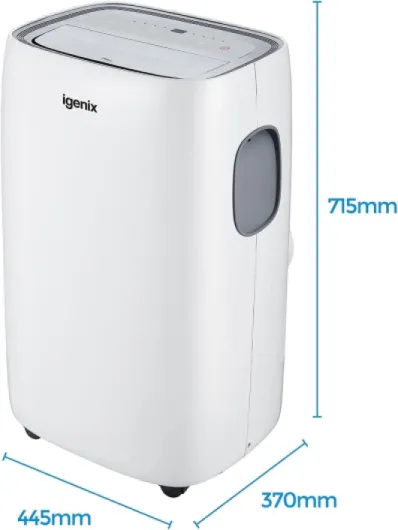
What stands out immediately is the combination of 9000 BTU cooling and a proper heating function in a relatively compact 37 × 44.5 × 71.5 cm body. Many portable units in this range only cool and dehumidify; here you get 2640 W cooling and 2560 W heating power on the spec sheet, plus an A energy efficiency label and R‑290 refrigerant. That positions it as a mid‑range, multi‑season appliance rather than a one‑trick summer gadget.
Among the reviews, several buyers insist that no portable air conditioner will behave like a fixed split system, and that seems fair. One buyer with a 9.3 m² south‑facing office reports holding 27 °C indoors while it was 39 °C outside, which is a decent real‑world gap for a single‑hose 9000 BTU unit. Others are more lukewarm and feel the cooling effect is only "okay" for the price, so expectations clearly matter a lot here.
In my opinion, this product makes sense for people who want a single device to cool a small office or bedroom, dry it out in humid weather, and add some occasional heat in shoulder seasons. It’s not trying to compete with a professionally installed split system, and some of the weaknesses (noise, single‑hose inefficiency, window‑kit faff) are inherent to this category. The question is whether the feature set and the feedback justify the asking price; that’s where the finer analysis of design, performance and value becomes important.
Value for money: who this 9000 BTU unit suits best
On the value front, opinions are a bit split. One reviewer explicitly says that for the price, the room doesn’t get cold enough and questions whether a professionally fitted air‑conditioning system, even at three times the cost, might actually be better value. That reaction highlights a key point: portable ACs are always a compromise. You pay a few hundred pounds for something you can wheel around and plug in, but you don’t get the performance or discretion of a split system. If someone expects split‑system comfort from a single‑hose portable, the perceived value will feel weak.
On the flip side, several buyers consider the Igenix a good deal precisely because it combines cooling, heating, fan and dehumidifier in one A‑rated unit. One long review compares this model’s COP/EER of about 2.9 with many 9000 BTU competitors at 2.6 and notes that going up to an A+ unit (around 3.1) usually costs significantly more for relatively small gains. They also highlight the inclusion of a heater as a differentiator in this BTU range. For someone who wants a single appliance they can use in summer heatwaves, autumn damp and cold snaps, that multi‑season use can justify the cost more easily.
There’s also the practical angle: many UK homes either can’t install or don’t want a fixed split AC due to building restrictions, aesthetics or cost. For those households, a decent portable is often the only realistic option. In this context, the Igenix’s 4.2/5 average rating, 2‑year warranty, and broadly positive comments on build and functionality make it look like a sensible mid‑range choice. It’s neither the cheapest basic box nor a high‑end quiet machine with dual hoses and smart features.
In my opinion, the value is solid if you meet three conditions: your room is genuinely in the 9–18 m² range, you can set up a decent window seal kit, and you understand that a portable AC is noisy and less efficient than a split. Under those assumptions, this Igenix gives you year‑round utility and competent performance for the money. If you want near‑silent operation, whole‑flat cooling, or you’re ready to invest in a fixed system, then this unit will feel like a compromise and the price may seem steep for what you get.
Design, ergonomics and noise: what buyers highlight
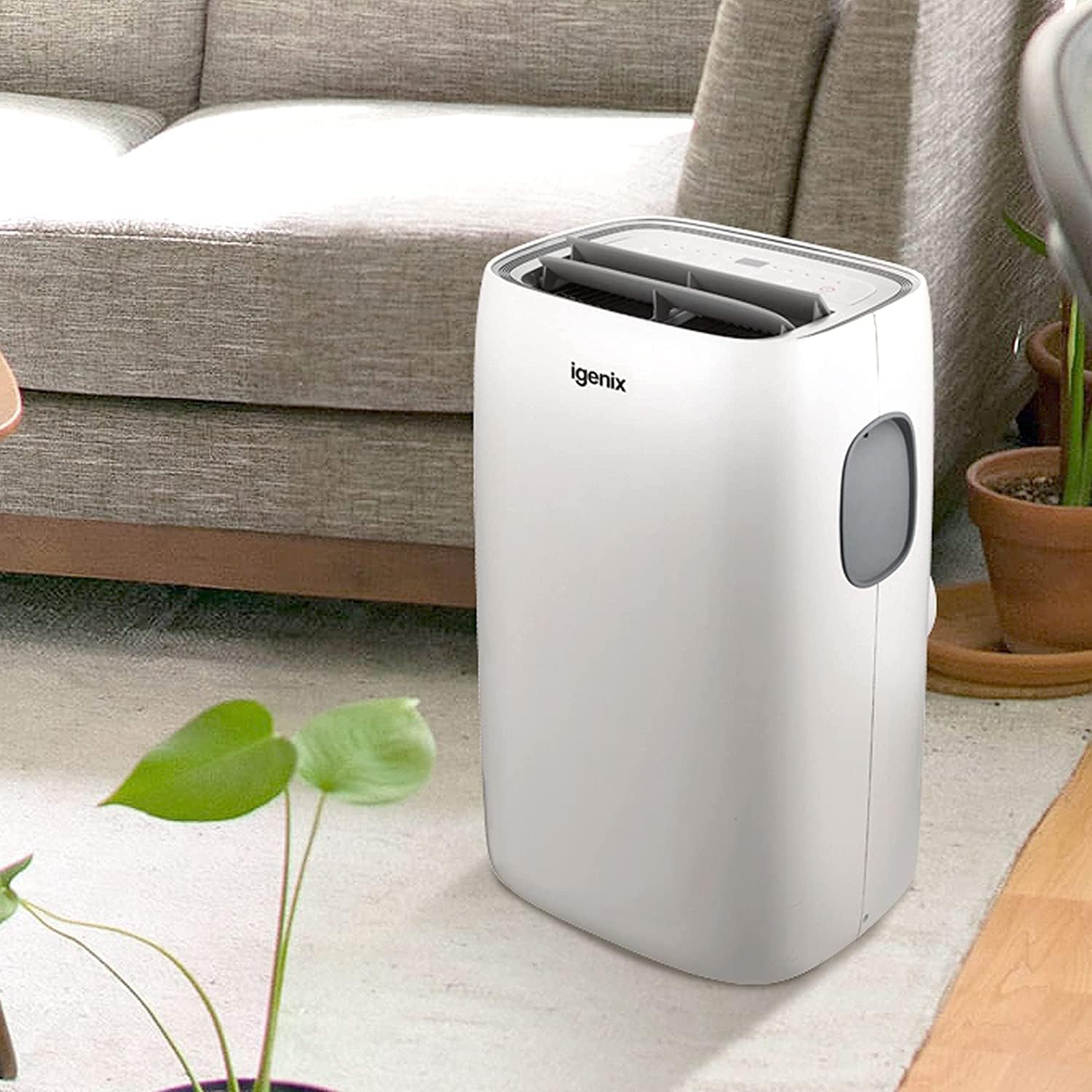
The Igenix 9000 BTU unit goes for a fairly standard tower‑like portable AC shape: 71.5 cm tall, 44.5 cm wide and 37 cm deep, weighing about 31 kg. That’s not feather‑light, but it’s in the same ballpark as most 9000–12000 BTU portables. The brand markets it as portable and easy to move between rooms, and several reviewers confirm that they do move it from a home office by day to a bedroom at night. The wheels and compact footprint help, but at 31 kg you’re still dealing with a bulky appliance that’s meant to roll, not be lifted regularly.
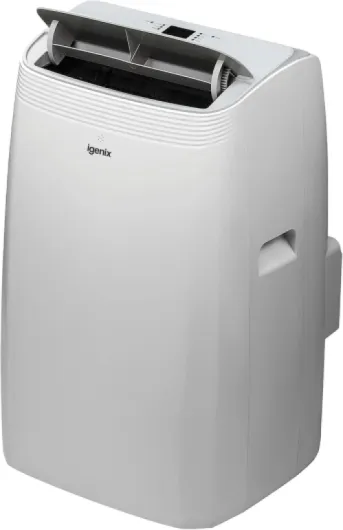
A notable design choice is the top‑mounted air outlet with motorised louvers, rather than a front‑facing grille. One detailed review explains that this top vent sends cold air upwards and around the room instead of blasting straight at you, which they see as a plus for bedroom use because you’re less likely to get a cold draft while sleeping. The oscillation can be toggled: the louvers slowly sweep back and forth, or you can stop them at a chosen angle. When powered off, the vent closes, which should help with dust and gives the unit a cleaner look.
The controls combine a digital display on the main unit with a simple remote. Several buyers like the straightforward interface but complain that the remote has no screen to show set temperature or fan speed, and no backlight. That means if you’re in bed and want to tweak settings, you either guess or switch on a light or go to the unit. One positive point mentioned by at least one owner is a power memory function: if you cut mains power via a smart plug, the unit resumes its previous mode when power returns, which is handy for remote activation.
Noise is officially quoted at 64–65 dB. In this product category that’s pretty typical, not especially quiet but not unusually loud either. Comments are divided: one reviewer praises the lack of rattles and considers the noise level relatively low for a portable AC, especially on fan‑only mode, while another is clearly less impressed and finds it too loud for the price. Realistically, any single‑box compressor unit in a small room will be noticeable; this model doesn’t change that. In my opinion, the design is solid and fairly thoughtful (top vent, auto‑fan, closing louvers), but the remote could be better and the noise is only average for the class, not a strong selling point.
Build quality, reliability and maintenance habits
There isn’t a massive volume of long‑term feedback yet – around 28 reviews and a 4.2/5 average – but a few elements point to how the Igenix 9000 BTU holds up. First, the basic construction: at 31 kg with a solid‑looking plastic shell and a thick exhaust hose, it comes across in comments as reasonably well built for a mid‑range portable. One buyer specifically praises the hose quality and the locking connector system at the back of the unit, explaining that even with heavy curtains resting on the hose it never worked loose. That’s a small detail, but hose connections are a common weak point on cheap models.
The unit comes with a 2‑year manufacturer warranty, which is decent in this category and suggests the brand isn’t expecting a flood of early failures. There are no widespread reports of breakdowns, leaks or catastrophic issues among the published reviews. Most criticism is about performance expectations, noise, and the hassle of window sealing rather than things physically breaking. That doesn’t guarantee flawless reliability, but the absence of recurring faults in the comments is at least reassuring.
Maintenance is standard for this type of product and matters for longevity. One very detailed reviewer shares their routine: clean the filters, periodically drain the condenser via the bottom drain (with a tray underneath), then run the unit in fan‑only mode for several hours before storing it for winter. The idea is to dry out the internals and avoid stale odours or mould buildup when you bring it back into service the next year. They also recommend insulating the exhaust hose to reduce heat radiation back into the room and to ease the workload on the compressor, which indirectly should help lifespan.
In my opinion, the Igenix lands as a solid but not premium piece of hardware. It’s not a flimsy budget unit, but it also isn’t built like a commercial‑grade machine. With normal care – keeping filters clean, draining when needed, avoiding constant transport up and down stairs – it should be fine for several UK summers based on what owners report so far. The 2‑year warranty and lack of horror stories in the comments support a reasonable confidence level, but if someone wants a unit to run heavily for many months every year, a higher‑end or split system would still be the safer long‑term bet.
Real‑world performance, airflow and noise trade‑offs
From a pure spec angle, the Igenix 9000 BTU offers 2640 W cooling and 2560 W heating, three fan speeds, an auto‑fan mode and a claimed airflow of about 300 m³/h (this figure is mentioned in a long buyer review referencing the manufacturer data). That airflow is slightly lower than some competing 9000 BTU models and noticeably lower than many 12000 BTU units that go past 450 m³/h. One buyer actually sees this as a plus: lower airflow can mean lower noise, and they report what they consider a relatively quiet operation for a portable AC, with no rattles or vibrations on wooden floors.
The auto‑fan mode behaves a bit like a car climate system: it adjusts fan speed based on the temperature difference. A useful detail in the feedback is that when the set temperature is reached, the compressor stops but the fan keeps running slowly, recirculating residual cool air instead of shutting down entirely. Many cheap portables cut both compressor and fan, which can lead to stagnant air and more noticeable temperature swings, so this behaviour is a small but practical advantage for comfort.
Energy‑wise, several comments mention that being A‑rated with a COP/EER around 2.9 makes it reasonably efficient for its class. A buyer estimates running costs around 24p per hour after the first hard‑working 20 minutes, based on a typical UK electricity tariff at the time and the 2640 W draw. That’s not scientific data, but it gives a ballpark idea: this is not a cheap fan to run, but it’s also not the worst offender compared with other portables. Single‑hose inefficiency is highlighted: by only expelling hot air and not bringing in outside air via a second hose, the unit inevitably pulls some warm air back into the room from gaps and adjacent areas, which drags down theoretical efficiency.
Noise is quoted at 64–65 dB and the subjective perception varies among buyers. One detailed reviewer finds the fan‑only mode "very quiet" and describes the overall sound as just a compressor hum plus airflow, without odd noises. Another owner clearly thinks the unit doesn’t justify its price given the noise and only moderate cooling in their setup. In my view, this isn’t a silent device and it won’t be discreet in a small bedroom at full blast; it’s more about tolerable noise for a few hot nights or daytime office use. Performance is solid but not game‑changing: you get the usual trade‑off of airflow, noise and efficiency that defines single‑box portable ACs.
What the Igenix 9000 BTU is and what it promises
On paper, the Igenix IG9919 / IGAC03009W is a 4‑in‑1 portable climate unit: air conditioner, heater, dehumidifier and fan. Cooling power is rated at 9000 BTU (about 2.6 kW), with a specified coverage of up to 18 m², which matches a typical UK double bedroom or a small home office. Heating output is listed at 2560 W, so the heat mode isn’t just an afterthought; it should be able to take the edge off in a modest‑sized room. The unit uses R‑290 refrigerant, the current go‑to for many domestic portables due to lower global warming potential compared with older gases.
The spec sheet lists an A energy efficiency rating and a quoted COP/EER around 2.9 in at least one detailed customer review. That’s slightly better than many basic 9000 BTU portables that sit closer to 2.6, but below the premium A+ models. Annual energy consumption is strangely listed at 20 kWh, which looks more like a label figure than anything you’d see in real usage; realistically, people will chew through more than that in a hot summer, but the point is that this is not a power‑hungry monster for its class.
Igenix advertises a 24‑hour programmable timer, three fan speeds, a digital display, and a dehumidification capacity of up to 22 litres per day. The included accessories are basic but standard: the main unit, a 1.5 m exhaust hose and a remote control. The manufacturer mentions window installation, but there is no universal hard plastic window kit in the description; buyers with top‑hinged or side‑opening windows often end up using third‑party fabric sealing kits.
In terms of application, it’s clearly aimed at indoor, multi‑purpose use with no outdoor unit required and a rotary/scroll compressor. It’s not an inverter model, so the compressor will cycle on and off rather than modulating output. That matters for comfort and humidity control: several reviewers mention that sizing the BTU output correctly to the room is key to avoiding rapid cycling and poor dehumidification. Overall, the promise is straightforward: a reasonably efficient, mid‑power portable unit that can stay useful beyond the few hottest weeks by doubling as a heater and dehumidifier.
Cooling, heating and dehumidifying: does it get the job done?
The key question with any portable AC is simple: does it actually cool the room to a comfortable level? For this Igenix 9000 BTU model, the answers in the reviews are mostly positive but not unanimous. One verified buyer with a 9.3 m² south‑facing office reports that during a 39 °C heatwave, the room held at about 27 °C. That’s a 12‑degree drop compared with outside, which is respectable for a 9000 BTU single‑hose unit working against high solar gain. Another reviewer using it in a 14 m² south‑facing first‑floor bedroom also describes the cooling as effective, noting that air coming out of the top vent measured around 10 °C with basic probes.
On the other hand, a different buyer sums up their experience as "it’s okay" and complains that, for the price, the room doesn’t feel "super cold". That mismatch comes up often with portable units: they don’t chill the whole space as fast or as deeply as a split system. With an 18 m² advertised coverage, this Igenix is sized for small to medium UK rooms; if someone expects it to rapidly cool a big, poorly insulated open‑plan area, disappointment is predictable. The single‑hose design also creates negative pressure, as one reviewer points out, which can drag warm air back in from adjacent spaces if the room isn’t well sealed.
Heating and dehumidifying get less detailed feedback, but the spec sheet is clear: up to 2560 W of heating and 22 L/day dehumidification capacity. Several buyers mention appreciating the heater as a rare feature in this BTU range and price bracket. For dehumidification, one long review explains that the unit is self‑evaporative, reusing much of the collected moisture in the cooling cycle to limit tank emptying, though you still have to drain it occasionally in very humid conditions. They also stress that correct BTU sizing helps because an oversized unit will reach target temperature quickly, cycle off, and stop dehumidifying, leaving the room cool but still sticky.
In my opinion, the effectiveness here lines up with what you’d expect from a decent 9000 BTU single‑hose unit: strong spot cooling around the unit, reasonable whole‑room cooling over time in rooms under about 18 m², and extra utility as a heater and dehumidifier. It’s not magic, and it won’t turn a sun‑soaked loft into a fridge in minutes, but for small bedrooms and offices with a sealed window setup, the feedback suggests it gets the job done for most users who size and vent it properly.
Pros
- 4‑in‑1 functionality (cooling, heating, fan, dehumidifier) with 9000 BTU output suitable for small rooms
- A‑rated efficiency with decent COP/EER around 2.9 and R‑290 refrigerant
- Top‑mounted oscillating vent, auto‑fan mode and power memory make day‑to‑day use more practical
Cons
- Single‑hose design causes negative pressure and is inherently less efficient than dual‑hose or split systems
- Noise around 64–65 dB; not ideal for light sleepers who want near‑silent operation
- Remote control is basic with no display or backlight, and window sealing often requires extra third‑party kits
Conclusion
Analysis score
The Igenix IG9919 / IGAC03009W 9000 BTU 4‑in‑1 sits in a realistic middle ground. It’s a compact, A‑rated portable unit that can cool, heat and dehumidify small rooms up to around 18 m². The spec sheet is coherent, the 2‑year warranty is reassuring, and an average of about 4.2/5 from buyers suggests that, for most people who size and install it properly, it does what they expect. Several owners report effective cooling in south‑facing bedrooms and offices, while also appreciating extras like auto‑fan, oscillating top vent and the heating mode.
It’s not perfect. Noise is typical for a portable AC, not especially low, and the single‑hose design means some inherent inefficiency and negative pressure. The remote is basic with no display or backlight, and people with awkward window designs may need to spend extra on a sealing kit and hose insulation to really get the best from it. One or two buyers feel the cooling punch doesn’t fully justify the price, especially when comparing in their head with a split system.
In my opinion, this unit makes sense for renters, flat dwellers and homeowners who can’t or won’t install fixed AC but still want reliable spot cooling and year‑round flexibility. It’s a good fit for small offices, bedrooms and spare rooms where 9000 BTU is appropriate, and where some fan noise is acceptable. People chasing near‑silent operation, whole‑house cooling or maximum efficiency should look at higher‑end solutions, but for a movable, multi‑use appliance, the Igenix offers a balanced feature set and generally positive real‑world feedback.