Summary
Analysis score
Average of the criteria rated below
Value for money: does it justify the spend?
Design, size and practicality: compact for an AC, bulky for a bedroom
Noise, sleep, and everyday comfort
Build, reliability and day-to-day robustness
Cooling performance, dehumidifying and real-world power use
What the Pro Breeze 9000 BTU is actually offering
Pros
- Strong 9000 BTU cooling with effective dehumidifier mode for year-round use
- Wi‑Fi app, Alexa/Google Home support and remote control for flexible operation
- Includes two window kits (sliding and hinged) and uses R290 refrigerant with Class A efficiency
Cons
- Quite noisy in operation, even in fan mode, according to multiple buyers
- Large and heavy at around 24.5 kg, awkward to move between floors
- Hinged-window kit relies on Velcro strips that some users find unattractive

Specifications
View full product page →| Brand | Pro Breeze |
A portable AC that’s actually built for UK-style heatwaves
The Pro Breeze 4-in-1 Portable Air Conditioner 9000 BTU sits in a category that has exploded over the last few summers: mobile AC units for people who can’t or don’t want to install a fixed split system. On paper, it tries to tick a lot of boxes at once: 9000 BTU cooling power, Wi‑Fi and voice control, 4 operating modes, and an included window kit that works with both sliding and hinged UK windows. It even carries a Which? Best Buy award for air conditioners from December 2025, which is a strong credibility boost in this segment.
With a 4.1/5 average rating from more than 700 Amazon reviews, this unit clearly has a solid user base. Many buyers highlight its raw cooling performance and the comfort it brings during hot nights, even if they also flag compromises like weight and noise. That mix of praise and criticism is exactly what you’d expect from a mid‑range, 9000 BTU portable AC aimed at bedrooms and medium‑sized rooms, not giant open‑plan spaces.
On the spec sheet, the Pro Breeze looks fairly modern: Class A energy efficiency, R290 refrigerant (advertised as much more climate‑friendly than older gases), Wi‑Fi app control compatible with Alexa and Google Home, and a 24‑hour timer. At 1130 W and a stated SEER of 14, it is not a miracle of efficiency, but it should keep running costs and power draw within reasonable limits for occasional heatwave use. The manufacturer positions it for areas up to about 450 square feet, which roughly covers typical UK bedrooms, small living rooms, and home offices.
In my opinion, this model is best seen as a practical appliance rather than a lifestyle gadget. It is big, heavy, and not quiet, but the published reviews suggest it actually cools rooms properly, which is what counts when you are trying to sleep in 28–30 °C indoor heat. The rest of the analysis looks at how its design, performance, noise, ease of use, and value hold up against those expectations and the common complaints found in user feedback.
Value for money: does it justify the spend?
The Pro Breeze 9000 BTU sits in a competitive segment where many brands offer similar cooling capacity with fewer features. Several buyers explicitly call it “a bit expensive” but also add that if you buy cheap you usually get poor results, and that this unit “does its job well” and feels worth the extra. That’s a telling pattern: people are aware they’re not buying the cheapest portable AC on the market, but they feel they are getting solid performance, smart features, and a known brand with a Which? Best Buy award backing it up.
On the feature side, the value equation includes Wi‑Fi, an app, Alexa/Google Home integration, and two window kits in the box. Cheaper models often skip smart control entirely or ship with only a basic remote and a single, generic window kit. Here, the ability to control the unit via phone or voice, set schedules, and monitor use adds convenience that many users genuinely appreciate. The dehumidifier function and sleep mode further increase year‑round usefulness, which spreads the cost beyond just a few hot weeks each year. In my opinion, that multi‑function angle helps justify a higher price than no‑name, fan‑only “air coolers” that barely change room temperature.
Running costs are another part of value. With a power draw of 1130 W and user‑reported energy costs of around 30–35p per hour at full blast, this is not a trivial appliance to run. But once the target temperature is reached, the compressor cycles off, so you’re not paying that peak rate constantly. For people who only switch it on during uncomfortable nights or short heatwaves, the electricity cost is a trade‑off most reviewers seem willing to make for a cool, sleepable room. If you plan to run an AC all day, every day in summer, a fixed split system would usually be more economical long‑term, but that’s a different budget and installation story.
Overall, I’d place the Pro Breeze 9000 BTU in the good value but not bargain category. You’re paying for real cooling power, smart features, and a relatively trusted name, not for design finesse or whisper‑quiet operation. If you mainly want the lowest possible price and don’t care about Wi‑Fi or voice control, there are simpler units that may cost less. If you prioritise strong, reliable cooling in UK‑style rooms and like the idea of app control and a Which? endorsement, this model offers a sensible balance between cost, performance, and functionality.
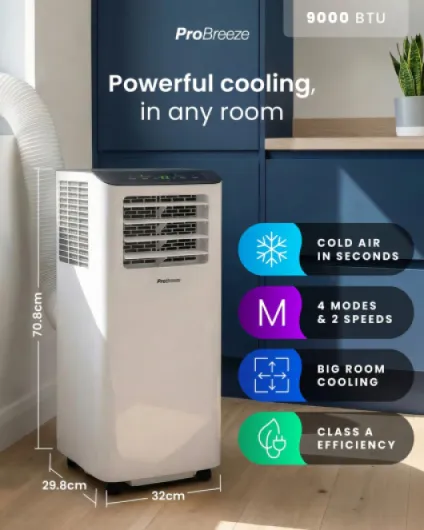
Design, size and practicality: compact for an AC, bulky for a bedroom
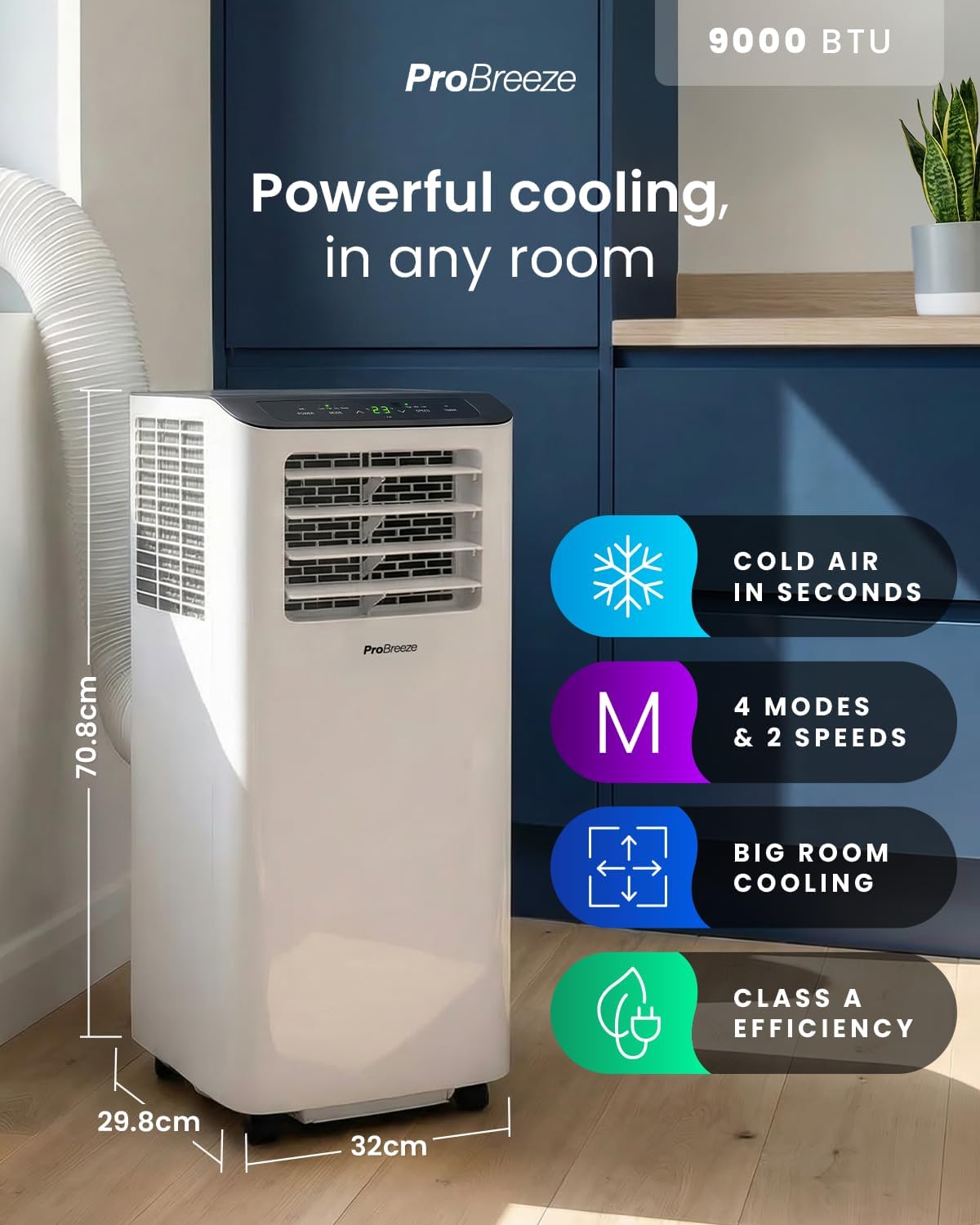
On paper, the Pro Breeze 9000 BTU is fairly typical for a portable AC in terms of footprint, but still a big appliance by normal home standards. The published dimensions are 32D x 70W x 29H cm, with a weight of about 24.5 kgwithin a floor, not something you casually carry up and down stairs every day.
Despite the size, the design includes wheels, which users say make it fairly easy to move around on hard floors. On carpet, movement seems more awkward, which is common for this type of unit because of weight and small casters. There is only one power level listed in the specs, which is a bit odd compared with some models that advertise multiple fan speeds. In practice, buyers talk about a “low setting”, so it likely has at least some basic fan speed control, but it’s not clearly highlighted in the spec sheet in a very transparent way.
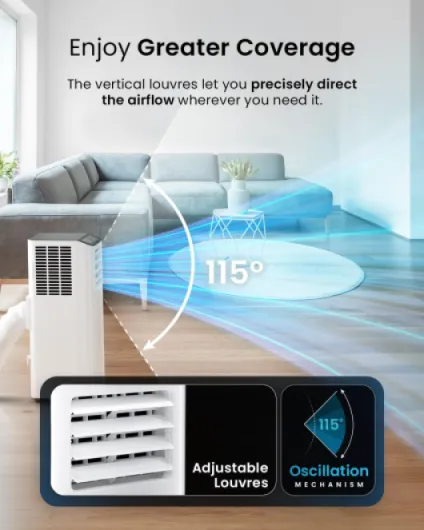
The colour scheme is black and white, with a digital display and louvers on the front. One buyer notes there is no motorised oscillation; you have to manually direct the airflow by adjusting the louvers yourself. That’s not a deal‑breaker, but at this price bracket some competitors do offer auto‑swing, which spreads the air more evenly. The lack of oscillation is one of those small design limitations that doesn’t kill the product but slightly reduces comfort and perceived sophistication.
In terms of window integration, the two included kits are a strong practical point, but they do affect aesthetics. The sliding‑window kit is a more common plastic panel solution, while the hinged‑window kit relies on fabric and Velcro. One reviewer mentions that the Velcro strips do not look great around the frame, especially once the kit is removed outside of hot periods. So the design approach is clearly focused on minimal permanent modification rather than visual perfection. In my opinion, that makes sense for renters and people who don’t want to drill or cut, but anyone very picky about window appearance might see this as a weak point.
Noise, sleep, and everyday comfort
Comfort with a portable AC is a mix of how well it cools and how tolerable the noise is. This Pro Breeze unit is specified at around 54 dB, which is pretty standard for this category, but not quiet in absolute terms. Multiple buyers call it “quite noisy” or compare the sound in cooling mode to a loud refrigerator combined with a strong fan. Even on fan‑only mode, one reviewer says it is substantially louder than their existing fans, and roughly on par with a large 18" metal fan in terms of perceived loudness. So anyone expecting near‑silent operation is likely to be disappointed; this is an AC first, not a whisper‑quiet bedroom fan.
That said, several comments also state that the cooling effect is strong enough that people are willing to accept the noise. One buyer explains they can sleep fine with it running, set at about 22 °C, and that both they and their partner manage to rest even though it is noisier than a typical fan. Another reviewer mentions looking forward to future heatwaves, precisely because the comfort of a cool room outweighs the sound level. In other words, the trade‑off is clear: if you badly need temperature reduction, you get it, but you won’t forget the machine is there.
The presence of sleep mode suggests the unit adjusts fan speed or compressor cycles at night, but user comments don’t go into much technical detail on how it behaves. What is clear is that the thermostat control helps: once the room reaches the target temperature, the compressor cycles off, which reduces both noise and power draw. Buyers note that the AC does not run flat‑out all night once the set point is reached, so you get bursts of louder operation followed by quieter periods, which may be easier to tolerate than constant roar.
From a comfort‑of‑use angle, the remote control and app help you avoid getting out of bed to change settings. Users mention controlling it via Alexa with simple commands and using the app to tweak mode and temperature, which is practical at night. The downside is the need to keep the exhaust hose connected and the unit relatively close to a window, which can constrain where you place your bed or desk. Overall, comfort here is a balance: strong cooling and decent smart control, offset by notable noise and the physical bulk of the appliance in the room.

Build, reliability and day-to-day robustness
Durability on this Pro Breeze model has to be inferred mainly from the brand’s positioning, the Which? Best Buy award, and the pattern of user reviews rather than detailed long‑term lab data. The unit uses a scroll compressor, which is usually a robust design in air conditioning, although the spec does not mention any fancy inverter technology; this is a straightforward on/off compressor, which is simpler but less efficient than inverter systems. The product is made in China, like most portable ACs, and comes with a limited warranty, though exact warranty length is not prominently advertised in the spec summary.
At around 24.5 kg, the machine is heavy, which often hints at a fairly solid internal build (compressor, heat exchangers, etc.) rather than ultra‑light, flimsy components. Buyers generally describe it as “well made” and give the impression that the casing and wheels feel sturdy enough for normal domestic use. There are no widespread reports in the comments about units falling apart, cracking, or failing after just a few uses, which is a good sign. With more than 700 reviews and a 4.1/5 average, any systemic reliability issue would likely show up as a cluster of one‑star complaints, and that doesn’t seem to be the dominant pattern.
Where some users raise mild concerns is in the practical wear and tear of accessories and handling. The Velcro‑based window kit for hinged windows, for example, relies on adhesive strips on frames and surroundings. Over time, adhesive can leave marks or lose grip, and one buyer clearly doesn’t like the look when the kit is removed. That’s more of an aesthetic durability issue than a functional failure, but it’s worth noting if you plan to mount and unmount the kit every summer. The exhaust hose is described as rigid but able to hold position, which should help it survive repeated adjustments, provided it isn’t over‑bent or crushed.
In my opinion, given the price bracket and the portable AC category, the Pro Breeze looks solid but not indestructible. Treated as a seasonal appliance, used carefully, and moved gently on its wheels rather than dragged or constantly carried upstairs, it should hold up for several hot seasons. It is not a premium split system built to run daily for years, but the combination of a respectable brand reputation, the Which? award, and the absence of widespread early‑failure stories suggests reliability that is decent for home and office heatwave use.
Cooling performance, dehumidifying and real-world power use
Performance is where this Pro Breeze model gets most of its positive feedback. With 9000 BTU of cooling power and a listed coverage of up to 450 sq ft, it is designed for medium‑sized rooms rather than giant open spaces. One buyer reports dropping a room from 23 °C down to 16 °C and feeling the cooling effect across the entire top floor of their house, which suggests strong airflow and decent capacity when doors are left open. Another review simply says that it “does what it’s meant to” and cools a decent‑sized room quickly, which lines up with the spec.
The unit has three main active functions mentioned repeatedly in reviews: cool, fan, and dry (dehumidifier). Cool mode is the loudest but delivers the temperature drop; fan mode gives you airflow without the refrigeration, so it’s more about air movement than actual cooling. Dry mode pulls moisture from the air, and at least one buyer highlights this as making the unit useful all year round, not just during hot spells. This aligns with the spec that lists a dehumidifying function and a 24‑hour timer, so you can theoretically run it in damp conditions to manage humidity even in cooler months.
In terms of energy, the AC is rated at 1130 W with a Class A efficiency label and a SEER of 14. That’s decent but not cutting‑edge; more efficient split systems can do better, but for a portable AC this rating is reasonable. Several buyers have tracked running costs with smart plugs and mention figures around 30–35p per hour when the compressor is running flat‑out, with a higher spike at initial cool‑down. However, they also note that once the target temperature is reached, the compressor cycles off and on, so the average hourly cost drops. The key point: if you run it constantly during extreme heat, you will see it on the electricity bill, but casual evening or night use should stay manageable.
Another performance angle is the R290 refrigerant, which the brand claims is up to 690 times more eco‑friendly than traditional gases. From a user perspective, this doesn’t change how the AC cools your room, but it does matter if you care about environmental impact. Combined with the Class A rating, it positions the unit as relatively responsible for a portable AC, although the simple fact of active cooling will always consume more power than a basic fan. Overall, the performance picture is clear: strong, effective cooling and useful dehumidification, at the cost of noticeable noise and typical portable‑AC energy consumption.
What the Pro Breeze 9000 BTU is actually offering
The Pro Breeze 4‑in‑1 Portable Air Conditioner is pitched as an all‑round climate unit rather than just a basic cooler. It combines four main modes: cooling (the full AC function), fan‑only, dehumidifying (dry mode), and a sleep mode that tweaks operation for night use. Several buyers explicitly mention using the dry function outside of heatwaves, which makes the machine useful in damp seasons as a dehumidifier, not only in summer. On paper that flexibility is one of its main strengths compared with cheap, fan‑only "air coolers" that don’t really lower room temperature.
Cooling power is listed at 9000 BTU / 0.75 tons, with the brand claiming it can bring rooms down to 16 °C. In UK terms, that’s a typical spec for a portable unit aimed at medium rooms and upstairs bedrooms. The manufacturer cites coverage up to 450 sq ft; in real‑world UK housing that usually means it should be more than enough for a bedroom and decent for a modest living room or office, but likely stretched in very large open‑plan spaces. Several reviews talk about feeling the effect across the top floor of a house, which suggests the airflow is fairly strong when doors are left open.
On the connectivity side, the unit supports Wi‑Fi app control plus voice control via Amazon Alexa and Google Home. Buyers report setting it up on 2.4 GHz Wi‑Fi and then using commands like “Alexa, turn on the AC” or switching between fan and cool modes by voice. There is also a physical remote and onboard digital display, so you are not locked into the app. This three‑way control (panel, remote, app/voice) means the device should integrate smoothly whether you are into smart homes or just want to press buttons.
The product ships with two window kits, one for sliding windows (vertical or horizontal) and one for hinged windows, which are common in the UK. One detailed review explains that the hinged‑window kit relies on Velcro strips stuck to the frame and reveals that the result is functional but not especially pretty once removed. That’s a trade‑off: you get a solution that avoids drilling or permanent changes, but you may not like the look of adhesive strips. Overall, the presentation of this AC is clear: a fairly powerful, connected, all‑in‑one cooling and dehumidifying box, aimed at people who want real temperature drop without installing a full split system.
Pros
- Strong 9000 BTU cooling with effective dehumidifier mode for year-round use
- Wi‑Fi app, Alexa/Google Home support and remote control for flexible operation
- Includes two window kits (sliding and hinged) and uses R290 refrigerant with Class A efficiency
Cons
- Quite noisy in operation, even in fan mode, according to multiple buyers
- Large and heavy at around 24.5 kg, awkward to move between floors
- Hinged-window kit relies on Velcro strips that some users find unattractive
Conclusion
Analysis score
The Pro Breeze 4‑in‑1 Portable Air Conditioner 9000 BTU comes across as a solid, practical choice for people who want real cooling in bedrooms, living rooms or home offices without installing a fixed system. On paper it delivers what matters most: enough power to noticeably drop room temperature, a useful dehumidifier mode for damp days, and a Class A efficiency rating with R290 refrigerant that keeps it relatively sensible on the energy front for a portable unit. The Wi‑Fi app, Alexa/Google Home compatibility, remote control and 24‑hour timer round it out as a modern appliance that fits easily into a smart home setup.
The downsides are straightforward: it’s heavy, physically large, and clearly not quiet. Multiple buyers highlight the noise, and the Velcro‑style hinged‑window kit is more about convenience than aesthetics. Portability is realistic within one floor thanks to the wheels, but frequent stair moves will be a chore. If you are extremely sensitive to noise or obsessed with a clean window look, this is probably not your ideal product.
In my opinion, this unit suits people in small to medium homes or flats who mainly need reliable cooling during heatwaves and are willing to accept fan‑plus‑compressor noise in exchange for a genuinely cooler room. Renters and those who can’t fit a split AC will likely find the combination of power, smart features and Which? Best Buy status convincing. On the other hand, anyone looking for near‑silent operation, ultra‑cheap running costs, or a very sleek installation should either look at fixed systems or be prepared to compromise. Overall, it’s a strong all‑rounder with clear strengths in performance and functionality, balanced by the typical trade‑offs of portable AC design.