Summary
Editor's rating
Noise levels: honest expectations vs marketing
Value for money: pricey but justifiable if you’ll actually use it
Design and build: sturdy unit, so‑so window kit
Comfort in real life: cooling, noise, and sleep
Build quality and long-term feel
Performance: cooling, dehumidifying, and smart features
What you actually get out of the box
Pros
- Cools small to medium rooms (around 12–20 m²) quickly and reliably
- Drainage-free operation in Cool mode under normal humidity, so no constant tank emptying
- Good smart features (app, Alexa/Google, sleep curve) and a practical magnetic remote
Cons
- Window kit is not ideal for UK-style casement windows and often needs DIY fixes
- Noise is noticeable, especially on high fan, despite the optimistic 46 dB claim
- Short 1.5 m exhaust hose can be limiting if your window is high or far from where the unit can stand

Specifications
View full product page →| Brand | DREO |
A portable AC that actually cools – but read the small print
I’ve been using the Dreo AC515S 10000 BTU portable air conditioner as my main cooling unit in a small UK bedroom and occasionally in the living room. I’m not sponsored, I paid for it myself, and I went into this a bit sceptical because a lot of the glowing reviews looked like giveaway units. After a couple of hot days and nights with it, I can say it does what it says on the box in terms of cooling, but it’s not magic and it’s not silent.
In my 12–14 m² bedroom, starting at around 27–30°C, it brings the room down to 22–23°C in under an hour if I close the door and sort the window seal properly. That’s basically the difference between lying there sweating and actually being able to sleep. It’s not going to take a roasting loft conversion from 30°C to 16°C like a built-in split system, so if that’s your expectation, you’ll be disappointed. But for a normal bedroom or small living room, it’s pretty solid.
The noise is there. It’s not “whisper quiet”, it’s roughly like having a couple of decent fans running in the room. I can still sleep with it on low or in sleep mode, but if you’re super sensitive to sound you’ll either need earplugs or use it to pre-cool the room and then switch it off. On the flip side, the white noise is actually kind of nice at night once you get used to it.
Overall first impression: good build, proper cooling, smart features that actually work, but some annoyances around the window kit and the marketing around noise and refrigerant. If you’re expecting a portable AC that behaves like a hotel split unit, this isn’t it. If you just want a decently powerful, app-controlled unit to get through heatwaves without melting, it gets the job done.
Noise levels: honest expectations vs marketing
Dreo advertises 46 dB noise, which sounds very low on paper. In reality, like most portable AC marketing, that number is optimistic and probably measured at a distance and at a specific fan speed. In my room, at about 1 metre away, it felt more like 50 dB or a bit more on low, and clearly louder on higher fan settings. One reviewer actually measured around 50 dB with a phone app, which seems about right. So no, it’s not silent, and if you’re expecting a quiet library vibe, you’re going to be disappointed.
That said, compared to other portable ACs I’ve used or heard at friends’ places, this one isn’t worse. I’d say it’s on the quieter end of the portable AC spectrum, but that still means noticeable fan and compressor noise. On low, it’s a steady whoosh and hum that you can talk over easily and sleep with if you’re not extremely sensitive. On high, it’s strong airflow plus more compressor noise, and watching a quiet TV show in the same room will need the volume turned up.
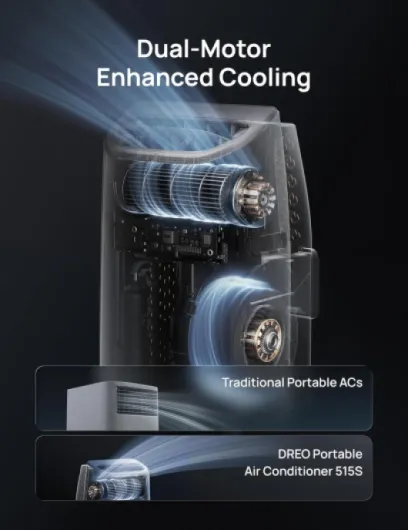
Dreo mentions a “patented noise isolation system” that supposedly keeps the compressor and turbulence noise under control. I’m sure they’ve done something inside the casing to dampen vibrations, because there’s no rattling or harsh mechanical sound, but physics is physics: you’re still moving a lot of air and running a compressor in the same box that’s in your room. The key point is that the sound is consistent and not annoying in tone. It’s more like a big steady fan than a clunky machine starting and stopping all the time.
For sleep, I ended up either running it on low/sleep mode all night, which I got used to, or using a timer to cool down the room for an hour or two before bed and then letting it turn off. If you already sleep with a fan or white noise app, this won’t be much of a change. If you need absolute silence, no portable AC is going to make you happy, and you probably need a split system instead.
Value for money: pricey but justifiable if you’ll actually use it
Price-wise, the Dreo AC515S sits a bit above the real budget portable ACs, but not in the top luxury bracket. You’re paying extra for the smart features, quieter design compared to some cheap units, and the drainage-free cool mode. The big question is whether that price bump is worth it. For me, in a house that turns into an oven a few weeks a year, the answer is yes, but with some conditions.
Compared to cheaper 7000–9000 BTU units, the 10,000 BTU here does make a difference. In a 12–14 m² bedroom, it cools quickly enough that you’re not running it flat-out for hours. That saves a bit on power and makes it more comfortable to live with. The smart app and voice control might sound like gimmicks, but being able to pre-cool the bedroom from downstairs or set a proper schedule without standing at the unit is actually useful. If you hate apps, you can ignore all that and just use the remote.
On the downside, you still need to factor in extras: possibly a longer exhaust hose, maybe a better window sealing kit, and definitely the electricity costs if you run it a lot. The listed power draw is up to around 3.5 kW, so this isn’t a toy. You also need to plug it directly into a wall socket, not a multi-way extension, which can mean rearranging things. If you’re only going to use it two or three days a year, it might feel like overkill, and a cheaper unit or just a decent fan could be enough.
Overall, I’d say the value is good if: you have a small to medium room that regularly becomes uncomfortably hot, you care about decent noise levels and build, and you’ll actually use the smart features or at least the better cooling. If you’re looking for the absolute cheapest way to get some cold air, this isn’t it. If you want something that’s more polished and reliable than random no-name units, the price makes sense.
Design and build: sturdy unit, so‑so window kit
Design-wise, the Dreo AC515S is pretty clean and neutral. It’s a white rectangular tower (44D x 36.5W x 71.5H cm), rounded enough that it doesn’t scream “industrial appliance” in the corner of the room. The plastic doesn’t feel flimsy, and the whole thing gives off a solid, well-assembled vibe. At 28.5 kg, it’s not light, but the caster wheels roll smoothly on hard floors. On carpet or when you’re going over thresholds, you still need to give it a proper shove and guide it with both hands.
The top control panel is simple: touch buttons for power, mode (Cool/Fan/Dry), fan speed, temperature, timer, and a small display. You can run it entirely from the unit if you want, but in practice I used the remote or the app 90% of the time. The remote is actually one of the nicer parts: it’s big enough that it doesn’t vanish into the sofa and it has a magnetic storage spot on top of the unit, so it’s always where you expect it. That sounds minor, but when you’re half asleep and roasting, not having to hunt for a tiny remote is a plus.
The main weak point of the design is the window solution. The sliding panels are fine if you have the right type of window, but for casement windows you’re either taping the cloth around the frame or inventing your own contraption. Also, the hose is only 1.5 m, which is OK if the unit can sit right under the window. If your sill is high or you’ve got furniture in the way, you end up raising the unit or buying an extension hose and adapter. That extra DIY is basically part of the deal with this model.
Overall, the design is practical more than pretty. The unit itself looks decent in a bedroom or living room and feels robust, but the accessories are clearly built to a budget. If your windows are straightforward and low enough, you’ll be happy. If not, expect to spend a bit of time swearing at the hose and reaching for duct tape.
Comfort in real life: cooling, noise, and sleep
In terms of actual comfort, this is where the Dreo AC515S earns its keep. In a 12–14 m² bedroom starting at around 27–30°C, it got the room down to about 22–23°C in roughly 30–60 minutes depending on how well I sealed the window and whether the sun was blasting the walls. That’s consistent with what other buyers report. It doesn’t hit the advertised 16°C from a very hot starting point, but honestly, going from sauna to “I can breathe and sleep” is what matters. If you pre-cool the room in the evening and then switch to Eco or Auto, it keeps things steady without cycling too aggressively.
Noise-wise, you need to be realistic. On low fan or sleep mode, it’s more like a strong desk fan plus compressor hum. One user measured about 50 dB at 1 m with a phone app, which matches my impression. On high fan, you know it’s there; watching TV quietly in the same room can be annoying unless you turn the volume up. For sleeping, I found it tolerable on low, and the constant hum actually works as white noise. If you’re very noise-sensitive, you might prefer to use it to cool the room down before bed, then set a timer so it turns off after an hour or two.
One nice thing is the drainage-free cool mode in normal humidity. In my use, I didn’t have to empty any water when running it just for cooling, even on muggy days. That’s a big comfort win compared to older units where you’re constantly checking a tank. In Dry (dehumidifier) mode, you do need to hook up the drain hose, but that’s expected. A few users also mentioned they didn’t feel as dehydrated or dried out as with some other ACs they’ve used, which lines up with my experience: the air feels cool and less sticky, but not like a desert.
Overall comfort: for sleeping and general use, it works well if you accept that portable ACs are never silent. It cools a typical bedroom fast enough, the airflow is strong, and once temperature is reached, Auto mode keeps things fairly stable. For a home office or living room, it’s good too, but if you’re on video calls all day, you may end up turning it down a notch to keep the background noise reasonable.
Build quality and long-term feel
I obviously haven’t had this unit for years, so I can’t pretend I know exactly how it will age, but I can comment on the build and how it feels after some sustained use. The main body feels solid: no creaking when you push or roll it, no loose panels, and the plastic has a decent thickness. The vents and louvers don’t feel like they’ll snap off the first time you bump into them. The caster wheels are sturdy enough and don’t feel like cheap toy wheels; they roll smoothly on hard floors and cope with being moved around a bit.
The weak links, if anything, are the accessories. The hose is fine but not premium; if you bend it too sharply or extend it to the limit, you can feel it’s not the toughest material on earth. Same with the sliding window panels: they do the job, but they’re thin plastic, and if you’re constantly installing/removing them, I wouldn’t be shocked if they started to warp or crack over a couple of summers. The sealing cloth for casement windows is even more temporary-feeling. It’s basically there as a starter solution; if you want something more durable, you’ll probably end up buying a better aftermarket kit or making your own.
On the electronics side, the controls, display, and remote all feel decent. Buttons are responsive, the app connection has been stable so far, and nothing has glitched out on me. The internal pump and so‑called drainage-free system haven’t thrown any errors or leaks in normal cooling use. The fact that other buyers mention using it through multiple heatwaves without issues is a good sign, but obviously we’re all early in the product’s life cycle given the start year.
Dreo’s customer service gets good feedback, and there’s a 1‑year standard warranty plus the option to extend it, which is reassuring. For a portable AC at this price point, I’d say the main unit itself feels like it should last several summers if you don’t abuse it. Just don’t expect the window kit and hose to be indestructible; treat them gently or plan to upgrade them down the line.

Performance: cooling, dehumidifying, and smart features
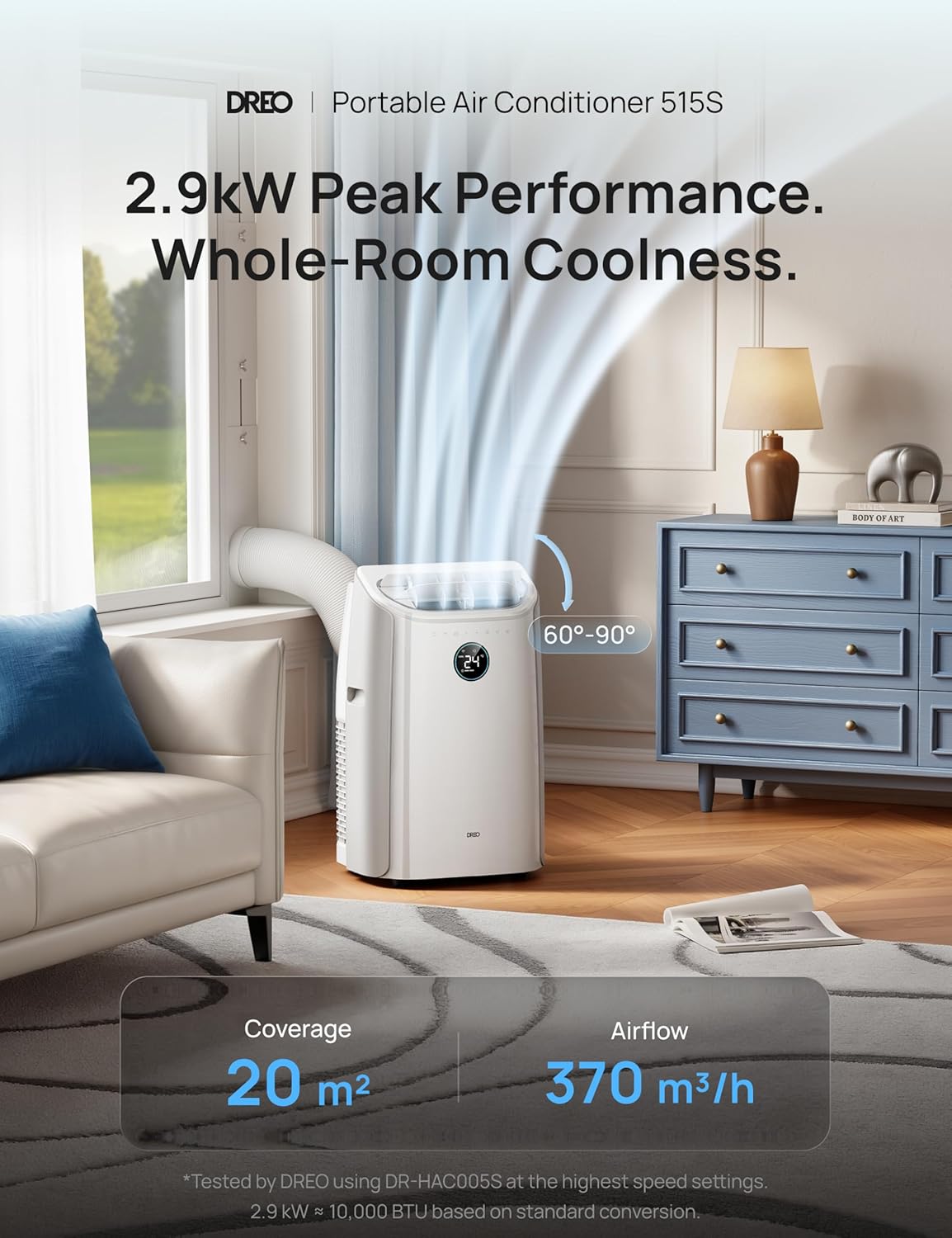
Performance-wise, this Dreo is pretty solid for a 10,000 BTU portable AC. In a small to medium room (up to about 20 m²), it cools fast. In my 14 m² bedroom, I saw drops of 4–7°C within an hour, similar to the user who went from 30°C to 23°C in about 30 minutes. In a larger living room, closer to the claimed 28 m² limit, it still helps a lot, but you shouldn’t expect it to turn a big open-plan space into a fridge in half an hour. Think “takes the edge off and makes it comfortable”, not “walk-in freezer”.
The 3‑in‑1 aspect (Cool/Fan/Dry) actually has some use. Cool is what you’ll live in most of the time. Fan mode is basically just a big fan if you don’t need active cooling. Dry mode pulls a decent amount of moisture out of the air (spec says 3.2 L/h). On humid days, running Dry for a while makes the room feel less sticky even before the temperature drops much. Just remember that Dry mode needs actual drainage; the so‑called drainage-free system is only for normal Cool mode, and that’s under humidity up to around 90% according to Dreo’s claims.
The smart side is better than I expected. The Dreo app connects over Wi‑Fi and lets you turn the unit on/off, change modes, tweak temperature, and see simple graphs of temperature and sometimes humidity over time. I could also link it to Alexa/Google and bark commands like “set bedroom AC to 22 degrees”, which is lazy but convenient. The sleep curve function in the app is handy: you can set it to slowly adjust the temperature overnight instead of blasting cold air all night. The remote is solid and has all the same core functions, so you’re not forced into the app if you hate that stuff.
One detail: the compressor does cycle on and off rather than smoothly ramping like a true inverter unit. So when it kicks in, you notice a small change in sound. It’s not jarring, but if you expected a fully variable-speed inverter, this isn’t that. Still, in daily use, it didn’t bother me much, and it didn’t hurt its ability to hold a target temperature within a degree or two.
What you actually get out of the box
Out of the box, the Dreo AC515S looks like a fairly standard modern portable AC: white plastic tower, vents at the front, hose connection at the back. It comes with the main unit, a 1.5 m exhaust hose, sliding window panels, some sealing bits, a drain hose, and a chunky remote. The box opens from the top and lifts off, which makes more sense than having to deadlift 28.5 kg of plastic and compressor straight up. If you’re taking it upstairs, I’d honestly unbox it downstairs first because the unit alone is heavy enough, and the cardboard and accessories add a bit of awkward bulk.
The included window kit is clearly designed with sliding windows in mind, not classic UK side-hinged casement windows. You get modular plastic panels that you can adjust between roughly 45–85 cm for sliding windows, plus sealing cloth for other setups. For a typical UK casement window, you will probably be improvising with tape, foam, cardboard, or the included cloth. It’s doable, but it’s not plug-and-play. Several users (me included) ended up bodging a solution for small top windows and raising the unit so the hose reaches without putting strain on the connection.
Documentation is decent. The manual is clear enough, and the Dreo app walks you through Wi‑Fi setup without too much pain. The key spec points are: 10,000 BTU / 2.9 kW cooling, coverage up to about 28 m², noise rated at 46 dB (which is optimistic in real life at close range), and a drainage-free cool mode in normal conditions. It also uses R290 refrigerant, not R32, which is a detail that annoyed at least one buyer because the listing text was confusing.
Overall, presentation is straightforward: you get everything you need to run it, but if your windows are awkward or high up, budget for either an extra hose, a better sealing kit, or some DIY effort. The product doesn’t feel cheap, but you can tell the window kit is made to hit a cost point, not to cover every weird UK window style perfectly.
Pros
- Cools small to medium rooms (around 12–20 m²) quickly and reliably
- Drainage-free operation in Cool mode under normal humidity, so no constant tank emptying
- Good smart features (app, Alexa/Google, sleep curve) and a practical magnetic remote
Cons
- Window kit is not ideal for UK-style casement windows and often needs DIY fixes
- Noise is noticeable, especially on high fan, despite the optimistic 46 dB claim
- Short 1.5 m exhaust hose can be limiting if your window is high or far from where the unit can stand
Conclusion
Editor's rating
The Dreo AC515S 10000 BTU portable AC is a solid choice if you’re dealing with a hot bedroom or small living room and you don’t want to mess with a full split system. It cools a 12–20 m² room quickly, holds a comfortable temperature, and the drainage-free cool mode means you’re not constantly emptying a tank. The noise is there, but it’s more like a strong fan than a rattling machine, and most people will get used to it, especially in sleep or low mode. The smart features (app, voice control, sleep curves) aren’t just marketing fluff; they do make day-to-day use easier.
It’s not perfect. The window kit is clearly designed for sliding windows, so UK-style casement windows will probably need some DIY or extra accessories. The 1.5 m hose is short if your window is high, and the real-world noise levels are higher than the glossy 46 dB number suggests. You’re also paying a bit more than bare-bones units, and you need to respect the power draw and plug it directly into a wall socket.
I’d recommend this to people who: have one or two key rooms that get uncomfortably hot every summer, are okay with some white noise, and want something that feels more refined than the cheapest options. It’s especially good for bedrooms where reliable cooling and decent noise control matter. If you’re extremely noise-sensitive, have very awkward windows and don’t want to DIY, or just want the cheapest possible unit to use once a year, you might want to look elsewhere or go straight for a professionally installed split system.