Summary
Analysis score
Average of the criteria rated below
Value for money: strong cooling and features, clear compromises
Compact footprint, simple look, and a window kit that divides opinions
Build quality, hoses and long-term concerns
Noise, airflow, smart control and real-world behaviour
What this Pro Breeze 12000 BTU unit actually offers
Cooling and dehumidifying: strong results for medium rooms
Pros
- Strong 12000 BTU cooling, effective in medium to large rooms according to buyers
- Smart control via app, remote, Alexa and Google Home with 24-hour timer and scheduling
- Multi-function device (cooling, fan, dehumidifier, sleep mode) with Energy Class A and R290 refrigerant
Cons
- High noise level reported by many users, especially noticeable at night
- Short exhaust and drain hoses plus a basic window kit that often require DIY upgrades or extra purchases

Specifications
View full product page →| Brand | Pro Breeze |
A powerful portable AC that trades silence for cooling
The Pro Breeze PB-AC-10 is a 12,000 BTU portable air conditioner aimed at people who want serious cooling in bedrooms, living rooms or home offices without installing a fixed split system. On paper, it combines solid cooling power, WiFi control, and an A energy efficiency rating, which is not bad for this category. With an average of 4.0/5 over around a few dozen Amazon reviews, reactions are generally positive but not unanimous.
What stands out from the comments is a clear trade-off: strong cooling and flexible controls on one side, high noise and some design compromises on the other. Several buyers say it can drop a medium room from around 28–30°C down to roughly 21–22°C in a fairly short time, which lines up with the 12,000 BTU spec. Others, however, point to the sound level and the accessories (window kit, hoses, drain tube) as the main weak spots.
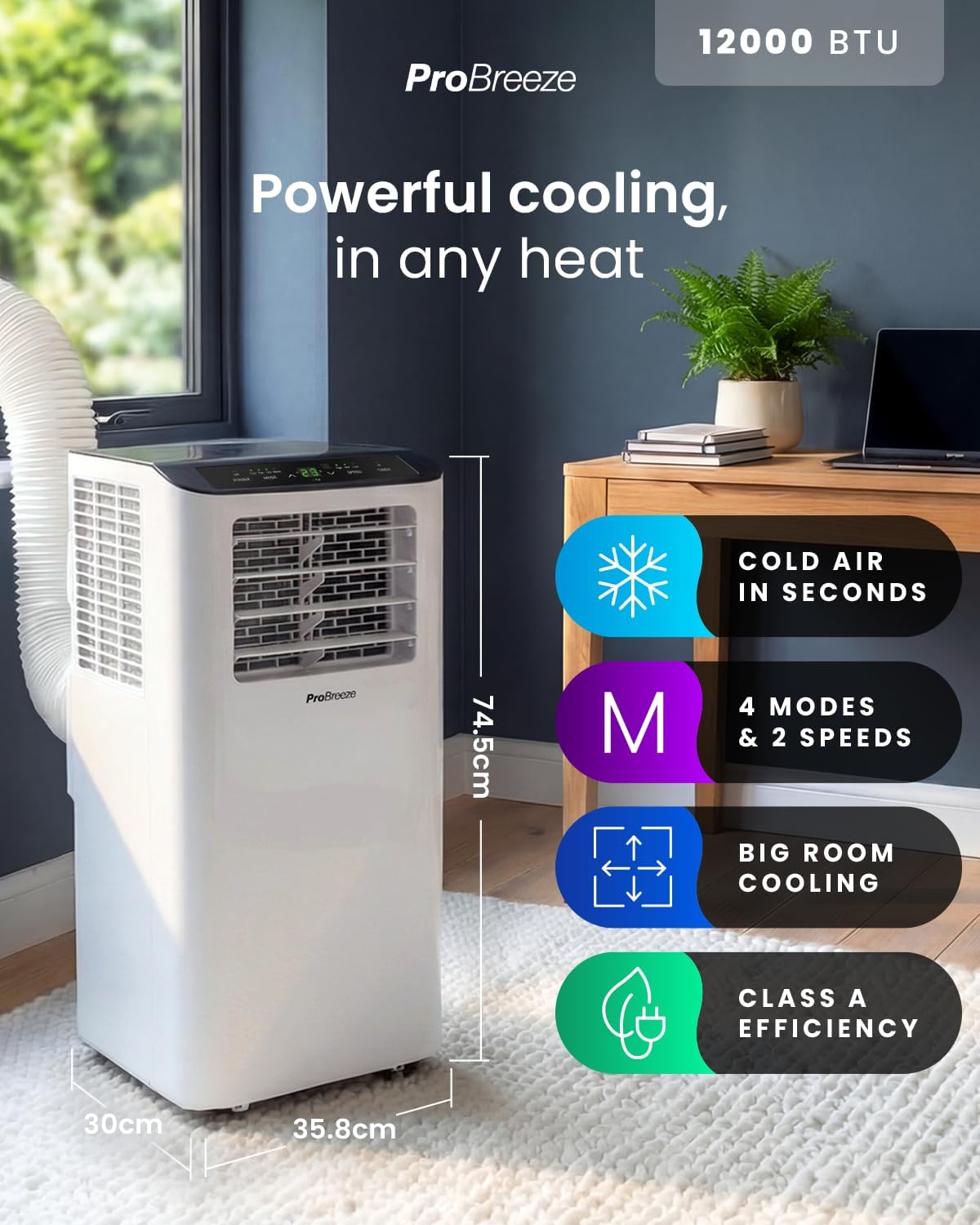
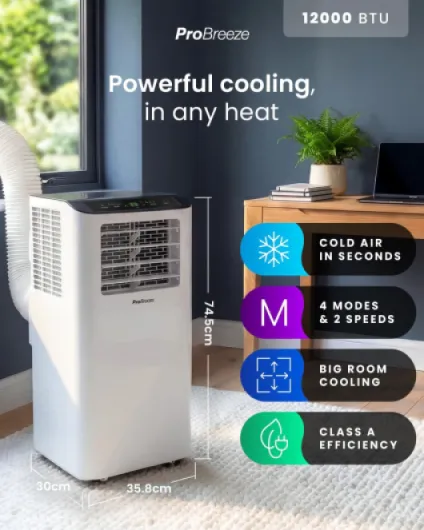
On the technical sheet, you get 12000 BTU cooling capacity, SEER 3.5, R290 refrigerant, 54 dB advertised noise, WiFi/app compatibility, Alexa/Google Home support, and a 24-hour timer. It also doubles as a dehumidifier and fan, which can save space versus buying three separate devices. The unit weighs 27.3 kg and is fairly compact for its category, with dimensions of 35.8 × 30 × 74.5 cm.
In my opinion, this model targets users who accept that a portable AC will be noisy but want strong cooling, simple app control, and an all-in-one solution. If your priority is ultra-quiet operation or a perfect window installation, the reviews suggest you should think carefully before buying. The rest of the analysis looks at how it performs on paper and what people actually say about living with it day to day.
Value for money: strong cooling and features, clear compromises
On the value for money front, this Pro Breeze model sits in an interesting spot. It offers 12000 BTU cooling, a Class A energy rating, WiFi/app and voice control, and multi-mode operation (cooling, fan, dehumidifier, sleep). It is also ranked very high in its category (number 1 in Mobile Air Conditioners in its marketplace), with an average of 4.0/5 from around 67 reviews, which suggests that most buyers feel they got what they paid for, even if some aspects are criticised.
One buyer explicitly calls it an “excellent purchase”, praising how quickly it cools a 5 × 4 m living room and saying they wish they had bought it sooner. Another says it is “brilliant at cooling” the first floor of a small three-bedroom home and is much better than a cheaper unit they owned previously. These comments indicate that, compared to low-end portable ACs, this model delivers a noticeable jump in performance and usability. The presence of both a remote and a functional smartphone app adds convenience usually reserved for slightly more expensive models.
On the other side, there is a 1-star review that is very negative about almost everything: noise, short water drain tube, short exhaust hose, and poor window system, with the conclusion that everything is bad for the price paid. This shows that expectations matter a lot. If someone expects a quiet, perfectly integrated cooling solution, they will probably feel disappointed. Portable monobloc ACs are a compromise by nature: they are louder and less efficient than split systems, but cheaper and easier to install.
In my opinion, the value is good but not spectacular. You are paying for strong cooling power, modern controls, and a reasonably efficient unit that can handle real heat waves in medium rooms. The price (not listed here) will obviously influence the judgement, but purely on features and feedback, it looks like a sensible choice for people who accept noise and are ready to tweak the installation (longer hose, better window seal) to get the best from it. If you want silence above all, or hate any DIY, you might be happier saving for a split system or looking for a lower-power, quieter unit even if it cools less.
Compact footprint, simple look, and a window kit that divides opinions
Visually and physically, the Pro Breeze PB-AC-10 is fairly compact for a 12,000 BTU machine. At 35.8 cm deep, 30 cm wide and 74.5 cm high, it has a relatively small footprint, which helps if you need it in a crowded bedroom or a tight home office. The weight of 27.3 kg is typical for this power range: it is portable in the sense that you can wheel it between rooms, but not something you casually carry up and down stairs on a daily basis.
The design is quite basic: white housing, front air outlet with oscillating louvres, and a top-mounted LED display and control panel. Several reviews mention that the display clearly shows temperature and mode, and the remote mirrors the main functions, so you do not need to interact with the top panel all the time. The overall look is discreet rather than flashy, which is probably good if it has to sit in a living room all summer.
Two design aspects come up repeatedly in the comments: noise and the window kit. Noise is more performance-related (covered later), but its perception is tied to design choices like internal insulation and fan layout. People describe the sound as a dull droning with occasional louder mechanical noises when the compressor kicks in, which is typical of monobloc units where everything sits in the room. On paper, the 54 dB figure looks reasonable, but reviews suggest it feels louder in real life, especially at night.
The window venting system is where opinions really diverge. The AC comes with a hose and a kit intended for typical windows. One buyer describes the standard kit for hinged windows as “ugly” but workable, and says a YouTube video helps with installation. Another reviewer is much harsher, calling the window system "so bad" and complaining that the exhaust hose is short. A different customer ended up ordering a longer hose and stresses that using a similar type to the original one is important to avoid tearing. My view: the included kit is functional but basic, and if you want a clean, semi-permanent setup (Perspex panel, custom seal, longer hose), expect some DIY or extra purchases.
Build quality, hoses and long-term concerns
The spec sheet positions the Pro Breeze PB-AC-10 as a mid-range portable AC with a standard construction: plastic housing, rotary/scroll compressor, and a corded electric power supply at 240 V. There is mention of a limited warranty, but no detailed duration is provided, which is a bit vague. The unit is manufactured in China, like most competitors in this category. On paper, nothing stands out as especially premium or especially weak: it looks like a typical consumer-grade appliance.
In terms of build quality, the general tone of the reviews is that the main unit feels solid enough, with one buyer explicitly saying it “looks good quality.” There are no widespread reports of catastrophic failures, cracks, or leaks in the published comments. However, the accessories and some design choices do raise questions about long-term ease of use. One buyer complains that the water drain tube is very short, and does not understand the logic behind it, suggesting that at least two metres would have been more practical. The same person also calls the exhaust hose short and criticises the window system, which they describe as bad overall.
Another buyer provides a more detailed story about the exhaust hose: they needed a longer one and first bought a third-party plastic hose with metal wire, which split when they tried to connect it via a coupler. They solved the problem by buying another hose identical to the one supplied, which then worked fine. This anecdote suggests two things: first, the original hose is reasonably robust if handled properly; second, compatibility and quality of replacement hoses matter a lot, and cheap generic hoses can fail easily.
In my opinion, long-term durability will depend heavily on how you handle the hoses, move the unit, and set up drainage. The core hardware (compressor, main body) does not attract major criticism so far, but the short drain tube and basic window kit may push some owners into DIY solutions that are less reliable. Given the lack of detailed warranty information, I would not treat this as a premium, decade-long investment; it looks more like a solid seasonal workhorse that should last several summers if used and installed with some care.

Noise, airflow, smart control and real-world behaviour
Beyond raw cooling, overall performance depends on noise levels, airflow management and control options. The manufacturer states a noise level of 54 dB, which, on paper, is moderate. In practice, buyers are very clear: this unit is loud. One reviewer says bluntly that if you think you will sit comfortably in the same room with it running, “forget about it,” calling it extremely loud. Another buyer, who is less sensitive, describes a dull droning with occasional louder sounds when the compressor cycles, and even compares some noises to a car door closing. At the same time, another person says they can sleep with it and even like the white noise, so tolerance clearly varies.
Several comments try to mitigate this: one buyer mentions that placing the unit on an anti-vibration mat helps reduce some of the noise and vibrations. In my opinion, this is typical of monobloc portable ACs: the compressor and fan are in the room rather than outside, so even a decent design will never be quiet. If you are a light sleeper or very sensitive to constant drone, you should assume this will be noticeable, especially at night, despite the dedicated sleep mode that lowers fan speed.
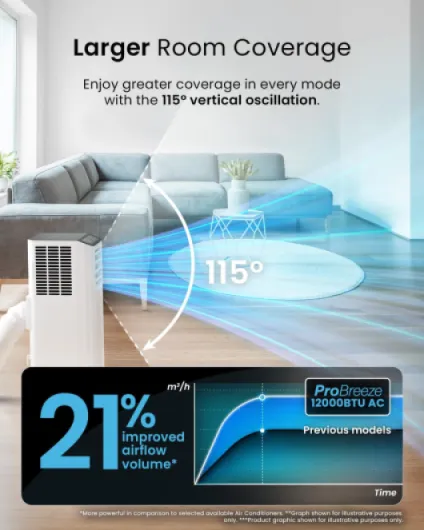
On the positive side, airflow seems strong. Buyers repeatedly mention that the fan mode alone moves a lot of air, even on low speed, and combined with the 115° automatic oscillation, this helps spread cool air around the room. This is consistent with the idea of using it to cool not just a single bedroom but also an adjacent landing or small corridor when doors are open. One user reports cooling three bedrooms and a landing upstairs, which shows the airflow is not just concentrated in one small area.
The smart features complete the performance package. The AC can be managed via the Pro Breeze app, with options to set temperature, timer, and schedule. Voice control via Alexa and Google Home is a plus if you already use a smart speaker. Some buyers say they have not even bothered with the app because the remote control is already convenient and responsive, letting you change modes, set the timer, and adjust settings from the sofa or bed. In my opinion, the smart side is a nice bonus but not the core reason to buy this model; it is more of a quality-of-life improvement on top of solid but noisy cooling.
What this Pro Breeze 12000 BTU unit actually offers
This Pro Breeze model is a portable, monobloc air conditioner designed for residential use, with no outdoor unit required. All the components (compressor, fan, heat exchanger) are in one body, and hot air is expelled through a hose to the window. With 12000 BTU of cooling power, it targets medium to large rooms such as typical bedrooms, living rooms or home offices. Several buyers mention using it in rooms around 5 × 4 m or across the first floor of a small house, which is consistent with that capacity.
The spec sheet lists 4 operating modes: cooling, dehumidifying, fan only, and sleep. You also get 3 fan speeds, a 24-hour digital timer, and an oscillating louvre system that can swing up to 115° to distribute air more evenly. On paper, this makes the unit quite adaptable: it can cool aggressively during the day, run quietly at low fan speed at night, or just work as a fan when you do not want full cooling.
One of the main arguments is Smart Home integration. The PB-AC-10 can be controlled via the Pro Breeze smartphone app (iOS and Android) and is compatible with Amazon Alexa and Google Home. That allows voice commands such as turning it on, adjusting temperature, or changing modes. Buyers often highlight the remote and app control as practical, especially when the unit is placed in a bedroom or living room where you do not want to get up every time you want a small adjustment.
On the energy side, the AC is rated Energy Class A, with a Seasonal Energy Efficiency Ratio (SEER) of 3.5 and annual energy consumption listed as 1343 kWh. It uses R290 refrigerant, which is advertised as far more eco-friendly than older gases (the brand claims up to 690 times less impact than some traditional refrigerants). In my opinion, this does not make it a "green" product in absolute terms—air conditioning always consumes power—but for a portable AC it is relatively efficient. Overall, the presentation is that of a modern, connected, mid–high power portable unit aimed at European-style flats and houses.
Cooling and dehumidifying: strong results for medium rooms
The main question for any portable AC is simple: does it cool properly? On paper, 12000 BTU is suitable for medium to large rooms, and most buyers confirm that the Pro Breeze PB-AC-10 delivers solid cooling in realistic conditions. One verified buyer reports dropping a 5 m × 4 m room from 30°C to 22°C in about 28 minutes, which is quite strong performance for a single monobloc unit. Another user describes cooling a small three-bedroom first floor to the point where “it feels like we live in the Arctic” after a few hours set to 22°C.
Not everyone is as enthusiastic, but even the more critical review acknowledges that it takes a room from around 28°C to 21–20°C in a couple of hours with the door closed. That person is sceptical about ever reaching the advertised 16°C target, and in my opinion that is a fair point: in typical UK or European homes with average insulation and some heat gain from outside, hitting 16°C with a portable unit is ambitious. However, several buyers stress that the perceived comfort improves faster than the raw temperature, because the air coming out is very cold and circulates well, so the room feels fresher even when the thermometer has only dropped a few degrees.
The AC also serves as a dehumidifier and fan-only unit. Some buyers say the fan mode is particularly effective, pushing a lot of air even on the low setting, which can be useful when you do not want full cooling but still need air circulation. Others mention being pleased with the dehumidifier function, although detailed humidity figures are not provided. The official capacity is listed as 0.6 litres, which likely refers to the internal tank volume before you need to drain it; that is not huge, so frequent drainage could be necessary in very humid environments.
In my opinion, the effectiveness picture is clear: cooling performance is the strong point, especially in closed rooms of reasonable size. You should not expect it to turn a sun-baked open-plan flat into a fridge, but for bedrooms, typical living rooms, and upstairs spaces, the feedback is largely positive. The main compromises are noise and the fact that portable ACs inevitably lose some efficiency through the exhaust hose and window gap, which no spec sheet can fully hide.
Pros
- Strong 12000 BTU cooling, effective in medium to large rooms according to buyers
- Smart control via app, remote, Alexa and Google Home with 24-hour timer and scheduling
- Multi-function device (cooling, fan, dehumidifier, sleep mode) with Energy Class A and R290 refrigerant
Cons
- High noise level reported by many users, especially noticeable at night
- Short exhaust and drain hoses plus a basic window kit that often require DIY upgrades or extra purchases
Conclusion
Analysis score
The Pro Breeze 12000 BTU portable air conditioner is, in my opinion, a straightforward workhorse: it cools strongly, covers a decent room size, and adds useful smart features, but it is loud and its accessories are basic. The spec sheet is solid for a portable unit: 12000 BTU, Class A efficiency, SEER 3.5, R290 refrigerant, and a 24-hour timer. Public reviews back up the idea that it can turn hot, stuffy rooms into comfortable spaces in a short time, whether that is a 5 × 4 m living room or a small upstairs floor with multiple bedrooms.
The downsides are equally clear. Noise is the main complaint: several buyers find it very loud, with a constant drone and occasional mechanical sounds when the compressor cycles. The standard exhaust hose, short water drain tube and basic window kit also draw criticism, and some users end up buying longer hoses or custom window panels to get a neater, more practical setup. This is not a plug-and-forget premium solution; it is a capable portable machine that benefits from a bit of DIY and tolerance for noise.
Who is it for? People in flats or houses who need serious cooling in one or two key rooms, accept the usual drawbacks of portable ACs, and like the idea of controlling the unit via app or voice. Who should skip it? Anyone obsessed with quiet operation, those expecting split-system performance and aesthetics, or users who do not want to deal with hoses, window seals or drainage. Overall, as a balance between power, features and price, a 4/5 analysis rating feels fair.