Summary
Editor's rating
Is it good value for money or should you look elsewhere?
Chunky but manageable design, clearly built as a workhorse
Comfort in real use: airflow, sleep mode and living with it
Build quality, maintenance and what might wear out first
Cooling, heating, noise: how it actually behaves day to day
What you actually get with this 5‑in‑1 unit
Does the 5‑in‑1 really replace several devices?
Pros
- Strong 12,000 BTU cooling and 9,000 BTU heating suitable for roughly 18–23 m² rooms
- 5‑in‑1 functions (cooling, heating, fan, dehumidifier, auto) plus WiFi and remote control
- Easy to move on wheels with side handles and practical cord storage at the back
Cons
- Bulky and heavy (30 kg) with a visible hose and window kit that take up space
- Noise level is noticeable, especially on higher fan speeds and for light sleepers
- Only 1-year warranty and no inverter, so energy use and long-term efficiency are just average

Specifications
View full product page →| Brand | KOMORE |
A rolling AC that’s trying to replace your heater too
I’ve been using this KOMORE 12000 BTU portable air conditioner with heat for a couple of weeks in a medium-sized flat, mainly in a 20 m² living room that opens onto a small hallway. I wanted something that could cover both summer and the shoulder seasons without drilling walls or dealing with a split system. On paper it ticks a lot of boxes: cooling, heating, fan, dehumidifier, WiFi, remote, timer, the whole lot.
In daily use, it feels like a very typical portable AC with a few modern touches. It’s not magic, it doesn’t turn the room into an icebox in five minutes, but it does bring the temperature down to a comfortable level and keeps it there. Same story with the heating: it’s more of a strong space heater than a full central heating replacement, which is what I expected anyway.
The noise level is listed at about 54 dB in sleep mode, and that matches what I’ve experienced: it’s audible, you won’t forget it’s running, but it’s not unbearable. For watching TV or working, it’s fine. For sleeping, it really depends how sensitive you are; I can sleep with it, my partner finds it a bit too loud for long nights. So it’s very much a personal tolerance thing.
Overall, my first impression is that this is a practical, fairly powerful, but bulky appliance. It’s not perfect: it takes space, it needs window venting, and you have to think about draining water if you use dehumidifier mode a lot. But if you accept the usual compromises of portable ACs, this one feels like a solid mid-range option rather than some cheap noisy box.
Is it good value for money or should you look elsewhere?
From a value for money point of view, I’d put this KOMORE unit in the “pretty solid” category. It’s not the cheapest portable AC out there, but you’re getting 12,000 BTU cooling, 9,000 BTU heating, WiFi control, a proper window kit, and a dehumidifier mode that actually works. The energy efficiency class A and use of R290 refrigerant are nice bonuses: it’s a bit more eco-friendly than older gases, and the energy use is reasonable for this power level, though it’s still a 1300 W device, so don’t expect miracles on your electricity bill if you run it non-stop.
Compared to simpler 9000 BTU portable units without heating or WiFi, you’re paying extra, but you’re also covering more use cases. If you only need occasional cooling for a tiny bedroom, this is probably overkill and you could go for something smaller and cheaper. But if you want one device to handle summer cooling, spring/autumn heating boosts, and occasional dehumidifying, the price starts to make more sense. I’d say it’s better value for people who will use at least two or three of its modes regularly.
The 1-year manufacturer warranty is standard, nothing special. I would have liked to see two years, but that’s not rare in this product category. Build quality feels solid enough that I don’t expect it to fall apart after one season, but long-term durability is hard to judge without a full year of use. The included accessories (remote, window kit, drain hose) mean you don’t have to spend extra right away, except maybe for some sealing foam to improve the window connection.
So, is it worth it? If you accept the usual downsides of portable ACs (space, noise, hose through the window) and you actually plan to use the heating and dehumidifier functions, then yes, it’s good value for money. If you only care about cooling a small space a few weeks a year, there are cheaper and simpler units that will get the job done without all the extra features you won’t use.

Chunky but manageable design, clearly built as a workhorse
Design-wise, it’s not going to win any beauty contests, but that’s not really the point here. The unit is roughly 30 × 44 × 71 cm and weighs about 30 kg, so it’s a fairly big white block on wheels. In a small room, you definitely notice it. In my living room, it sits next to the window and blends in enough, but I wouldn’t call it discreet. If you’re hoping for something that hides in a corner, this isn’t it.
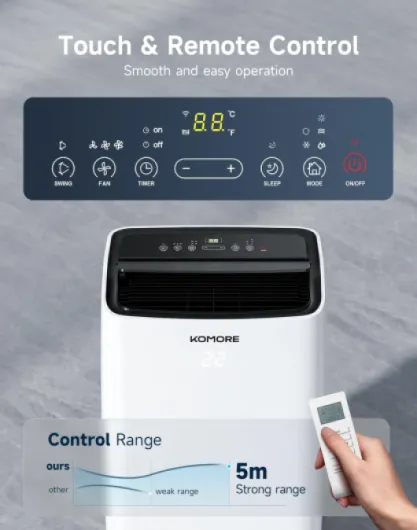
The front has a simple LED temperature display that shows the set or current temperature depending on the mode. The touchscreen controls are on the top, which is actually practical: you don’t have to bend down to adjust settings. The icons are straightforward: mode, temperature up/down, fan speed, timer, swing, etc. The feedback is clear and you get a short response when you enable vertical swing, which is useful to confirm it actually registered your touch.
On the sides you’ve got handles, and underneath there are universal wheels. Moving it around on hard floors is easy enough; you can roll it from room to room without killing your back. Lifting it up stairs alone is another story – 30 kg is no joke – so plan where it will live most of the time. I liked the little cord and plug storage area at the back: you can wrap the cable and clip the plug in so it doesn’t drag on the floor or tangle around furniture. It’s a small detail, but it keeps the corner around the unit less messy.
Vent-wise, the main air outlet is at the top front with a vertical swing flap that moves the air up and down. There’s no fancy side-to-side swing, but for a portable unit, vertical swing already helps to spread cool or warm air better. The overall build feels solid enough: it’s mostly plastic, as expected, but nothing feels loose or overly flimsy. It’s more functional than pretty, but that fits the product type: it’s a tool, not decor.
Comfort in real use: airflow, sleep mode and living with it
Comfort with this kind of device is more than just temperature; it’s also about airflow, noise profile and how much it gets in your way. The airflow of 400 m³/h feels strong enough to move air around a standard living room. The vertical swing helps avoid that classic portable AC problem where you only cool your ankles or blast one spot on the sofa. Here, the air is pushed upwards and circulates reasonably well, especially if you don’t block it with furniture right in front.
The sleep mode is only available in cooling, which is a bit of a shame if you were hoping to use a very quiet mode while heating at night. When you activate sleep mode, the fan speed drops and the set temperature slowly increases over several hours, then the unit stops after 6 hours. The idea is to avoid overcooling you while you sleep and to save some energy. Noise is reduced a bit but it doesn’t become silent. For me, it’s okay with the bedroom door slightly open; if the unit is right next to the bed, you do feel and hear it.
One thing I appreciated is the 24-hour timer. You can set it to start or stop at specific times, either from the panel, the remote, or the app. In practice I’ve used it mainly to pre-cool the living room 30 minutes before I get home, and to make sure it doesn’t run all night by mistake. Combined with the memory function, it’s pretty convenient: you don’t have to reprogram everything every day.
On the comfort downside, you still have the usual window hose and partial opening. Hot air leaks around the window kit if you don’t seal it properly, so you feel some warm draft near the window area. With some extra foam tape it improves a lot, but it’s something you need to factor in. Also, because the unit is fairly tall and chunky, if your room layout is tight, you may end up stepping around it to get to the window. In short, comfort is good once you accept the compromises of portable ACs: it definitely makes the room more livable, but it’s not as discreet or quiet as a split system.
Build quality, maintenance and what might wear out first
I haven’t had this unit long enough to comment on multi-year durability, but I can talk about build quality and maintenance, which usually give a good hint. Out of the box, the plastics feel decent: not premium, but not the thin, creaky kind you see on some bargain models. The wheels roll smoothly on hard floors, and the side handles feel secure enough when you tilt it to move. The exhaust hose is fairly standard: not ultra thick, but not flimsy either. If something is likely to age badly, it’s usually the hose or the plastic window plate, especially if you’re constantly installing and removing it.
Maintenance is quite simple. There’s a removable filter you can take out and rinse with water and a mild detergent. I did that once after about ten days, and it had already collected a fair bit of dust, so it’s worth setting a reminder to clean it regularly. A clogged filter will reduce performance and make the unit work harder and probably louder. The manual suggests letting it dry fully before putting it back, which is obvious but important if you don’t want mould inside.
For condensation, you have a water level indicator and a drain port at the base. If you use cooling or dehumidifier mode a lot, water will build up inside. You can either drain it occasionally by opening the port and letting it flow into a tray, or connect the supplied drain hose for continuous drainage. If you’re lazy about this, you’ll end up with the unit stopping and warning you that the tank is full, so it’s something you need to stay on top of, especially in humid environments.
Given the 1300 W power draw and the mechanical nature of the compressor, the parts that will matter long-term are the compressor itself and the fan motor. There’s no inverter, so it’s a simpler on/off system, which in theory means fewer complex electronics but also less energy optimisation. With normal use and basic care (keep the filter clean, don’t bash the hose, avoid running it in filthy or extremely dusty environments), it should handle several seasons. Still, with only a one-year warranty, I’d keep the receipt and maybe avoid moving it around more than necessary to reduce the risk of bumps and knocks.
Cooling, heating, noise: how it actually behaves day to day
In terms of cooling performance, this 12,000 BTU rating feels honest. In a 20 m² living room with decent insulation, it took roughly 30–40 minutes to bring the temperature down by about 4–5°C on a warm day (around 28–29°C outside). After that, it maintained the set 23–24°C without constantly running at full blast. If you try to cool a larger open-plan space, it still helps, but you’ll get more of a temperature drop around the unit and less uniform comfort across the room.
For heating, it’s clearly a secondary function but not just a gimmick. On a cool evening, I set it to 24°C from a starting point of 19°C, and it reached that in a bit under an hour. The warm air flow is quite strong, so the area in front of the unit heats up quickly. It won’t replace central heating in January if you live somewhere cold, but as a booster heater or for a home office or bedroom, it does the job. The auto mode is actually handy: it switches between cooling, fan and heating depending on the room temperature, which saves you from constantly adjusting it when the weather is unstable.
Noise-wise, the brand mentions around 54 dB in sleep mode. In practice, at low fan speed, it’s a steady hum plus compressor noise. You can hear it clearly, but it’s not a high-pitched whine, more like a loud fridge or a small extractor fan. On high fan speed, it gets noticeably louder, so I use high only when I want a quick temperature drop and then switch down. For watching TV, low or medium is fine. For sleeping, if you’re used to some background noise, you’ll probably adapt; if you’re very sensitive, you may find it too present.
The dehumidifier mode pulls about 1.1 L/hour according to the specs. I didn’t measure it precisely, but in a damp basement room, the water level indicator climbed fairly quickly and the air felt less sticky after a couple of hours. Just remember that in heavy dehumidification use, you’ll need to either drain it regularly or hook up the supplied drain hose for continuous drainage. Overall, performance is solid for the price range: it cools and heats as advertised, but you need to have realistic expectations about the room size and the usual noise of portable ACs.
What you actually get with this 5‑in‑1 unit
This KOMORE model is sold as a 5‑in‑1: cooling, heating, fan, dehumidifier and auto mode, with a separate sleep mode and a 24‑hour timer. Cooling power is 12,000 BTU, which the brand says is suitable for about 18–23 m². In my case, that matched reality: my 20 m² living room gets from 27–28°C down to 23–24°C in around 30–40 minutes on a hot day, which is quite decent for a single portable unit.
On the heating side, it’s rated at 9,000 BTU. I tried it on a chilly evening, around 15°C outside, and it lifted the room from 19°C to 22°C in a bit under an hour. It doesn’t feel like a full replacement for proper heating in winter, but as a booster heater or for rooms with weak radiators, it’s useful. The temperature range goes from 15°C to 31°C, so you’ve got enough wiggle room for both summer and winter use.
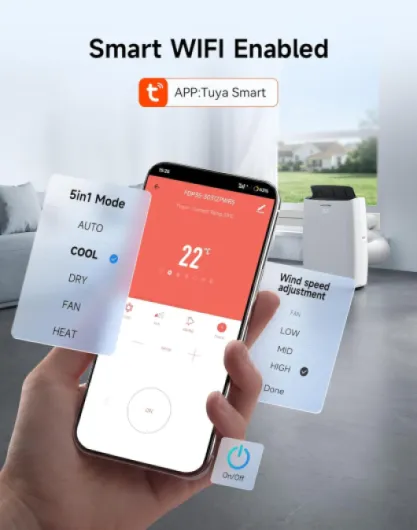
The control options are pretty complete: you have a top touch panel, a remote, and WiFi control through the Tuya Smart app on 2.4 GHz WiFi. I linked it to my phone in about 5–10 minutes. Once it’s set up, you can turn it on/off, change mode, set temperature, fan speed and timer directly from the app. The memory function is also handy: when power comes back or you turn it off and on, it remembers the last mode and temperature, so you don’t have to reset everything every time.
One important point: you do get a window kit in the box with a retractable exhaust hose (up to 1.5 m), connector, window adapter and a sliding baffle plate. It’s designed for vertical or horizontal sliding windows, and no drilling is required. If you have tilt-and-turn windows or weird shapes, you’ll need to improvise a bit with extra foam or tape, but that’s the case with most portable ACs. In short, the package is fairly complete: the only extra thing I’d suggest buying is some foam or sealing tape to reduce hot air leaks around the window plate.
Does the 5‑in‑1 really replace several devices?
The big selling point is the 5‑in‑1 aspect: cooling, heating, fan, dehumidifier, and auto mode. In practice, I’d say it does a decent job of replacing three separate devices: a window or portable AC, a basic space heater, and a standalone dehumidifier, at least for medium-sized rooms. You’re not getting the same fine-tuned performance as three specialised appliances, but you also don’t have three boxes taking up space and three things to plug in and maintain.
As a fan, it’s nothing special but it’s useful when the weather is warm but not hot enough to justify full cooling. You can set three fan speeds and the air movement is strong enough on medium to feel a clear breeze across the room. It doesn’t add much noise compared to cooling mode, since the compressor is the main source of extra sound. I used fan mode a few evenings just to keep the air moving when it was stuffy, and it felt fine.
The dehumidifier mode is probably the most underrated part. In a slightly damp basement room, after about two hours of dehumidifying, the air felt less heavy and the smell of humidity was reduced. You do have to keep an eye on the water level and use the supplied drain hose if you don’t want to manually empty it often. If you live in a very humid area, this mode will likely be running a lot in summer, which is something to consider for energy use.
The auto mode uses temperature sensors to switch between cooling, fan, and heating. It’s not ultra smart like a full-blown thermostat, but it works reasonably well if you set a target temperature and just let it go. For a home office, that’s quite handy: you don’t need to think whether you should be in heating or cooling mode when the weather is all over the place. Overall, the 5‑in‑1 claim is not just marketing fluff; it’s genuinely a flexible appliance. Just keep in mind it’s still one compressor and one fan doing all the work, so it won’t be as silent or efficient as dedicated equipment for each function.
Pros
- Strong 12,000 BTU cooling and 9,000 BTU heating suitable for roughly 18–23 m² rooms
- 5‑in‑1 functions (cooling, heating, fan, dehumidifier, auto) plus WiFi and remote control
- Easy to move on wheels with side handles and practical cord storage at the back
Cons
- Bulky and heavy (30 kg) with a visible hose and window kit that take up space
- Noise level is noticeable, especially on higher fan speeds and for light sleepers
- Only 1-year warranty and no inverter, so energy use and long-term efficiency are just average
Conclusion
Editor's rating
This KOMORE 12000 BTU KOMORE portable air conditioner with heat is a practical, fairly powerful all-rounder. It cools a medium-sized room properly, heats it reasonably well, and doubles as a decent dehumidifier. The WiFi control and remote make it easy to live with, and the auto and sleep modes are handy once you get used to their quirks. It’s not small, it’s not silent, and it won’t replace proper central heating, but it clearly improves comfort in both summer and the shoulder seasons.
It’s best suited for people in flats or rentals who can’t install a split system, and for those who want one device to handle several jobs: cooling, extra heating, drying out a damp room, and general air circulation. If you accept the usual portable AC compromises – hose through the window, some noise, and a chunky footprint – it offers good value for money and feels more flexible than many basic 9000 BTU cool-only units. On the other hand, if you only need light cooling for a small bedroom a few weeks a year, or you’re extremely sensitive to noise while sleeping, you might be better off with a smaller, quieter unit or a fixed AC system.