Summary
Editor's rating
Is it good value for money or should you look elsewhere?
Compact tower-style design with a few small quirks
Living with it: comfort, sleep, and everyday use
Noise, energy use, and day-to-day behaviour
What you actually get out of the box
Cooling power in real life, not just on the box
Pros
- Cools small rooms (up to ~18 m²) effectively when the window kit is installed properly
- Simple to use with clear controls and a remote, plus a practical sleep mode and timer
- Compact and relatively light for a portable AC, easy to roll between rooms
Cons
- Noise level is noticeable, especially on high fan speed and for light sleepers
- Limited hose length and need for a well-sealed window setup can restrict placement
- Not suitable for cooling large open-plan spaces; power is best for one room at a time

Specifications
View full product page →| Brand | Shinco |
A small portable AC for when a fan just isn’t enough
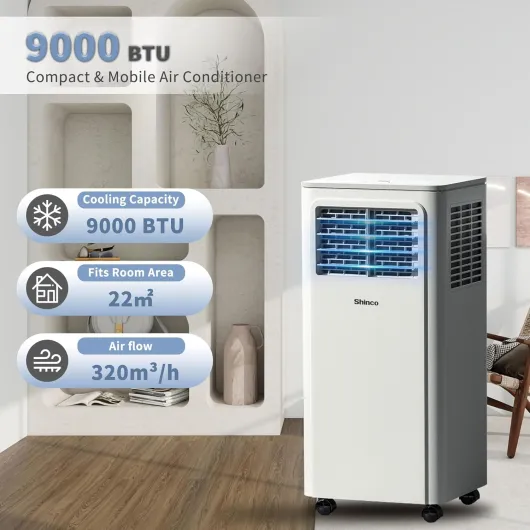
I picked up the Shinco 9000 BTU portable air conditioner because my small bedroom and home office turn into an oven every time there’s a heatwave. A normal fan was just blowing warm air around, and I didn’t want to mess with a split unit or ask the landlord for permission. So this kind of compact, plug‑and‑play AC felt like the easiest option to try.
I’ve been using it mainly in a room of about 12–14 m², which is within the advertised 18 m² limit. So this review is really from that angle: small UK‑style room, one window, no fancy insulation. I’m not testing it in a big open-plan living room, because honestly 9000 BTU is a bit light for that anyway, no matter what the box says.
What I wanted was pretty simple: I wanted the room to actually get cooler, not just "a bit less hot". I also wanted something I could install without drilling holes or calling an engineer. And I didn’t want a machine that sounds like a jet engine all night. So I focused a lot on cooling speed, noise level, and how annoying (or not) the setup is.
Overall, it does the job: it cools the room properly if you use it right and keep your expectations realistic. It’s not perfect, it’s not magic, and it’s not silent. But for a small flat or bedroom, especially in the UK or similar climate, it’s a pretty solid compromise between price, power and hassle.
Is it good value for money or should you look elsewhere?
From a value point of view, I’d call this Shinco 9000 BTU good, but not mind-blowing. It sits in that mid-range zone where you’re not paying top money for a premium brand, but you’re also not buying the absolute cheapest no-name unit. For that price bracket, you get all the core functions (cooling, dehumidifying, fan, timer, sleep mode), an energy class A rating, and a cooling capacity that actually matches what’s realistic for a small room.
Compared to some slightly cheaper units I’ve seen or tried, this one feels a bit more solid and cools more consistently. The remote works properly, the window kit is usable without having to DIY too much, and the temperature control doesn’t feel random. On the flip side, it doesn’t have extras like Wi‑Fi control, app integration, or fancy swing modes. If you care about those features, you’ll probably need to spend more or look at bigger brands.
Where it scores well in value is in the "plug it in and it works" category. For someone in a rental, a student flat, or a small home office, the combination of power, size, and running cost is quite reasonable. It’s not dirt cheap, but if you compare it to the cost of fitting a split system or suffering through a heatwave with just a fan, it starts to feel like a sensible buy rather than a luxury.
There are definitely more powerful or quieter units out there, but usually at a higher price or with a bulkier form factor. Here, you’re paying for a compact machine that does what it claims in rooms up to around 18 m². If that matches your situation, the value is pretty solid. If you’re hoping to cool a big open-plan area, you’ll either be disappointed or end up running it on full blast all the time, which kind of kills the value argument.
Compact tower-style design with a few small quirks
Design-wise, the Shinco is a pretty standard white rectangular tower: about 68 cm high, 30.5 cm wide, and 29 cm deep. It’s small enough to tuck in a corner next to a window, which is important because the hose has a limited length. The wheels roll fine on hard floors; on thick carpet it’s a bit more effort, but you’re not dragging it around every hour anyway. The side handles are useful when you first lift it out of the box or shift it between rooms.
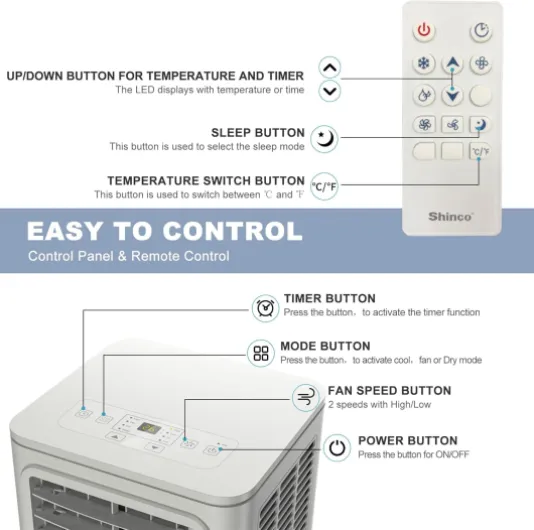
The control panel on top is clear enough: big power button, mode button, fan speed, temperature up/down, and timer. The icons are not fancy but you understand them within a minute. The LED display is bright but not blinding. At night, it’s visible from across the room but it didn’t bother me enough to cover it. If you’re very sensitive to light when sleeping, you might want to angle it away from the bed or stick a bit of tape over part of the display.
The air outlet is on the front, with basic horizontal louvers. You can manually adjust the angle up or down, but there’s no automatic swing left/right. That means the cool air is mostly blowing straight ahead. In a small room it’s fine, but if you’re off to the side you don’t feel it as much. Personally, I just pointed it slightly up so it bounces off the ceiling and circulates better, which worked okay.
One small downside: because it’s compact and light for an AC, it can vibrate a bit on certain floors when the compressor kicks in. On my laminate floor it was fine, but on a slightly uneven floorboard I noticed a bit of extra rattle until I moved it and made sure all four wheels were flat. Nothing dramatic, but it’s the kind of little thing you only notice after a few days of use.
Living with it: comfort, sleep, and everyday use
Comfort-wise, the Shinco changes the room from "sweaty and sticky" to "actually livable" during hot spells, which is basically what I wanted. The airflow on high is strong enough that if you sit or lie directly in front of it, you feel a clear blast of cold air. After the room is cooled, switching to low keeps the temperature steady without feeling like you’re in a wind tunnel. I found that pointing the vent slightly upwards works best, so it doesn’t blow straight into your face or dry your eyes out.
For sleep, it’s a bit of a balance. On the one hand, having the room at 22–24°C instead of 28°C is a big improvement. On the other hand, there is the noise and the occasional compressor kick. In my case, after a couple of nights I just got used to the hum and slept fine. If you’re very sensitive, you might prefer to run it hard for an hour before bed, then turn it off or leave it on a higher temperature. The sleep mode is a nice compromise if you don’t want to wake up freezing at 4am.
Comfort also includes how annoying it is to move and set up every time. Here, the wheels and handles help a lot. I can roll it from the bedroom to the small living area without much drama, plug it into another socket, and stick the hose in a different window. It’s not as convenient as fixed air con, obviously, but for a rental flat or a place where you only need cooling a few weeks per year, it’s a pretty low‑effort solution.
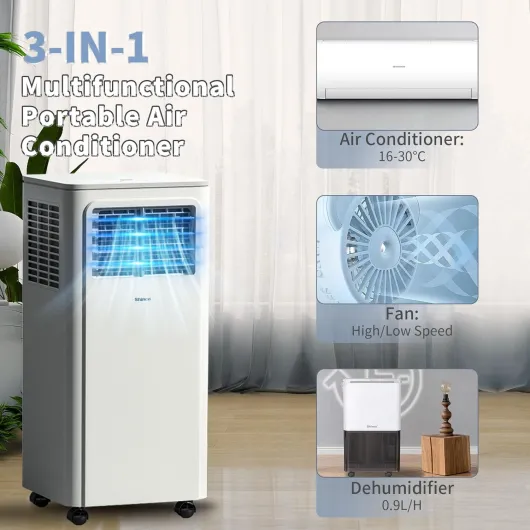
One small thing: because it also dehumidifies, the air feels less heavy after a while, especially during those muggy days. I noticed less of that sticky feeling on my skin, and bedding didn’t feel damp. It’s a subtle difference, but once you turn the unit off and go back to just a fan, you notice how much heavier the air is. So in terms of overall comfort, not just temperature, it does a decent job.
Noise, energy use, and day-to-day behaviour
On performance, there are three big points: noise, power draw, and how it behaves over a full day of use. Let’s start with noise. The spec says up to 65 dB, which matches what it feels like: on high fan speed with the compressor running, it’s clearly audible. You can still watch TV or work with it on, but you won’t forget it’s there. On low speed and once the room has cooled down, it’s more of a steady background hum. For sleeping, I’d say it’s acceptable if you’re not super sensitive to noise, but it’s definitely not "silent" in the strict sense.
Sleep mode helps a bit. When you activate it, the fan drops to low and the target temperature slowly goes up by 1°C after 2 hours. In practice, that means it doesn’t blast cold air at you all night, and the compressor cycles a bit less. On a hot night, I set it to around 23–24°C in sleep mode, and it kept the room comfortable enough without waking me up. If you’re used to total silence, any portable AC will feel loud, and this one is no exception, but it’s manageable.
In terms of power, it’s rated around 1000 W. So yes, it uses more electricity than a fan, but that’s normal for this type of device. I ran it a few evenings in a row (3–5 hours per day) and didn’t see a scary jump on my energy monitor, just a noticeable extra chunk. For heatwave days, it’s a trade‑off I’m okay with. If you’re on a very tight energy budget, you’ll want to be selective: cool the room before bed, then maybe switch to fan or a higher temperature to save some power.
Day to day, the performance is predictable, which I appreciate. You turn it on, it starts cooling within a few minutes, and you feel the difference. The remote works reliably from across the room, the temperature setting is respected reasonably well (within a degree or so), and the unit doesn’t randomly shut off or throw error codes. It’s not the quietest or most powerful machine out there, but for a 9000 BTU portable unit, it behaves exactly how you’d expect.
What you actually get out of the box
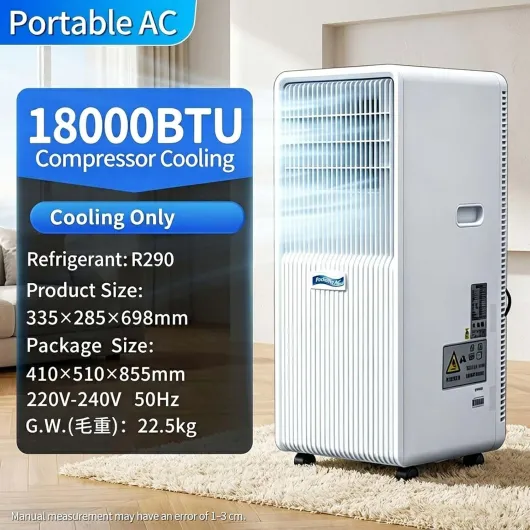
Out of the box, the Shinco 9000 BTU is pretty straightforward. You get the main unit, the exhaust hose (extends up to about 1.5 m), the window kit, and a small remote. No weird extra parts, no tools needed apart from maybe a screwdriver if your window setup is awkward. The unit weighs around 21.5 kg, so it’s not light, but it’s manageable to move around on its wheels once it’s on the floor.
The advertised features are pretty standard for this type of portable AC: cooling mode with temperature from 16°C to 30°C, dehumidifier mode with up to about 21.6 L/day, and a simple fan mode with two speeds. There’s also a 24‑hour timer and a sleep mode that slowly raises the temperature by 1°C every 2 hours and drops the fan to low speed. It’s all controlled either from the top panel or the remote, and there’s a basic LED display showing the current or target temperature.
In practice, the main thing you’ll use is the cooling mode at somewhere between 20–24°C, depending on how cold you like it. The fan mode is more of a backup when it’s not too hot outside. Dehumidifier mode is handy on really sticky days, but keep in mind you’re still dealing with hot air unless you’re also venting properly through the hose. The R290 refrigerant is mentioned as being more environmentally friendly, which is good to know, but in daily use you don’t really notice anything different compared to older gases.
From a user point of view, the general presentation is: compact machine, clear buttons, basic remote, and all the essentials included. Nothing fancy, nothing missing. It’s not packed with smart‑home features or Wi‑Fi, but honestly I didn’t really miss that. I just wanted something I could plug in, set to 21°C, and let it run. On that front, it’s simple and gets the basics right.
Cooling power in real life, not just on the box
This is the part that matters: does it actually cool the room properly? In my case, in a roughly 12–14 m² bedroom/office with one medium-sized window, yes, it does. On a hot day (around 28–30°C outside), starting from a room at 27°C, I could get it down to about 22–23°C in roughly 45–60 minutes with doors and curtains closed. That’s with the unit set to 20–21°C on high fan speed. It’s not instant, but the difference is clearly noticeable after 15–20 minutes already.
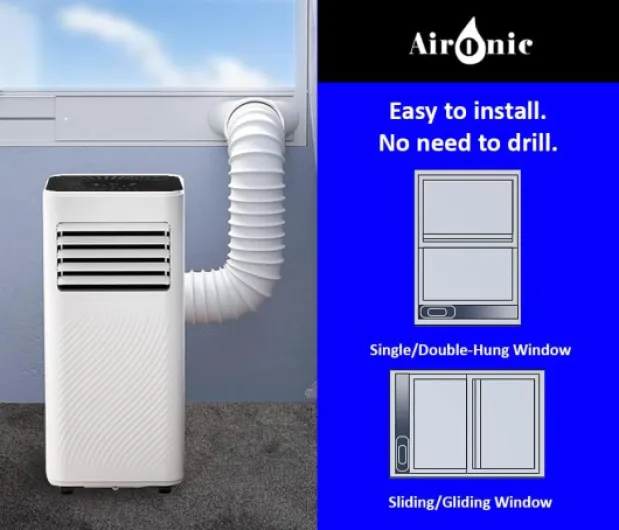
The key is proper installation of the exhaust hose and window kit. If you just hang the hose out of a half-open window without sealing around it, hot air sneaks back in and you lose a lot of efficiency. With the included window kit properly fitted, the room cools much faster and stays cooler. I tested both ways: with a badly sealed window, the room barely dropped 2–3°C in an hour. With the kit installed correctly, it dropped 4–5°C in the same time. So the installation is not optional if you want decent results.
For dehumidifying, it pulls a good amount of moisture out of the air. On a sticky day, the room feels less clammy after an hour or two, even if the temperature change is moderate. If you live in a humid area, this part is actually quite useful. Just remember that in full dehumidifier mode you may need to manage the water drainage, depending on how your model handles condensation (some re‑evaporate, some need manual draining if humidity is high).
Overall, in the size of room it’s designed for (up to about 18 m²), the effectiveness is solid as long as you use it correctly: closed doors, sealed window kit, and give it some time to work. If you try to cool a big open living room or a whole flat with it, you’ll probably be disappointed. But used in the right context, it genuinely turns a hot, stuffy room into something comfortable enough to sleep or work in.
Pros
- Cools small rooms (up to ~18 m²) effectively when the window kit is installed properly
- Simple to use with clear controls and a remote, plus a practical sleep mode and timer
- Compact and relatively light for a portable AC, easy to roll between rooms
Cons
- Noise level is noticeable, especially on high fan speed and for light sleepers
- Limited hose length and need for a well-sealed window setup can restrict placement
- Not suitable for cooling large open-plan spaces; power is best for one room at a time
Conclusion
Editor's rating
After using the Shinco 9000 BTU portable air conditioner in a small bedroom/office, my conclusion is pretty simple: it gets the job done for the space it’s designed for, without pretending to be something it’s not. It cools a 10–18 m² room reliably as long as you install the exhaust hose and window kit properly and keep doors and windows closed. It’s not silent, but the noise level is manageable, especially on low or in sleep mode, and the comfort boost during hot spells is noticeable.
This unit makes the most sense if you live in a flat or rental where you can’t install a fixed system, and your main goal is to cool one room at a time: bedroom at night, office or living area during the day. You get straightforward controls, a usable remote, and a form factor that’s easy enough to roll between rooms. It’s not packed with smart features, and it won’t magically chill a big open-plan space, but it’s a practical tool for dealing with heatwaves.
If you’re extremely sensitive to noise, want to cool a large area, or are looking for lots of advanced functions, you should probably look at a more powerful or higher-end unit (and be ready to pay more). But if you just want a compact, no-nonsense portable AC that cools a small room properly and doesn’t feel like a waste of money, this Shinco is a decent choice.



![Portable Air Conditioner, 9000 BTU 2,6kW, Cooling, Dehumidifier, Fan, Sleep Mode, For Max 18㎡, Remote Control, 24h Timer, Window Kits [Energy Class A]](https://www.portable-air-conditioner-guru.com/storage/895615/71Gx-VXwt0L._AC_SL1500_.jpg)