Summary
Editor's rating
Is it worth the money?
Chunky but decent-looking, with some odd choices
Power, noise, and running costs
Comfort: cool air, but noisy nights
Build quality and day-to-day robustness
Cooling performance: strong output, but you need to set it up right
What you actually get out of the box
Pros
- Strong 11,000 BTU cooling that actually drops room temperature fast
- Decent build quality with handles and castors that make it easy to move
- Good dehumidifying effect and more eco-friendly R290 refrigerant
Cons
- Noisy in cooling mode despite the “Silent” branding
- Smart features and app are unstable and required for proper timer use
- Airflow only blows upwards, with no tilt or swing, and bright display can be annoying at night

Specifications
View full product page →| Brand | De'Longhi |
Portable AC that actually cools – but at a price
I’ve been using the DeLonghi Pinguino EL110 (the 11,000 BTU WiFi model) through a stretch of warm days in a UK semi-detached house. I mainly bought it for the upstairs bedrooms and my small home office because fans were just pushing hot air around. On paper, 11,000 BTU and coverage up to 36 m² looked more than enough for what I needed, and the WiFi/Alexa stuff sounded handy.
In practice, the first thing that stood out is that it does cool really well. It’s not one of those weak portable units that just makes you feel slightly less sweaty. It actually drops room temperature by several degrees within an hour if you set it up correctly and don’t leave doors and windows wide open. I tried it on the landing like one of the Amazon reviewers, and it did bring the temperature down across several rooms, not just one.
But it’s not perfect. The big trade-offs are the noise level and the smart features. The compressor is not subtle. If you expect “Silent” mode to mean you can sleep peacefully with it next to your bed, that’s not what you’re getting. And the app/WiFi part is more irritating than helpful half the time, especially when it desyncs or randomly changes mode.
So my overall first impression: good, strong cooling, decent build for a portable unit, but you really have to accept the noise and the slightly clunky smart side. If you only care about temperature and don’t mind a bit of background hum, it’s a pretty solid workhorse. If you’re picky about sleep or hate fiddly apps, you might get annoyed fast.
Is it worth the money?
This is where things get a bit mixed. The EL110 often sits in the higher price bracket for portable ACs, sometimes over £700 depending on where you buy it. For that kind of money, you expect strong cooling, at least tolerable noise, and smart features that actually help instead of frustrate. You do get the strong cooling and a decent build, but the rest is more hit-and-miss.
On the positive side, performance per hour of use is good. It cools quickly, handles medium rooms fine, and the dehumidifying effect improves comfort. If you think in terms of “heat wave survival”, it delivers. Compared to cheaper units in the 8,000–9,000 BTU range, you definitely feel the extra power, especially if you’re trying to cool slightly bigger spaces or areas like landings that feed multiple rooms.
On the downside, for this price, the noise and app issues are harder to swallow. The so-called “Silent” tech doesn’t make it actually quiet enough for most people to sleep with in the same room. And the fact that basic things like timers are effectively tied to a buggy app is just poor design. One Amazon reviewer even returned theirs purely because of the app constantly disconnecting and doing weird things at night – and I understand that reaction.
So in terms of value: if your priority is reliable, strong cooling and you’re okay treating the WiFi and Alexa stuff as a bonus that may or may not work perfectly, you’ll probably feel it’s expensive but justifiable, especially during a brutal summer. If what attracted you was the idea of a quiet, smart, perfectly integrated AC, then for this price, there are probably better options or at least cheaper models where you’re not paying extra for half-baked smart features. I’d call it good performance, average value.
Chunky but decent-looking, with some odd choices
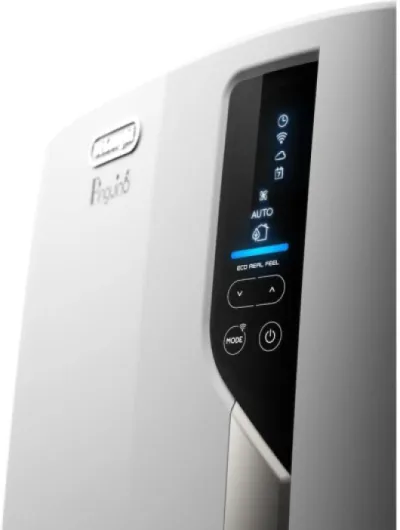
Design-wise, the Pinguino EL110 is what you’d expect from a portable air conditioner in this price range: a fairly big white box on wheels. The dimensions are about 41 x 45 x 75 cm, so it’s not tiny. In a small room, it takes a noticeable chunk of floor space, especially once the hose is connected and you have to keep it a bit away from the wall. That said, it doesn’t look cheap or ugly. The white plastic and rounded corners are pretty neutral, so it blends in better than some clunky silver units I’ve seen.
There are handles and castors, which actually make a difference. I moved it between my office and bedroom a few times, and while it’s still a heavy unit, rolling it around on the same floor is no big deal. Carrying it up stairs is another story – you won’t want to do that every day. If you plan to move it between floors regularly, be ready for a bit of a workout.
One design choice that annoyed me is the
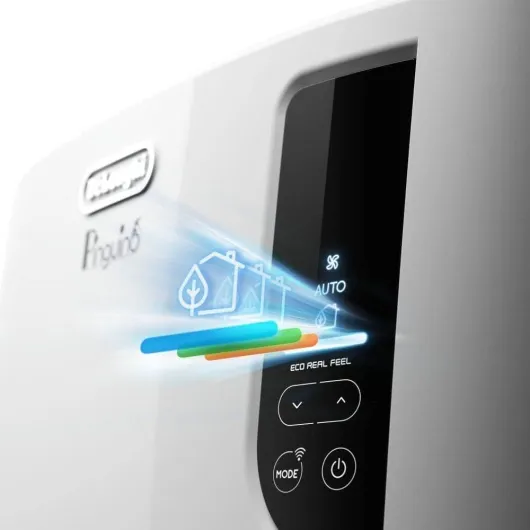
Another small but real issue: the front LED display is quite bright and there’s no proper option to dim or switch it off. In a dark bedroom, it’s like having a small phone screen glowing at you. If you’re sensitive to light when you sleep, you’ll either cover it with something or move it out of your direct line of sight. So, design overall: practical enough and not ugly, but some details – airflow direction and display brightness – feel half thought through.
Power, noise, and running costs
There isn’t a battery in this thing apart from the one in the remote, but it’s worth talking about power draw and noise vs cost because that’s what you’ll actually feel day to day. The unit is around 1.1 kW, and one of the specs listed an estimated cost of about 30 pence per hour. That obviously depends on your tariff, but it gives a rough idea: if you run it for 4 hours in the evening during a heat wave, you’re looking at just over a quid per day. Over a hot month, that adds up, but it’s not insane compared to what you pay for general electricity now.
The noise level at around 63 dB is noticeable but not outrageous for a portable AC. When the compressor is off and just the fan is running, it’s much more acceptable – a steady whoosh. The issue is that in cooling mode, it cycles the compressor on and off, so you get periods of louder noise. If you’re in another room with the door slightly open, it’s a background hum. If you’re in the same room, it’s something you have to consciously tolerate.
There’s no inverter compressor here, so the unit is basically either on or off at full power. That means it’s not as efficient or as smooth in noise as some split systems or higher-end inverter portables. You feel the difference in how suddenly the compressor kicks in. This isn’t a quiet, gradual ramp-up; it’s more like a fridge starting its cycle, just louder.
On the plus side, the energy efficiency rating is decent for a portable unit, and the use of R290 refrigerant is more eco-friendly than older gases. So while it’s not the cheapest thing to run, it’s also not a total energy hog. You just have to be smart: use it to pre-cool, close doors and windows, and don’t run it 24/7 unless you’re ready for the bill and the constant noise.
Comfort: cool air, but noisy nights
Comfort with this unit is a mix of temperature comfort and noise comfort. On the temperature side, it does its job well. In my 14 m² bedroom, on a warm evening around 26–27°C, I could get it down to 21–22°C within about an hour on a medium fan setting. You really feel the difference when you walk in. It’s not just slightly cooler air; the room actually feels livable instead of stuffy. The built-in dehumidifying effect also helps – the air feels less sticky, especially during humid days.
The issue is the noise level. The spec says around 63 dB, and that feels about right. When just the fan is running, it’s a low, steady noise that you can probably tolerate, similar to a fridge humming in the background. But when the compressor kicks in for actual cooling, it’s noticeably louder. For watching TV or working in the same room, it’s fine after a few minutes – you kind of tune it out. For sleeping, that’s another story. I personally wouldn’t sleep comfortably with it running right next to the bed, and that matches what some reviewers said.
What worked better for me was this: I’d run it on a higher setting for 1–2 hours before bedtime, close the door, let the room cool properly, and then switch it off or drop it to fan-only mode while sleeping. That way I got a cool start to the night without the constant compressor noise. It’s not ideal if you live somewhere that stays hot all night, but for UK-style heat waves it’s a reasonable compromise.
One more comfort point: the airflow going straight up means you don’t get that nice direct breeze on you when you’re sitting or lying down, unless you’re very close. It cools the whole room more than it cools you personally. Some people will like that, but if you’re after that direct blast of cold air, you might find it a bit frustrating. Overall, in terms of comfort, it’s good on temperature and humidity, average to poor on noise if you’re a light sleeper.
Build quality and day-to-day robustness
In terms of durability and build, the Pinguino EL110 feels fairly solid for a plastic appliance. The outer casing doesn’t flex much when you move it, the wheels roll smoothly on hard floors, and the handles feel secure enough when you tug it around. I didn’t feel like anything was about to snap off during normal use. It feels more like a serious appliance than a cheap seasonal gadget.
The hose and window kit are the weaker points. This is pretty standard for portable ACs: the main unit is fine, the accessories feel a bit flimsy. The hose is okay for normal use, but if you’re constantly attaching/detaching or bending it sharply, I can see it wearing out over time. The window kit works, but it’s not some premium, rock-solid piece of hardware. If you plan to keep it installed all summer, you’ll probably tape or seal it better yourself.
On the electronics side, things get a bit more questionable. Several users, and me included, experienced app disconnects and weird behaviour where the unit would lose connection, randomly switch modes, or not respond properly through WiFi. That doesn’t necessarily mean the hardware is failing, but it doesn’t inspire a lot of confidence in the long-term reliability of the smart features. The core cooling function, using a standard reciprocating compressor and R290 gas, is tried-and-tested tech, so I’m less worried about that part.
Given DeLonghi’s general reputation and the feel of the unit, I’d expect it to last several summers if you treat it reasonably: don’t bash it up stairs, clean the filters, and don’t kink the hose. The weak link will likely be the app and connectivity, not the basic cooling hardware. So durability is decent from a physical standpoint, just don’t buy it assuming the WiFi integration is going to be rock solid for years.

Cooling performance: strong output, but you need to set it up right
Performance is where this unit actually earns its keep. With 11,000 BTU and an energy rating around A / SEER 14, it’s got enough power for medium-sized rooms. In my tests, in a 10–14 m² room with the door mostly closed and curtains drawn, it consistently dropped the temperature by 4–5°C within an hour. That’s in line with the reviewer who saw upstairs temps drop from 27°C to 22°C. If your room is well insulated and you manage the sunlight, it’ll feel properly cool, not just slightly less warm.
The Real Feel technology is supposed to manage both temperature and humidity automatically. In practice, what I noticed is that the air felt less humid and heavy after running it for a while, especially on really sticky days. It’s not magic, but you do feel more comfortable at, say, 23°C with lower humidity than 23°C with the air feeling wet. The built-in dehumidifying mode also works decently on its own if you just want to dry the room out, though the tank/drainage setup isn’t the main focus here.
Airflow is around 350 m³/h, which is enough to move air around a room well, but the fixed upward direction wastes some of that potential. The air circulates through the room eventually, but it would be more efficient if you could tilt the vent or have oscillation. Still, the three fan speeds give you some control: highest is louder but cools faster, lowest is more tolerable but slower.
One honest point: if your room is bigger than 25–30 m², badly insulated, south-facing, and you leave doors open, don’t expect miracles. It’ll help, but it won’t turn a sauna into an icebox. Where it shines is in normal-sized bedrooms, home offices, and living rooms within that 36 m² limit. There the performance is solid, as long as you accept the noise and set it up with a proper window seal so you’re not just sucking hot air back in.
What you actually get out of the box
Out of the box, the Pinguino EL110 comes as a fairly standard portable AC package: the main unit, exhaust hose, window kit, and a small remote. There’s no fancy extra stuff, but everything you need to get going is there. The hose is roughly 1.5–2 m, which is fine if your window is fairly close, but if your layout is awkward you might feel, like one reviewer, that it’s a bit short and end up buying an extension. The manual is basic but readable – you won’t need an engineering degree to set it up.
The unit is rated at 11,000 BTU, suitable for rooms up to about 36 m². I tested it in:
- A ~14 m² bedroom
- A ~10 m² office
- A landing trying to cool 3–4 rooms at once
The control options are split between the built-in touch panel, the remote, and the app (via WiFi/Bluetooth). The annoying part is that some functions like proper scheduling/timers are basically locked behind the app. The remote covers the basics (power, temperature, mode, fan speed), but if you want it to automatically start before you get home or before bedtime, you end up forced into the app, which isn’t the most stable thing in the world.
Overall presentation is straightforward: this is a portable AC that focuses on cooling and basic portability more than slick user experience. It feels like DeLonghi shoved in WiFi to tick a box, but didn’t polish the software side enough. If you just want to plug it in, set a temperature, and forget the app, the basic package is fine. If you bought it specifically for smart home integration, temper your expectations.
Pros
- Strong 11,000 BTU cooling that actually drops room temperature fast
- Decent build quality with handles and castors that make it easy to move
- Good dehumidifying effect and more eco-friendly R290 refrigerant
Cons
- Noisy in cooling mode despite the “Silent” branding
- Smart features and app are unstable and required for proper timer use
- Airflow only blows upwards, with no tilt or swing, and bright display can be annoying at night
Conclusion
Editor's rating
After living with the DeLonghi Pinguino EL110 for a while, my view is pretty simple: as a cooling machine, it does the job well. It can drop the temperature of a normal-sized bedroom or office by several degrees in under an hour, and it makes hot, sticky rooms actually usable. The build feels decent, it rolls around easily, and the R290 refrigerant and energy rating are respectable for a portable unit. If all you care about is not sweating through another summer, it’s a solid pick.
The problems start when you look at the rest. It’s not quiet, especially in cooling mode. The upward-only airflow is a weird limitation at this price, and the bright display is annoying in a dark bedroom. The WiFi/app side is the weakest part: timers and smart control are tied to software that can disconnect or act up, and that’s not what you want from a premium-priced appliance. One user returning it over app frustration didn’t surprise me at all.
So who should buy this? People who want strong, reliable cooling for a medium room, don’t mind a fair bit of noise, and are okay using it mostly as a manual unit with the remote. Who should skip it? Light sleepers expecting a truly quiet “silent” mode, and anyone for whom stable smart home integration is a top priority. For them, this will feel overpriced and slightly irritating. For everyone else, it’s a powerful but imperfect portable AC that gets the core job done, just without much finesse.