Summary
Editor's rating
Value: strong cooling per dollar, with a few trade-offs
Design: ugly but practical (and big airflow)
Comfort in real life: airflow, noise, and humidity
Build quality & durability: lots of plastic, but feels work-ready
Performance: actually cools, but only in the right conditions
What you actually get with the MC37M
Pros
- Pushes a lot of air and actually cools well in hot, dry climates
- Simple setup and controls (fill, plug, switch on) with no learning curve
- Can run off a large tank or be hooked to a garden hose for continuous use
Cons
- Loud on higher speeds and not ideal for quiet indoor spaces
- Needs frequent water refills (every 3–4 hours) if not using a hose
- Cooling performance drops sharply in humid conditions

Specifications
View full product page →| Brand | Hessaire |
Big plastic box, lots of air: does it really cool?
I’ve been using the Hessaire MC37M 3100 CFM for a full hot spell, basically every afternoon during a heatwave. Think garage, patio, and a half-finished basement – all spots where normal AC either struggles or doesn’t exist. I didn’t buy it expecting miracles, just something that could make 100°F+ days less miserable without rewiring the house or dropping thousands on mini-splits.
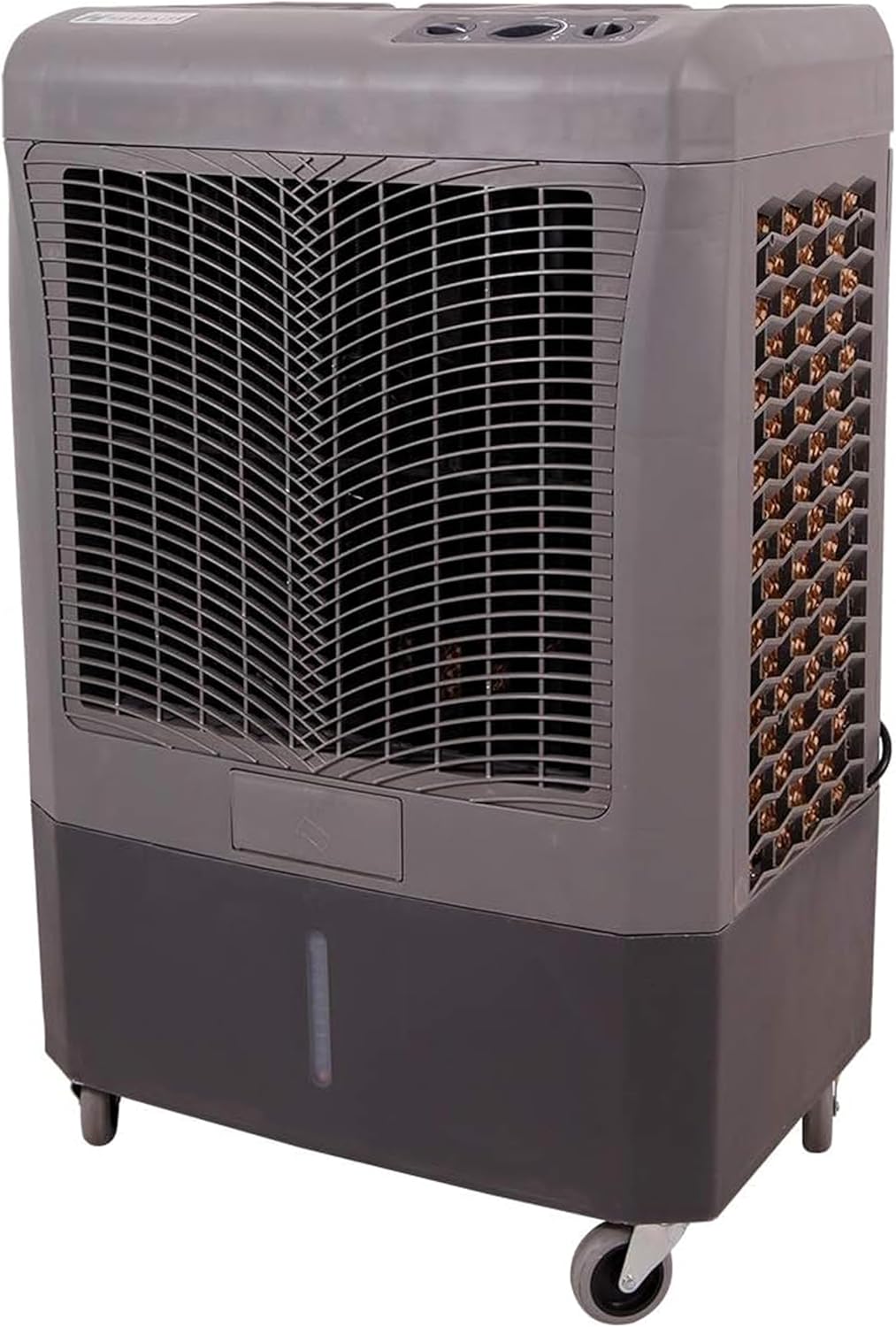
Right away, this thing feels more like a tool than a home appliance. It’s not pretty, it’s not smart, there’s no app, no remote, nothing fancy. It’s a big gray plastic cube on wheels that pushes a lot of air through wet pads. If you’re used to small “evaporative coolers” that are basically fans with a damp sponge, this is a different league. It actually moves enough air to matter in a decent-sized space.
I used it in a roughly 2-car garage with the door half open and temps around 95–105°F outside. With the pump on and fan on low or medium, the air right in front of it genuinely felt cooler, not just like a hair dryer in your face. It’s still not real AC, but you can feel a clear drop in perceived temperature, especially if you’re standing in the airflow.
It’s not perfect. You have to babysit the water level if you don’t hook up a hose, and it’s not what I’d call quiet. But compared to a regular fan, or those weak “swamp coolers” that barely change anything, this one actually gets the job done as long as your climate is dry enough. If you’re in a humid area, don’t bother; if you’re in a desert-ish climate, it starts to make sense.
Value: strong cooling per dollar, with a few trade-offs
Looking at the price range this usually sits in, the Hessaire MC37M gives you a lot of airflow and real cooling effect compared to many so-called “evaporative coolers” that are basically overpriced fans. For a few hundred bucks, you get 3,100 CFM, a 10.3-gallon tank, and a unit that can actually make a hot garage or patio feel noticeably cooler in the right climate. Considering the 4.1/5 rating from over 10,000 reviews, it’s clear a lot of people find it worth the money.
Where the value really shows is if you compare it to portable AC units. A portable AC that can meaningfully cool close to 900–1,000 sq ft is way more expensive, uses a lot more electricity, and needs venting. This thing uses water and a fan, so power consumption is much lower, and there’s no refrigerant or complex install. The flip side is: it only works well in dry air and doesn’t give you the same controlled, precise cooling as a real AC. So you’re trading raw efficiency and flexibility for lower running costs and simplicity.
On the downside for value, you have a few annoyances: manual refilling every 3–4 hours if you don’t hook up a hose, no remote or timer, noticeable noise, and a very basic look. If you want quiet, sleek, and low-maintenance, this is not the best match. Also, if you live in a humid area, the value is basically zero because the core cooling principle just doesn’t work well in high humidity; you’d be better off with a good fan or a real AC.
For someone in a dry climate who needs to cool a garage, workshop, outdoor booth, or to help their central AC during heatwaves, I’d say the MC37M is good value for money. It’s not cheap, but it’s cheaper than upgrading your whole HVAC, and it does more than a regular fan. If you only want to cool a small bedroom and you live where summers are muggy, I’d save the money and look at something else.
Design: ugly but practical (and big airflow)
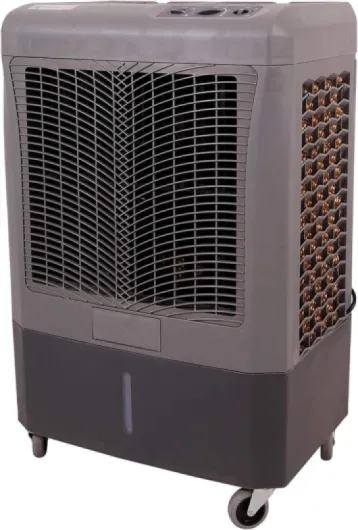
Design-wise, the MC37M is pretty blunt: a gray polypropylene box with vents, louvers, and a big fan inside. If you want something that looks nice in a modern living room, this isn’t it. It’s about 24" deep x 16" wide x 38" high, so it takes up about the footprint of a small shop vac but taller. It’s narrow enough to tuck against a wall, but it’s still a noticeable unit, not something you hide behind a plant.
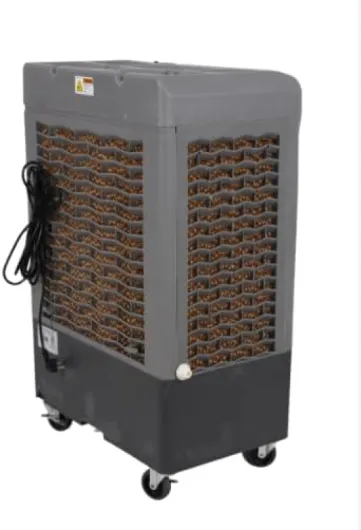
The good part of the design is that it’s clearly built around function. You’ve got three intake panels for air (left, right, and back), which helps it pull in more hot air and actually use the whole pad surface. The front has oscillating louvers that can sweep the airflow across the room, and that’s useful because the airflow is strong and pretty directional. On low, it’s already pushing a lot of air; on high, it feels like a shop fan level of blast.
The casters roll fine on smooth floors and concrete. I rolled it in and out of a garage and across a patio without issues. The built-in water level window is simple but handy; you can see at a glance if you’re running low instead of guessing. The top has a small manual fill door – functional, but the latch is a bit flimsy. I’m not shocked some users report that little door latch breaking; it feels like the weakest detail on the body.
The controls are placed up high on the front, easy to reach and see. Knobs are chunky and basic. No confusion, no menus. It’s very much a “grab knob, twist, cold air comes out” kind of device. The design won’t impress anyone, but it’s practical, and for a garage, workshop, or patio, that’s honestly what matters. If you’re okay with the industrial vibe, the design works.
Comfort in real life: airflow, noise, and humidity
From a comfort point of view, the MC37M is all about airflow + moisture. If you stand in front of it with the pump on, it feels like a cool, damp breeze rather than a hot blast. On hot, dry days, that’s a big relief. In my use, the sweet spot was usually low or medium fan with the pump on. High was sometimes too much – strong wind and more noise than I needed unless it was really brutal outside.
One thing to keep in mind is how much humidity it adds. In a dry garage or patio, that’s actually welcomed; it takes that bone-dry, baking air and makes it feel more breathable. But if you try to run this in a small closed room, it will get humid fast. That can be okay if you’re using it deliberately as a humidifier in winter like some people do, but for summer cooling in a sealed, already-humid house, it becomes counterproductive. You need open windows or doors to let the moist air escape and bring in fresh dry air.
Noise is the trade-off. On low, I could still talk over it without yelling, but it’s not discreet. It’s about what you’d expect from a decent box fan, maybe a bit more. On medium and high, it’s closer to a shop fan. I wouldn’t want it right next to the couch while watching a movie, but for working in a garage or sitting outside, I honestly stopped noticing it after a while. The water trickling sound is there but pretty mild compared to the fan noise.
In day-to-day use, comfort also depends on how okay you are with refilling it. If you don’t use a hose, you’ll be topping it up every few hours during hot afternoons. For me, that became part of the routine: check water, refill, flip the pump back on. Not ideal, but manageable. If you want set-and-forget comfort, use the hose outside or in an area where a small leak won’t ruin anything. Overall, comfort is decent as long as your expectations are realistic: this is a strong, slightly noisy cooler that works best with moving air and open space.
Build quality & durability: lots of plastic, but feels work-ready
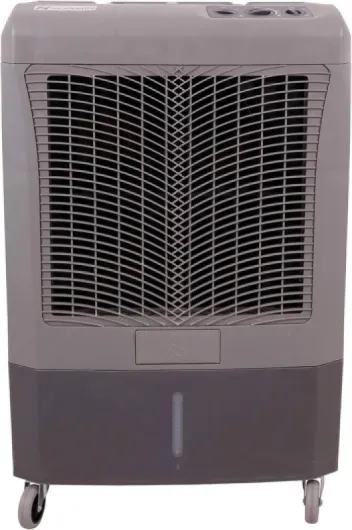
The whole unit is made from polypropylene plastic, which at first glance looks a bit cheap, but it has a purpose: it keeps the weight down and doesn’t rust. For something that’s meant to be rolled around garages, patios, and workshops, that’s actually a plus. You can splash some water, bump it into a workbench, and it doesn’t feel fragile. It’s not pretty, but it feels like it can take some abuse.
The panels and housing feel reasonably thick and don’t flex too much when you push on them. The casters are basic but have held up fine rolling over concrete and tile. They’re not heavy-duty industrial casters, but for a 39 lb unit plus water, they’re adequate. I didn’t notice any sketchy wobbling or weird noises from the wheels. The handles molded into the body make it easier to grab and adjust the position without feeling like you’ll rip something off.
Where it feels a bit more budget is in the small details: the little door for manual water fill has a thin plastic latch that doesn’t inspire much confidence, and you can tell that repeated use or a hard bump could snap it. Some user reviews mention that exact part breaking, and I’m not surprised. Also, the knobs are simple plastic, nothing fancy, but they do their job and didn’t feel loose or sloppy during my tests.
The cooling media itself (the pads) look like the higher-density rigid kind, not the cheap flimsy stuff you see on very low-end units. Long term, those pads will eventually need replacing, and how fast they wear will depend on your water hardness and how well you keep the unit clean and drained. Overall, I’d say the materials are utilitarian but acceptable for the price and purpose. It’s not premium, but it’s not flimsy trash either. Just don’t expect luxury finishes – this is closer to a shop tool than a designer appliance.
Performance: actually cools, but only in the right conditions
Performance is where this thing either makes sense for you or doesn’t. In a hot, dry climate (think SoCal, Nevada, Utah, interior dry areas), it does a solid job. In my garage on a 100°F day with low humidity, with the pump on and fan on low or medium, I could feel a clear difference. It doesn’t turn the space into a fridge, but it takes air that feels brutal and makes it reasonably bearable, especially if you’re in the airflow path.
I also tried it as a backup inside during a heatwave, using it to help central AC that couldn’t keep up. Not the textbook way to use an evaporative cooler, but in an emergency it helped. It took a room sitting around 85–86°F and nudged it down to around 78–80°F near the airflow, according to a basic thermometer. That lines up with what other users say: it won’t replace AC in a sealed humid house, but as an assist or in a semi-open space, it does something useful.
Noise-wise, it’s not quiet. On low, it’s a constant fan noise that’s fine for a garage or patio, borderline for a living room if you’re picky. On medium and especially high, it sounds like a strong shop fan. It’s not a high-pitched whine, more a steady whoosh, but if you’re looking for a silent cooler, this is not it. Personally, for outdoor and work use, I didn’t mind it. Indoors for TV watching, I’d probably keep it on low or use it in bursts.
One important point: it chews through water. The spec says around 2.58 gallons per hour, and that’s pretty accurate. I got roughly 3–4 hours per tank with the pump running. You either accept the refills or hook up a hose to the float valve. With a hose, it’s much more convenient for all-day use, but I’d only do that outside or in an area where a leak wouldn’t be a disaster. Overall, in the right climate and with proper ventilation, the performance is pretty solid for the price. In humid climates, I would skip this entirely; the cooling effect will drop off fast and you’ll just end up with sticky, warm air.
What you actually get with the MC37M
The Hessaire MC37M is basically a mid-sized swamp cooler rated at 3,100 CFM with a claimed coverage of around 950 sq ft. In real life, I’d say it’s ideal for a 1–2 car garage, a workshop, a patio, or a big room with good ventilation. It weighs about 39 lbs empty, which is manageable, and once you add water it’s heavier but still easy enough to roll around on the four casters.
Setup is very basic: pop on the wheels, plug it in, fill the 10.3-gallon tank, and flip a few knobs. There’s no learning curve. The controls are old-school: a fan speed knob (3 speeds), a pump switch, and an oscillation control. No remote, no timer, no digital anything. If you want smart features, this is not the product. If you like simple and mechanical, you’ll probably appreciate it.
In terms of how it’s supposed to work: it pulls hot, dry air through three sides of wet cooling media, and the evaporation drops the air temperature before it blows out the front. There’s a built-in float valve and a standard garden hose connection if you want continuous water feed. If you don’t hook a hose, you’re looking at about 3–4 hours per tank because it uses around 2.5–3 gallons per hour, which matched my experience pretty closely.
Overall, the product is positioned as a heavy-duty portable cooler for outdoor or semi-outdoor use, not a living-room showpiece. In practice, that’s accurate. It’s happiest in a well-ventilated, dry environment where you don’t care if it’s a bit loud and industrial-looking, and you’re okay with the idea that it’s more like a power tool than a decorative appliance.
Pros
- Pushes a lot of air and actually cools well in hot, dry climates
- Simple setup and controls (fill, plug, switch on) with no learning curve
- Can run off a large tank or be hooked to a garden hose for continuous use
Cons
- Loud on higher speeds and not ideal for quiet indoor spaces
- Needs frequent water refills (every 3–4 hours) if not using a hose
- Cooling performance drops sharply in humid conditions
Conclusion
Editor's rating
Overall, the Hessaire MC37M 3100 CFM is a solid, no-frills swamp cooler that actually delivers noticeable cooling in the right conditions. It’s basically a workhorse: big airflow, simple controls, and enough capacity to make a garage, patio, or workshop much more tolerable during hot, dry days. It won’t replace a real AC in a sealed, humid house, but it’s a good tool if you understand its limits and use it where it’s meant to be used.
The main strengths are its strong airflow, straightforward operation, and the option to run it off the tank or a garden hose for continuous use. The plastic build is more practical than pretty, but it feels reasonably tough and easy to move. The flip side is the noise, the frequent refills if you don’t use a hose, and the fact that it becomes much less effective if your local humidity is high. It's also pretty bare-bones on features – no remote, no fancy modes, just knobs and a fan.
If you live in a dry climate (California interior, Nevada, Utah, Arizona, etc.) and you want something to cool a large space without spending a fortune on AC, this unit makes sense. It’s also useful as a backup or helper during heatwaves when your central AC is struggling. If you’re in a humid region or you’re very sensitive to noise and want something sleek for a living room, I’d skip it and look at other options. For the right user and environment, though, it’s a pretty solid buy that does what it’s supposed to do without overcomplicating things.