Summary
Editor's rating
Is it worth the money compared to a basic window AC?
U-shaped design: clever, but with a few trade-offs
Day-to-day comfort: sleeping, working, and using the smart features
Build quality, installation, and long-term concerns
Cooling, noise, and real-world behavior
What this Midea U-shaped AC actually offers
Pros
- Very quiet operation compared to standard window ACs, especially on low fan
- Inverter compressor gives stable temperatures and uses less energy over time
- U-shaped design keeps more of the window usable and lets you still open it
Cons
- Heavier and more complex to install than a basic window unit
- Higher price than non-inverter, non-smart alternatives for the same BTU rating

Specifications
View full product page →| Brand | Midea |
A window AC that doesn’t sound like a lawnmower
I’ve been using the Midea 8,000 BTU U-Shaped Smart Inverter in a small apartment bedroom/living area combo (around 300–320 sq ft) for a few weeks, replacing a basic old-school 6,000 BTU window unit. My main goal was simple: less noise and better comfort. I was tired of that constant droning sound and the on/off compressor kicks that wake you up at 3 a.m. This model is pretty hyped online, so I wanted to see if it’s actually better in day-to-day use or just clever marketing.
Right away, the first thing you notice is the noise level. On low, it’s genuinely very quiet. Not silent, but it’s more like background fan noise rather than a machine grinding away. I can watch TV, take calls, and sleep without feeling like I’m in a server room. Compared to my old unit, it’s a big step up. It’s not magic, you still hear air moving, but the compressor noise is basically outside thanks to the U-shape design.
The second thing is the cooling behavior. Because it’s an inverter unit, it doesn’t just slam on and off. It ramps up, cools the room, then settles into a lower speed to maintain the temperature. In real life, that means the room feels more stable and you don’t get those big swings between freezing and sweaty. In my 300+ sq ft room, it takes roughly 10–15 minutes to go from 80°F to something like 73–74°F, which is totally fine for an 8,000 BTU unit.
It’s not perfect though. Installation takes more effort than a cheap box AC, and the unit is heavy. The app is useful but a bit clunky sometimes. Still, from a normal user point of view, it’s a pretty solid mix of quiet, efficient, and modern. If you’re expecting absolute silence and instant cooling in a huge room, you’ll be disappointed. If you just want a quieter, smarter upgrade over a standard window AC for a small to medium room, it gets the job done quite well.
Is it worth the money compared to a basic window AC?
On price, this Midea is usually more expensive than a basic 8,000 BTU window AC. You’re paying for the inverter tech, the U-shaped design, and the smart features. If your only goal is “make the room colder for the lowest possible price,” there are cheaper options that will do that. But they’ll be louder, less efficient, and more annoying to live with. So the main question is whether the extra cost is justified by the quieter operation and lower energy use.
In my case, I’d say yes, with some conditions. I run AC a lot in the summer, and I work and sleep in the same space. Noise really matters to me, and lower energy use is a bonus on my bill. Over a couple of summers, the power savings will probably cover a chunk of the price difference. Also, the fact that I can still open the window and keep more natural light is a quality-of-life thing that I actually notice every day. It’s not just a gimmick; the room feels less closed off.
If you’re on a tight budget, don’t care about noise, and just need something for a spare room or a place you don’t use much, this might feel like overkill. A basic $200 unit will cool the room too, just less comfortably. But if this is for your main bedroom, home office, or studio where you spend a lot of time, the quieter operation, smoother temperature control, and smartphone control start to feel like money well spent.
Overall, I’d rate the value as solid but not crazy good. You’re paying a premium, but you’re actually getting something for it: real noise reduction, better energy efficiency, and smarter controls. If those matter to you, it’s worth it. If they don’t, you can save money with a simpler model and live with the extra noise and higher power draw.
U-shaped design: clever, but with a few trade-offs
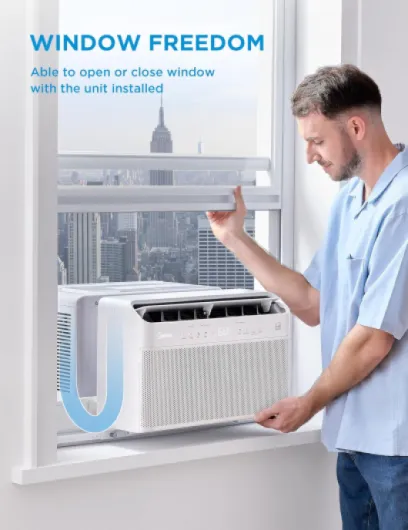
The U-shaped design is honestly the main reason I picked this model. Traditional window ACs are like a big block that kills your whole window. This one leaves a decent chunk of glass free, so my room doesn’t feel like a bunker. With the unit in, I still get natural light and can slide the window up a bit if I want to air the place out. That’s something I’ve never had with a window AC before, and in day-to-day use, it’s actually pretty handy.
In terms of looks, it’s plain white plastic, nothing fancy, but it doesn’t look cheap or out of place. The front grille is simple, the display is small and not too bright, and the buttons are straightforward. It doesn’t scream “high-end”, but it doesn’t look like a budget unit either. It just blends in, which is what I want from something that’s going to sit in my window for months. The size is pretty compact for 8,000 BTU: about 22" wide, 19" deep, and 13.5" high.
The downside of this design is installation complexity and weight. The unit weighs around 55–56 pounds, and because it hangs off a bracket, getting it into place is a bit of a workout. The quick-snap bracket is smart, but you still have to line things up, adjust side panels, and seal around it. A normal window AC is more “lift, shove, screw, done.” This one feels more like a mini project. I did it with one person, but I’d strongly recommend two people if you don’t want to risk dropping it or smashing your fingers.
From a practical standpoint, though, the design works. Noise stays mostly outside, you keep more of your view, and the unit feels stable once installed. Just be aware: this isn’t a plug-and-play chunk you throw in the window in five minutes. For someone who moves often or needs to reinstall it every season, the design is a bit more demanding. If you’re planning to leave it in the same window for a long time, the extra effort is easier to justify.
Day-to-day comfort: sleeping, working, and using the smart features
From a comfort standpoint, this unit is way easier to live with than a basic window AC. For sleeping, the combination of low noise and stable temperature makes a big difference. I run it in a small bedroom at night on low fan, set around 73–74°F. Instead of the room turning into a fridge, then warming up, then repeating, it just stays in that comfortable band. The fan noise becomes a soft background hum. If you’re sensitive to sound, you’ll still hear it, but it’s not that harsh mechanical noise you get from older units.
The airflow is decent. You can adjust the louvers, but they don’t have super precise control—you can direct air up/down and a bit side to side, but it’s not like a split system. Still, I never felt like the air was stuck in one corner. It spreads out enough that the whole room gets reasonably even cooling after a short time. I liked running it on medium fan during the day and low at night. The fan-only mode is also handy when it’s not too hot but you still want some air movement without full cooling.
The smart features actually help with comfort more than I expected. Being able to turn it on from my phone when I’m on my way home means I don’t walk into a hot box. I also set a simple schedule: cooler in the evening, slightly warmer overnight. The app isn’t perfect—sometimes it feels a bit slow or clunky—but it works. Voice control with Alexa/Google is more of a nice-to-have than essential, but I did use it a few times when I was already in bed and didn’t want to hunt for the remote.
One small but useful detail is the filter reminder. I’m lazy about cleaning filters, and this at least nudges you to pull it out and rinse it. A clean filter actually helps the unit cool better and stay quieter. Overall, comfort is where this AC earns its price: quieter nights, less temperature swinging, and the convenience of remote control. It’s not perfect, but compared to a standard noisy box AC, living with this day-to-day is just less annoying.
Build quality, installation, and long-term concerns
Build quality is decent but not bulletproof. The outer shell is plastic, but it feels more solid than the really cheap units you see in big-box stores. Nothing on mine rattles or feels loose so far. The front grille clicks in firmly, the control panel buttons don’t feel mushy, and the side panels seal reasonably well once you install the foam. It’s not industrial-grade hardware, but for a home window AC, it feels fine.
The window bracket and mounting hardware are actually one of the stronger points. The bracket is metal and feels sturdy once it’s screwed into the sill. When the unit sits on it, everything locks in pretty well. I never felt like it was going to tip or fall out of the window. The anti-theft bar that locks the window sash down is also a nice touch if you’re on a lower floor and worry about someone pushing the window up. Just be prepared to spend time getting the bracket level and the foam seals in the right places if you want a tight fit.
In terms of long-term durability, it’s hard to judge fully after just several weeks, but a lot of people have been using similar Midea U models for a couple of seasons and the general pattern seems okay: some units run for years without issue, others run into occasional sensor or app glitches. The two-year limited warranty is pretty standard, not generous but not stingy either. Personally, I’d treat this as something you expect to last at least a few summers if you take care of it—clean the filter, don’t let water pool where it shouldn’t, and don’t bang it around when installing or removing.
The one thing I’ll point out is that because it’s an inverter unit with more electronics and Wi‑Fi, there’s more that can theoretically fail compared to a dumb mechanical AC. If you want something you can kick around for 10 years and never think about, a basic non-smart unit might be safer. But if you’re okay with a bit more complexity in exchange for lower noise and power use, this feels like a reasonable trade. Overall, I’d call the durability prospects good enough, but not bulletproof. Take care during installation, and it should hold up.
Cooling, noise, and real-world behavior
In terms of cooling performance, for an 8,000 BTU unit, it does what it’s supposed to. My space is just under the rated 350 sq ft, and it handles it without struggling. On a hot day (outside around 88–90°F), my room went from about 80°F down to 73–74°F in roughly 10–15 minutes with the fan on high and set temp at 72°F. After that, it just settles in and holds the temperature. The air throw is decent; it doesn’t blast across the room like a jet, but you feel the cool air within a few minutes even if you’re not right in front of it.
The inverter compressor is what makes the biggest difference over a basic unit. Instead of full-power on/off cycles, it ramps up to cool quickly, then slows down and cruises. That means fewer temperature swings and less of that sudden “the compressor just kicked on” noise. In practice, the room feels more stable and I don’t wake up shivering or sweating. For sleeping, this is a big plus. You mostly hear the fan, not the compressor slamming on and off.
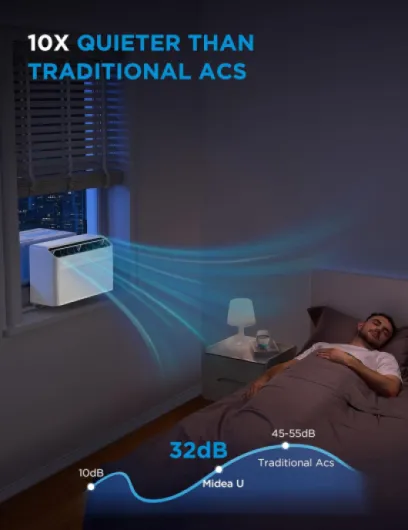
Noise-wise, it’s genuinely quiet for a window AC. Specs say around 32 dB on low, and while I’m not measuring that with equipment, subjectively it’s way quieter than every normal window unit I’ve owned. On low, it’s like a small desk fan. On high, you definitely hear it, but it’s still more of a steady whoosh than a roar. If you work from home, take calls, or are sensitive to noise at night, this is probably the main reason to pick this model over a cheaper one.
On the energy side, I can’t verify the exact 37% savings, but I did compare my power usage to last summer with a similar pattern of use. With this Midea running a few hours a day, my bill was noticeably lower than with my older non-inverter 6,000 BTU unit, despite this being more powerful. It’s not going to magically cut your bill in half, but if you run AC a lot, the savings add up. Overall, performance is strong and consistent. It’s not a miracle machine, but for a normal-sized bedroom or small living room, it cools fast enough, stays quiet, and doesn’t suck power like crazy.
What this Midea U-shaped AC actually offers
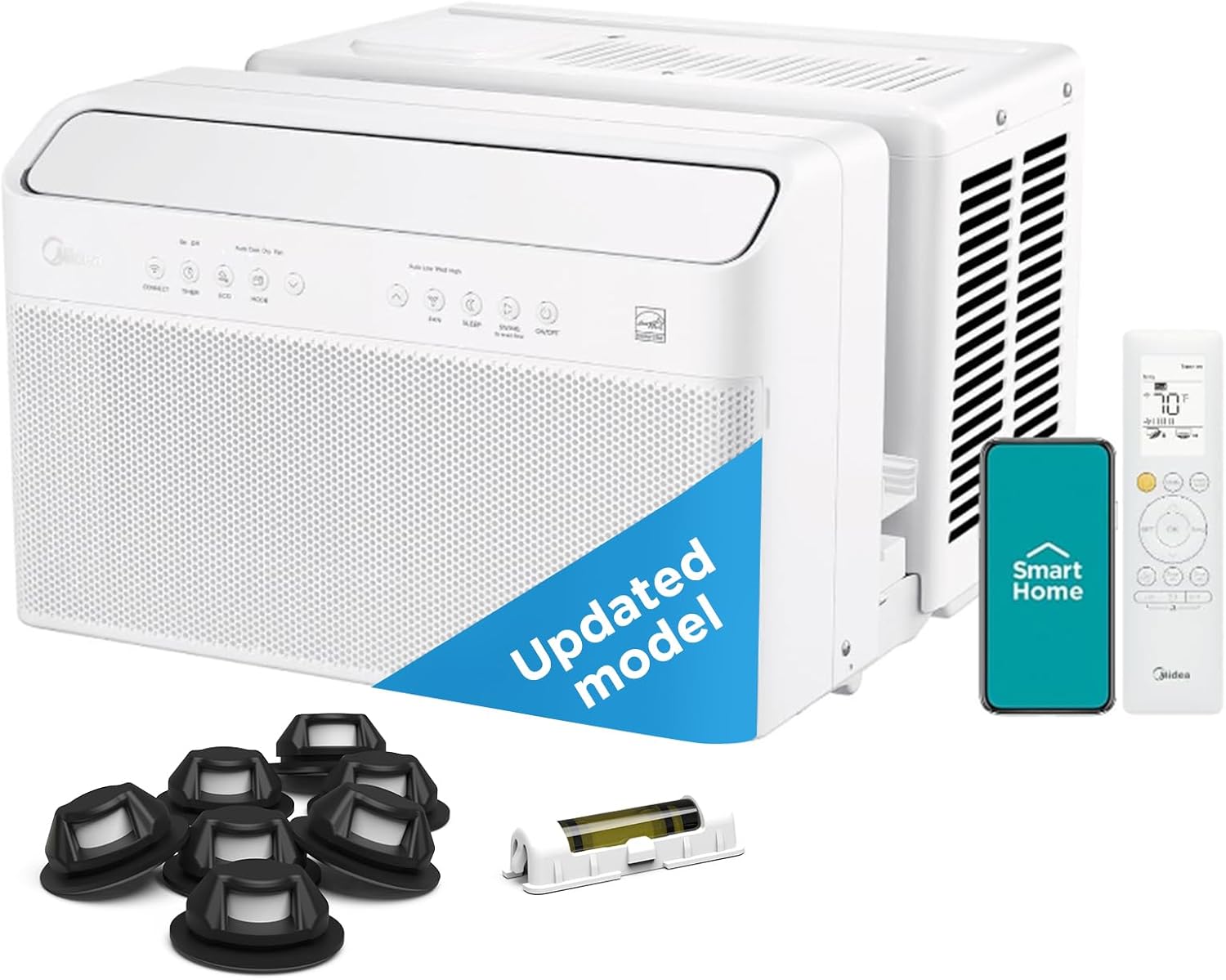
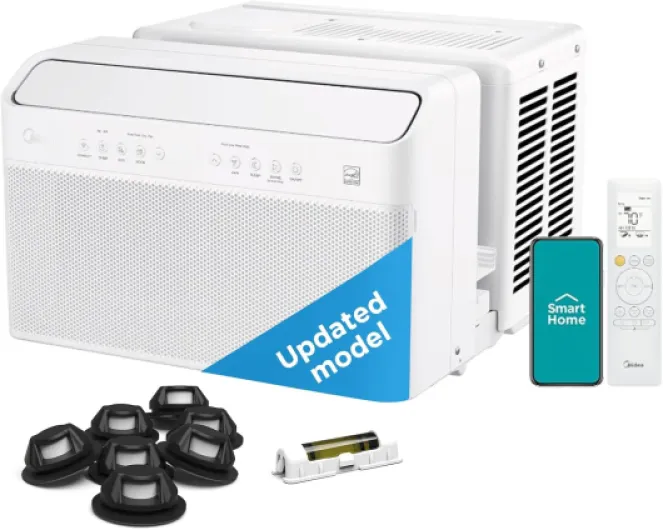
On paper, this thing checks a lot of boxes. It’s 8,000 BTU, rated for up to about 350 sq ft, runs on 115V, and pulls about 710W. It uses an inverter compressor, which is basically the secret sauce for the quieter operation and lower energy use. It’s also Energy Star rated and Midea claims more than 35–37% energy savings compared to a regular non-inverter window unit. I can’t verify the exact percentage, but I did see a noticeable drop in my usage compared to my old 6,000 BTU unit that ran like a dinosaur.
Feature-wise, you get the usual stuff: cooling, fan-only mode, dehumidifier mode, timer, ECO mode, and multiple fan speeds. There’s a remote included that actually works from across the room (not always the case with cheap remotes), plus Wi‑Fi control through the Midea SmartHome app on iOS/Android. You can also hook it up to Alexa or Google Assistant, so you can yell at it from your couch or bed. All of that worked for me after a bit of setup—no deal-breaking issues, just the usual app login and Wi‑Fi pairing dance.
The U-shaped design is the main difference from a typical window AC. The compressor and loud parts sit outside the window, and the inside part is basically a quiet air handler. Your window slides down into the U, which keeps more of your view and lets you still open the window a bit if you want fresh air when the unit is off. There’s also an anti-theft mechanism when the window is closed, so the sash is basically locked down by the unit.
Overall, in terms of what you get for the price, it’s pretty loaded: quiet operation, smart control, lower power draw, and a more flexible window situation than a brick-style AC. It’s not the cheapest 8,000 BTU unit out there, but it’s clearly a step above the basic mechanical-dial models. You’re basically paying for less noise, better power use, and the smart features. If those matter to you, then the specs and features line up pretty well with the real-world experience.
Pros
- Very quiet operation compared to standard window ACs, especially on low fan
- Inverter compressor gives stable temperatures and uses less energy over time
- U-shaped design keeps more of the window usable and lets you still open it
Cons
- Heavier and more complex to install than a basic window unit
- Higher price than non-inverter, non-smart alternatives for the same BTU rating
Conclusion
Editor's rating
After using the Midea 8,000 BTU U-Shaped Smart Inverter for a while, my take is pretty straightforward: it’s a very solid choice if noise and comfort matter to you, and just okay value if all you care about is raw cooling for the lowest cost. It cools a 300–350 sq ft room reliably, keeps temperatures stable thanks to the inverter compressor, and is noticeably quieter than the usual box-style window ACs. The U-shaped design isn’t just a gimmick either—you really do keep more of your window and can still crack it open when the unit is off.
On the flip side, it’s heavier and more involved to install than a standard unit, the app can be a bit clunky at times, and you’re paying extra for the smart and inverter features. If you just want something cheap for a guest room that runs a few weekends a year, this is probably more than you need. But if this is for your main bedroom or home office, where you actually care about sleep, video calls, and your power bill, it’s a strong option that feels worth the price premium.
So, who should get it? People who want a quiet, efficient, and reasonably smart window AC for a small to medium room and are okay spending a bit more and doing a more careful installation. Who should skip it? Anyone on a tight budget, people who move often and don’t want to deal with the bracket setup, or those who don’t care about noise and just want the cheapest box that blows cold air.