Summary
Editor's rating
Value for money: strong if you respect its limits
Design: big, plain, and mostly focused on function
Smart features, remote, and control (not really about batteries)
Build quality, reliability, and dealing with repairs
Performance: strong cooling, solid heating, very quiet
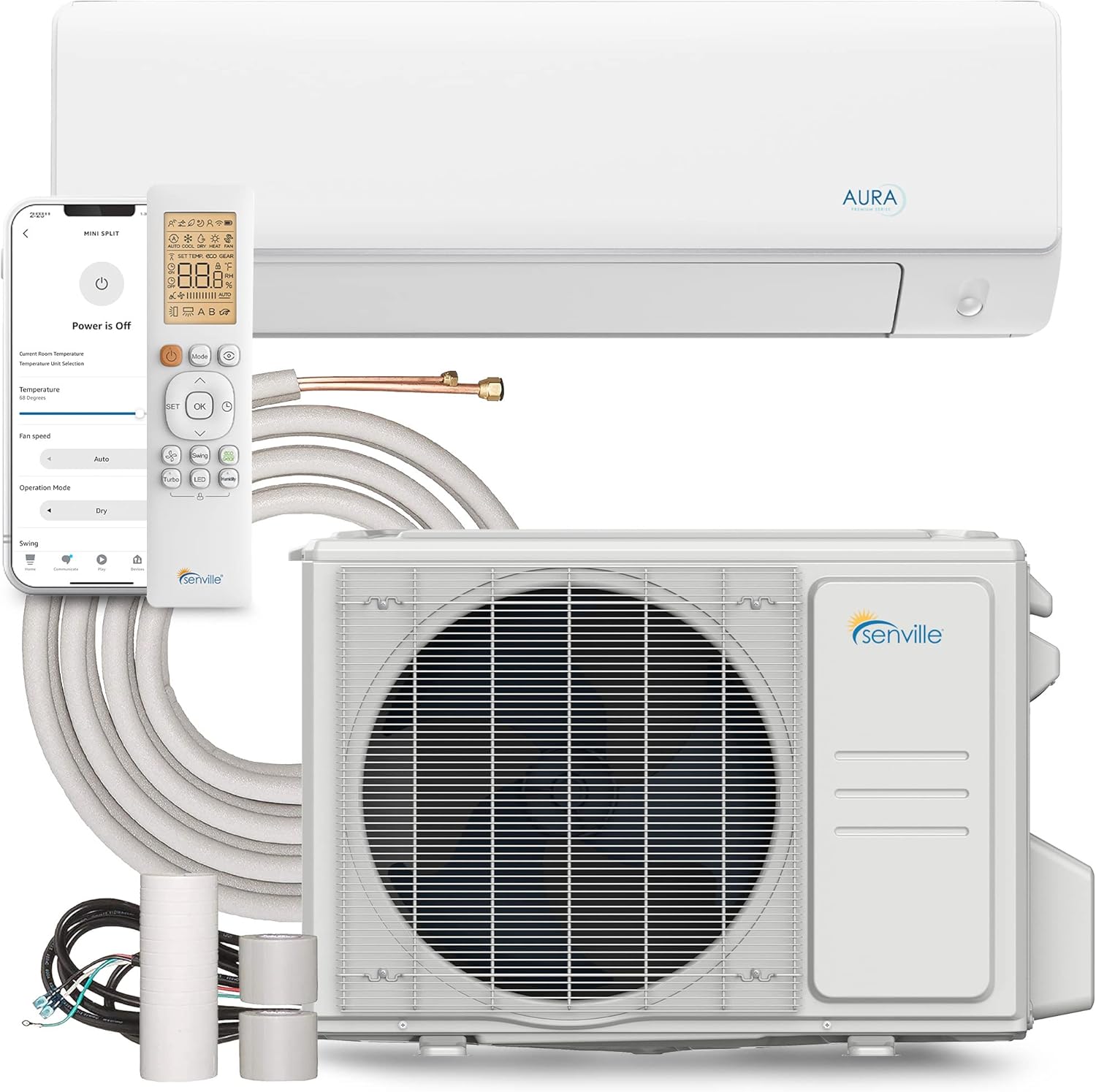
What you actually get with the Senville AURA 24000 BTU
Real-world effectiveness: comfort vs. insulation and layout
Pros
- Strong cooling and solid heating performance for up to ~1,200 sq ft when the space is reasonably open
- Quiet indoor operation with inverter compressor and decent energy efficiency (SEER 20.5, Energy Star)
- Good value for the price, with included line set, WiFi module, and a 3-year parts / 7-year compressor warranty
Cons
- Professional installation basically required for warranty and proper operation, adding to total cost
- Smart features and app/Alexa setup are a bit fiddly and not as polished as premium brands
- Plain, bulky indoor unit design and limited included accessories (no line covers, mismatched cable/line lengths)

Specifications
View full product page →| Brand | Senville |
A big step up from window units and space heaters
I put the Senville AURA 24000 BTU mini split in a roughly 1,100–1,200 sq ft open space that used to rely on a noisy window AC and a couple of electric heaters. So this isn’t a lab test, it’s just me trying to keep a real space comfortable without killing the power bill. I went for the 24k BTU version because I didn’t want it running at full blast all the time, and the specs say it’s meant for up to about 1,250 sq ft, which lines up with my setup.
First thing: this is not a plug-and-play gadget. You’re dealing with 240V, refrigerant lines, vacuum pumps, the whole thing. I had an HVAC guy do the install to keep the warranty valid, but I stuck around and watched everything. Between the unit, materials, and labor, this is a real investment, not an impulse buy, so I went in with fairly high expectations on performance and noise.
After a few weeks of daily use in mixed weather (chilly nights, warm afternoons), the general feeling is: it gets the job done quietly and efficiently, but it’s not magic. It won’t fix a badly insulated house and it won’t heat the whole neighborhood. When the space is reasonable, though, it holds temperature very well and doesn’t sound like a jet engine taking off, which is already a big step up from what I had before.
If you’re coming from window ACs or old baseboard heaters, this kind of system is a clear upgrade in comfort and noise. But you need to be realistic about the install, the cost, and the fact that the smart features are a bit fiddly. It’s a solid workhorse unit, not a fancy toy you just take out of the box and plug in.
Value for money: strong if you respect its limits
On the value side, this is where the Senville AURA 24k makes the most sense. You’re getting a 2-ton, Energy Star, inverter mini split with WiFi and Alexa support, plus line set and basic install kit, at a price that’s usually lower than a lot of big-name brands. It’s not dirt cheap, but for what it offers, the cost per BTU and the efficiency rating are pretty attractive. Several buyers who work in trades (electricians, builders) called it a good value and even bought multiple units.
Where the total cost can creep up is the installation. If you follow the rules and get a pro to install it, expect a few hundred dollars more at least. One reviewer mentioned around $400 per unit with custom track, which is actually reasonable. Still, you need to factor that in. If you try to cut corners with a half-baked DIY job and then have issues, any savings can vanish quickly. Also, small extras like line covers, extra line length, or a better condensate drain setup can add to the bill.
Running costs are where it keeps paying you back. With a SEER of 20.5 and inverter tech, it’s clearly more efficient than old-school central systems or window units. People replacing propane or baseboard heat noticed lower bills, especially in milder weather where heat pumps are most efficient. One user even measured current draw and was impressed by how little power it used for the output. In my case, the power usage spike on the panel is modest compared to what I was expecting for a 2-ton unit.
So, in simple terms: if you want top-tier brand prestige and super-polished apps, this isn’t it. If you want a pretty solid workhorse that cools and heats well, is quiet, and doesn’t wreck your power bill, the value is hard to argue with. Just remember to budget for proper install and maybe a future repair down the road, instead of pretending it’s a one-and-done forever purchase.
Design: big, plain, and mostly focused on function
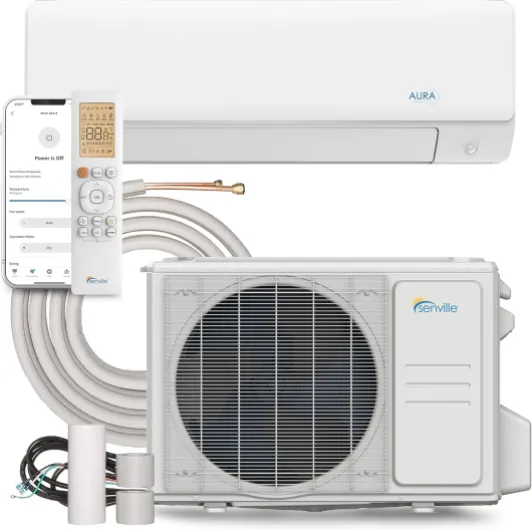
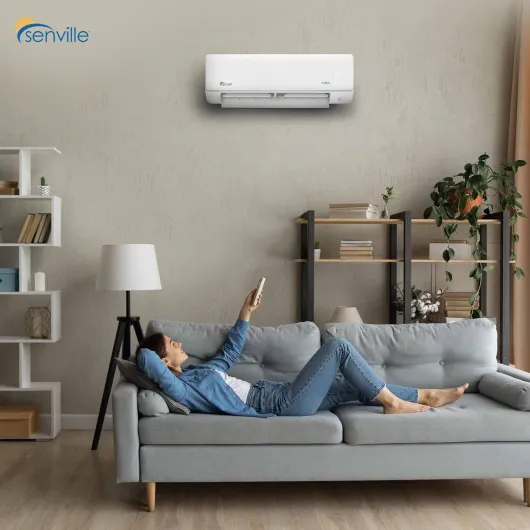
Design-wise, this thing is pretty plain and utility-focused, which honestly is fine for me. The indoor unit is just a big white bar on the wall. If you’re used to slim designer units, this will look a bit chunky. It’s 40 inches wide and sticks out about 10 inches, so it’s not something you ignore visually. In a living room it’s noticeable, in a garage or workshop you probably won’t care at all.
The plastic on the indoor unit feels decent, not fancy but not flimsy either. The front panel opens up to access the filters easily, and the louvers move automatically when you start the unit. The display is basic: temperature and a few icons. No flashy lighting or weird design choices, which I actually like. It looks like what it is: a white appliance meant to push air and that’s it.
The outdoor condenser is also straightforward: a big metal box with a fan, nothing glamorous. It’s not the smallest 2-ton condenser out there, but it’s in the normal range. The casing feels solid enough, and the fins are the usual thin aluminum, so you’ll want to keep it away from kids kicking balls and from weed whackers. There are clear service panels and access points, which my installer liked because it makes future repairs or checks less annoying.
One minor annoyance: the kit doesn’t come with any kind of fancy line cover or trim, just the bare essentials. If you want the install to look clean inside and out, you’ll probably buy a separate line set cover kit. Also, the power and drain lines aren’t the same length as the refrigerant lines, which a couple of other buyers mentioned too. It just means you need to plan the run carefully instead of bundling everything perfectly in one neat channel. Overall, the design is practical and low-key, not stylish, but it fits fine in most normal homes or garages.
Smart features, remote, and control (not really about batteries)
There isn’t a real “battery” story here beyond the remote, but the control side is worth talking about. The handheld remote runs on standard AA batteries (not included in my box), and it’s basic but functional. You get mode selection (cool, heat, dry, fan, auto), temperature up/down, fan speed, and a few extra buttons like sleep and swing. The remote works fine as long as you point it at the unit like an old TV remote. Nothing fancy, but it does the job.
The more interesting bit is the WiFi and Alexa integration. The included WiFi module is a small card you plug into the indoor unit. Setup is a bit fiddly: you need to use their app, connect to a temporary WiFi, then hook it into your home network. It took me a couple of tries, and one reviewer also mentioned it was a little fussy. Once it’s paired, though, it’s fairly stable. I can turn the unit on/off, change temperature, and switch modes from my phone or with voice commands.
Alexa support is handy if you’re already using it. I set up simple routines like “turn on heat to 68 at 6 am” and “turn off AC at midnight.” It’s not as polished as a dedicated smart thermostat, but for a mini split, it’s decent. The app itself is not pretty, but it’s usable. You don’t get super detailed energy stats or anything, just basic control and scheduling.
Overall, the control side feels a bit behind what you get with high-end systems, but it’s still a clear step up from an old-school IR-only remote. Just don’t buy this solely for the smart features. Treat them as a nice bonus that makes life easier once you’ve wrestled through the initial setup, not the main reason to pick this model.
Build quality, reliability, and dealing with repairs
Durability is always tricky to judge early, but I can at least talk about build feel and some real user repair stories. Physically, both the indoor and outdoor units feel reasonably solid for the price. The plastics don’t creak much, the louvers move smoothly, and the condenser housing isn’t paper-thin. It’s not industrial-grade heavy steel, but it doesn’t feel like a toy, either. The mounting brackets and hardware my installer used held it firmly with no vibration issues.
What gives me a bit more confidence are the reports from people who’ve had these running for over a year and actually needed service. One verified buyer said their unit tripped the breaker after about 13 months. They called Senville, got someone competent on the phone quickly, answered a few questions, and Senville shipped a new circuit board by FedEx. Three days later, part swapped, unit back up and running. That’s not perfect reliability, but it’s a decent outcome: failure happened, but support and parts were available.
The warranty is 3 years on parts and 7 years on the compressor, but labor is on you. And they’re clear that professional installation is required to keep that warranty valid. That’s important: if you DIY and something goes wrong, you might end up paying for everything yourself. Replacement parts are available for purchase even outside warranty, which is good if you plan to keep it long-term and don’t mind doing some repairs or paying a tech.
From what I’ve seen and read, you should treat this as a mid-range, good-value unit, not a top-shelf brand that you expect to run untouched for 20 years. If you keep the filters clean, wash the outdoor coil at least once a year, and protect the condenser from physical damage, it should hold up fine. Just go in knowing that if something fails, you’ll likely be dealing with parts replacement rather than junking the whole thing, and Senville seems reasonably responsive on that front.
Performance: strong cooling, solid heating, very quiet
In day-to-day use, the cooling performance is strong for a 1,100–1,200 sq ft open area. On a hot day (around 88–90°F outside), I can set it to 72°F and it gets there in a reasonable time, then mostly idles at low fan speed. The inverter compressor helps a lot here: instead of constantly starting and stopping, it ramps up and down, which keeps the temperature more stable and avoids those annoying blasts of hot/cold air. Compared to my old window unit, the room feels more even and less sticky.
Heating is where I was more curious, because I wanted to reduce use of electric heaters. In shoulder seasons (around 35–50°F outside), the heat pump handles everything easily. The air it pushes out is pleasantly warm, and it keeps the space at 68–70°F without running full tilt all the time. When it gets closer to freezing, it still does the job, but you feel it running longer and doing defrost cycles now and then. The defrost cycles are noticeable but not dramatic: a short pause in heat and then back at it.
Noise-wise, the indoor unit is very quiet on low and medium fan. You can comfortably watch TV or work on a laptop right under it. On the highest fan speed, you obviously hear air movement, but it’s still just airflow noise, not mechanical rattling. The outdoor unit is also pretty tame. Standing a few feet away you hear a steady hum, but nothing extreme. Neighbors won’t complain unless it’s right outside a bedroom window and they’re very sensitive.
One thing I checked was how hard it hits the electrical panel. Under heavy cooling, it pulls noticeably less than some older 2-ton units I’ve seen. Other users measured around 3–4 amps per leg at 240V under load, which lines up with the Energy Star rating and what my usage graph suggests. It’s not free to run, but for the amount of heating and cooling you get, the power draw is reasonable. It’s not perfect—there’s a bit of temperature overshoot sometimes, and the thermostat in the unit isn’t as accurate as a good smart thermostat—but for the price bracket, the performance is pretty solid.
What you actually get with the Senville AURA 24000 BTU
Out of the box, the Senville AURA 24k is a complete mini split kit, not just a random indoor unit. You get the indoor air handler, the outdoor condenser, a 16 ft line set, communication cable, a wall remote, and the WiFi module. That’s basically everything you need on the equipment side, as long as your install is within that 16 ft distance or you’re okay buying extra line set. No batteries included for the remote in my case, even though the spec sheet mentions AA batteries, so don’t count on that.
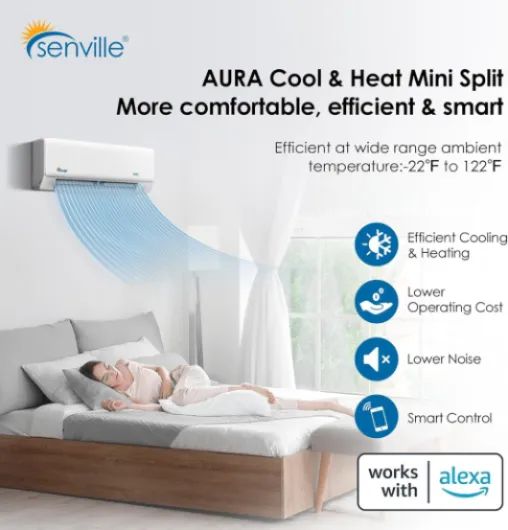
The unit is rated at 24000 BTU (2 tons), runs on 208–230V, and claims a SEER of 20.5 with Energy Star certification. On paper, that means it should be pretty efficient for both cooling and heating. It’s also AHRI certified and UL listed, which for me just means it’s not some random no-name import with sketchy numbers. The brand is clearly targeting the budget-conscious buyer who still wants something certified and relatively trustworthy, not a top-tier premium brand.
The system is advertised as handling heating down to around -22°F (-30°C). I haven’t hit those temps personally, but users in colder areas report it still putting out heat at very low temps, just with longer run times. The noise rating for the indoor unit is listed at 36 dB, which fits my experience: it’s low enough that you just forget it’s there on the lower fan speeds.
Important detail: professional installation is required for the warranty (3 years parts, 7 years compressor). If you DIY and something fails, you’re probably on your own. Some reviewers did install it themselves with a vacuum pump and gauges, but they’re clearly people who know what they’re doing. If you’re not comfortable with high-voltage and refrigerant, budget for an installer. The system isn’t overly complicated, but it’s not a weekend IKEA project either.
Real-world effectiveness: comfort vs. insulation and layout
Effectiveness really depends on your space, and that shows with this unit. In my fairly open, decently insulated area, the Senville AURA 24k keeps things comfortable without much drama. If I set 72°F in cooling or 68°F in heating, it usually sits around that with only 1–2 degrees of drift. The air distribution is decent, but like any wall-mounted mini split, it favors the area right in front of it. If your layout has lots of walls and rooms, don’t expect one unit to magically handle the whole house.
I tested it in a couple of ways: letting it run all day at a fixed setpoint, and also using the schedule and Alexa routines to pre-heat or pre-cool before I got home. When running continuously, it’s very steady, and the inverter really shines. When using schedules, there’s a bit of ramp-up time; it doesn’t instantly cool or heat a big space, so you have to give it 30–60 minutes depending on the temperature difference and insulation.
Where it impressed me is in replacing other heat sources. Several reviewers mentioned ditching propane or baseboard heat, and I see why. In mild to moderately cold weather, this thing easily covers what my old space heater setup used to do, but more evenly and with less noise. I still wouldn’t rely on it as the sole source of heat in extreme cold without backup, but for most winter days in a moderate climate, it’s enough.
It’s not flawless. The temperature reading on the unit doesn’t always match a separate room thermometer, and sometimes it overshoots by a couple of degrees before throttling down. Also, if doors are closed and the air can’t circulate, rooms far from the unit will lag behind. But overall, as a main comfort system for one large zone, it’s effective and predictable once you learn how your particular space reacts.
Pros
- Strong cooling and solid heating performance for up to ~1,200 sq ft when the space is reasonably open
- Quiet indoor operation with inverter compressor and decent energy efficiency (SEER 20.5, Energy Star)
- Good value for the price, with included line set, WiFi module, and a 3-year parts / 7-year compressor warranty
Cons
- Professional installation basically required for warranty and proper operation, adding to total cost
- Smart features and app/Alexa setup are a bit fiddly and not as polished as premium brands
- Plain, bulky indoor unit design and limited included accessories (no line covers, mismatched cable/line lengths)
Conclusion
Editor's rating
The Senville AURA 24000 BTU mini split is, in my experience, a solid, no-nonsense option if you want efficient heating and cooling for a medium-to-large space and you’re okay dealing with a proper installation. It doesn’t try to be fancy: the design is plain, the app is basic, but it cools and heats well, runs quietly, and doesn’t chew through electricity like older systems. For garages, big living rooms, open-plan areas, or small shops, it fits pretty well.
Where it shines most is the balance of price, performance, and efficiency. You’re not paying premium-brand pricing, but you still get Energy Star ratings, inverter tech, and decent support with parts availability. The downside is you absolutely need a correct install—vacuumed lines, proper electrical, good condensate routing—or you’re asking for trouble. The smart features are a nice bonus once set up, but not the main reason to buy it.
If you’re in a moderate or cold-ish climate, have one main zone you want to handle, and don’t mind calling an HVAC tech (or you are one), this unit is worth a serious look. If you’re expecting a plug-in DIY solution, or you want slick smart-home integration and designer looks, you’ll probably be happier with something else. For most practical homeowners who just want a reliable, efficient workhorse at a fair price, it’s a good pick with a few quirks to accept.