Summary
Editor's rating
Value for money: decent if you set it up right
Design and installation: heavy, slightly annoying, but manageable
Everyday comfort: temperature, airflow, and living with it
Build quality and long-term feel
Cooling performance and noise: solid, with a few caveats
What this LG wall AC actually offers on paper
Pros
- Good cooling power for small to medium rooms (up to ~400 sq ft in real use)
- Reasonably quiet for a through-the-wall unit with useful Energy Saver and Dry modes
- Simple controls with remote, timer, and washable filter for easy daily use
Cons
- Picky about wall sleeves and ventilation, with risk of CH34 overheating errors in bad installs
- Cheap-feeling front plastics and trim, occasional rattles and only a 1-year warranty

Specifications
View full product page →| Brand | LG |
A wall AC that’s good, but not magic
I’ve been using this LG 10,000 BTU through-the-wall unit in a small apartment setup, basically a living room plus a bit of open kitchen, roughly in that 350–400 sq ft range. I didn’t buy it expecting miracles, just something that would keep the place livable in summer without sounding like a jet engine. Overall, it does the job, but there are a few quirks you should know before you cut a hole in your wall or slide it into an old sleeve.
The first thing I noticed is that the cooling power is legit for a normal-sized room, but the advertised “up to 440 sq ft” is the absolute upper limit. If your space is poorly insulated or has big sunny windows, don’t expect ice-cold everywhere. In my case, it brought the room from around 78°F down to 72–73°F in a few hours, which is fine. It’s not instant, but it’s not weak either.
Noise-wise, it’s there. This is a through-the-wall AC, not a whisper-quiet split system. On low and medium it’s totally tolerable for TV and working on a laptop. On high, you know it’s running, but it’s still better than some older window units I’ve had. If you’re super sensitive to noise when sleeping, you’ll probably need to play with fan speeds and modes to find a balance.
Where things get a bit annoying is around installation and compatibility with old sleeves, plus some reports of overheating (CH34 error) if the back of the unit can’t breathe properly. I didn’t hit that myself, but the risk is clearly there if you shove it into a bad sleeve or a tight, unvented cavity. So, in short: it cools well, it’s reasonably quiet for what it is, but it’s not plug-and-play in every wall and it’s not flawless.
Value for money: decent if you set it up right
In terms of value, this LG sits in that middle zone: not super cheap, not premium. For the price, you get a known brand, solid cooling performance, a remote, and some useful modes like Energy Saver and Dry. It’s not overloaded with features, but in everyday use, the basics are covered. Compared to going for a no-name wall unit, I do feel slightly better having LG on the label, even if they’re not perfect.
The main question is: are you ready to deal with installation and potential sleeve issues? If you already have a compatible wall sleeve or you’re doing a new framed opening sized for this unit, the value is pretty good. You pay once, get decent cooling for a medium room, and ongoing costs are reasonable thanks to the EER of 10.7. It won’t crush your electric bill if you’re sensible with the settings and use Energy Saver when you’re not home.
If, on the other hand, you’re trying to shove this into a very old or weird sleeve, the value drops. You might need extra foam, shims, or even a new sleeve. And if you end up with CH34 overheating errors because the back can’t vent properly, then the whole thing becomes a headache and a bad purchase. In that case, you’d probably be better off with a model that’s known to play nicer with older sleeves, like some Frigidaire or Friedrich units people mentioned.
So from my point of view: the value is decent but not outstanding. If you can get it at a fair price and your wall situation is compatible, it’s a solid choice that gets the job done. If you have to start modifying walls or taking big installation risks, I’d think twice and maybe look at alternatives or step up a bit in budget for something more robust or with better support.
Design and installation: heavy, slightly annoying, but manageable
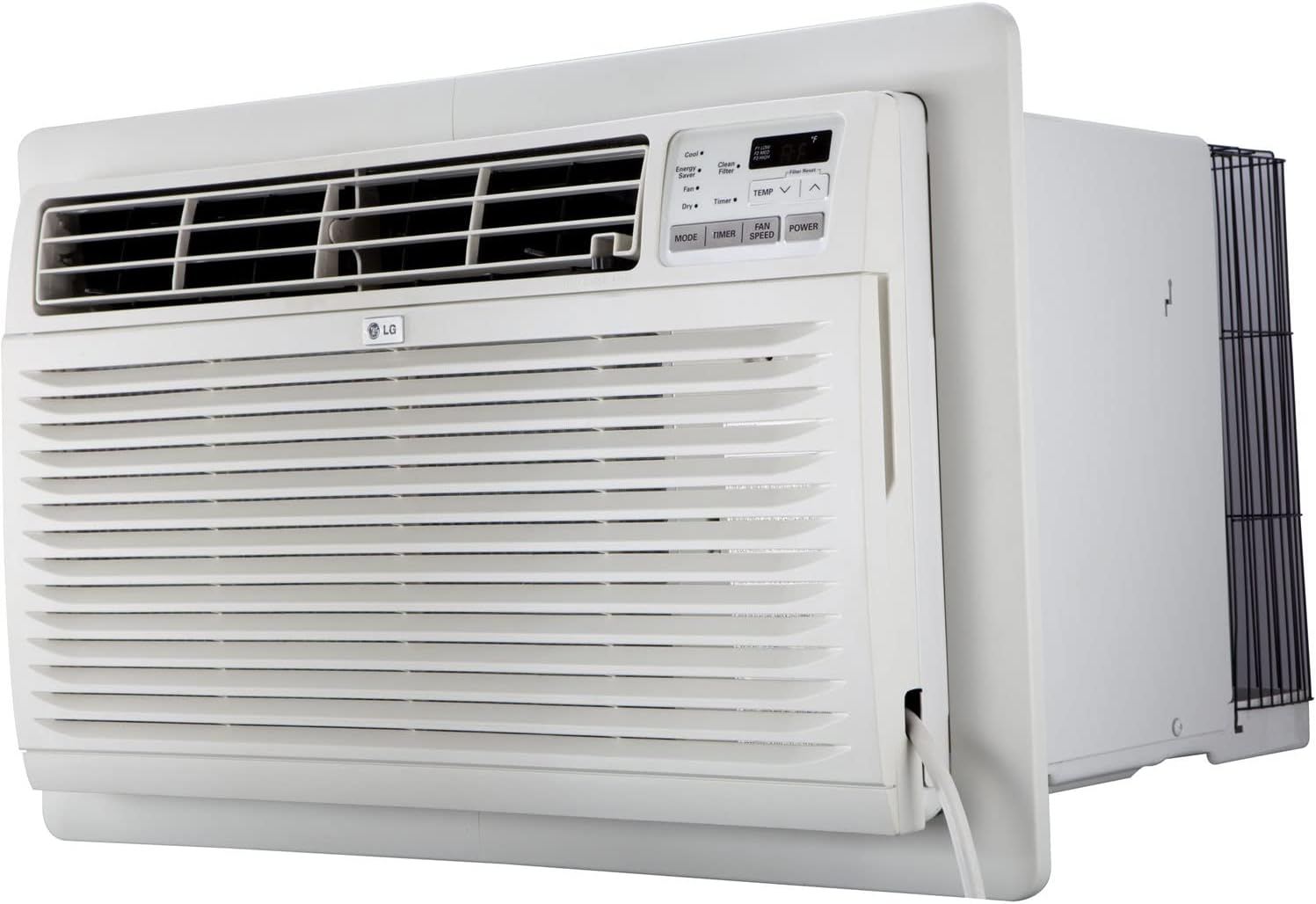
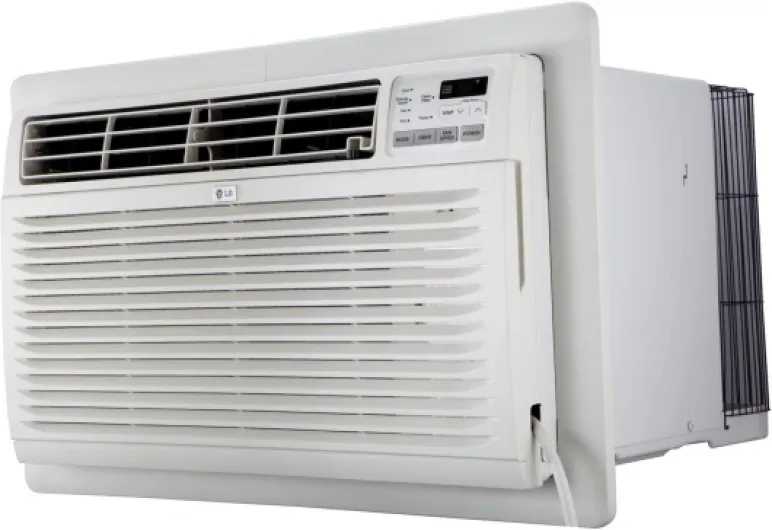
Design-wise, this thing looks like pretty much every other white wall AC: a big rectangular box with a plastic front grille and a small digital display. It’s not ugly, it’s just an appliance. If you’re expecting something stylish, this isn’t it. The front panel has the usual buttons for mode, temp up/down, fan speed, and power, plus the little display angled a bit upward. That angle actually matters: if your unit is mounted high on the wall, you kind of have to aim the remote downward and stand back a bit to see the display properly. It works, but it’s slightly awkward.
The unit is heavy: around 77 pounds. This is not a one-person install unless you’re stubborn and like back pain. Getting it into a second-floor wall sleeve definitely took two people. The included trim kit is plastic and snaps together around the unit from the inside, giving it a finished look. It does the job, but it feels cheap and a bit flimsy. Once it’s on the wall and you stop touching it, you don’t really care, but during install you realize this is not premium hardware.
The biggest design headache is compatibility with existing wall sleeves. Older sleeves, especially from the 80s or early 90s, can be taller or deeper than modern ones. This LG is about 24" wide, 20.1" deep, and 14.4" high, and some people found their old sleeves were a few inches taller, which means you end up stuffing foam and making shims to close gaps. The instructions barely explain why you put foam in certain places. They just show vague little drawings. If you’re handy, you’ll figure it out, but it could be clearer.
In actual use, the design is mostly fine. The 4‑way air deflection lets you aim the airflow up/down and side-to-side, which is helpful in a bedroom or office where you don’t want cold air blasting directly at your face. One small negative: the front grille can rattle at times, especially on higher fan speeds. It’s not constant, but you can tell the plastic isn’t the most rigid. Overall, the design is practical and basic. It works, but nothing about it feels high-end.
Everyday comfort: temperature, airflow, and living with it
In terms of comfort, once this LG is set up right, it makes the room feel decent, especially on muggy days. The air it pushes out is properly cold on Cool mode, and the fan is strong enough that you don’t get weird hot corners in a normal-sized room. The 4‑way deflection helps a lot. You can angle the vents up if the unit is near a bed so the cold air mixes before it hits you, or point them sideways if you’re mostly trying to cool one end of the room.
The Dry mode pulls out moisture pretty well. It’s rated at around 2.9 pints per hour, and while I didn’t measure exact water volume, the room definitely felt less sticky on humid days when using Dry. It’s not a replacement for a dedicated dehumidifier in a basement, but in a bedroom or living room, it’s enough to make the air more comfortable. If you live somewhere with high humidity, this mode is actually useful and not just a gimmick.
Noise is the main comfort trade-off. If you’re used to central air, any through-the-wall AC will feel loud. Compared to older units, this LG is on the quieter side, but you still have a steady fan noise and the occasional compressor thud. On low, I could sleep with it running, but I wouldn’t call it quiet. On high, it works best as a “white noise plus cooling” combo. If you’re sensitive to intermittent noises, Energy Saver might annoy you because the fan cycles every few minutes. Constant fan mode is actually easier to tune out, even if it uses a bit more power.
One small detail: the filter light goes on based on hours of operation (around every 250 hours), not on actual dirt level. So you’ll see it light up even when the filter still looks pretty clean. It’s not a huge deal, but it feels slightly naggy. At least the filter is easy to pull out and rinse. Overall, comfort is good: the room feels cooler, less humid, and the airflow is strong. You just have to accept a bit of noise and the quirks of the modes.
Build quality and long-term feel
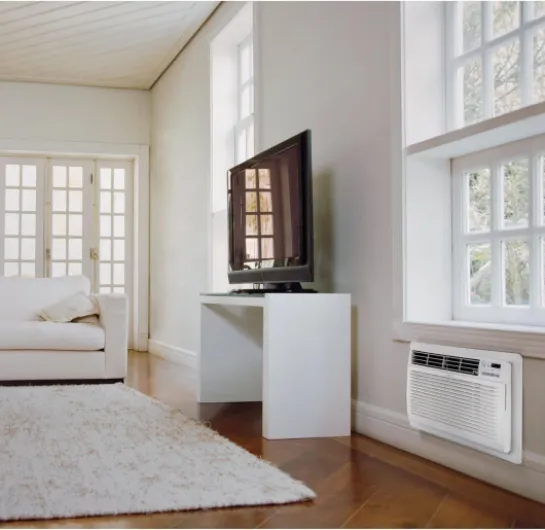
Build quality on this LG is somewhere in the middle: not junk, but you can tell they saved money on some parts. The outer shell and main chassis feel sturdy enough when you’re lifting it – it’s heavy and solid. That part inspires some confidence. Once installed, nothing feels like it’s about to fall apart. The issues are more with the front plastic pieces and trim, which are on the flimsy side. The front grille can rattle, and the trim kit feels like basic plastic that you snap and hope it doesn’t crack.
The internal components – compressor, fan, electronics – are harder to judge without years of use, but looking at user reviews and my own time with it, you see a pattern: most people are fine for at least a couple of seasons, but there are some complaints about overheating errors and occasional failures. The CH34 issue is more of a design/installation combo problem than a random defect, but it still affects how durable the unit feels. If a product is picky about where it’s installed, that’s a risk point long term.
The warranty is 1 year parts and labor. That’s standard, but not generous. For an appliance in this price range and category, I’d like to see at least 2–3 years on the sealed system. You don’t get that here, so if something major goes wrong in year two, you’re probably paying out of pocket. On the plus side, the basic maintenance is easy: wash the filter regularly, keep the outside clear so it can vent heat, and you’re mostly good. There’s not a lot for the user to break.
Overall, I’d rate durability as “acceptable but not bulletproof.” If you install it correctly in a proper sleeve with good ventilation and don’t abuse it, it should last several summers. But between the so-so plastics, the picky ventilation needs, and the short warranty, I wouldn’t call it a tank. It feels like a modern appliance: fine while it works, but you don’t get the old-school 15-year confidence.
Cooling performance and noise: solid, with a few caveats
Performance-wise, the LG does what it’s supposed to do: it cools a medium room reasonably fast and keeps it at a stable temperature. In my case, cooling a roughly 350–400 sq ft space, it dropped the temp from around 78°F down to 72–73°F in about 3 hours on a hot, humid afternoon. That lines up with other users who said it cooled a similar-size apartment in a few hours. If your room is closer to 440 sq ft and gets a lot of sun, just expect it to work harder and take longer.
The 3 fan speeds make a difference. On low, it’s fine for sleeping if you’re okay with a steady hum. On medium, you get a good balance of airflow and noise. On high, it moves a lot of air and you’ll feel it across the room, but you’ll also clearly hear it. Again, it’s not insane – it’s actually quieter than some older Keystone and generic units I’ve heard – but this is not a silent machine. The compressor has a noticeable thud when it kicks on or off, which is normal but still slightly jarring at night until you get used to it.
The Energy Saver mode is both nice and a bit annoying. It turns the compressor off when the room hits the set temperature and keeps the fan cycling every few minutes to check the temperature. That saves power, but if you’re lying in bed half-asleep, that fan cycling every 3 minutes is a constant reminder the unit is there. Temperature control is fairly accurate: set at 69°F, I usually saw the room float between about 72–74°F depending on humidity and how long the compressor had been off. It’s not super precise to the degree, but it’s fine for normal comfort.
Now the big warning: some users reported CH34 overheating errors, especially when the unit is installed in certain older wall sleeves. That error basically means the unit thinks the internal temperature is too high. LG’s standard answer is “check coils, give it shade,” but one repair tech mentioned that these units can struggle to dump heat properly in some sleeves, and LG is aware. I personally didn’t hit CH34, but if your sleeve is very tight, deep, or blocked, I can see how hot air might get trapped. So performance is good if the unit can breathe. If you cram it into a bad sleeve, you’re gambling.
What this LG wall AC actually offers on paper
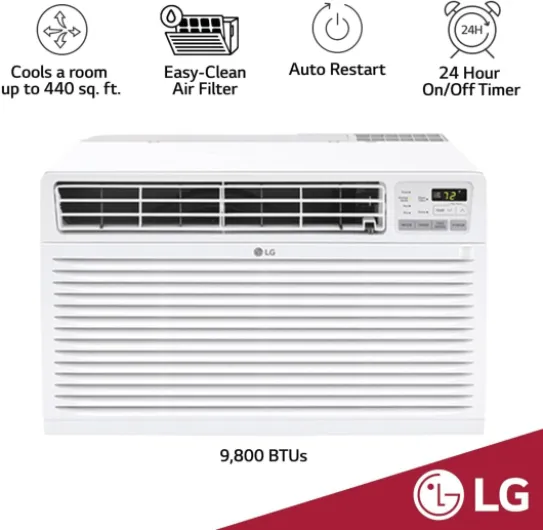
On paper, this LG LT1016CER is a pretty straightforward unit: around 9,800–10,000 BTU, 115V, cool-only, through-the-wall. No heat pump, no fancy Wi‑Fi, just cooling. It’s rated for rooms up to 440 sq ft, has 3 cooling speeds, 3 fan speeds, a digital display, a remote, and a few modes like Energy Saver and Dry (dehumidify). The airflow is about 250 CFM, which is decent for a wall unit of this size.
The energy efficiency ratio (EER) is listed at 10.7. That’s not top-of-the-line efficient, but it’s perfectly acceptable for a wall unit. It uses R‑32 refrigerant, which is more modern and a bit more efficient than the older R‑410A. Power draw is about 920 watts, so you can run it on a normal 115V outlet as long as the circuit isn’t already overloaded with other big appliances. This is handy if you’re in an older place where running a 240V line is a pain.
You also get a 24‑hour timer, auto‑restart after power cuts, and a filter reminder light. The filter is washable and slides out from the front, which is convenient. LG includes a mesh filter, a trim kit to clean up the wall opening on the inside, and some insulation foam. It’s meant specifically for through-the-wall installation, not a standard window mount; the way the vents and casing are built really expects a wall sleeve or framed opening.
In daily use, what all that means is: it’s a no-nonsense cooling box. You set the temp, pick a fan speed or mode, and forget about it. No app, no smart home, nothing fancy. If you like simple, that’s a plus. If you want modern connected stuff, this one feels a bit old-school. The specs match the real-life feel: solid cooling, average efficiency, basic but functional features.
Pros
- Good cooling power for small to medium rooms (up to ~400 sq ft in real use)
- Reasonably quiet for a through-the-wall unit with useful Energy Saver and Dry modes
- Simple controls with remote, timer, and washable filter for easy daily use
Cons
- Picky about wall sleeves and ventilation, with risk of CH34 overheating errors in bad installs
- Cheap-feeling front plastics and trim, occasional rattles and only a 1-year warranty
Conclusion
Editor's rating
Overall, the LG 10,000 BTU through-the-wall AC is a pretty solid “workhorse” unit as long as you respect its limits. It cools a medium room well, the airflow is strong, and the noise level is acceptable for a wall unit. The remote, timer, Energy Saver, and Dry mode are all genuinely useful and not just marketing fluff. Day to day, you set the temperature, pick a mode, and it keeps the room comfortable enough without much fuss.
Where it falls short is mainly around design quirks and long-term confidence. The plastics and trim feel cheap, the instructions for foam and sleeve setups are vague, and the CH34 overheating issue can pop up if your sleeve doesn’t let the unit breathe. The 1‑year warranty doesn’t inspire a ton of trust either. If you have a proper sleeve or you’re building a new opening to spec, it’s a decent value. If you’re trying to retrofit into an old, oversized or weird sleeve, this model is more of a gamble.
I’d recommend it for people who: have a compatible wall sleeve or are okay framing a new one, want simple cool-only operation, and are fine with some noise in exchange for solid cooling. I’d skip it if: your sleeve is very old and deep, you’re extremely sensitive to noise changes at night, or you want something that feels more robust and long-term. It’s not a bad unit, it just sits in that middle ground of “works fine, but not impressive.”