Summary
Editor's rating
Value for money: where it really makes sense (and where it doesn’t)
Design: simple, not pretty, but it blends in
Comfort & noise: quiet enough to forget it’s running
Packaging & installation kit: everything you need… if you know what you’re doing
Build quality & durability: feels decent, but time will tell
Cooling & heating performance: does it actually handle 1,200+ sq ft?
What you actually get with the Senville LETO 24k
Pros
- Strong cooling and heating performance for large spaces (around 1,000–1,200 sq ft)
- Quiet indoor operation, comfortable to work or relax near it
- Good value for money if you can handle some or all of the installation yourself
Cons
- Installation is not beginner-friendly and requires specific tools or a professional
- Documentation is a bit confusing since it covers multiple models
- Wi-Fi module is extra and the official one is relatively pricey compared to universal options

Specifications
View full product page →| Brand | Senville |
A 2-ton mini-split that doesn’t wreck your wallet
I’ve been running the Senville LETO 24,000 BTU in a large space that’s roughly 1,000–1,200 sq ft, so pretty much what they claim it can handle. The idea was simple: get something that can cool in summer, heat in winter, and not cost as much as the big-name brands. I wasn’t expecting miracles, just something that keeps the place comfortable without sounding like an old window unit shaking itself to death.
In practice, it does what it says. The cooling power is strong enough that I can actually feel the temperature drop within 10–15 minutes, even when it’s hot out. The heat pump side also pulls its weight; it doesn’t feel like a weak space heater pretending to be a real system. It’s not perfect, but for the price bracket it sits in, it’s pretty solid.
Where you really feel the trade-offs is on the installation and some of the small details. This is not a plug-and-play unit. If you’ve never touched HVAC before, you’re either going to spend money on tools or pay someone to do it. Also, the documentation is a bit vague because it covers multiple models, so you have to read between the lines a bit or watch YouTube guides.
Overall, my first impression after getting it up and running was: “Okay, this actually works and it’s quieter than I expected.” Over time, what stands out most is the combination of good performance, low noise, and decent energy use for the cost. If you go into it knowing you’ll either need a pro or be a fairly serious DIY person, it’s a reasonable choice.
Value for money: where it really makes sense (and where it doesn’t)
This is where the Senville LETO 24k makes the most sense: price vs what you actually get. Compared to quotes I’ve seen for similar-capacity systems from more premium brands, you’re often looking at double or more the total cost once you factor in equipment + install. One reviewer mentioned a local quote of around $3k for a similar system (not even a top-tier brand), and this Senville setup came out much cheaper—even after buying some tools and materials.
If you’re an experienced DIYer or have a handy friend/family member (especially an electrician or someone with HVAC tools), the value is strong. You get: cooling, heating, dehumidifying, and fan in one unit, quiet operation, and reasonable efficiency. For garages, basements, sheds, home offices, or small shops, it’s a cost-effective way to make the space actually usable year-round. In those cases, I’d say it’s good value for money, no question.
Where the value drops is if you’re not doing any of the work yourself. If you have to pay an electrician for the 220V line and an HVAC tech to handle the line set, evacuation, and startup, the total bill can creep up quickly. Add in any extra line set length, wall brackets or pads, and maybe a line cover kit, and you might end up close to what a more premium system would cost you installed. At that point, it’s worth at least getting a quote from a local HVAC company to compare.
So my view is simple: if you’re hands-on, comfortable with tools, and willing to learn, this unit gives you a lot for the price and is easy to recommend. If you’re planning to outsource everything, it’s still not a bad deal, but the price advantage shrinks, and you might want to shop around locally before committing.
Design: simple, not pretty, but it blends in
Design-wise, this mini-split is about what you’d expect at this price: plain white indoor unit, boxy outdoor condenser, nothing flashy. The indoor air handler is a standard long white bar that sits high on the wall. It’s not ugly, but it’s not something you’re going to admire either. That said, once it’s up, you stop noticing it. One small detail I liked: the branding and logos can be wiped off with nail polish remover if you really want a clean, plain white look, as one user did. So if you hate big logos on your wall, that’s an easy fix.
The dimensions (about 33" wide for the outdoor unit) are manageable. It doesn’t take up much more space than a typical small outdoor condenser. For mounting, I put mine on a small pad, similar to what another user did with a 3x4 Sakrete pad, and bolted it down. That keeps it stable and helps with vibration. The indoor unit’s wall plate is straightforward, and the hole you need to drill for the lines is around 3.5 inches, which is standard for mini-splits but still something to plan for, especially if you’re going through brick or block.
The remote is basic but functional. You can control all the main modes, set temperature, fan speed, swing, and so on. It’s not fancy, but it works. The screen is readable and the layout is logical enough after a day or two. If you add the Wi-Fi module (Senville’s or a cheaper Midea-compatible one), you can use an app and voice control, which is genuinely convenient if the unit is in a detached space or you like to adjust things before you walk in.
Overall, the design is practical and discreet. It won’t impress anyone visually, but it also doesn’t look cheap or flimsy on the wall. It feels like something designed more for garages, basements, and offices than for someone who obsesses over interior design. And honestly, for this kind of product, that’s fine by me.
Comfort & noise: quiet enough to forget it’s running
Comfort-wise, this is where the Senville LETO is actually pretty good. The indoor unit is quiet—they claim around 34 dB, and based on real use, that feels about right. It’s more like a gentle fan noise than anything harsh. One user even mentioned their previous unit shook the walls and this one was pleasantly quiet by comparison. In my space, I can work, take calls, or watch something without feeling like I need to raise the volume just because the mini-split kicked on.
The airflow is strong enough to move air across a large room without feeling like a jet engine. You can adjust the louvers so it doesn’t blow directly on you, which helps. Once I found the right angle and temp (around 74–76°F for me), I basically stopped touching the remote. Like another reviewer said, once you dial it in, you just forget about it. The temperature feels stable, not constantly swinging between too cold and too warm.
In terms of comfort, the dehumidification is also noticeable. On humid days, even if I don’t set the temp super low, the air feels less sticky and more breathable. This matters a lot in basements and garages where humidity tends to build up. It’s not as targeted as a dedicated dehumidifier, but for a combo unit, it does a decent job. You just need to make sure the drain line is properly sloped so you’re not backing up condensate.
Overall, if your main question is “Can I sit, work, or sleep near this thing without being annoyed?”, I’d say yes. It’s quiet, steady, and comfortable once it’s set up right. It’s not totally silent—you’ll hear the fan and the occasional compressor ramp-up—but compared to a window unit or a portable AC, it’s on a different level in terms of comfort and background noise.

Packaging & installation kit: everything you need… if you know what you’re doing
The packaging itself is straightforward: the units come well protected with foam and cardboard, and nothing arrived damaged in my case. The installation kit is where things get interesting. You get a 16 ft copper line set (two lines), communication cable, and drain hose. For a lot of installs, that 16 ft length is enough, and in my case it was pretty much perfect—similar to what another user mentioned. If your setup needs more than 25 ft total, though, you’re in for extra work because you’ll need to extend the lines and add refrigerant.
The one thing that’s missing if you’re thinking of DIY is tools. To do this properly, you need at least: a vacuum pump, refrigerant gauges, likely a flaring tool, a 3.5" hole saw or masonry bit, and the usual drill/anchors/etc. If you’re going through brick or block, that big masonry bit plus a heavy-duty drill is not cheap. One reviewer pointed this out clearly: if you have to buy all the tools from scratch and you’re not planning on installing more mini-splits in the future, you might be better off just paying a pro.
The instructions are okay but not great. They cover multiple models, so sometimes you’re reading steps that don’t exactly match your unit. This is where having some prior knowledge or watching YouTube tutorials helps a lot. The wiring diagrams are there, but if you’ve never wired a 220V circuit or dealt with HVAC equipment, it can look confusing. I had to double-check a couple of things against videos to feel confident.
Still, for what’s included in the box, I’d say Senville does a decent job. You’re not left hunting for random fittings or cables. Just be realistic: the included kit is enough to install the unit, but not enough to make it easy for a total beginner. Either plan on borrowing tools, renting, or budgeting for a pro if this is your first rodeo and you don’t want to risk messing up the refrigerant side.
Build quality & durability: feels decent, but time will tell
On durability, I haven’t had this thing for 5+ years obviously, but I can at least talk about build quality and what I’ve seen so far. The outdoor unit feels solid enough: the casing doesn’t flex too much, and the fan and compressor don’t rattle around. Once bolted to a concrete or Sakrete pad, it stays put and doesn’t vibrate excessively. The indoor unit plastic is standard mini-split plastic—nothing premium, but not super flimsy either. The front panel closes well, and the filters slide out without feeling like they’ll snap.
Other users who have had theirs for 6+ months are also reporting that it keeps running quietly and efficiently without weird noises or obvious wear. That’s a good sign, especially in hot climates like Texas and Arizona where these things get pushed hard. I haven’t seen any strange error codes or leaks, but a lot of that also comes down to installation quality. If your flares are bad or you don’t vacuum the lines properly, you’re asking for problems later, no matter what brand you buy.
The 5-year parts and 5-year compressor warranty is reassuring on paper, but you have to remember: labor is on you. So if something fails in year three, you might get the part for free but you’ll still be paying someone to install it unless you’re comfortable doing that work yourself. That’s pretty standard for budget and mid-range mini-splits, though. The unit is also AHRI certified and ETL listed, which at least means it meets basic standards and isn’t some random no-name box off the internet.
My honest take: build quality is good enough for the price. It doesn’t feel like a tank the way some of the high-end Japanese brands do, but it doesn’t feel cheap either. If you install it properly, keep the filters clean, and don’t abuse it, I’d expect it to last a reasonable number of years. Just don’t go in thinking it’s indestructible or that you’ll never have to touch it again after install.

Cooling & heating performance: does it actually handle 1,200+ sq ft?
On performance, this unit is strong where it matters. In cooling mode, the 24,000 BTU capacity is legit. In my space (around 1,000–1,200 sq ft, average insulation), it can bring the temperature down from mid-80s to something comfortable in under an hour, and you start feeling the difference in the first 10–20 minutes. Several users mentioned similar experiences in garages and basements of comparable size. If you’re in a place like Arizona or Texas and your insulation is weak, you’ll still feel the load, but the unit can keep up as long as you’re not constantly opening big doors.
The heat pump side is actually one of the nice surprises. It’s rated to work down to about 5°F / -15°C, and in practice, it still puts out usable heat in cold weather. It’s not as strong as a dedicated furnace when you get into really low temps, but for a garage, basement, or office, it’s more than enough most days. One user mentioned using it to keep a garage warm in winter and being satisfied with how it handled the job. The air blowing out in heat mode is genuinely hot, not lukewarm.
On efficiency, the SEER2 18 rating is decent. It’s not top-tier, but it’s solid for the price. Real-world, I’ve noticed that when it’s maintaining temperature instead of pulling down from extreme heat, the compressor cycles down and the power draw is pretty modest. One user in Arizona even said their overall power use kind of balanced out because their garage fridge and freezer no longer had to fight the heat all day. In my case, the power bill bump was there, but not brutal, and definitely less than running multiple window units.
The only real performance downside I’ve noticed is that, like most mini-splits, it works best if you set a temp and leave it alone. Constantly fiddling with settings or turning it off/on makes it less efficient and a bit slower to feel right. But if you treat it more like a small central system—pick a temp and let it manage—then it does a steady, reliable job cooling, heating, and even drying the air when it’s humid.
What you actually get with the Senville LETO 24k
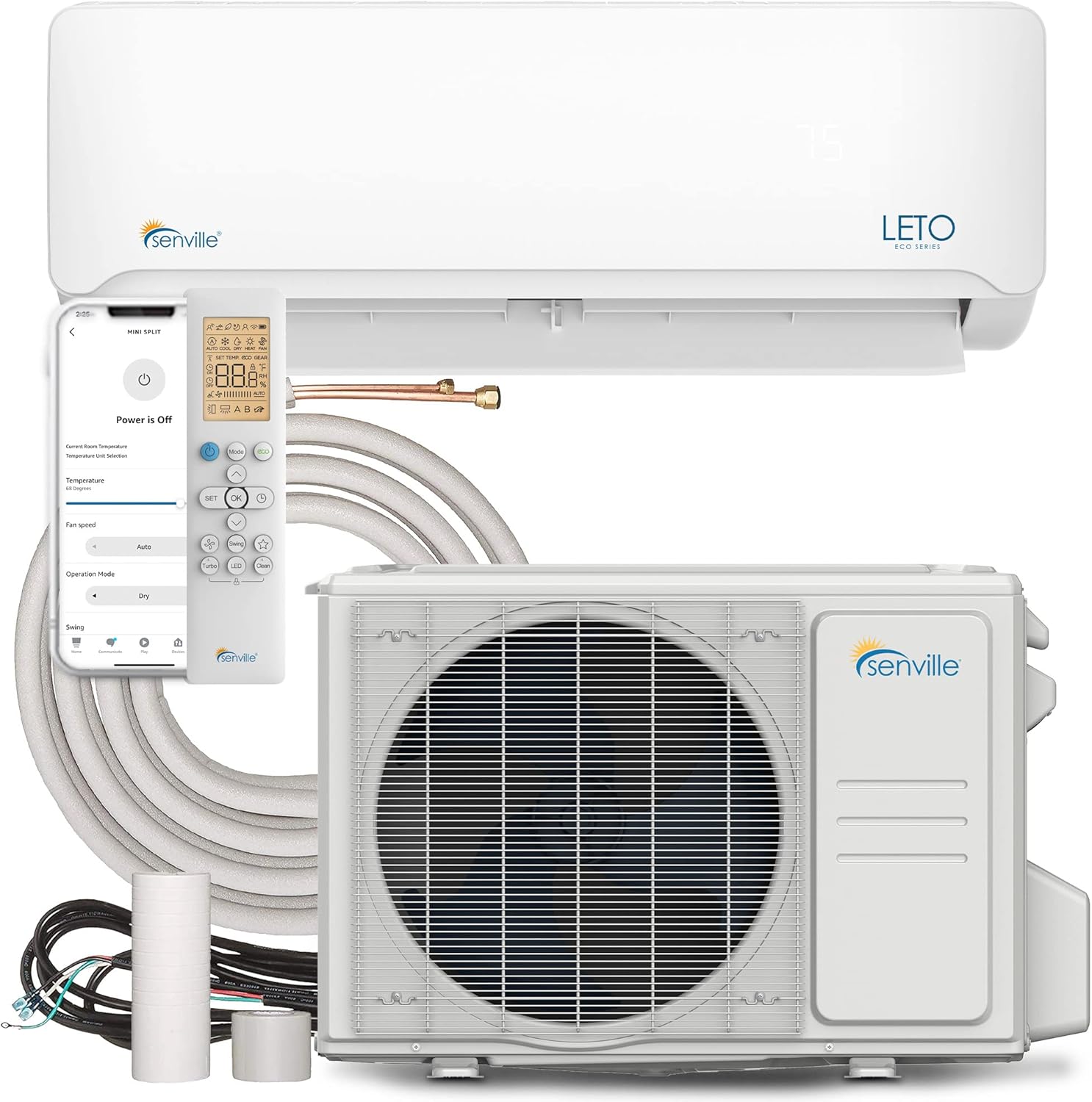
On paper, this unit checks a lot of boxes: 24,000 BTU (2 tons), SEER2 18, heat pump that works down to around 5°F / -15°C, and it’s Alexa compatible if you add the Wi-Fi module. It’s rated for up to about 1,250 sq ft, which lines up with a big open basement, large garage, or a smaller whole-floor space. In my case, it’s in a big unfinished/finished mixed area, and it handles it fine as long as doors aren’t constantly left open.
In the box, you get everything you need for a basic install: indoor air handler, outdoor condenser, 16 ft line set, communication cable, and drain hose. The outdoor unit comes pre-charged with refrigerant up to 25 ft, which is important: if you go beyond that, you’re into adding refrigerant territory, and that’s where a lot of DIY people hit their limit. The warranty is 5 years on parts and 5 years on the compressor, which is decent for this price range, but labor is not included, so if something fails, you’re still paying someone to fix it unless you do it yourself.
Function-wise, it’s a 4-in-1: cooling, heating, dehumidifying, and fan mode, plus a turbo mode that basically tells it to go full blast for quick temp changes. The dehumidifier mode is useful in muggy weather; you can feel the space getting less sticky even if you’re not blasting cold air. The fan-only mode is handy when temps are mild but you want air movement without running the compressor.
From a more practical angle, this is a unit that’s clearly built to hit a price point but still be usable in real homes, garages, and small shops. It’s not trying to be fancy; it’s trying to be good enough on performance and features while staying way cheaper than Mitsubishi, Daikin, etc. If you expect premium everything, you’ll find flaws. If you expect a solid mid-range workhorse, it lines up with that pretty well.
Pros
- Strong cooling and heating performance for large spaces (around 1,000–1,200 sq ft)
- Quiet indoor operation, comfortable to work or relax near it
- Good value for money if you can handle some or all of the installation yourself
Cons
- Installation is not beginner-friendly and requires specific tools or a professional
- Documentation is a bit confusing since it covers multiple models
- Wi-Fi module is extra and the official one is relatively pricey compared to universal options
Conclusion
Editor's rating
Overall, the Senville LETO 24,000 BTU mini-split is a solid, no-nonsense option if you want real cooling and heating for a larger space without paying top-brand prices. It cools and heats well, runs quietly, and covers the basics: AC, heat pump, dehumidifier, and fan. In day-to-day use, it just does its job. Once you set your preferred temperature, you mostly forget about it, which is exactly what you want from something like this.
Where it shines is in value for DIY-friendly people. If you’re comfortable with tools, or you have help from someone who knows electrical and basic HVAC, you can get a capable 2-ton system installed for a lot less than a typical contractor quote. The comfort level and noise are much better than window or portable units, and the energy use is reasonable for the performance you get.
Who should skip it? If you’re not handy at all, don’t know anyone who is, and plan to pay pros for everything, the price gap between this and a more premium system shrinks fast. Also, if you want perfect documentation, app polish out of the box, and a unit that feels high-end in every detail, this isn’t that. But if you’re okay with a practical, budget-conscious workhorse that gets the job done in a garage, basement, office, or large room, the Senville LETO 24k is a good, realistic choice.